

AI for stock trading signals provides a statistically validated, probabilistic edge rather than guaranteed profit. These systems combine quantitative technical indicators, natural language processing for news sentiment, and multi-agent filtering to surface high-conviction trade alerts. Recent breakthroughs in AI in Finance demonstrate that replacing static, rule-based indicators with dynamic machine learning pipelines helps identify non-linear relationships across thousands of equities simultaneously.
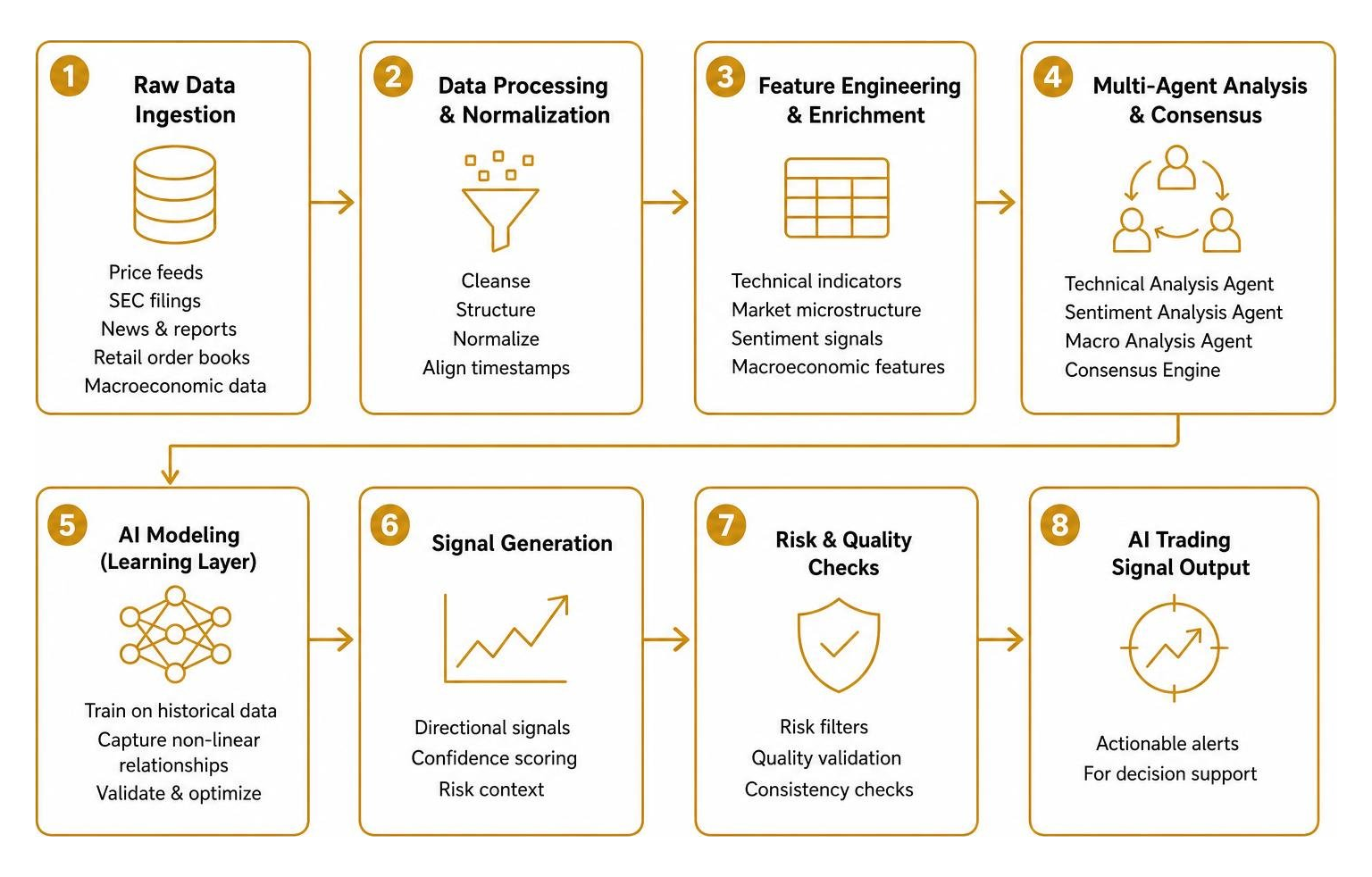
Modern financial markets produce more unstructured noise every microsecond than any individual trading desk could parse in a lifetime. Financial technology relies on layered artificial intelligence architectures designed to convert raw price feeds, SEC filings, global macroeconomic bulletins, and retail order books into actionable directional alerts.
At its foundation, an enterprise-grade signal generation platform combines quantitative market microstructure data with natural language processing (NLP). Academic benchmarks, such as those evaluated in WealthWise: An AI-Based Stock Analysis Tool, demonstrate the power of combining traditional technical indicators (such as Exponential Moving Averages, Bollinger Bands, RSI, MACD, and On-Balance Volume) with advanced language models to interpret news sentiment. In controlled testing, this hybrid approach achieved a 90.22% accuracy rate, a 91.23% precision rate, and a 92.04% F1-score by contextualizing technical oscillators within real-time financial headlines.
Multi-Agent LLM Frameworks and Consensus Pipelines
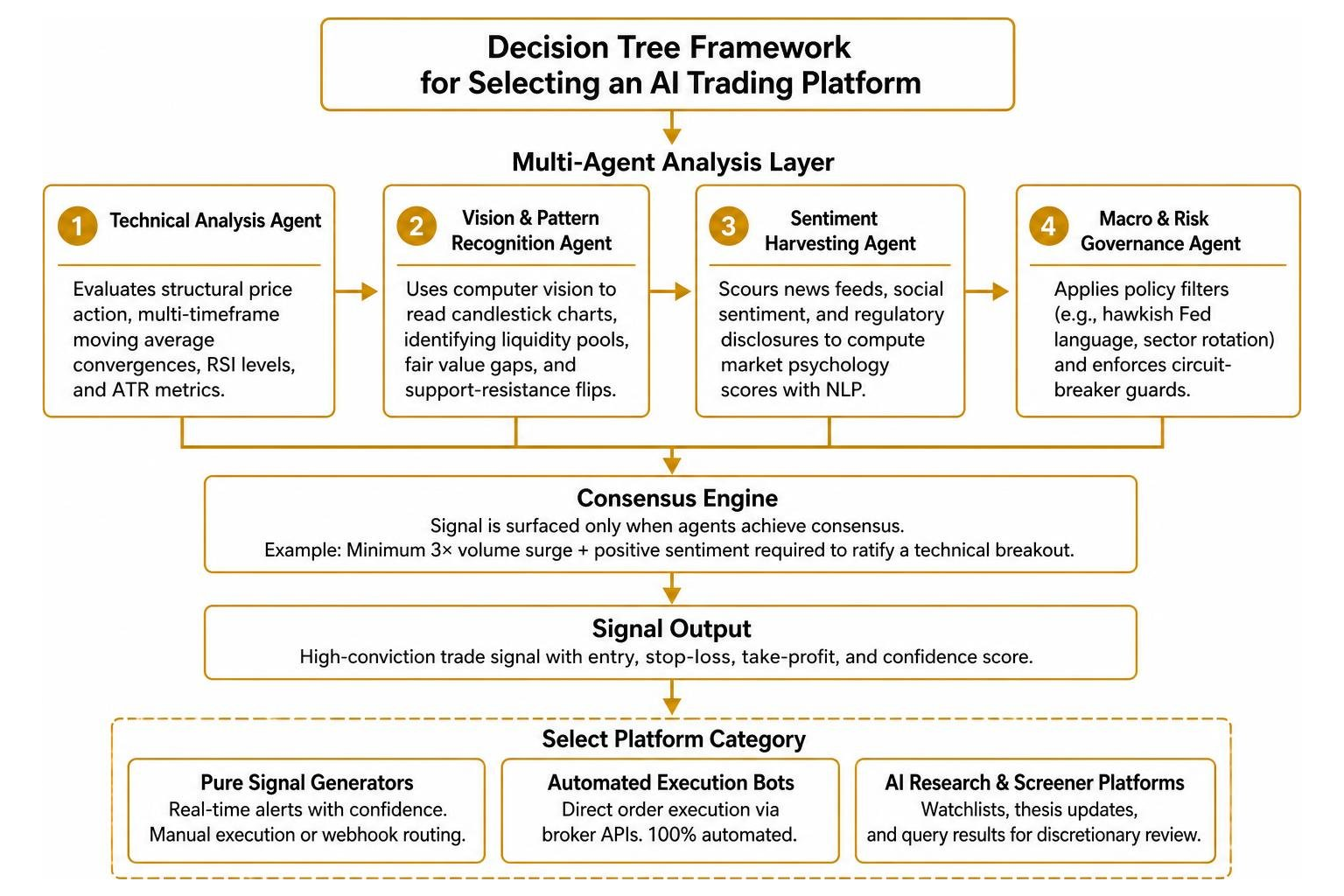
The latest generation of signal generation has moved beyond isolated predictive models toward collaborative multi-agent ecosystems. Tools like the Alpha Hunter — Free AI Stock Research & Trading Analysis Tool deploy multi-agent crews where individual autonomous models specialize in distinct signal layers:
- Technical Analysis Agent: Evaluates structural price action, multi-timeframe moving average convergences, Relative Strength Index levels, and Average True Range metrics.
- Vision & Pattern Recognition Agent: Employs computer vision models to read raw candlestick charts, identifying institutional liquidity pools, fair value gaps, and support-resistance flips directly from visual data.
- Sentiment Harvesting Agent: Scours live news feeds, social sentiment streams, and regulatory disclosures to compute market psychology scores using NLP models.
- Macro & Risk Governance Agent: Applies systematic policy filters (such as evaluating hawkish Federal Reserve language or broad sector rotation) and enforces circuit-breaker guards.
A signal is only surfaced to the user when these specialized agents achieve consensus. For instance, an agent pipeline might require a minimum 3× volume surge accompanied by positive sentiment scoring before ratifying a technical breakout. This multi-layered filtering significantly suppresses false positive signals.
Deep Learning Architectures and Execution Frequency
For intraday and multi-day swing horizons, deep learning frameworks handle time-series forecasting. High-frequency execution environments demand low computational latency, especially since algorithmic trading accounts for over 70% of all executed market volume.
Research from the Increase Alpha: Performance and Risk of an AI-Driven Trading Framework paper shows that lightweight deep learning networks paired with curated features can rival massive transformer architectures. By running scenario analyses across 814 U.S. equities, the framework generated daily directional forecasts across 10 forward horizons while keeping daily cloud compute costs low ($95–$100 on AWS). The study demonstrated that deep feed-forward and recurrent neural networks (RNNs/LSTMs) can establish statistically validated edges across multi-horizon holding periods.
Evaluating Signal Providers: Key Frameworks and Tool Categories
Choosing the right tool requires matching software capabilities with your trading execution style. Platforms fall into three distinct functional categories:
| Feature / Category | Pure Signal Generators (e.g., AlphaEdge) | Automated Execution Bots (e.g., MetaTrader EAs) | AI Research & Screener Platforms (e.g., Sortefi, Mad Dog Alpha) |
|---|---|---|---|
| Primary Output | Real-time Buy/Sell alerts with confidence scores | Direct order execution via broker APIs | Watchlists, thesis updates, and plain-English query results |
| Execution Style | Manual execution or webhook routing | 100% automated algorithmic order routing | Discretionary review and swing positioning |
| Latency & Update Rate | Sub-minute (e.g., 60-second refreshes) | Milliseconds to seconds | 30–60 seconds per custom scan / daily digests |
| Asset Coverage | Equities, Forex, Crypto, Indices | Equities, Futures, Forex | Multi-market (U.S., global equities, ETFs, crypto) |
| User Control | High (trader confirms entry and risk) | Low to Medium (bot executes based on parameters) | Maximum (informs research and discretionary setups) |
Modern setups bridge these platforms with stock broker software via REST APIs and Webhook integrations, allowing traders to automate alerts directly into their execution accounts.
Pure Signal Generators vs Fully Automated Bots
Signal generators provide actionable alerts featuring entry prices, stop-loss levels, and take-profit targets alongside algorithmic confidence scores. For traders focused on fast trades and low fees for intraday pros, pure signal generators allow discretionary oversight before capital is committed.
Conversely, automated bots and Expert Advisors (EAs) remove human latency altogether. These tools connect directly to your broker, translating signals into market orders instantly. While automation eliminates hesitation and emotional bias, it requires robust risk controls to prevent rapid capital drawdowns during erratic market conditions.
Natural Language Screeners and Live Thesis Trackers
For research-driven swing traders and investors, modern AI tools simplify market scanning. Platforms like Sortefi — AI Stock Screener & Watchlist Builder allow users to type plain-English screening parameters (e.g., “Find S&P 500 stocks within 3% of their 52-week highs with volume breaking the 20-day average and daily RSI below 65”), returning validated watchlists in seconds across multiple markets.
Meanwhile, platforms like Mad Dog Alpha — AI Stock Research Software track dynamic investment theses. Rather than requiring you to read every quarterly filing, the system monitors earnings reports, news items, and valuation multiples, alerting you only when a material change alters your original investment case. Integrating these tools is one of the most effective ways of supercharging your latest news stock market updates without suffering from information overload.
Measuring Real-World Performance, Risk, and Common Pitfalls
Marketing claims in the algorithmic space often promise impossible win rates. When evaluating AI trading tools, you must separate marketing hype from verifiable, statistically significant performance.
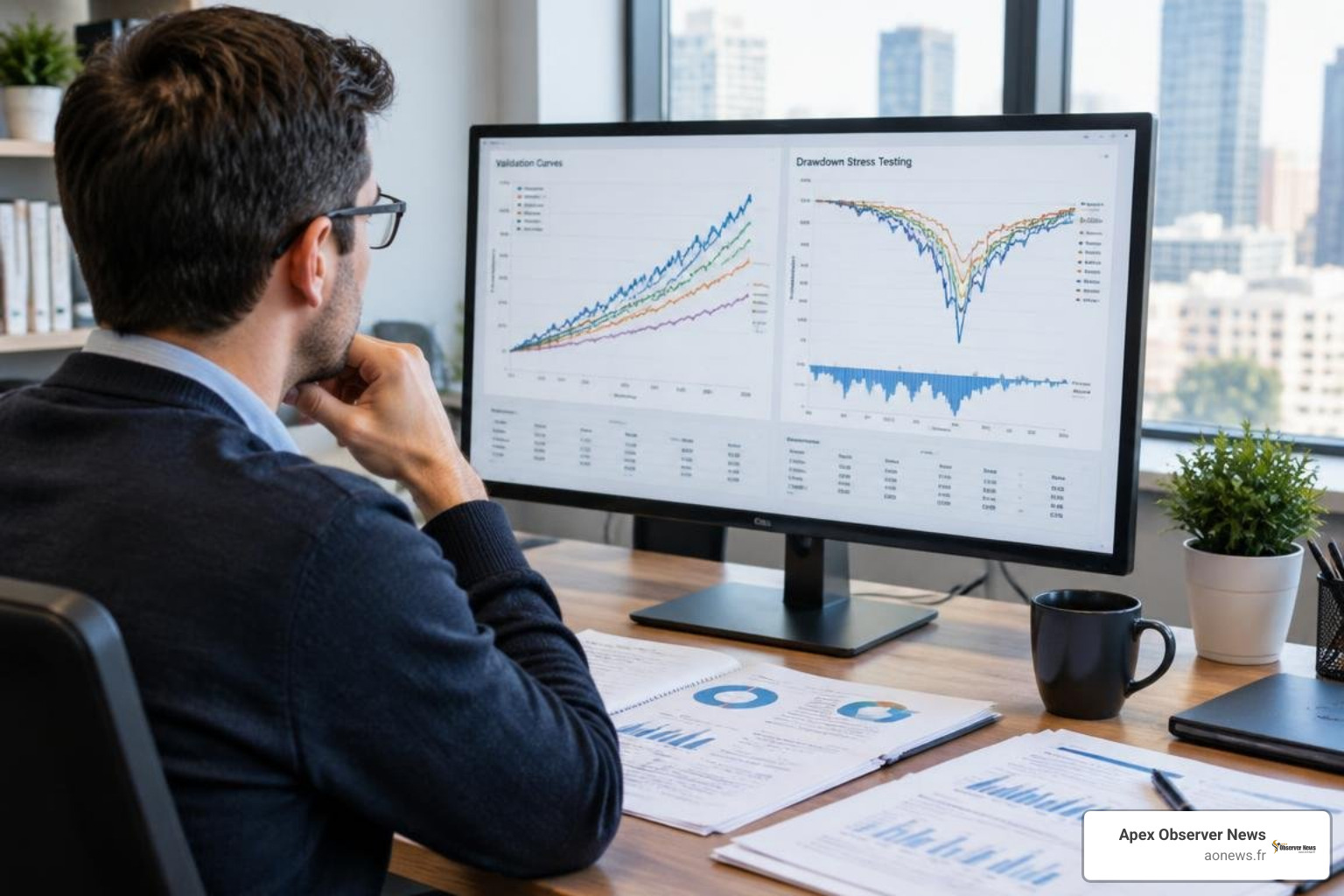
Evaluating AI for Stock Trading Signals: Real-World Metrics vs Benchmark Returns
A high win rate is meaningless if a single outsized loss wipes out weeks of gains. When assessing how to deploy AI for stock trading signals, focus on risk-adjusted return metrics over raw percentage gains:
- Sharpe Ratio: Measures excess return per unit of total risk. A Sharpe ratio above 1.5 indicates solid risk-adjusted performance; the Increase Alpha framework achieved an annualized Sharpe ratio exceeding 2.5 in out-of-sample testing.
- Maximum Drawdown (MDD): The largest peak-to-trough decline in portfolio equity. In the Increase Alpha experimental portfolio, an equally weighted MDD-based strategy achieved a +26.4% cumulative return while capping maximum drawdown at roughly 3.0%.
- Statistical Significance (p-values): Verifies whether signal accuracy beats random chance. In rigorous testing, over 74% of long-signal p-values generated by the Increase Alpha model fell below 1% ($p < 0.01$), and over 86% fell below 5% ($p < 0.05$).
- Market Correlation: A strong algorithmic signal framework should exhibit near-zero correlation to broad benchmarks like the S&P 500, delivering true alpha rather than just leveraged market beta.
Critical Risks: Overfitting, Regime Shifts, and Over-Automation
Relying on artificial intelligence introduces unique operational and statistical hazards:
- Overfitting (Curve Fitting): Complex neural networks can easily memorize historical market noise rather than discovering recurring structural patterns. An overfitted model delivers flawless backtests but fails when deployed in live market conditions.
- Market Regime Shifts: An AI trained during a zero-interest-rate bull market will struggle during sudden inflationary spikes, quantitative tightening, or geopolitical volatility.
- Survivorship Bias: Backtests that evaluate only currently active companies skew historical results upward by omitting businesses that went bankrupt or were delisted.
- Slippage and Cost Drag: High-frequency signals can be rendered unprofitable by exchange fees, broker commissions, and execution slippage. Always calculate returns net of all trading friction.
Implementing AI Signals Across Diverse Market Styles
Successful implementation requires aligning your selected software with your trading horizon, risk tolerance, and available screen time. Finding the right software setup is as crucial as finding the best stock broker platform for your portfolio.
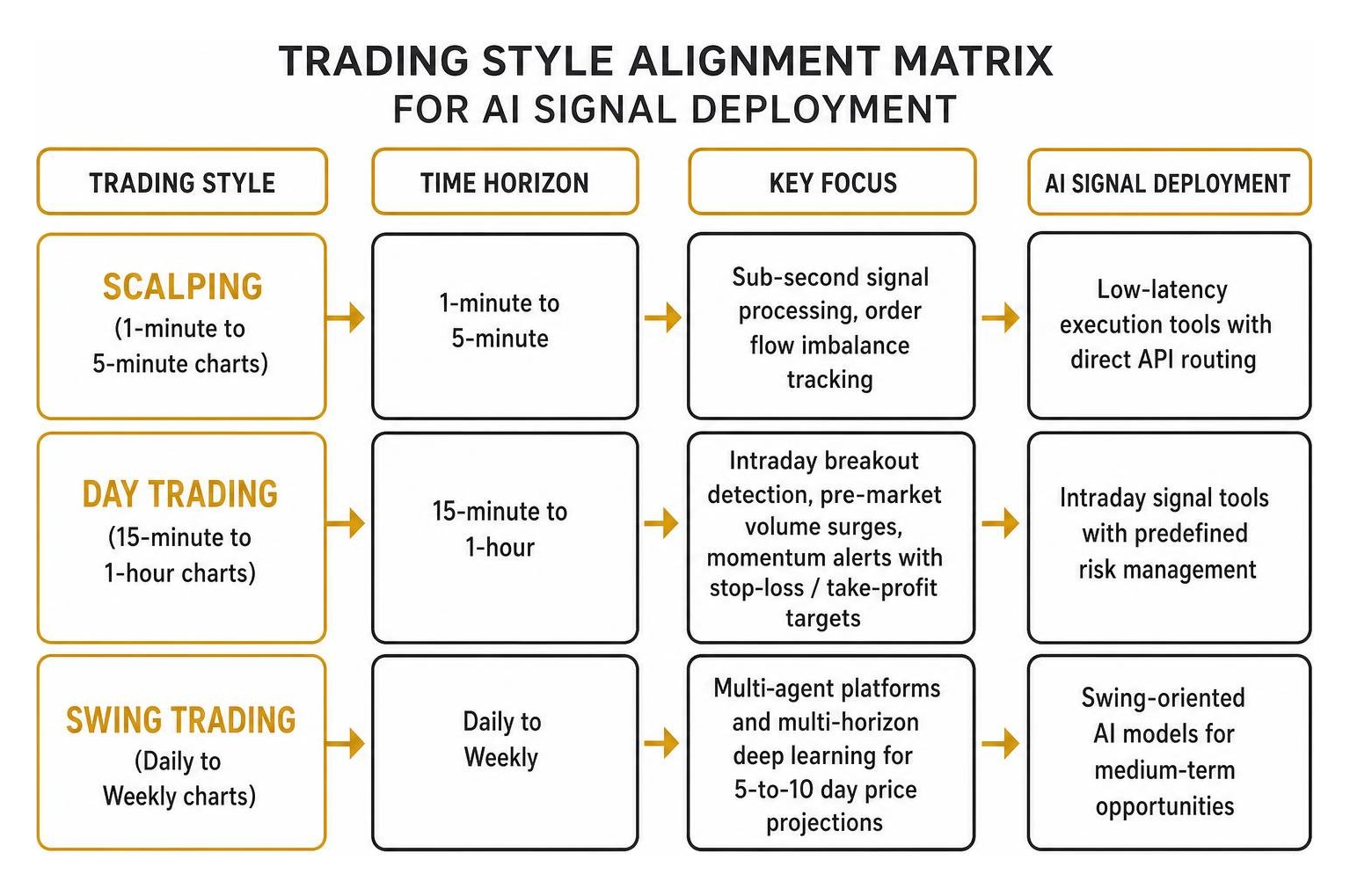
Selecting the Right Tool: Tailoring AI for Stock Trading Signals to Your Strategy
- Scalping (1-minute to 5-minute charts): Requires sub-second signal processing, order flow imbalance tracking, and direct API routing. Traders must prioritize low-latency execution tools.
- Day Trading (15-minute to 1-hour charts): Focuses on intraday breakout detection, pre-market volume surges, and morning momentum alerts with predefined stop-loss and take-profit targets.
- Swing Trading (Daily to Weekly charts): Well-suited for multi-agent platforms and multi-horizon deep learning frameworks that project price movement over 5-to-10 trading days.
- Long-Term Investing: Focuses on natural language fundamental screeners, dynamic portfolio rebalancing models, and automated material thesis change trackers.
Open-source initiatives also reflect this shift toward agent-native infrastructure. The community project AI-Trader on GitHub (boasting over 22,782 stars and 3,439 forks) demonstrates how traders build agent-native environments to run paper-trading simulations with virtual capital before deploying live funds.
Regulatory Compliance, Data Privacy, and Human Oversight
Financial authorities like the Financial Conduct Authority (FCA) and the SEC require signal platforms to clearly distinguish between automated algorithmic research and regulated financial advice. When connecting brokerage accounts via API keys:
- Always use trade-only or read-only API permissions, disabling withdrawal privileges.
- Verify that your data provider complies with industry data privacy standards.
- Keep a human in the loop. The strongest trading setups combine artificial intelligence for data scanning and pattern recognition with human judgment for final risk approval.
Frequently Asked Questions About AI Trading Signals
Can AI trading signals guarantee consistent stock market profits?
No. Financial markets are non-deterministic, open systems governed by unpredictable macroeconomic developments, regulatory decisions, and human psychology. AI provides a probabilistic statistical edge, not a certainty. Robust risk management and strict position sizing remain essential.
Do traders need programming skills to use modern AI signal platforms?
No. While quantitative developers use Python, C++, and REST APIs to build custom strategies, modern commercial platforms offer intuitive no-code dashboards, plain-English search bars, mobile alerts, and plug-and-play integrations for MetaTrader and popular brokerages.
How do machine learning models prevent false breakout signals?
Advanced models filter price anomalies by demanding multi-factor confirmation. They evaluate whether a price move is supported by a volume surge (often requiring 3× normal volume), analyze news sentiment scores, cross-check multi-timeframe moving averages, and incorporate macro policy filters before confirming a signal.
Conclusion
Artificial intelligence has transformed retail and institutional market participation. By processing massive multi-asset data feeds, running complex sentiment harvesting, and recognizing technical patterns in seconds, modern AI signal tools provide a measurable analytical edge. However, these systems are decision-support frameworks, not magic money machines. Long-term profitability requires treating AI signals as statistical hypotheses that must be paired with strict capital preservation, independent verification, and disciplined risk management.
To build an institutional-grade trading workflow, explore our breakdown of the major stock brokers that dominate the American market and discover how to pair market-leading execution platforms with next-generation AI intelligence.
References
Rishabh Barhate, Shubhangi Kharche, Dhawal Mahajan, Mukesh Prajapati, Ishaan Sansare, Ronit Chaudhari. “WealthWise: An AI-Based Stock Analysis Tool.” 2025 International Conference on Emerging Technologies in Electronics and Green Energy (ICETEG), 2025. DOI 10.1109/iceteg66194.2025.11472907.
