


Why the Largest Online Brokers Matter to U.S. Investors
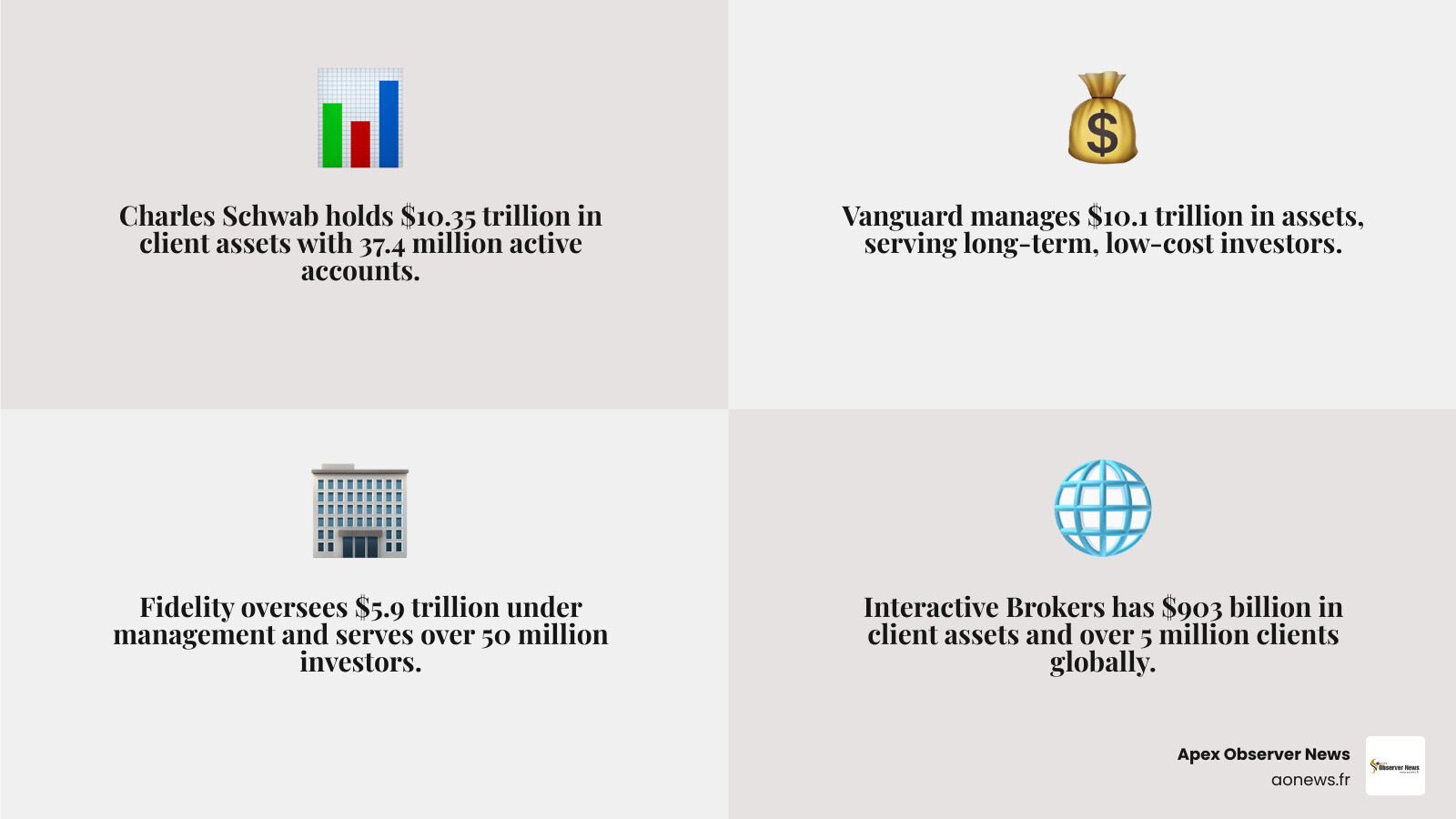
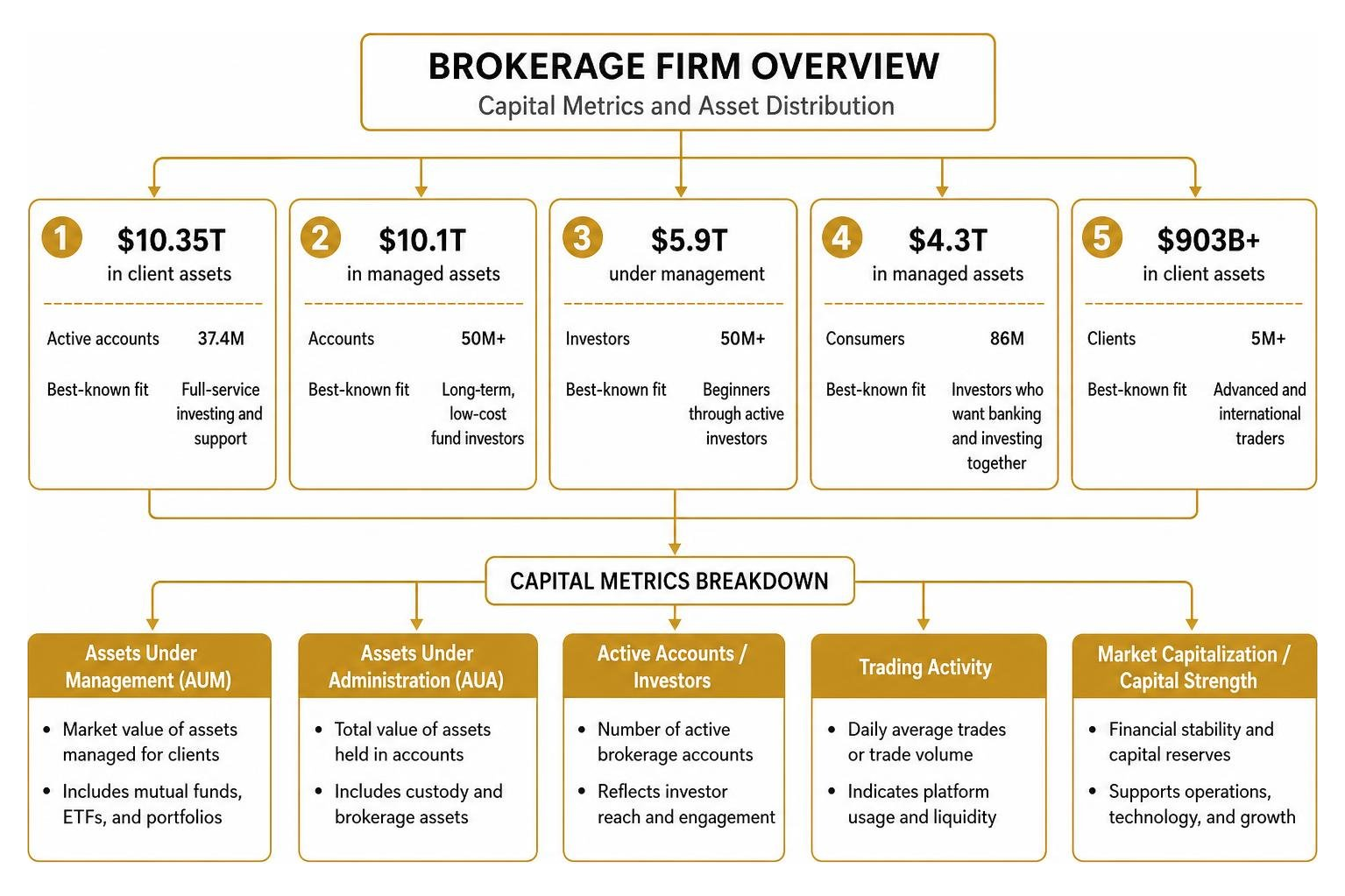
The largest online brokers in the American market are Charles Schwab, Vanguard, Fidelity Investments, J.P. Morgan, and Interactive Brokers. They lead in different ways: Schwab and Vanguard hold about $10 trillion each in client or managed assets, Fidelity serves more than 50 million individual investors, J.P. Morgan reaches tens of millions of consumers, and Interactive Brokers stands out for global, high-volume trading.
| Broker | Recent scale measure | Best-known fit |
|---|---|---|
| Charles Schwab | $10.35 trillion in client assets; 37.4 million active brokerage accounts | Full-service investing and support |
| Vanguard | $10.1 trillion in managed assets; 50+ million accounts | Long-term, low-cost fund investors |
| Fidelity | $5.9 trillion under management; 50+ million investors | Beginners through active investors |
| J.P. Morgan | $4.3 trillion in managed assets; 86 million consumers | Investors who want banking and investing together |
| Interactive Brokers | More than $903 billion in client assets; 5+ million clients | Advanced and international traders |
Size is useful, but it is not the whole story. The right broker depends on what you trade, how often you trade, the tools you need, the help you expect, and the costs that apply beyond a $0 stock commission.
I am Faisal S. Chughtai, founder of ActiveX, with experience in digital platforms, SEO, and technology-driven business services. In this guide to the largest online brokers, I break down the market in plain language so you can compare scale, platforms, fees, and investor fit without the jargon.
Related content about largest online brokers:
- biggest online brokers
- largest brokerage firm
- top online trading companies
Ranking Scale and Capital: Overview of the Largest Online Brokers
When we evaluate the powerhouses of the retail financial sector, understanding how size is measured is essential. Evaluating a broker involves examining Assets Under Management (AUM), total assets under administration, active account counts, daily trade volume, and overall market capitalization. A firm might manage trillions of dollars in retirement plans while another handles millions of rapid-fire option trades each day.
The evolution of retail investing has driven historic consolidation across the financial landscape. Major acquisitions—such as Charles Schwab’s $26 billion takeover of TD Ameritrade (which fully completed its account migration in May 2024)—have concentrated vast wealth into a handful of colossal financial institutions. Understanding these scale metrics helps clarify how each firm maintains capital stability, invests in infrastructure, and executes trades effectively.
To better navigate this multi-trillion-dollar industry, investors frequently consult our detailed breakdown of the largest brokerage firm standards and capital structures.
Dominant Wall Street Institutions by AUM
The top tier of American financial institutions is led by Charles Schwab and Vanguard, both managing client capital in the tens of trillions of dollars.
As of mid-2025, Charles Schwab held an astounding $10.35 trillion in client assets across 37.4 million active brokerage accounts. Schwab’s financial strength was further reinforced by its 2024 Annual Report, which documented $367 billion in core net new assets for that year alone—a 20% jump over the previous year—while daily average trades surged to 5.9 million. Schwab’s dual focus on self-directed retail accounts and independent advisor custody makes it a central pillar of modern Wall Street.
Vanguard follows closely, holding $10.1 trillion in managed assets across more than 50 million active investor accounts worldwide. Vanguard operates under a distinct investor-owned business model. Rather than serving public shareholders, Vanguard is owned by its funds, which are in turn owned by the investors holding shares in those funds. This structural design ensures that management decisions, fee reductions, and operational enhancements directly benefit fund holders, keeping expense ratios among the lowest in the asset management industry.
High-Volume Global Trading Networks
While legacy asset managers focus heavily on wealth retention and index investing, global electronic execution platforms operate on high-speed trade routing and broad international connectivity.
Home | Interactive Brokers LLC represents the pinnacle of institutional-grade trading infrastructure. Tracing its historical roots to founder Thomas Peterffy’s early automated trading systems on exchange floors—where he famously constructed mechanical keyboard rigs and color-coded screen systems to digitize pit trading—Interactive Brokers has built one of the world’s most sophisticated electronic trading platforms.
By late 2025, Interactive Brokers held $779.9 billion in customer equity across 5.1 million active accounts. By mid-2026, client assets expanded past $903 billion, supported by a corporate capital equity base exceeding $22 billion. IBKR executes over 4 million trades daily across more than 170 global markets in 200 countries. Investors analyzing public broker valuations can review the Largest Online Brokers Public Companies index for detailed financial metrics. Furthermore, European market comparative data can be explored at Biggest Online Brokers in Europe (ranked by AUM in 2026).
Platform Features and Fee Structures Across Market Leaders
Since major brokerages widely eliminated standard $4.95 stock trade commissions in late 2019, zero-commission trading for online U.S. equities and ETFs has become standard across the industry. However, fee differences still exist in options contract fees, margin interest tiers, mutual fund transaction costs, and yield rates on uninvested cash.
Understanding these structural costs is critical, especially when comparing execution quality and price improvement against surface-level free trades.
| Brokerage Platform | Equity & ETF Commission | Options Pricing Structure | Base Margin Borrowing Rates | Idle Cash Yield Options |
|---|---|---|---|---|
| Fidelity Investments | $0.00 | $0.65 per contract | Standard tiered margin schedules | Automated sweep into high-yield money market funds |
| Charles Schwab | $0.00 | $0.65 per contract | Tiered standard margin interest | Standard cash sweep or manual money fund purchase |
| Interactive Brokers (IBKR Pro) | $0.005 per share | $0.15 to $0.65 per contract | Benchmark-linked (as low as USD 4.13%) | Up to 3.13% APY on uninvested USD cash |
| E*TRADE (Morgan Stanley) | $0.00 | $0.65 per contract ($0.50 for 30+ trades/qtr) | Standard tiered margin interest | Premium Savings Account option (up to 4.00% APY promo) |
Feature Breakdown Across the Largest Online Brokers
Fidelity Investments commands $5.9 trillion in discretionary assets under management—and over $15 trillion in total assets under administration—serving more than 50 million individual retail accounts. Fidelity earned top honors as NerdWallet’s #1 Best Online Broker for Beginning Investors in 2026, largely due to its commitment to zero account minimums, zero account maintenance fees, zero expense ratio proprietary index funds (Fidelity ZERO funds), and excellent order execution quality that passes price improvements directly to clients.
For a comprehensive side-by-side analysis of features, read our guide on 7 best online brokerage companies compared.
On the banking and institutional side, E*TRADE—operating under Morgan Stanley—combines intuitive consumer web applications with deep institutional equity research. Through the platform at E*TRADE | Investing, Trading & Retirement, investors access standard zero-commission equity trades along with options trading at $0.65 per contract (reducing to $0.50 for traders executing 30 or more trades per quarter). E*TRADE also supports futures trading at $1.50 per contract per side, crypto asset trading via Zero Hash integration at a transparent 0.50% fee markup, and cash savings products such as the Premium Savings Account featuring promotional cash yields up to 4.00% APY.
In addition, J.P. Morgan oversees $4.3 trillion in client investment assets while engaging 86 million consumer banking customers. By linking Chase online banking with self-directed Wealth Plan investment accounts, J.P. Morgan allows retail users to manage routine checking, savings, mortgages, and investment portfolios within a unified digital hub.
To expand your overall strategy, see our overview of Best Online Share Trading practices.
Technological Innovations in Trading Platforms
Active trading demands reliable software capable of streaming tick data, analyzing multi-leg option chains, routing orders intelligently, and maintaining uptime during high volatility.
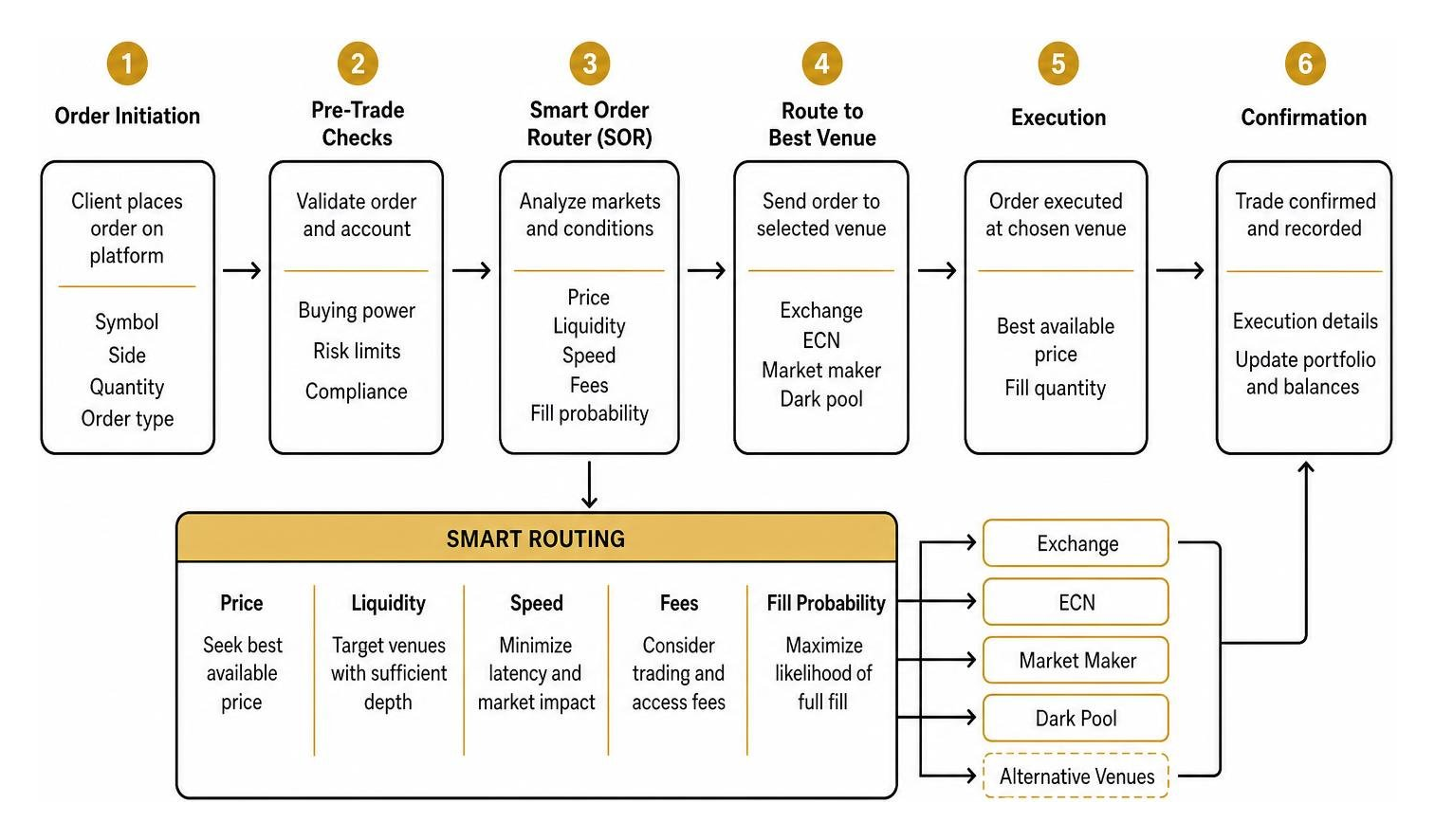
Interactive Brokers’ flagship desktop app, Trader Workstation (TWS), serves institutional desks and professional traders worldwide. Named NerdWallet’s Best Online Broker for Advanced Traders in 2026, IBKR provides direct market access, advanced smart order routing, and fractional share access across 15,000 international stocks.
In late 2025 and mid-2026, IBKR introduced support for the Model Context Protocol (MCP). This innovation allows clients to securely connect conversational AI assistants—including ChatGPT, Claude, and Grok—directly to their brokerage environments to review portfolio allocations, run real-time market scans, and prepare trade parameters under direct user supervision.
For active derivative traders, platform choice hinges on low margin rates and advanced order routing. IBKR Pro offers margin borrowing rates as low as USD 4.13%, which can save high-volume margin traders up to 55% compared to standard retail broker pricing schedules.
Active options and futures traders can evaluate low-cost execution venues via our resource on Cheapest Fo Trading Platforms For Serious Derivative Traders.
Meanwhile, ETRADE’s Power ETRADE web platform continues to receive recognition for its interface, advanced charting toolsets, probability calculators, and seamless paper trading functionality.
Service Quality, Security Standards, and Investor Fit
Choosing among the largest online brokers requires matching a platform’s strengths to your personal investment strategy, technological proficiency, and financial goals. A long-term index investor seeking automated dollar-cost averaging requires very different tools than a professional trader executing cross-border currency hedges.
Evaluating Usability Across the Largest Online Brokers
Different investor profiles require different platform capabilities:
- Beginner Investors: Novice investors benefit from intuitive interfaces, rich educational video libraries, interactive webinars, step-by-step stock screeners, and responsive customer service. Fidelity and Charles Schwab excel here by providing 24/7 phone support, extensive walk-through guides, and physical branch access across major U.S. cities.
- Paper Traders & Learners: Investors practicing complex trading mechanics without committing capital can leverage dedicated demo accounts. E*TRADE and Webull feature robust paper trading environments that simulate real-time option pricing tools and stop-loss execution mechanics.
- Advanced & International Traders: High-volume, sophisticated traders require multi-currency accounts, algorithmic trade building, low margin rates, extensive fixed-income inventories (IBKR offers over 1 million bond selections), and raw direct market access. Interactive Brokers leads this market segment globally.
To help evaluate your entry point into stock trading, review the definitive guide to picking your first stock market broker. For an unbiased performance audit across major institutions, check out an honest review of top stock broker companies.
Financial Protections and Regulatory Oversight
Asset security is a top priority when placing personal savings with financial custodians. All primary U.S. brokerages discussed—including Schwab, Fidelity, Vanguard, E*TRADE, and IBKR—are members of the Securities Investor Protection Corporation (SIPC) and registered with the Financial Industry Regulatory Authority (FINRA).
SIPC insurance protects customer securities and cash in the event that a brokerage firm fails financially. The standard SIPC coverage limit is $500,000 per customer, which includes up to $250,000 for uninvested cash claims. Most major brokerages also carry supplemental “excess SIPC” private insurance policies through commercial underwriters like Lloyd’s of London, extending protection limits into tens of millions of dollars per account.
However, SIPC coverage does not protect against market value declines or investment losses resulting from trading decisions.
Regulatory oversight also involves enforcing operational compliance and system reliability. Major platforms occasionally face regulatory reviews or enforcement actions regarding Anti-Money Laundering (AML) supervisory controls, order handling reporting, or software resilience during extreme market events.
For instance, during the unprecedented April 2020 collapse of WTI crude futures into negative pricing, Interactive Brokers experienced software calculation errors unable to process sub-zero values, resulting in the firm paying over $82 million in customer compensation. More recently, in June 2024, a temporary technical feed pricing glitch caused select mega-cap share price quotes to display incorrectly before being resolved.
These occurrences demonstrate why large firms maintain substantial regulatory capital reserves and customer protection sweep frameworks.
For a essential overview of rules and trading concepts, refer to our cheat sheet to brokerage and trading.
Frequently Asked Questions About Major Stock Brokers

What protection exists for assets at major online brokerages?
Securities held inside registered U.S. brokerage accounts are protected by SIPC coverage up to $500,000 overall, including a $250,000 limit for uninvested cash. This protection covers missing assets if the firm becomes insolvent or fails operationally.
Furthermore, mega-cap brokerages maintain additional private supplemental policies (often referred to as excess SIPC coverage) securing aggregate corporate asset pools up to hundreds of millions of dollars. Additionally, uninvested cash placed into partner bank cash sweep accounts receives FDIC insurance coverage up to $250,000 per individual bank institution.
How do account minimums and trade commissions compare?
Most major U.S. online brokerages—including Fidelity, Charles Schwab, E*TRADE, Vanguard, and Interactive Brokers (Lite tier)—charge $0 minimum account opening balances and $0 commissions on standard online U.S. stock and ETF trades.
Options trades typically carry a $0 base commission plus a standard contract fee ranging between $0.50 and $0.65 per contract. Interactive Brokers Pro utilizes a commission model starting at $0.005 per share, designed for active high-volume traders who prioritize lower margin rates and optimized trade execution.
To understand how trade execution affects your overall account balance, consult our guide on online-free-stock-trading how to keep profits.
How long does an ACAT transfer take between brokerage firms?
Transferring an existing investment portfolio between financial institutions via the Automated Customer Account Transfer (ACAT) service typically takes 5 to 7 business days to complete. ACAT allows investors to execute in-kind asset transfers, meaning stocks, ETFs, options, and mutual fund shares move directly into the new brokerage account without needing to be liquidated into cash. This avoids triggering unnecessary capital gains tax events.
While outgoing brokers often charge an account exit or transfer fee (typically ranging from $50 to $100), many receiving online brokers offer full fee reimbursements or initial deposit bonus promotions when transferring eligible account balances.
Conclusion
The market for the largest online brokers in the United States remains dominated by established industry giants. Charles Schwab and Vanguard lead in total managed asset scale, holding roughly $10 trillion each. Fidelity Investments delivers an ideal platform for self-directed investors through zero-minimum funds and low costs. J.P. Morgan bridges mainstream retail banking with digital stock investing, while Interactive Brokers provides institutional traders with advanced global execution technology across 170+ markets worldwide.
Choosing the ideal brokerage firm requires matching your investment timeline, trading style, derivative usage, and desire for research or advisor support against each broker’s operational strengths.
At Apex Observer News, we continuously track market shifts, platform upgrades, regulatory changes, and fee structure updates across the financial landscape. Stay informed by exploring our ongoing market intelligence and financial breakdowns in the Apex Observer News Stock Market Coverage hub.
