

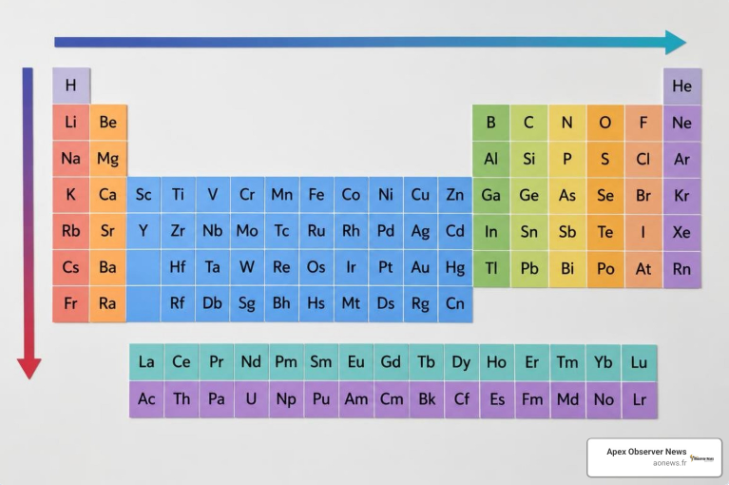
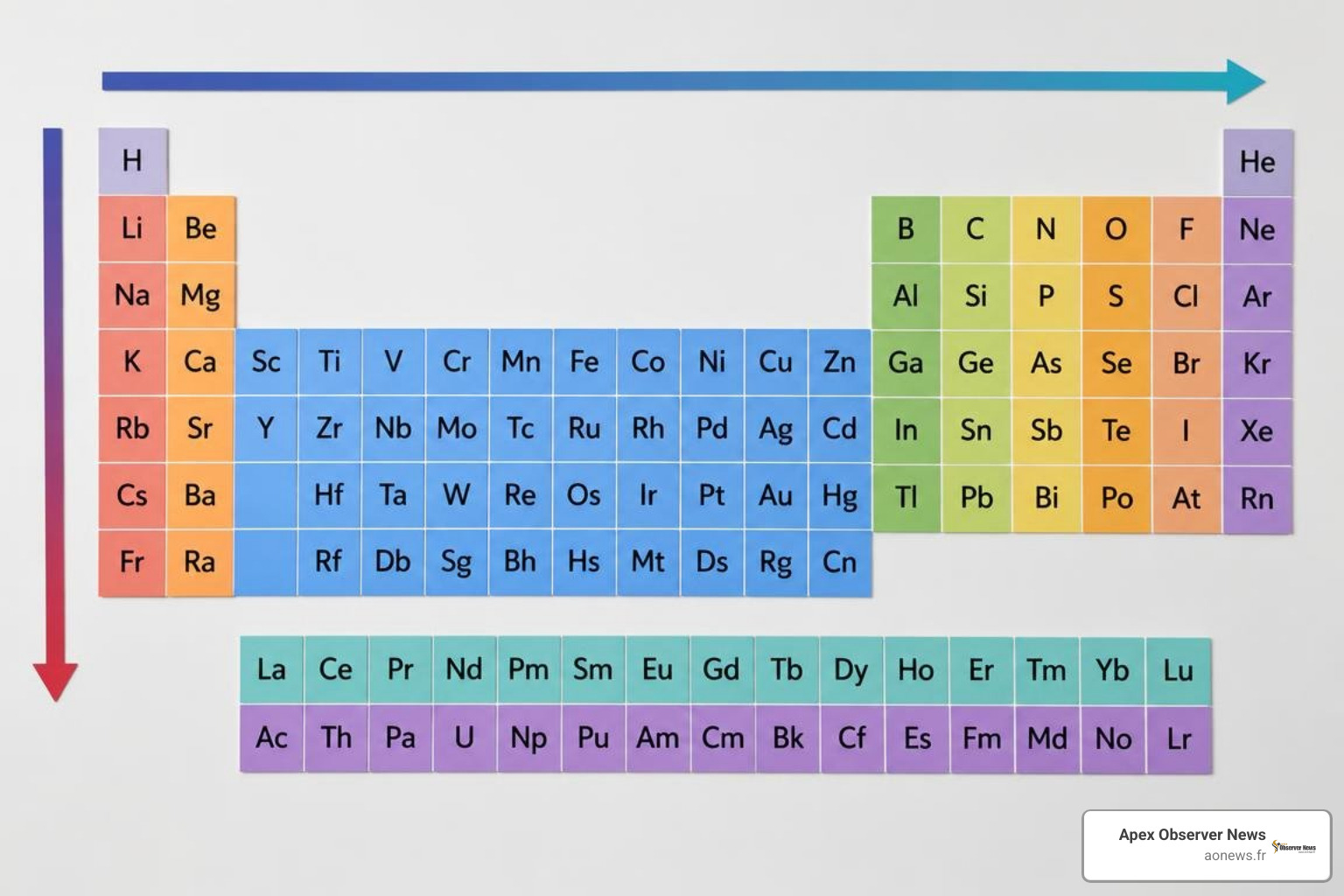
When you sit for the exam, the reference packet provides a clean, standardized chart spanning all 118 elements arranged across 18 groups and 7 periods. The lanthanide and actinide series rest neatly along the bottom. Unlike colorful classroom posters, this official sheet contains no color coding, no labeled orbital blocks, no electronegativity keys, and no diagonal metalloid staircases.
To score well, you must treat this document not as a passive reference sheet, but as a visual calculator. As outlined in this AP Periodic Table study guide on core concepts, mastering the underlying patterns lets you deduce chemical reactivity directly from an element’s coordinates.
| Information Provided on Exam Sheet | Information Deliberately Omitted | Student Must Deduce Independently |
|---|---|---|
| Atomic Number (Z) | Electronegativity values | Valence electron count |
| Element Symbol | Atomic and ionic radii values | Ground-state electron configuration |
| Average Atomic Mass (to 2–4 decimals) | Ionization energies (first, second, and later values) | Common ionic charges and oxidation states |
| Group Numbers (1–18) and Period Numbers (1–7) | Electron configurations | Periodic trend vectors and Coulombic forces |
| Separate Lanthanide / Actinide rows | Orbital block labels (s, p, d, f) | Metallic vs. nonmetallic character |
Reading Core Data on the AP Chem Periodic Table
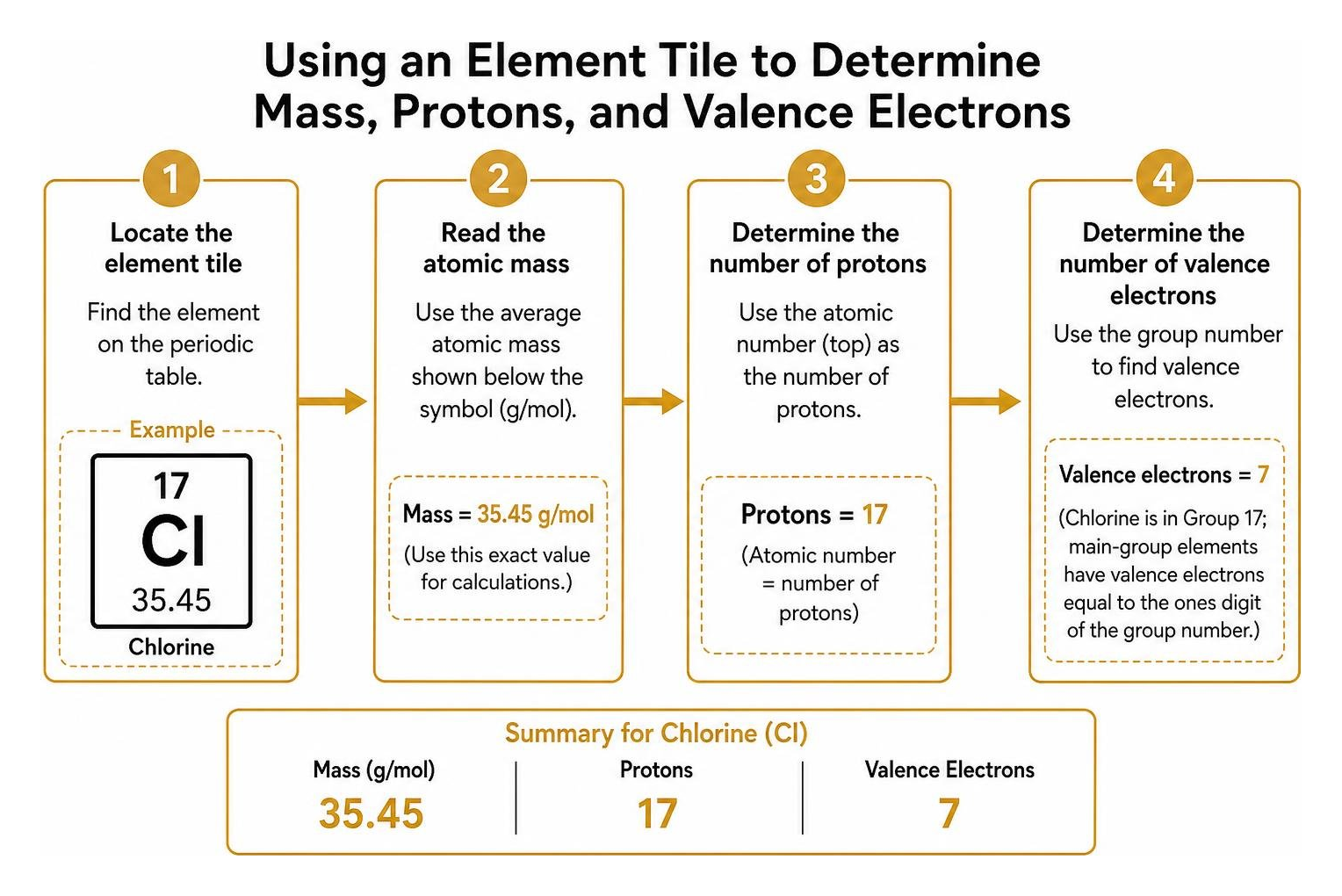
Every tile gives you three pieces of data: the atomic number at the top, the chemical symbol in the center, and the average atomic mass below it.
During stoichiometry calculations on Section II, always use the exact atomic mass printed on the sheet rather than rounding to whole numbers. For instance, carbon is printed as 12.01 grams per mole, chlorine as 35.45 grams per mole, and iron as 55.85 grams per mole. Rounding carbon to 12 grams per mole or chlorine to 35 grams per mole can propagate errors that knock your final calculation outside the rubric’s acceptable scoring range.
Deriving Electron Configurations from the AP Chem Periodic Table
You can establish the ground-state electron configuration of any element by navigating the blocks across periods:
- s-block: Groups 1 and 2 (plus Helium), corresponding to the filling of ns orbitals.
- p-block: Groups 13 through 18, representing the filling of np orbitals.
- d-block: Groups 3 through 12 (transition metals), representing the filling of (n-1)d orbitals.
- f-block: Lanthanides and actinides, representing the filling of (n-2)f orbitals.
To write noble gas shorthand quickly, locate the target element, move up one row to the far right to find the preceding noble gas, place it in brackets, and then read left-to-right across the target element’s period. Remember the classic transition metal exceptions driven by subshell stability: Chromium (Cr, atomic number 24) is [Ar] 4s¹ 3d⁵ rather than [Ar] 4s² 3d⁴, and Copper (Cu, atomic number 29) is [Ar] 4s¹ 3d¹⁰ rather than [Ar] 4s² 3d⁹.
Explaining Key Periodic Trends Through Coulombic Principles
Every periodic trend tested on the AP exam stems from Coulomb’s Law, which governs the electrostatic force (F) between charged particles. The force is directly proportional to the product of the charges divided by the square of the distance between them. In other words, a larger charge creates a stronger attraction, while a greater distance weakens it substantially.
Here, the first charge represents the effective nuclear charge (Z effective) experienced by the valence electrons, the second charge represents the charge of an electron, and the distance represents the separation between the valence electrons and the nucleus (the principal energy level or shell number, n).
- Moving Down a Group: The principal quantum number n increases, adding occupied electron shells. This greater distance drastically decreases the Coulombic attraction between the nucleus and the valence electrons. Inner shells also shield the valence shell from the full positive pull of the nucleus. As a result, atomic radius increases, while first ionization energy and electronegativity decrease.
- Moving Across a Period (Left to Right): The number of protons (Z) increases while electrons enter the same principal energy level (n remains constant). Because core shielding remains essentially unchanged, the effective nuclear charge increases (Z effective is approximately Z minus the shielding constant). The higher effective nuclear charge exerts a stronger electrostatic pull, drawing the valence electrons closer to the nucleus. As a result, atomic radius decreases, while first ionization energy and electronegativity increase.
Fluorine is the most electronegative element on the Pauling scale (assigned a value of 4.0), exhibiting the strongest pull on shared bonding pairs due to its high effective nuclear charge and minimal shielding (n equals 2).
Atomic and Ionic Radii Patterns
When an atom forms an ion, its radius changes predictably based on electron-electron repulsion and proton-to-electron ratios:
- Cations are smaller than their parent neutral atoms: Forming a cation involves removing valence electrons. This often eliminates the outermost shell entirely and reduces electron-electron repulsion among the remaining electrons, allowing the nucleus to pull them in closer.
- Anions are larger than their parent neutral atoms: Adding electrons to a valence shell increases interelectronic repulsion without changing the nuclear charge (Z), causing the electron cloud to expand.
In an isoelectronic series (species with identical electron configurations, such as O²⁻, F⁻, Na⁺, Mg²⁺, and Al³⁺, all possessing 10 electrons), ionic radius decreases as atomic number (Z) increases. Aluminum (Al³⁺, Z equals 13) has 13 protons pulling on 10 electrons, creating a much stronger inward attraction than oxygen (O²⁻, Z equals 8), which has only 8 protons pulling on the same number of electrons.
Successive Ionization Energies and Valence Structure
Successive ionization energy data measures the energy required to remove electrons one after another from a gaseous atom. Removing an electron from a positively charged ion always requires more energy (first ionization energy is less than second, which is less than third), but the data displays an enormous jump when an ionization step removes a core electron rather than a valence electron.
| Element | First Ionization Energy (kJ/mol) | Second Ionization Energy (kJ/mol) | Third Ionization Energy (kJ/mol) | Fourth Ionization Energy (kJ/mol) | Valence Electrons | Identified Group |
|---|---|---|---|---|---|---|
| Element X | 578 | 1,817 | 2,745 | 11,577 | 3 | Group 13 |
| Element Y | 738 | 1,451 | 7,733 | 10,543 | 2 | Group 2 |
| Element Z | 496 | 4,562 | 6,910 | 9,543 | 1 | Group 1 |
In the table above, Element X shows a moderate rise across the first, second, and third ionization energies, followed by a massive fourfold jump at the fourth ionization energy. This reveals that Element X possesses exactly 3 valence electrons; the fourth electron must be pulled from an inner, lower-n core shell that experiences significantly less shielding and a much stronger Coulombic hold.
Step-by-Step Guide to Explaining Trend Exceptions
On free-response questions, the exam often tests the irregularities where general periodic trends break down. Check this analysis of exam periodic trends and anomalies for deeper practice problems.
Group 2 vs Group 13 and Group 15 vs Group 16 Ionization Drops
Although ionization energy generally increases from left to right across a period, two notable drops occur:
- Drop from Group 2 to Group 13 (e.g., Beryllium to Boron):
- Be (Z equals 4): 1s² 2s² (first ionization energy equals 899 kJ/mol)
- B (Z equals 5): 1s² 2s² 2p¹ (first ionization energy equals 801 kJ/mol)
- Mechanism: Removing an electron from Boron involves taking a single electron from the 2p subshell, which is higher in energy and partially shielded by the filled 2s subshell. This makes the 2p electron easier to remove than a paired 2s electron in Beryllium.
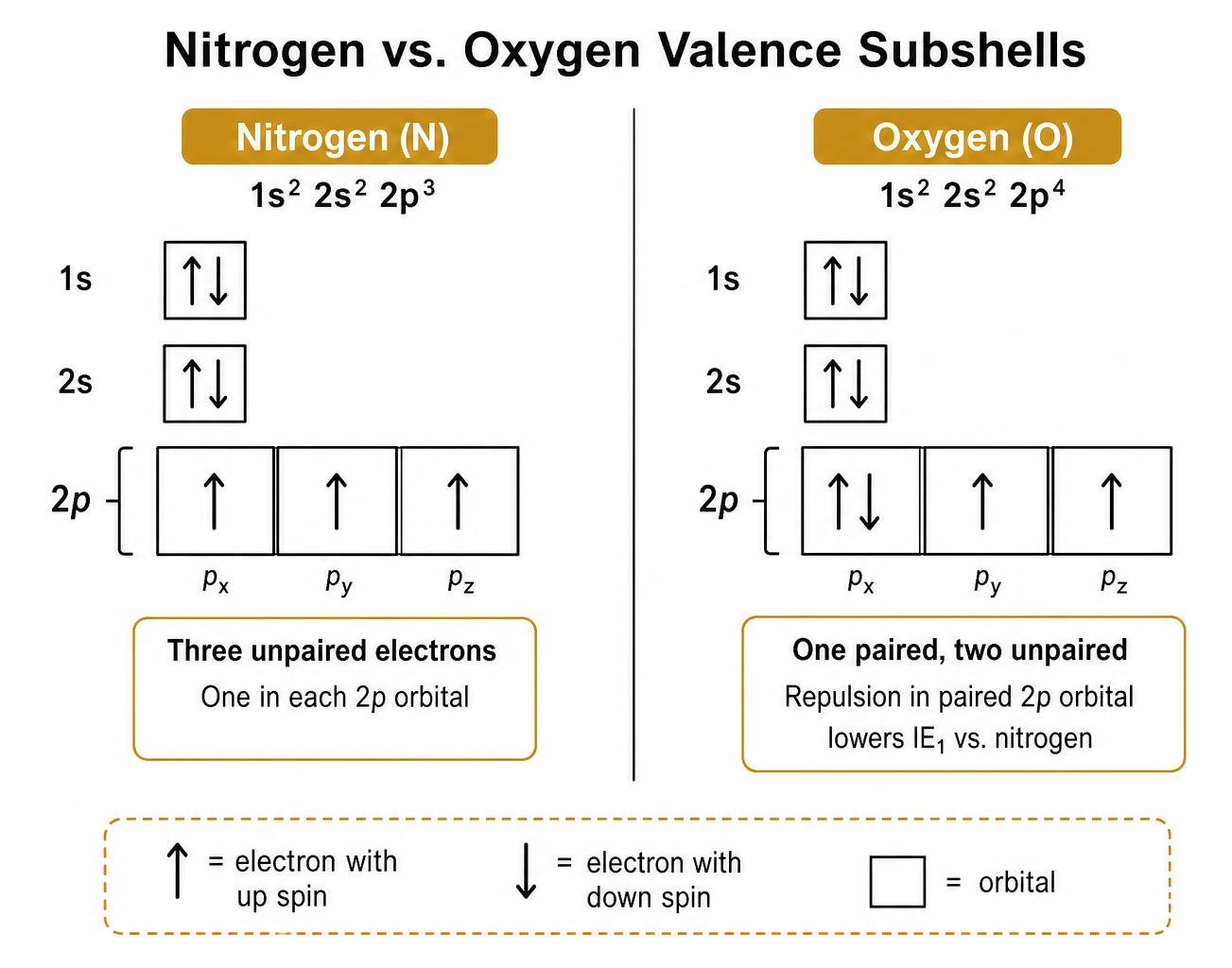
- Drop from Group 15 to Group 16 (e.g., Nitrogen to Oxygen):
- N (Z equals 7): 1s² 2s² 2p³ (three unpaired electrons in separate 2p orbitals) (first ionization energy equals 1,402 kJ/mol)
- O (Z equals 8): 1s² 2s² 2p⁴ (one paired 2p orbital, two half-filled 2p orbitals) (first ionization energy equals 1,314 kJ/mol)
- Mechanism: In Oxygen, the fourth 2p electron must share an orbital with another electron. The resulting electron-electron repulsion within that shared orbital raises the energy of the electron, making it easier to remove despite Oxygen’s higher nuclear charge.
Electron Affinity Anomalies in Halogens
Electron affinity measures the enthalpy change when an electron is added to a gaseous atom. While you would expect Fluorine to have a more exothermic electron affinity than Chlorine due to being closer to the nucleus, Chlorine actually releases more energy (Cl: -349 kJ/mol vs. F: -328 kJ/mol).
Fluorine’s 2p subshell is exceptionally compact. Forcing an incoming electron into this tiny volume creates substantial interelectronic repulsion, which partially offsets the stabilizing attraction of the nucleus. In Chlorine, the incoming electron enters the larger 3p subshell, where the lower electron density minimizes repulsion.
Strategic Exam Applications for Multiple-Choice and Free-Response Sections
Scoring a 5 requires combining strong theoretical understanding with strategic time management on both sections of the exam.
Free-Response Justification Frameworks
AP readers use strict rubrics that award zero credit for simply stating trend directions (such as “Fluorine is smaller because atomic radius decreases across a period”). You must always justify observations using physical mechanisms:
- Horizontal Comparisons: State that both elements have their valence electrons in the same principal energy level (n), but the element further right has more protons, resulting in a higher effective nuclear charge that pulls the valence electrons more strongly toward the nucleus.
- Vertical Comparisons: State that the element further down has its valence electrons in a higher principal energy level (n), meaning the valence shell is located farther from the nucleus and experiences greater shielding from filled inner shells, weakening the Coulombic attraction.
Common Calculation Pitfalls and Speed Drills
Under exam pressure, students frequently make preventable reference errors:
- Adjacent Element Mass Confusion: Be careful when looking up transition metals. Misreading Iron (Fe, 55.85 grams per mole) as Cobalt (Co, 58.93 grams per mole) or Manganese (Mn, 54.94 grams per mole) will compromise your stoichiometry points.
- Hydrate Molar Mass Calculation: When finding the molar mass of hydrates like copper(II) sulfate pentahydrate (CuSO₄ · 5H₂O), calculate the anhydrous salt and the water molecules separately. The total molar mass equals 63.55 plus 32.06 plus four times 16.00 plus five times 18.02, which comes to 249.71 grams per mole.
Build speed by running 15-second ranking drills twice a week: pick three random elements (such as S, As, and K) and quickly rank them by atomic radius or first ionization energy using only effective nuclear charge and principal energy levels.
Frequently Asked Questions About the AP Chemistry Periodic Table
Does the AP Chemistry exam provide electronegativity values or atomic radii?
No. The College Board reference sheet intentionally omits electronegativity values, atomic radii, and ionization energies. You are expected to determine these properties based on an element’s position by evaluating nuclear charge, shielding, and principal energy levels.
Can students bring a personal annotated periodic table to the exam room?
No. You may not bring any personal reference sheets, annotated tables, or scratch paper into the exam room. The testing center will provide the official College Board reference packet containing the standard periodic table and equations sheet.
How do successive ionization energy tables reveal valence electrons?
Look for the largest relative jump between consecutive ionization energies. If the jump occurs between the second and third ionization energies, the atom has two valence electrons (Group 2), because removing the third electron requires pulling from a stable, inner principal energy shell.
Conclusion
Succeeding on the AP Chemistry exam does not require memorizing every number on the periodic table. Instead, it comes down to understanding how atomic structure dictates chemical properties. By viewing the reference table through the lens of Coulomb’s Law and effective nuclear charge, you can answer both multiple-choice and free-response questions with speed and confidence.
At Apex Observer News, our educational reporting follows our strict fact-checking policy to provide accurate, reliable study guides. Incorporate these structural strategies and speed drills into your weekly review sessions to ensure complete readiness on test day.
