

Understanding the AP Biology Test Structure and Timing
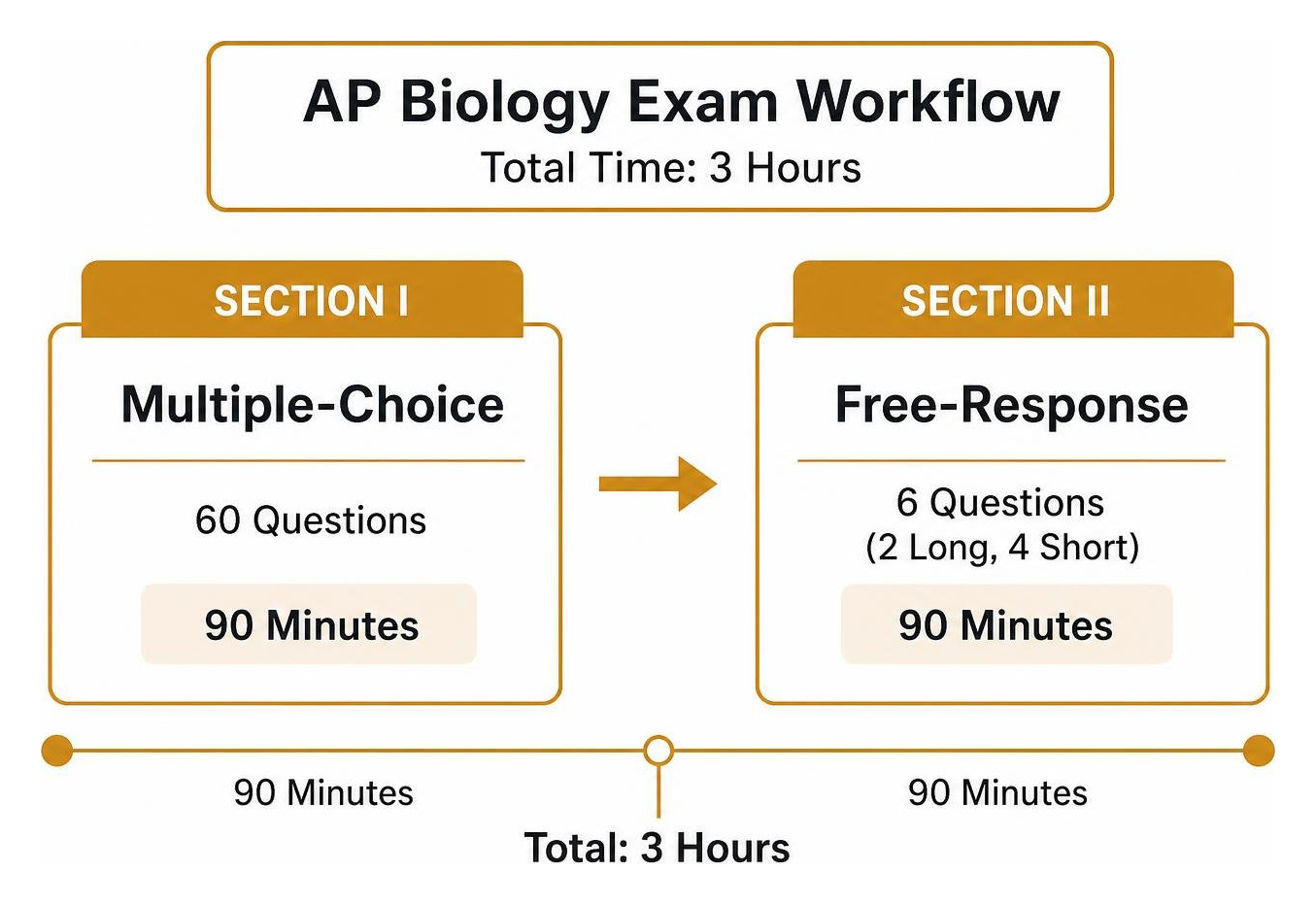
Preparing for the AP Biology exam requires understanding its structure. The test spans three hours and evaluates conceptual understanding, analytical thinking, and quantitative reasoning. Administered as a hybrid digital exam, students complete Section I via the College Board’s Bluebook application while completing the free-response prompts in Section II by hand in paper booklets.
| Section | Question Count | Time Allotted | Score Weighting | Key Focus Areas |
|---|---|---|---|---|
| Section I: Multiple-Choice | 60 Questions | 90 Minutes | 50% | Discrete items, stimulus-based sets, data interpretation, conceptual analysis |
| Section II: Free-Response | 6 Questions (2 Long, 4 Short) | 90 Minutes | 50% | Experimental design, graphing, data analysis, biological justification |
Both halves carry equal weight toward the composite score, making balanced preparation across multiple-choice questions and written prompts essential.
Navigating the Section I Multiple-Choice AP Biology Test Format
Section I presents 60 multiple-choice questions in 90 minutes, providing an average of 90 seconds per question. This section contains a mix of stand-alone discrete questions and stimulus-based question sets. These sets present a biological scenario, experimental dataset, or visual diagram followed by two to five related questions.
Success in Section I relies on data interpretation and scientific reasoning rather than rote memorization. Questions frequently present unfamiliar biological research, requiring students to interpret graphs, evaluate variables, and deduce mechanisms using core biological principles.
Pacing is essential. When tackling complex stimulus sets:
- Identify the biological system and experimental independent/dependent variables before reading the questions.
- Eliminate options that contradict established biochemical rules, such as base-pairing principles or laws of thermodynamics.
- Review older materials like the 2013 Public Practice Exam: AP Biology to become familiar with stimulus-style questions.
Deconstructing the Section II Free-Response Questions
Section II contains six free-response questions (FRQs) completed in 90 minutes. A recommended 10-minute reading period allows students to review prompts, annotate diagrams, and plan responses before writing.
The six questions follow a consistent structure:
- Question 1 (Long, 9 points): Interpreting and Evaluating Experimental Results. Requires analyzing a real-world biological experiment, evaluating data, and predicting changes to the system.
- Question 2 (Long, 9 points): Scientific Investigation. Requires constructing a properly scaled graph, analyzing data patterns, and justifying biological claims.
- Question 3 (Short, 4 points): Scientific Investigation. Focuses on experimental design and evaluating procedures.
- Question 4 (Short, 4 points): Conceptual Analysis. Assesses biological mechanisms at the cellular or molecular level.
- Question 5 (Short, 4 points): Model Analysis. Requires interpreting visual diagrams or structural models.
- Question 6 (Short, 4 points): Data Analysis. Tests the ability to read and interpret quantitative biological data.
Reviewing released questions from the AP Biology Exam Questions archive helps familiarize you with the specific command verbs used on the exam, such as describe, calculate, predict, and justify.
Core Curriculum Units and the Four Big Ideas
The AP Biology curriculum is structured around four foundational “Big Ideas” that connect eight core units:
- Big Idea 1: Evolution (EVO): The diversity of life evolves through natural selection, genetic drift, and shared ancestry.
- Big Idea 2: Energetics (ENE): Biological systems utilize free energy and molecular building blocks to grow, reproduce, and maintain homeostasis.
- Big Idea 3: Information Storage and Transmission (IST): Living systems store, retrieve, transmit, and respond to essential life information.
- Big Idea 4: Systems Interactions (SYI): Biological systems interact, and these complex interactions exhibit emergent properties.
Prioritizing High-Weight Units and Cellular Energetics
Unit weights vary across the exam, making strategic review essential:
| Unit | Title | Exam Weight | Primary Focus Concepts |
|---|---|---|---|
| Unit 1 | Chemistry of Life | 8–11% | Water properties, hydrogen bonding, biological macromolecules (proteins, nucleic acids, carbohydrates, lipids) |
| Unit 2 | Cell Structure & Function | 10–13% | Organelle structure and function, surface area-to-volume ratio, membrane permeability, tonicity, and osmoregulation |
| Unit 3 | Cellular Energetics | 12–16% | Enzyme kinetics, factors affecting denaturation, photosynthesis (light reactions and Calvin cycle), cellular respiration (glycolysis, Krebs cycle, oxidative phosphorylation) |
| Unit 4 | Cell Communication & Cycle | 10–15% | Signal transduction pathways, G-protein coupled receptors, feedback loops, mitosis, cell cycle checkpoints |
| Unit 5 | Heredity | 8–11% | Meiosis, genetic variation, Mendelian genetics, non-Mendelian inheritance, linked genes, pedigree analysis |
| Unit 6 | Gene Expression & Regulation | 12–16% | DNA replication, transcription, translation, operons, eukaryotic gene regulation, mutations, biotechnology |
| Unit 7 | Natural Selection | 13–20% | Evolutionary mechanisms, Hardy-Weinberg equilibrium, phylogenetic trees, cladograms, speciation |
| Unit 8 | Ecology | 10–15% | Energy flow in ecosystems, food webs, population growth models, community dynamics, invasive species |
Cellular Energetics (Unit 3) is a foundational topic. Questions frequently assess how changes in enzyme structure impact catalysis rates. Understanding how temperature and pH affect molecular kinetic energy and cause protein denaturation is critical for both the multiple-choice and free-response sections.
Students should also review chemiosmosis and proton gradients across the inner mitochondrial membrane and thylakoid membranes, along with experimental indicators like DPIP used to measure photosynthesis rates.
Mastering Information Flow, Genetics, and Ecology
Units 6, 7, and 8 represent a significant portion of the total exam weight. Focus on the central dogma: DNA transcription to mRNA, followed by ribosomal translation into functional polypeptides. You should also be comfortable analyzing prokaryotic gene regulation via inducible and repressible operons.
In genetics and evolution, practice calculating allele and genotype frequencies using Hardy-Weinberg equations (where p + q = 1 and p² + 2pq + q² = 1). In ecology, focus on trophic cascades, calculating energy transfer efficiency between trophic levels, and analyzing how invasive species disrupt ecosystem stability.
Tackling Experimental FRQs, Graphing, and Scientific Evidence

FRQ 1 and FRQ 2 require translating raw experimental data into scientific arguments and properly formatted graphs.
Constructing Accurate Biological Graphs and Interpreting Data
FRQ 2 regularly requires graphing experimental data. Follow these conventions to earn full credit:
- Identify Variables Accurately: Place the independent variable on the horizontal x-axis and the dependent variable on the vertical y-axis.
- Label Axes and Include Units: Write out full variable names followed by units in parentheses, such as Incubation Temperature (°C) or Oxygen Production Rate (mL/min).
- Use Consistent, Linear Scaling: Space grid increments evenly across both axes. The plotted data points should fill at least 50% of the available graphing grid.
- Plot Points and Add Trendlines/Bars: Plot data points precisely. If creating a bar graph, draw bars to their exact values. Connect data points directly only when instructed, or draw an appropriate best-fit line.
- Draw Error Bars Correctly: When standard error of the mean (SEM) or 95% confidence interval values are provided, plot error bars extending symmetrically above and below each data point. If the error bars of two experimental conditions overlap, the difference between the means is generally not statistically significant.
Justifying Claims and Identifying Experimental Controls
Experimental design questions evaluate your ability to identify and justify controls:
- Negative Controls: Samples not exposed to the experimental treatment, establishing a baseline to demonstrate that the observed effect is caused solely by the independent variable.
- Positive Controls: Samples treated with a known factor to confirm the experimental setup is functioning properly.
When justifying biological claims, use the Claim-Evidence-Reasoning (CER) framework:
Reviewing historical exam rubrics, such as the 2002 AP Bio Exam and Answers, shows that complete explanations linking structure directly to function consistently earn the highest marks.
Key Insights and Common Misconceptions from Chief Reader Reports
The 2025 Chief Reader Report for AP Biology highlighted clear performance trends across the 288,132 students who took the exam. The global mean score was 3.24, with the following distribution:
This represents an increase in top scores compared to 2022, when 15.0% achieved a 5, 23.1% earned a 4, 29.7% scored a 3, 21.6% scored a 2, and 10.5% received a 1. Despite these gains, student responses revealed several recurring conceptual errors.
Molecular and Cellular Biology Pitfalls
- Ribosome Function vs. Protein Translocation: Many students confuse translation with intracellular protein sorting. Ribosomes synthesize polypeptides by forming peptide bonds; they do not transport proteins across membranes. Translocation into the endoplasmic reticulum depends on signal recognition peptides (SRPs) and membrane translocons like Sec62.
- Membrane Polarity and Transport: Responses often describe transport mechanisms simply as “active” or “passive” without explaining the chemical properties involved, such as how polar, charged amino acid residues interact with hydrophobic phospholipid fatty acid tails.
- Mechanisms of siRNA Knockdown: Students frequently state that small interfering RNAs (siRNAs) destroy DNA or inhibit transcription. In reality, siRNAs bind complementary mRNA transcripts in the cytoplasm, targeting them for degradation and preventing translation.
Avoiding Common Errors in Evolution and Genetics
- Codon-to-Amino-Acid Conversions: A frequent error is dividing nucleotide differences incorrectly when determining amino acid changes. Genetic codons consist of three consecutive nucleotides. A 9-nucleotide coding difference corresponds to three amino acids.
- Phylogenetic Interpretation: Students often misread phylogenetic trees by counting intervening nodes rather than identifying the most recent common ancestor. Taxa sharing a more recent common ancestor are more closely related, regardless of horizontal positioning on the diagram.
- Hardy-Weinberg Assumptions: Students often struggle to explain how violations of Hardy-Weinberg conditions (such as small population size leading to genetic drift) shift allele frequencies across generations.
Proven Preparation Tactics and Exam-Day Stamina

Advanced Study Strategies for the AP Biology Test
- Complete Full-Length Timed Practice Exams: Take complete 3-hour practice tests to build mental stamina and practice pacing under realistic exam conditions.
- Maintain an Error Log: Document every question missed during practice. Categorize errors as a content gap, data misinterpretation, or misread prompt to target your review effectively.
- Grade Responses with Official Rubrics: Practice writing out full FRQ answers and scoring them against released College Board guidelines. This helps you identify the specific details and keywords graders look for.
- Practice Quantitative Data Analysis: Regularly solve problems involving rate calculations, chi-square goodness-of-fit tests, water potential, and Hardy-Weinberg equations.
Leveraging Official Bluebook and AP Classroom Resources
Use the College Board’s official digital preparation materials:
- Bluebook App Previews: Complete practice sets inside Bluebook to familiarize yourself with the digital interface, highlight tools, and reference sheet navigation prior to test day.
- AP Classroom Daily Videos and Topic Questions: Review short AP Daily videos for challenging concepts and use progress check quizzes to assess unit mastery.
- Released Student Samples and Commentary: Study sample student responses to see clear examples of answers that earned full credit alongside those that fell short.
Frequently Asked Questions About the AP Biology Exam
What calculator is permitted on the AP Biology exam?
Students may use any four-function (with square root), scientific, or graphing calculator approved under the College Board AP Calculator Policy. Ensure your calculator has fresh batteries or is fully charged before test day.
How is the free-response section scored?
Section II is evaluated by trained college professors and high school AP teachers during the annual AP Reading. Graders use standardized, analytical rubrics that award points for specific biological assertions, correct data plots, accurate calculations, and evidence-based claims. Partial credit is awarded for individual parts of multi-step questions.
What is a passing score on the AP Bio exam?
Scores of 3, 4, and 5 are considered passing by the College Board and demonstrate college-level mastery:
- 5: Extremely well qualified
- 4: Well qualified
- 3: Qualified
Most colleges and universities grant introductory biology credit or elective credit for scores of 3 or higher, though competitive programs often require a 4 or 5 for prerequisite course waivers.
Conclusion
Succeeding on the AP Biology test requires balancing detailed content knowledge with data interpretation and experimental design skills. By mastering the core curriculum units, avoiding common exam misconceptions, and practicing with official scoring rubrics, you can approach test day with confidence.
At Apex Observer News, we provide accurate, reliable educational reporting to support your academic journey. For more on our editorial standards and source verification practices, review our fact-checking policy. Use these study strategies to focus your prep, master the multiple-choice and free-response sections, and achieve your target score.
