

Best Stock Trading Sites for Your Trading Style
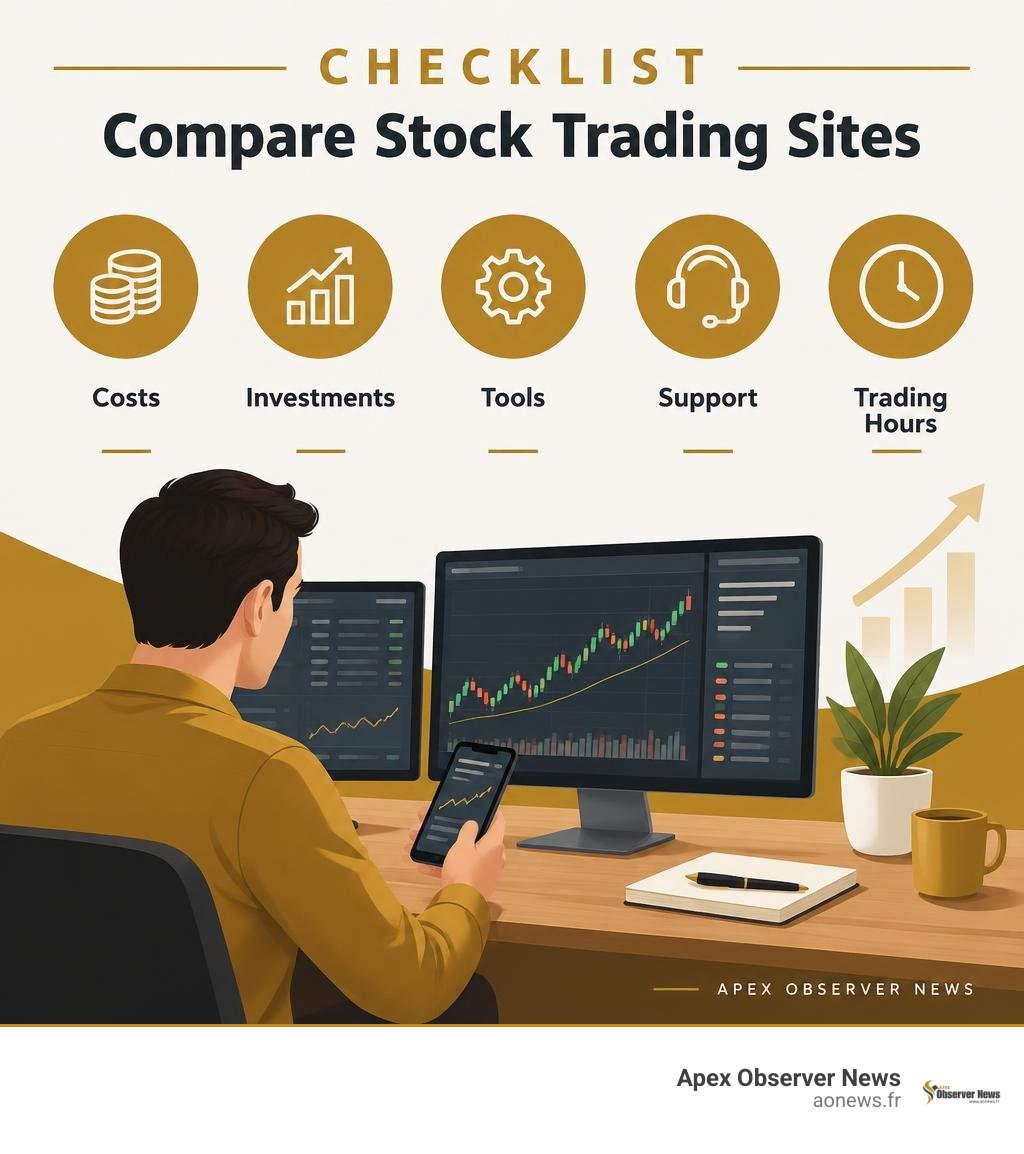
Start with Fidelity, Charles Schwab, Interactive Brokers, and Webull. The best choice depends on what you trade and how often. Compare the full cost of each platform, not just its advertised stock commission. Then check its investment choices, research tools, mobile app, support, and trading hours.
A $0 stock-trade commission can still come with other costs, such as options fees or margin interest. If you trade before the open or after the close, pay close attention to order rules and bid-ask spreads.
What Makes the Best Stock Trading Sites Stand Out in 2026?
The online brokerage landscape has evolved dramatically. Today, finding a platform that offers standard zero-commission trades on US equities and exchange-traded funds (ETFs) is merely the starting point. When retail investors navigate the market, we must look deeper into the overall value proposition of each service. Our team at Apex Observer News constantly tracks these financial technology shifts to separate genuine market innovations from marketing hype.
To uncover what truly separates industry leaders from mediocre platforms, we evaluate several vital criteria:
- Pricing Structure and Hidden Charges: While $0 commission on equities is standard, evaluate secondary costs. This includes per-contract fees on options, margin loan interest rates, and wire transfer costs. Understanding the mechanics behind a guide to free stock trading helps you identify whether a broker offsets free trades through wider execution spreads or payment for order flow.
- Account Minimums and Deposit Flexibility: Most top-tier brokerages now feature $0 minimum deposit requirements, allowing you to begin investing with whatever capital you have available.
- Breadth of Tradable Assets: Modern portfolios require diversity. Leading platforms provide seamless access to US and international stocks, index funds, fixed-income securities, options, futures, and direct or spot cryptocurrency markets.
- Research Depth and Advanced Charting: High-grade platforms integrate institutional data feeds, multi-timeframe charting tools, automated technical pattern recognition, and comprehensive fundamental analyst reports.
- Customer Support and Usability: Responsive live chat, 24/7 phone assistance, and intuitive desktop and mobile interfaces ensure you never miss critical market moves due to technical friction.
If you are just getting started, reviewing a beginners guide to choosing an online broker provides the foundational knowledge required to match these criteria against your personal investing strategy.
Comprehensive Comparison of Top Online Brokerages
Choosing between the top brokers requires a direct examination of their platform mechanics, asset access, and operational costs. For a comprehensive overview of cross-platform trading mechanics, explore our definitive guide to best online share trading.
| Broker | Overall Rating / Score | Stock & ETF Commissions | Account Minimum | Options Contract Fee | Standout Strength |
|---|---|---|---|---|---|
| Interactive Brokers (IBKR) | 5.0 / 5.0 (NerdWallet) | $0 (IBKR Lite) / $0.0005–$0.0035 per share (IBKR Pro) | $0 | $0.15–$0.65 per contract | Global market access, low margin rates, professional execution |
| Fidelity Investments | 5.0 / 5.0 (NerdWallet) | $0 | $0 | $0.65 per contract | Comprehensive research, 24/7 support, zero-fee index funds |
| Charles Schwab | 4.9 / 5.0 | $0 | $0 | $0.65 per contract | thinkorswim platform, deep banking integration, extensive research |
| Webull | 9.4 / 10 (Finder Score) | $0 | $0 | $0 | 24/5 trading hours, advanced mobile charts, competitive cash sweep |
| Robinhood | 4.2 / 5.0 | $0 | $0 | $0 | Frictionless mobile UI, IRA contribution matching, fractional shares |
Independent review aggregators highlight strong performance metrics across these firms. For instance, Interactive Brokers and Fidelity both maintain top-tier 5.0 ratings from NerdWallet, while Webull commands a 9.4 out of 10 Finder Score based on comprehensive platform usability benchmarks.
Advanced Execution and Multi-Asset Powerhouses
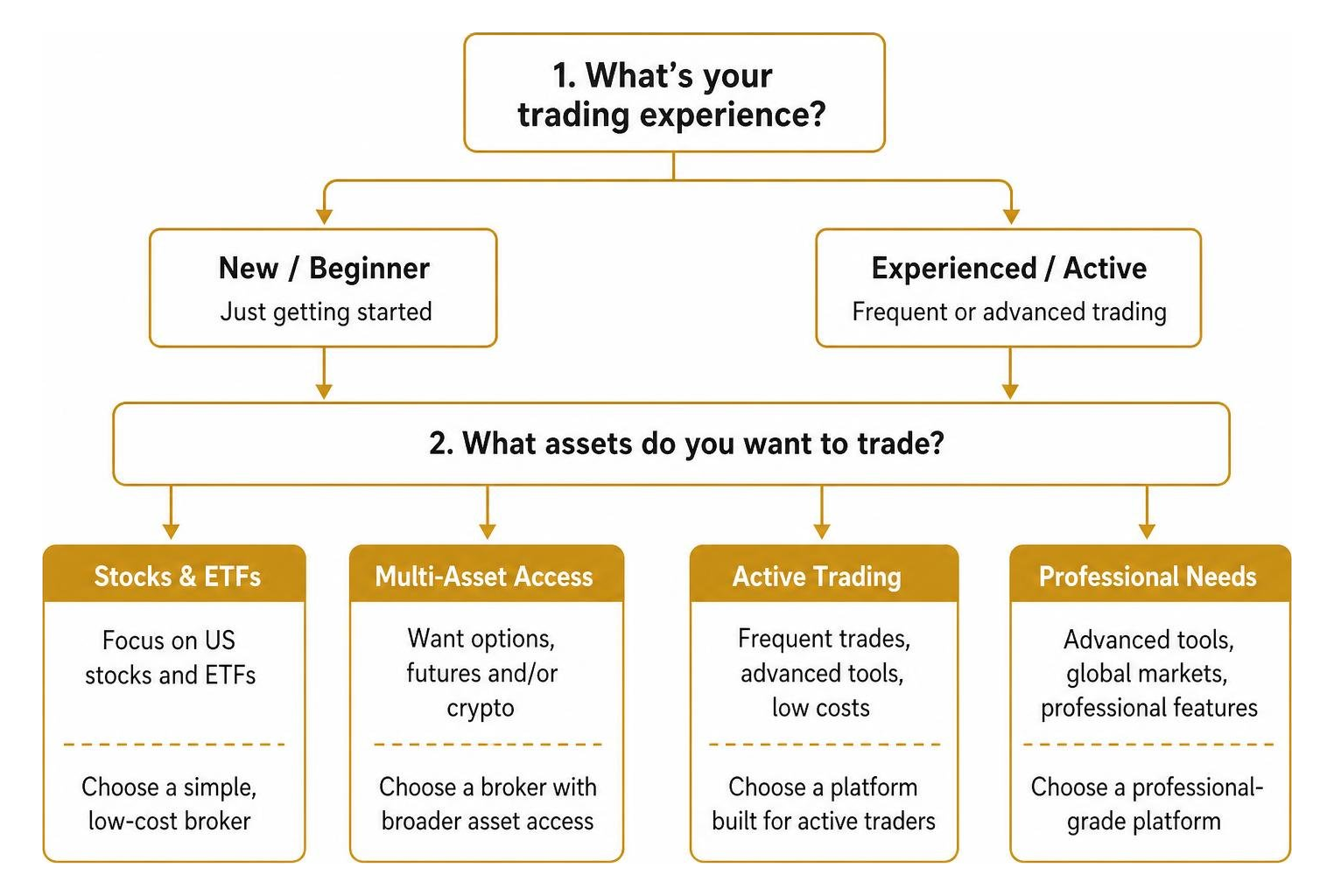
For professional intraday traders, institutional investors, and algorithmic strategists, Interactive Brokers (IBKR) remains the gold standard. Founded over 47 years ago, IBKR delivers institutional-grade trading technology to retail accounts.
IBKR’s proprietary SmartRouting technology continuously searches for competing equity, option, and exchange venues to achieve optimal trade execution and price improvement. Traders seeking fast trades and low fees for intraday pros benefit significantly from IBKR Pro’s tiered pricing schedule, where per-share commissions scale down from $0.0035 to $0.0005 for high-volume accounts.
Additionally, IBKR provides unmatched access to 150 global markets across 34 countries, allowing you to fund accounts in multiple currencies and trade foreign equities seamlessly. For cross-border investors looking beyond domestic boundaries, research from BrokerChooser’s review of international platforms reinforces why robust multi-currency clearing makes global access straightforward.
Best Stock Trading Sites for Beginners and Passive Investors
New market participants and buy-and-hold investors require simplicity, rich educational resources, and powerful portfolio automation. For these goals, Fidelity Investments and Charles Schwab excel.
Both institutions offer $0 minimum account balances, zero-commission equity trades, and an extensive catalog of no-transaction-fee mutual funds. Fidelity stands out by offering proprietary ZERO index funds, which carry absolute 0% expense ratios. Both platforms provide fractional-share investing—allowing you to buy blue-chip stocks with as little as $1—and automated dividend reinvestment plans (DRIPs).
Before putting capital on the line, beginners can leverage our ultimate guide to picking your first stock market broker alongside paper trading simulators to practice execution risk-free.
Leading Mobile-First Apps for Options and Fractional Investing
Modern mobile-first trading apps have transformed retail market access by delivering sleek interfaces, zero options contract fees, and attractive cash sweep yields.

- Webull: Designed for dynamic technical traders, Webull combines zero-commission trading with Level 2 market data (Nasdaq TotalView), technical indicators, and comprehensive options analysis. Webull also provides competitive cash sweep yields, allowing idle cash balances to earn prevailing market rates.
- Robinhood: The pioneer of zero-commission mobile trading continues to lead in mobile simplicity. Its intuitive interface makes managing equities, index funds, options, and cryptocurrencies effortless. Investors looking for a complete breakdown of its features can consult our user review of commission free trading. Robinhood also offers retirement account perks, including direct IRA contribution matches on eligible deposits.
Extended-Hours and Market Access: Navigating Non-Traditional Sessions
Market-moving events do not pause when the opening bell chimes at 9:30 a.m. or when the floor closes at 4:00 p.m. Eastern Time. Earnings releases, economic data drops, and global geopolitical developments frequently occur outside standard exchange operating hours.

Extended-hours trading relies on electronic communication networks (ECNs) that digitally match buy and sell orders. Because trading volume is distributed across these independent electronic venues rather than concentrated on central exchanges, these sessions exhibit unique structural dynamics.
Evaluating the Best Stock Trading Sites for Pre-Market and 24/5 Trading
Different brokerages provide vastly different windows for extended-market access:
- Interactive Brokers: Provides an expansive trading window, facilitating trades from 4:00 a.m. to 8:00 p.m. EST, alongside an overnight trading session that covers up to 24 hours a day, 5 days a week on select popular equities and ETFs.
- Webull: Features complete 24/5 trading capabilities, allowing retail traders to react to international developments from Sunday evening through Friday night.
- Fidelity and Charles Schwab: Both legacy powerhouses offer full pre-market (starting at 7:00 a.m. EST) and after-hours trading (running until 8:00 p.m. EST), enabling straightforward access for domestic earnings plays.
To explore how top providers handle extended trading windows, consult NerdWallet’s guide on extended-hours brokers.
Liquidity Risks, Bid-Ask Spreads, and Order Execution Quality
While extended-hours trading enables rapid reaction to breaking news, it introduces significant risks that every trader must manage:
- Lower Liquidity and Volume: Fewer active market participants translate to reduced trading volume, making it harder to enter or exit large positions smoothly.
- Wider Bid-Ask Spreads: With fewer orders on ECN order books, the spread between what buyers are willing to pay and what sellers demand widens considerably, increasing execution cost.
- Mandatory Limit Orders: To protect investors from severe price slippage, most regulated brokers prohibit standard market orders during pre-market and after-hours sessions, requiring limit orders exclusively.
Before submitting orders during non-traditional sessions, bookmark our cheat sheet to brokerage and trading to ensure your risk parameters and order types are properly structured.
Hidden Fees, Regulatory Security, and Account Protection
Zero commissions do not necessarily mean zero platform expenses. When comparing platforms, look closely at secondary fee schedules:
- Payment for Order Flow (PFOF): Many zero-commission brokers route retail orders to market-making wholesalers who pay for order volume. While this keeps upfront commissions at zero, poor order execution can cost you money through subtle price slippage.
- Margin Interest Rates: If you trade on leverage, margin rates can range anywhere from competitive base rates plus 1% to over 12% annualized depending on your brokerage.
- Ancillary Account Fees: Check for outbound ACAT transfer fees, paper statement delivery fees, and international wire transfer surcharges.
To protect your returns, review our strategies on how to find low commission stock brokers without getting fleeced.
Furthermore, always verify that your broker maintains active regulatory standing with the Securities and Exchange Commission (SEC) and the Financial Industry Regulatory Authority (FINRA). Legitimate US brokerages carry Securities Investor Protection Corporation (SIPC) coverage, which protects securities and cash in your account up to $500,000 (including a $250,000 limit for cash) against brokerage insolvency. For additional buyer satisfaction ratings and verified customer sentiment across top platforms, consult ConsumerAffairs’ online broker reviews and Finder’s comprehensive brokerage comparisons.
Frequently Asked Questions About Online Brokers
Can I trade stocks online with zero account minimums?
Yes. The vast majority of top-tier online brokerages—including Fidelity, Charles Schwab, Interactive Brokers, Webull, and Robinhood—feature $0 minimum balance requirements for standard cash accounts. This allows you to open an account, fund it with any amount, and utilize fractional shares to purchase high-value equities and ETFs without committing thousands of dollars upfront. For a complete walkthrough on launching your account from scratch, check our stock market online trading 101 guide.
What is the difference between discount brokers and full-service firms?
Discount brokers (and automated robo-advisors) provide digital self-directed platforms where you make your own investment decisions at ultra-low or zero commission costs. In contrast, full-service firms assign dedicated financial advisors to provide personalized wealth planning, tax structuring, and estate management services in exchange for asset-under-management (AUM) fees or per-trade commissions. To determine whether dedicated advisory oversight fits your situation, explore our guide on full service brokers that earn their commission.
How do I avoid overpaying on trading fees and hidden charges?
To minimize total drag on your portfolio, evaluate the complete fee schedule of your platform. Focus on margin rates, options contract costs, cash sweep yields, and currency exchange fees. If you hold cash between trades, choose a broker that automatically sweeps idle cash into high-yield partner banks rather than leaving it in low-interest settlement accounts. For actionable tactics to streamline your expenses, review our breakdown on how to stop overpaying your broker right now.
Conclusion
Maximizing your stock market returns requires more than picking winning assets—it demands using an efficient, reliable platform that aligns with your specific trading style. Whether you require the institutional multi-asset routing of Interactive Brokers, the comprehensive research ecosystem of Fidelity and Schwab, or the mobile agility of Webull and Robinhood, selecting the right platform protects your hard-earned profits from execution drag and unnecessary fees.
At Apex Observer News, we remain committed to delivering clear, fact-checked financial journalism and real-time market insights to help you navigate modern investing. When you are ready to expand your platform research, explore the major stock brokers that dominate the American market to align your portfolio with industry-leading infrastructure.
