



For fast market news, use a live news feed, an economic calendar, and alerts for the assets you follow. Check company filings and exchange data to confirm major updates. Keep oil prices, stock futures, bond yields, and currencies in one view so you can see how a headline affects more than one market.
The goal is not to read every alert. It is to spot what matters, check the source, and understand the impact. These 10 methods will help you build that routine.
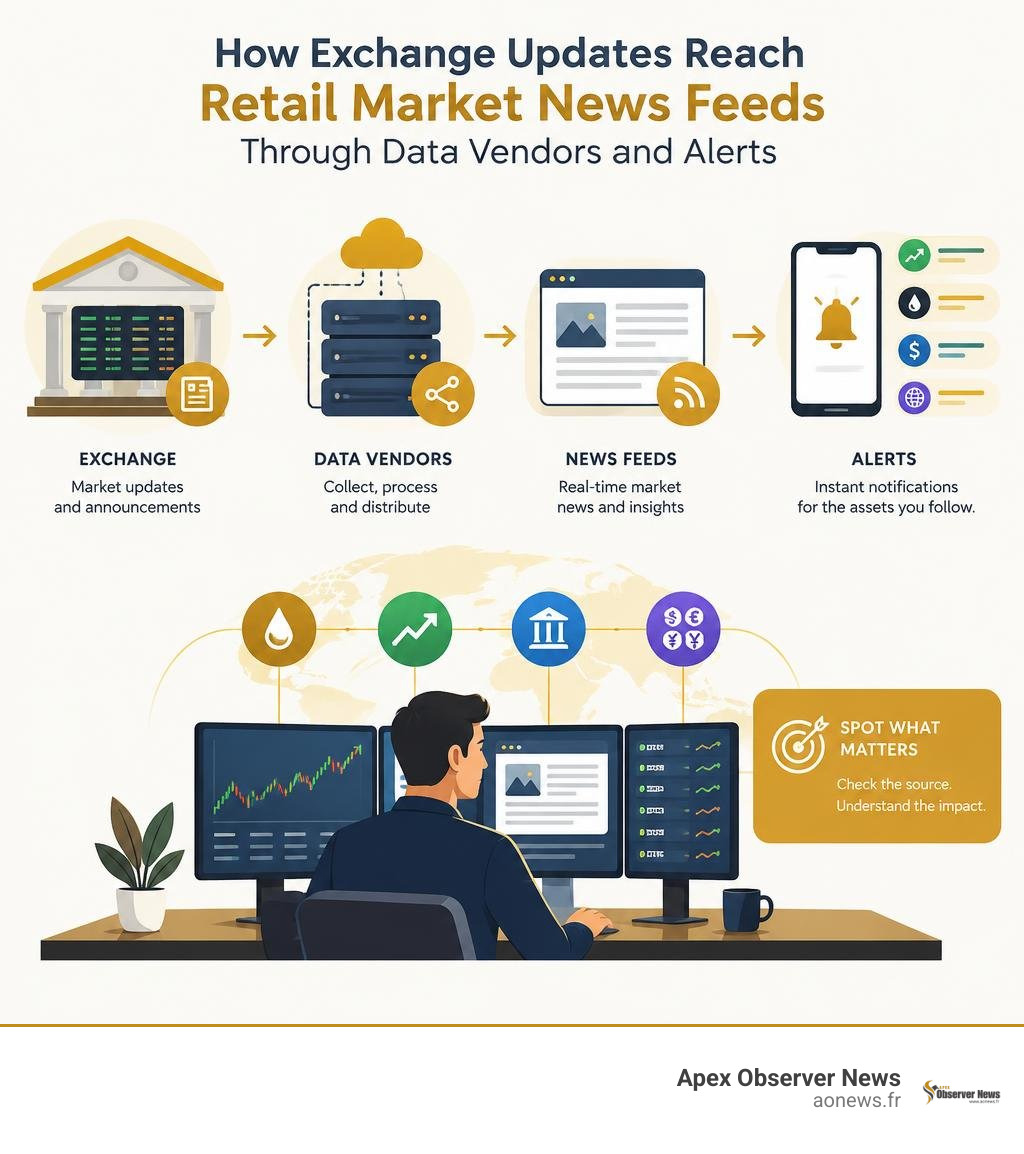
Why Real-Time Market News Dictates Modern Trading Strategies
Navigating today’s macroeconomic landscape requires more than just a passing glance at the morning paper. In an era where algorithmic execution occurs in milliseconds, rapid price discovery and sudden liquidity shocks can redefine asset valuations before most market participants have even finished their morning coffee. A headline emerging from a central bank press conference or an unexpected supply disruption across critical maritime shipping corridors instantly ripples across every asset class.
The interconnected nature of our global economy means that isolationist trading strategies no longer hold up under pressure. When commodity markets experience violent swings, equity valuations, foreign exchange rates, and sovereign debt yields immediately recalibrate. For example, crude oil price shocks driven by geopolitical tensions in the Middle East do not simply affect oil producers; they inflate transport overhead, squeeze corporate profit margins, and revive sticky consumer inflation metrics. Maintaining a sharp, real-time news architecture is fundamental to executing sound portfolio risk mitigation strategies.
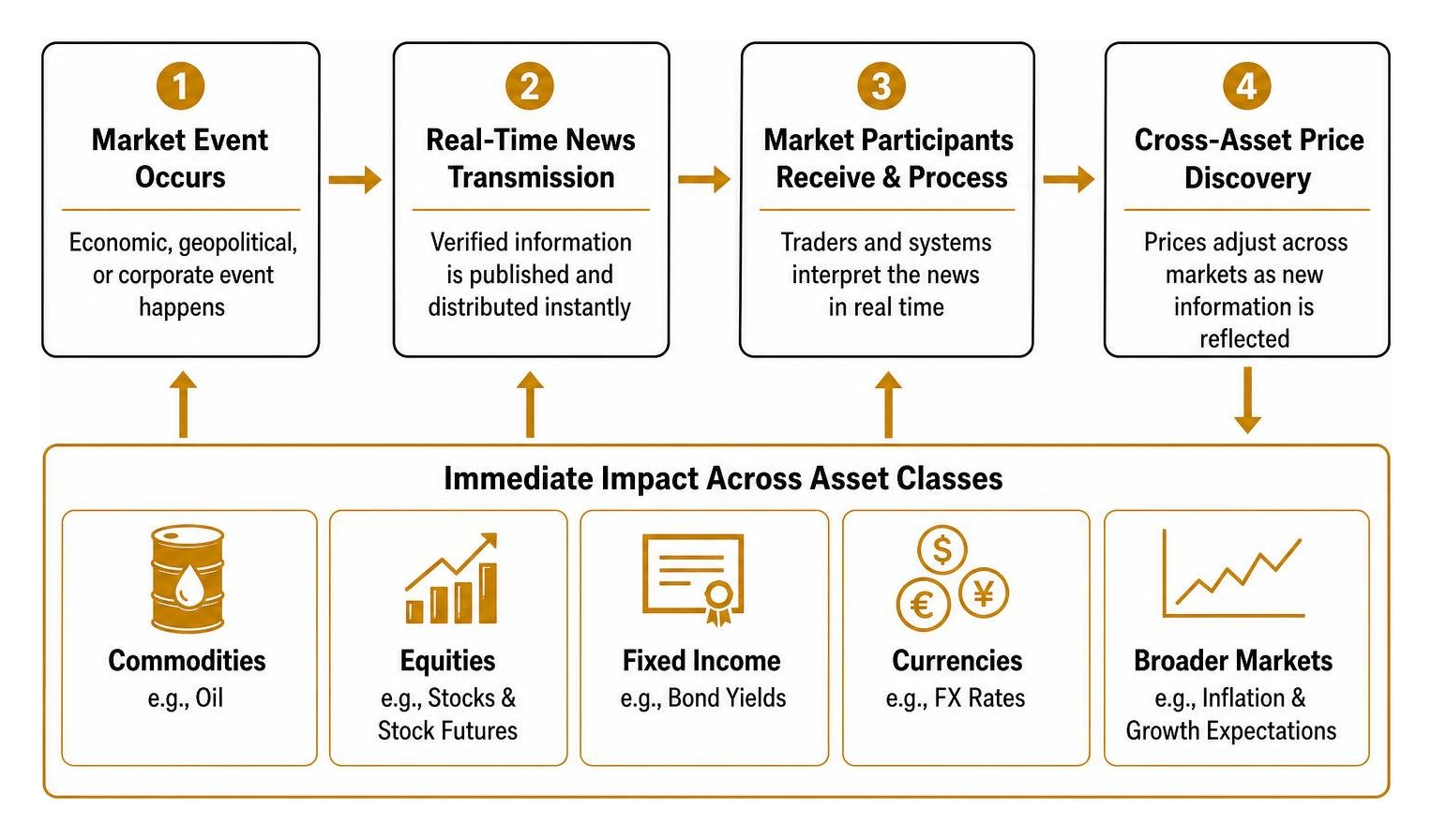
10 Proven Methods to Capture Market Movements in Real Time
To stay ahead of swift trend reversals, serious market participants deploy an integrated matrix of distribution channels. Depending on whether you trade equity derivatives, fixed income, or physical commodities, your choice of delivery channels dictates your latency edge and data depth.
| Method / Channel | Latency Level | Primary Data Depth | Target Asset Coverage |
|---|---|---|---|
| 1. Direct Broker Wire APIs | Ultra-Low (<100ms) | Raw price updates & tick data | Equities, Futures, FX |
| 2. Real-Time Newswire Desks | Low (Seconds) | Breaking corporate & macro text | Cross-Asset Global |
| 3. Automated Regulatory Filings | Ultra-Low (Sub-second) | Form 10-K, 10-Q, 8-K, insider moves | Equities & Corporate Debt |
| 4. Central Bank Wire Syndications | Very Low (Seconds) | Policy statements, rate decisions | Bonds, Currencies, Rates |
| 5. Macro Economic Calendars | Low (Scheduled) | CPI, PPI, GDP, labor market data | Sovereign Debt, Equities, FX |
| 6. Commodity Exchange Trackers | Very Low (Real-Time) | Spot energy, metals, inventory counts | Energy, Precious Metals, Ags |
| 7. Institutional Audio Squawk Boxes | Ultra-Low (Audio instant) | Unfiltered trading floor rumors & news | Futures, Index Options, FX |
| 8. Blockchain On-Chain Monitors | Real-Time (Block-level) | Whale wallet flows, exchange reserves | Digital Assets, Crypto Equities |
| 9. Sovereign Credit Rating Feeds | Medium (Event-driven) | Sovereign downgrades & outlooks | Emerging Market Debt, FX |
| 10. Curated Real-Time Mobile Alerts | Low (1–5 seconds) | Filtered high-impact headlines | Multi-Asset Portfolios |
Automated Alerts for Breaking Market News and Macro Triggers
Setting up automated alerts based on critical macro indicators prevents you from getting caught off guard by scheduled volatility events. Key economic data releases—such as the US Consumer Price Index (CPI)—set the tone for central bank policy worldwide. When inflation metrics cool or accelerate beyond expectations, benchmark bond yields move rapidly, pulling equities along for the ride.
We saw this dynamic play out vividly when UK inflation slowed down to a 15-month low of 2.6% year-over-year in June, with core CPI printing at 2.6% and services inflation moderating to 3.6%. While this softness brought initial relief to interest-rate expectations, persistent energy price pressure kept policy makers at the Bank of England on alert. By deploying sound market analysis techniques, traders track real-time feeds to separate temporary baseline fluctuations from lasting inflationary trends.
Direct Feeds for Equity Earnings and Corporate Filings
Corporate earnings releases provide unfiltered clarity on operating margins, consumer demand, and forward guidance. Tracking these announcements through direct regulatory feeds such as SEC EDGAR ensures you receive the figures long before secondary commentary filters into broad media.

Recent corporate reports illustrate the vast dispersion across sectors:
- GE Vernova: Boosted its full-year 2026 revenue guidance to between $45.5 billion and $46.5 billion, while dramatically raising its free cash flow target to $11.5 billion–$12.5 billion (up from $6.5 billion–$7.5 billion), powered by strong electrification and power grid demand.
- AT&T: Reported second-quarter adjusted earnings of 65 cents per share, reaffirmed plans to maintain its annualized common stock dividend of $1.11 per share, and outlined roughly $24 billion in share repurchases, including approximately $10 billion earmarked for 2026.
- PulteGroup: Faced margin compression and higher operating expenses that dented net income, even as net new orders climbed 6% with robust backlog growth.
- Otis Worldwide: Delivered solid quarterly net income of $428 million, highlighting steady modernization and service contracts.
- Wabtec: Booked strong quarterly net income of $395 million, supported by freight rail equipment orders.
- Cal-Maine Foods: Posted a 31.7% drop in net sales and a 74% decline in quarterly net income, directly pressured by historically low shell egg prices amid rapid domestic supply recovery.
Dedicated Terminals for Commodity and Energy Volatility
Energy markets act as the primary engine for global cost-push inflation. Keeping live terminals dedicated to physical commodity hubs allows you to track spikes in Brent crude—which surged 4.4% to trade at $95.05 per barrel—and West Texas Intermediate (WTI), which climbed 4.6% to reach $88.22 per barrel.
Much of this upward trajectory stems from an oil price surge following Middle East supply disruptions and heightened military posturing between the US and Iran. This geopolitical tension threatens vital maritime chokepoints and injects severe risk premiums into freight logistics.
Beyond crude oil, seaborne thermal coal demand is seeing structural shifts, while industrial metals tell a nuanced economic story. Shanghai copper contracts pushed to seven-week highs on tight regional supply and targeted Chinese infrastructure spending, even as broader industrial copper prices faced resistance from cautious global buyers wary of elevated inflation. Concurrently, heightened geopolitical risk coupled with shifts in Federal Reserve policy expectations supported rising gold prices, keeping spot gold firm above $4,100 per ounce.
Filtering Sector Earnings and Commodity Market News
Parsing high-frequency data streams allows investors to spot powerful sector rotations. Global equity markets recently snapped broader losing streaks thanks to a resilient rebound across semiconductor and technology shares.
On Wall Street, technology strength lifted the primary benchmarks, with the Dow Jones Industrial Average gaining 385.38 points (0.74%), the S&P 500 rising 65.92 points (0.89%), and the tech-heavy Nasdaq Composite surging 329.13 points (1.29%). European equities mirrored this resilience, as energy shares and big tech counters lifted the pan-European STOXX 600 index, absorbing the shock of elevated crude prices.
In Asia, South Korea’s Kospi climbed 0.7% to close at 6,797.70 led by heavyweight chip manufacturers, while Chinese mainland bourses extended their tech-driven rebound. Conversely, Japan’s Nikkei Stock Average slipped 0.2% to 66,115.60, weighed down by margin pressure across retail names. Keeping a direct tab on stock market futures enables institutional and retail desks alike to gauge opening sentiment across European and US trading sessions well before cash equity bells ring.
Key Macro Indicators Shaping Cross-Asset Trends

Understanding broad asset moves requires tracking the underlying macro levers: sovereign yields, currency pairs, and alternative stores of value.
Sovereign Debt Yields and Central Bank Policy
Sovereign bond markets are pricing in prolonged monetary policy divergence. German policy-sensitive two-year Bund yields touched fresh two-year highs, closely tracking energy-driven inflation risks. In the UK, 10-year Gilt yields pushed to one-month highs as the surge in global oil prices overshadowed the positive momentum of easing core inflation figures.
Global central banks are responding across different timelines:
- Federal Reserve: Navigating a complex balance between persistent service-sector wage pressures and high energy costs.
- Bank Indonesia: Surprised markets by holding its benchmark rate steady at 5.75%, opting to protect regional growth while monitoring currency stability.
- National Bank of Hungary: Continued its easing campaign by cutting policy rates again in response to disinflation.
- Emerging Economy Inflation: South Africa reported annual headline consumer inflation accelerating to 5.0%, while New Zealand recorded second-quarter inflation at 4.1% year-over-year, marking a multi-year high.
- Sovereign Credit Upgrades: S&P raised Pakistan’s sovereign rating to ‘B’ following key economic reforms, while Moody’s upgraded Argentina to ‘B3’ with a positive outlook.
Foreign Exchange Volatility and Commodity-Linked Currencies
Currency valuations are experiencing intense volatility as oil import bills climb. The US Dollar broke above ¥163 against the Japanese Yen, reaching a four-decade high before speculative reports suggested the Bank of Japan might need to hike policy rates faster than projected. Although Japan’s exports grew 19.3% year-over-year in June, soaring energy import costs drove the national trade deficit to ¥406.9 billion.
In emerging Asia, the Indian Rupee fell to 96.34 against the greenback as crude import expenses mounted. This currency pressure fed directly into local equity declines, causing India’s benchmark Sensex to tumble over 800 points while the Nifty retreated toward 23,950 support levels.
Digital Asset Tracking and Institutional Capital Inflows
Digital assets continue to cement their place within mainstream asset allocation. Supported by expanding institutional ETF products and clearer global regulatory frameworks, Bitcoin surges past major price levels to maintain institutional adoption momentum.
Demographic surveys indicate that retail and institutional ownership of Bitcoin in the United States has expanded to 18.6%, comfortably outpacing traditional retail gold ownership (10.8%). This growing digital adoption represents a fundamental broader financial trend, positioning liquid digital assets alongside conventional hedges during periods of cross-border currency depreciation.
Frequently Asked Questions About Market News Tracking
How do crude oil price swings impact broader stock market futures?
Surging crude prices act as an immediate tax on global enterprise. When benchmark crude contracts cross $90 per barrel, airlines, logistics providers, and consumer packaging firms face immediate margin contraction. Furthermore, higher energy costs drive headline inflation higher, forcing central banks to delay interest rate cuts. This dynamic pushes sovereign bond yields higher, compresses equity valuation multiples, and causes stock market futures to open lower.
Why are central bank interest rate decisions moving global bond yields?
Central bank policy rates establish the risk-free rate within modern financial models. When a central bank adjusts or signals an adjustment in its overnight lending rate, the short end of the sovereign yield curve recalculates instantly. Higher interest rate expectations raise the discount rate applied to future corporate cash flows, triggering portfolio realignments away from highly valued growth stocks and into short-duration debt instruments.
What is the most reliable method to track corporate earnings announcements?
The most reliable method combines direct regulatory database alerts (such as SEC EDGAR feeds) with direct company investor relations press portals and real-time audio squawk networks. Secondary media reports often suffer from editorial delays; accessing primary wire releases guarantees immediate insight into net income, revenue surprises, and forward EBITDA revisions.
Conclusion
Building a systematic news workflow is essential for operating in volatile financial environments. Rather than reacting blindly to fragmented headlines, successful market participants maintain clear visibility across equity futures, energy benchmarks, foreign exchange crosses, and central bank communications.
At Apex Observer News, we focus on delivering real-time, fact-checked reporting that cuts through market noise, arming you with the critical data needed to make informed trading and investment decisions. For comprehensive reporting on corporate earnings, economic policies, and macro developments, explore our latest global business and financial market analysis.
