


To use an AP United States History score calculator, count your correct multiple-choice answers and score your short-answer questions, DBQ, and LEQ against the rubrics. Convert each section to its weight (40%, 20%, 25%, and 15%), add the results into a number out of 100, and match that number to a 1 to 5 band. Roughly 45 points or more points toward a 3, about 57 or more toward a 4, and about 70 or more toward a 5.
The hard part is that raw scores do not add up the way they look. The multiple-choice section has 55 points and the DBQ has 7, yet the DBQ is worth far more per point. Online calculators also use different composite scales, and the College Board does not publish exact cutoffs ahead of the exam. Many tools hide their math, so you get a number with no idea how to move it.
This guide is part of our AP exam prep coverage at AONews. It shows you the exam structure, then walks through four steps: scoring each section, converting to weighted points, matching a 1 to 5 score, and turning the estimate into a study plan. You can run the math by hand or in a spreadsheet.
What the APUSH score is made of
Your AP US History score comes from four parts that carry fixed weights: multiple choice 40%, short answers 20%, the DBQ 25%, and the LEQ 15%. Every APUSH score calculator is built on those four numbers, so learn them first.
The four parts of the exam
The exam lasts 3 hours and 15 minutes. Section I holds the multiple-choice questions and short answers. Section II holds the two essays.
| Part | Questions | Time | Raw points | Weight |
|---|---|---|---|---|
| Multiple choice (MCQ) | 55 | 55 min | 55 | 40% |
| Short answer (SAQ) | 3 | 40 min | 9 (3 each) | 20% |
| Document-based question (DBQ) | 1 | 60 min, with a 15-minute reading period | 7 | 25% |
| Long essay (LEQ) | 1 | 40 min | 6 | 15% |
You answer SAQs 1 and 2, then choose either SAQ 3 or SAQ 4. For the LEQ, you pick one of three prompts. Wrong multiple-choice answers do not lose points, so never leave one blank.
Why raw points cannot simply be added
The raw points total 77 (55 + 9 + 7 + 6). If you added them directly, multiple choice would make up about 71% of your score. In reality, it is worth 40%. The writing sections hold only 22 of the 77 raw points, but they carry 60% of the weight.

Each essay point is worth several multiple-choice questions, so a calculator that adds raw points will mislead you.
What you need before you start
Gather a full practice exam, the scoring guidelines for each free-response question, and a pencil or a spreadsheet. A released College Board exam with its scoring guidelines gives you the most trustworthy raw scores. If you only practiced one section, run the calculation anyway, but treat the result as a partial picture.
Step 1. Score each section honestly
Start by getting four raw numbers: your MCQ correct count out of 55, your SAQ total out of 9, your DBQ score out of 7, and your LEQ score out of 6. The most common calculator error is inflated essay scores, so be strict.

Count your multiple-choice answers
Count correct answers only. Skip any penalty math, because there is none. If you finished a section under real timing, your count is reliable. If you took extra time, subtract a few questions mentally, since untimed practice overstates your score.
Score the SAQs
Each SAQ has three parts (A, B, and C) worth 1 point each. Award a point only when you name or explain exactly what the part asks. A vague answer that merely sounds related earns nothing. Add the three questions for a total out of 9.
Score the DBQ and LEQ against the rubric
Use the official rubric line by line. Here is what the points cover:
- DBQ (7 points): thesis (1), contextualization (1), evidence (3, which includes 1 for outside evidence beyond the documents), analysis and reasoning (2).
- LEQ (6 points): thesis (1), contextualization (1), evidence (2), analysis and reasoning (2).
Give a point only when you can point to the sentence that earns it. Better yet, have a teacher score one essay and compare. Students tend to score themselves one to two points high on the DBQ, mostly on the complexity point and on evidence that is described instead of explained.
If you cannot point to the sentence that earns a rubric point, you did not earn it.
Step 2. Convert raw scores to weighted points
Convert each section by dividing your score by its maximum and multiplying by its weight. Together the four results make a composite out of 100, which keeps the weights honest and is easy to check by hand.
The conversion formula
| Section | Formula | Value of one raw point |
|---|---|---|
| MCQ | correct ÷ 55 × 40 | 0.73 |
| SAQ | total ÷ 9 × 20 | 2.22 |
| DBQ | score ÷ 7 × 25 | 3.57 |
| LEQ | score ÷ 6 × 15 | 2.50 |
The right-hand column is the useful one. One DBQ point equals about five multiple-choice questions. One LEQ point equals about three and a half.
A worked example
Say you got 38 of 55 on multiple choice, 5 of 9 on the SAQs, 4 of 7 on the DBQ, and 3 of 6 on the LEQ.
- MCQ: 38 ÷ 55 × 40 = 27.6
- SAQ: 5 ÷ 9 × 20 = 11.1
- DBQ: 4 ÷ 7 × 25 = 14.3
- LEQ: 3 ÷ 6 × 15 = 7.5
Your weighted composite is 27.6 + 11.1 + 14.3 + 7.5 = 60.5 out of 100.
Run it in a spreadsheet
Put your MCQ count in B1, SAQ total in B2, DBQ score in B3, and LEQ score in B4. Then paste this formula into B5:
=B1/55*40+B2/9*20+B3/7*25+B4/6*15
Change any input and the composite updates, so you can test “what if I earn one more DBQ point” in seconds.
Divide by the section maximum, multiply by the weight, and the composite takes care of itself.
Step 3. Match your composite to a 1 to 5 score
Compare your composite to the score bands below. These are rounded planning bands based on the usual shape of past APUSH curves, not official cutoffs, so expect an error of a few points either way.
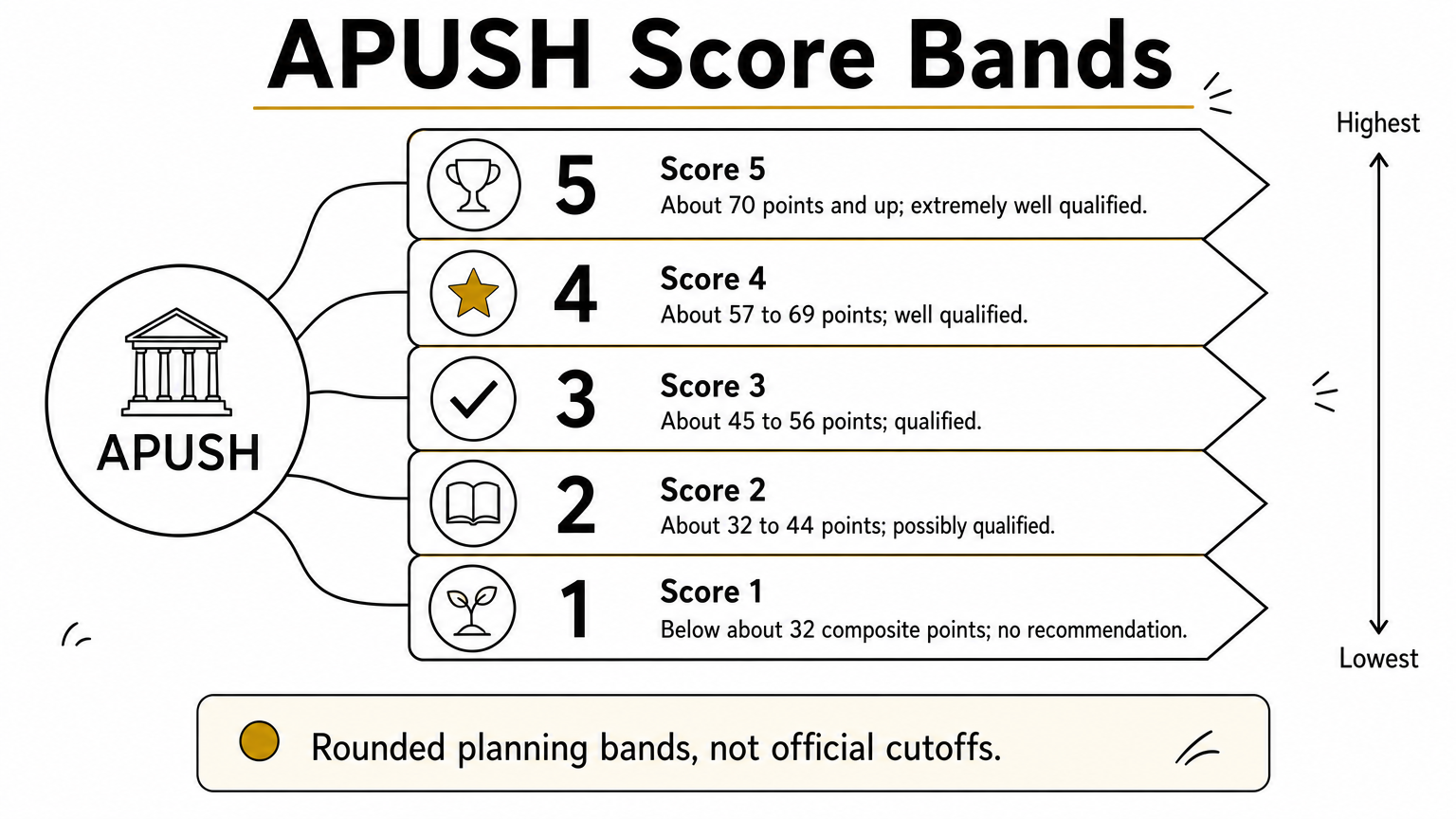
Approximate score bands
| AP score | Composite out of 100 | College Board label |
|---|---|---|
| 5 | about 70 and up | Extremely well qualified |
| 4 | about 57 to 69 | Well qualified |
| 3 | about 45 to 56 | Qualified |
| 2 | about 32 to 44 | Possibly qualified |
| 1 | below about 32 | No recommendation |
Our example of 60.5 lands in the 4 band. A student who gets 28 MCQs, 4 SAQ points, 3 DBQ points, and 3 LEQ points scores about 47.5, which is a solid 3.
Why the cutoffs move
The College Board sets cutoffs after each exam, so the points needed for a 3, 4, or 5 shift from year to year. That is why different calculators disagree and why some use a 130-point or 150-point composite instead of 100. The scale does not matter. The percentages are what count. If a tool shows a different total, divide your result by its maximum and compare it to the bands above.
Treat borderline results with care
If you land within three points of a cutoff, call it a coin flip. A composite of 54 and one of 58 can sit on opposite sides of the 3/4 line, so use the calculator to find your range, not a promise. Run the math for a pessimistic and an optimistic version of your essay scores and see whether both land in the same band.
A composite within three points of a cutoff means you should plan for the higher score and practice like you need it.
Step 4. Turn your estimate into a study plan
Use the weighted points to find where practice pays off fastest. Your estimate matters only if it changes what you study next.
Chase the cheapest points
Compare your section percentages. Say you earned 69% of the MCQ points but only 43% of the DBQ points. The DBQ is worth 25% of the exam, so lifting it from 3 to 5 adds about 7 weighted points. Reaching that with multiple choice alone would take about 10 more correct answers. Contextualization and the outside-evidence point are usually the quickest DBQ gains because they are about knowing a pattern, not writing more.
What counts as a good score
A 3, 4, or 5 is a passing score, and many colleges give credit for it. Policies vary by school, so check the College Board credit policy search for yours. The 2023 results show how hard the top scores are:
| Score | Share of 2023 test takers |
|---|---|
| 5 | 11% |
| 4 | 15% |
| 3 | 22% |
| 2 | 23% |
| 1 | 29% |
That means about 48% scored a 3 or higher. The mean score ran between about 2.5 and 2.9 from 2020 to 2023. The College Board posts current figures on its AP score distributions page.
Rerun the numbers after every practice test
Calculate your composite after each full practice exam, not just once. Write the four raw scores in a notebook so you can see which section is moving. If your estimate climbs two or three points between tests, your study plan is working. If it stalls, change the plan before you add more hours.
Your first estimate is a baseline, and the second one tells you whether your study plan works.
Your next step toward a 4 or 5
An APUSH score is a weighted blend, with multiple choice at 40%, short answers at 20%, the DBQ at 25%, and the LEQ at 15%. Score each part against the rubric, convert it with the formulas above, and compare the composite to the bands. Then practice where each point is cheapest, usually in the essays.
Keep your expectations honest. The cutoffs shift every year, so a calculator gives you a range, and the range is enough to guide your study time. For more AP score calculators, exam schedules, and study guides, browse the Education section at AONews.
