

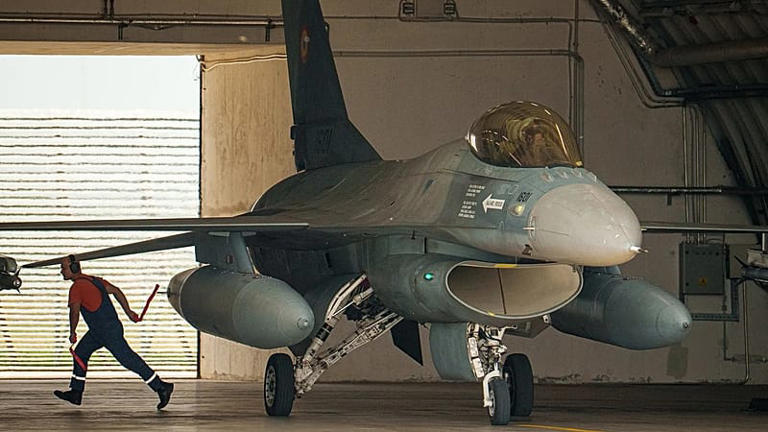
Escalating aerial and maritime breaches prompt NATO jet scrambles as European leaders point to hybrid warfare threats.
A Romanian F-16 fighter jet intercepted and destroyed an explosive-laden maritime drone operating dangerously close to Europe’s largest active offshore energy initiative in the Black Sea, coming just hours after an unidentified aerial drone crashed inside NATO territory.
The maritime drone was spotted at approximately 06:28 local time by a commercial vessel. It was drifting just a few hundred meters from construction activities at the Neptun Deep offshore gas development site, located roughly 80 nautical miles east of the Romanian port city of Constanța.
To safeguard the hundreds of personnel on-site and secure critical energy infrastructure, Romanian military authorities scrambled two F-16 fighters, one of which neutralized the vessel. Defense Minister Radu Miruță confirmed the drone carried live explosives, while officials in Kyiv confirmed the craft did not belong to Ukrainian forces.
Romanian President Nicuşor Dan condemned the sequence of events as an escalation of “irresponsible incidents,” placing blame on Moscow. European Commission President Ursula von der Leyen characterized the maneuver as part of a broader “hybrid warfare” strategy aimed at unsettling European citizens and dividing the European Union.
Double Incident: Airspace Violation and Crash in Tulcea County
The maritime action followed a separate airborne breach earlier that night during a heavy air attack across neighboring Ukraine.
Military radar detected incoming aerial targets north of Tulcea County near the Ukrainian border at 02:23 local time. NATO air policing assets responded immediately:
Two Spanish F-18 jets stationed in Romania were scrambled to monitor the airspace.
A Romanian IAR-330 SOCAT military helicopter was dispatched for reconnaissance.
Emergency alerts were issued to residents across nearby civilian regions.
At 03:21, radar tracked a drone crossing 13 kilometers east of Galați into Romanian airspace. Three minutes later, the helicopter crew reported the drone had crashed approximately four kilometers northeast of Grindu village in Tulcea County. The impact triggered a localized fire that burned out naturally. Military teams secured the perimeter, confirming no casualties or critical property damage occurred.
Rising Pattern of Regional Border Incursions
Though authorities are still examining the debris from the Tulcea crash, the event comes on the heels of several similar incidents in the region:
Days Prior: A Spanish F-18 downed an unidentified drone that entered Romanian airspace via Moldovan airspace (later designated by NATO officials as likely Russian in origin).
Earlier Interceptions: Romanian F-16s intercepted three Russian drones in July alone.
As a dual member of NATO and the EU sharing a long border with Ukraine, Romania has routinely dealt with airspace violations and falling debris since the full-scale invasion began in 2022. The broader scope of Thursday’s regional strikes also prompted neighboring Poland to activate air defense systems and mobilize military aircraft along its eastern border.
The Neptun Deep project, crucial to reducing Eastern Europe’s reliance on imported energy, remains scheduled to begin natural gas production in 2027 under heightened security protocols.
