

Why the World Currency Ranking List Starts With Gulf Money
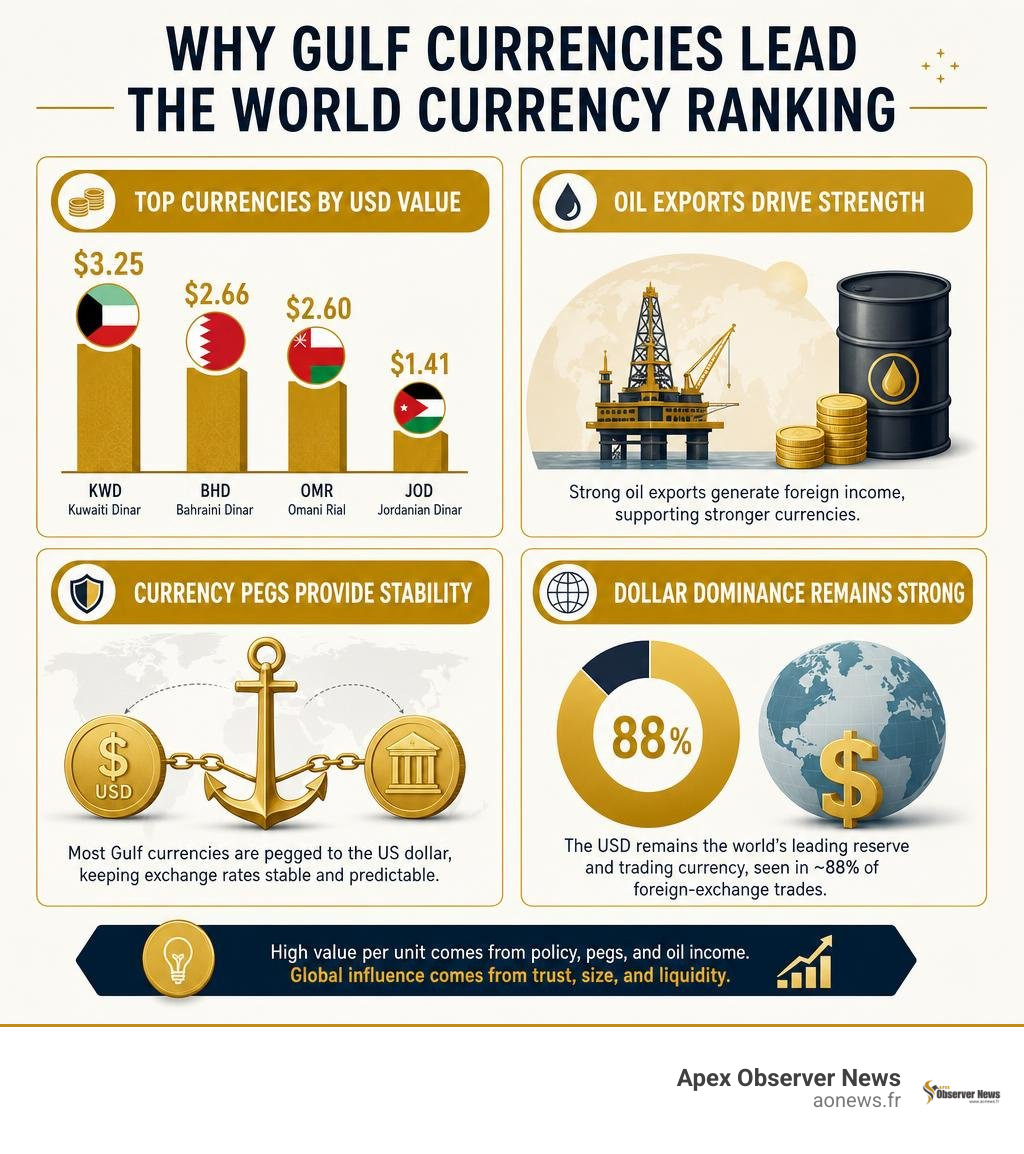
The 2026 world currency ranking list places the Kuwaiti dinar (KWD) first by nominal value: 1 KWD is worth about $3.25 USD. It is followed by the Bahraini dinar (BHD), Omani rial (OMR), and Jordanian dinar (JOD). Oil-export income, large foreign reserves, and exchange-rate pegs help these currencies stay high above the US dollar on a per-unit basis.
That does not mean the dollar is weak. The USD remains the world’s leading reserve and trading currency, appearing on roughly 88% of foreign-exchange trades. This list measures a narrower thing: how many US dollars one unit of another currency can buy.
I am Faisal S. Chughtai, founder of ActiveX and a digital marketing and SEO professional who turns complex financial and technology topics into clear guides. In this world currency ranking list, we will separate nominal value from stability, liquidity, and real global financial influence.
The Complete 2026 World Currency Ranking List by Value
When assessing a Currency purely on its face value against the US dollar, the results often surprise seasoned market observers. High nominal value does not necessarily reflect the absolute gross domestic product (GDP) of a nation. Instead, it is a mathematical reflection of monetary policy, unit denomination conventions, export strength, and currency pegs.
How to Get a Fully Funded Scholarship: Essential Top Opportunities
Below is the definitive ranking of the top 15 strongest currencies in the world as of August 2026, benchmarked directly against the US dollar:
| Rank | ISO Code | Currency Name | Issuing Country / Territory | Exchange Rate (USD Equivalent) | Exchange Rate Regime |
|---|---|---|---|---|---|
| 1 | KWD | Kuwaiti Dinar | Kuwait | ~$3.25 | Managed Basket Peg |
| 2 | BHD | Bahraini Dinar | Bahrain | ~$2.65 | Fixed USD Peg (1 BHD = $2.659 USD) |
| 3 | OMR | Omani Rial | Oman | ~$2.60 | Fixed USD Peg (1 OMR = $2.6008 USD) |
| 4 | JOD | Jordanian Dinar | Jordan | ~$1.41 | Fixed USD Peg (1 JOD = $1.41 USD) |
| 5 | GBP | British Pound Sterling | United Kingdom | ~$1.33 – $1.35 | Free-Floating |
| 6 | GIP | Gibraltar Pound | Gibraltar | ~$1.33 – $1.35 | 1:1 Parity Peg to GBP |
| 7 | CHF | Swiss Franc | Switzerland & Liechtenstein | ~$1.22 – $1.25 | Free-Floating |
| 8 | KYD | Cayman Islands Dollar | Cayman Islands | ~$1.20 | Fixed USD Peg (1 KYD = $1.20 USD) |
| 9 | EUR | Euro | Eurozone (21 Member States) | ~$1.14 – $1.16 | Free-Floating |
| 10 | USD | United States Dollar | United States | $1.00 (Benchmark) | Free-Floating |
| 11 | BND | Brunei Dollar | Brunei | ~$0.76 – $0.78 | 1:1 Peg to Singapore Dollar |
| 12 | SGD | Singapore Dollar | Singapore | ~$0.76 – $0.78 | Managed Currency Basket (S$NEER) |
| 13 | CAD | Canadian Dollar | Canada | ~$0.72 – $0.74 | Free-Floating |
| 14 | AUD | Australian Dollar | Australia | ~$0.66 – $0.67 | Free-Floating |
| 15 | NZD | New Zealand Dollar | New Zealand | ~$0.59 – $0.61 | Free-Floating |
Top Tier Powerhouses on the World Currency Ranking List
The top four spots on our global valuation board belong entirely to Middle Eastern nations. At the apex sits the Kuwaiti dinar (KWD), where a single dinar commands roughly $3.25 USD. Kuwait holds approximately 7% of proven global crude oil reserves, and petroleum products account for nearly 80% to 90% of state revenue. Backed by the Kuwait Investment Authority—one of the largest sovereign wealth funds in the world managing over $800 billion—Kuwait abandoned its pure USD peg in May 2007 in favor of an undisclosed currency basket. This policy shields the domestic economy from imported inflation while keeping the dinar exceptionally valuable.
Following closely behind are the Bahraini dinar (BHD) and the Omani rial (OMR). Bahrain has maintained a strict peg of 1 BHD to $2.659 USD since 2001, supported by offshore banking integration and petroleum exports. Oman has maintained its peg of 1 OMR to $2.6008 USD unchanged since 1986, demonstrating decades of monetary discipline.
Rounding out the top tier is the Jordanian dinar (JOD) at approximately $1.41 USD. Unlike its resource-rich neighbors, Jordan does not possess vast oil fields. Instead, the Central Bank of Jordan maintains a strict fixed peg to the US dollar to anchor investor confidence, minimize currency volatility, and attract vital cross-border capital. Understanding these monetary mechanisms is essential when Making Sense of Cents and Why Exchange Rates Keep Changing across global borders.
Major Global Reserves and Floating Currencies
Moving past the pegged powerhouses, the ranking introduces the world’s heavy-hitting floating currencies. The British pound sterling (GBP) is the oldest currency still in continuous circulation, dating back over 1,200 years to Anglo-Saxon England. Free of artificial pegs, sterling floats according to Bank of England interest rates, foreign investment, and UK macroeconomic health. Its statutory parity partners, including the Gibraltar pound (GIP), Falkland Islands pound, and Saint Helena pound, mirror its per-unit valuation.
The Swiss franc (CHF) trades around $1.24 USD and remains an undisputed safe haven. Backed by Switzerland’s massive gold reserves, political neutrality, low sovereign debt, and legal stability, the franc frequently surges during geopolitical turbulence.
The Euro (EUR) represents the joint economic output of 21 European Union member states, covering nearly 450 million citizens. A major shift occurred on January 1, 2026, when Bulgaria officially adopted the euro, phasing out the Bulgarian lev (BGN) at a conversion rate of 1 EUR = 1.95583 BGN. This expansion consolidated the Eurozone’s footprint, reinforcing the euro as the world’s second most traded currency.
Why Oil Wealth and Currency Pegs Dominate Nominal Value Over the US Dollar

Many observers wonder: If the United States possesses the world’s largest GDP, why does the US dollar rank 10th in nominal unit value?
The answer lies in the fundamental difference between nominal unit price and macroeconomic dominance. When a central bank defines the denomination of its currency, it creates an arbitrary baseline. If a country chooses to issue a small number of banknotes worth a large amount of purchasing power, its single unit will buy more foreign goods. That structural choice does not mean its economy is larger or healthier than an economy with a lower unit denomination (such as the Japanese yen, which trades at fractions of a cent per unit despite Japan being an economic superpower).
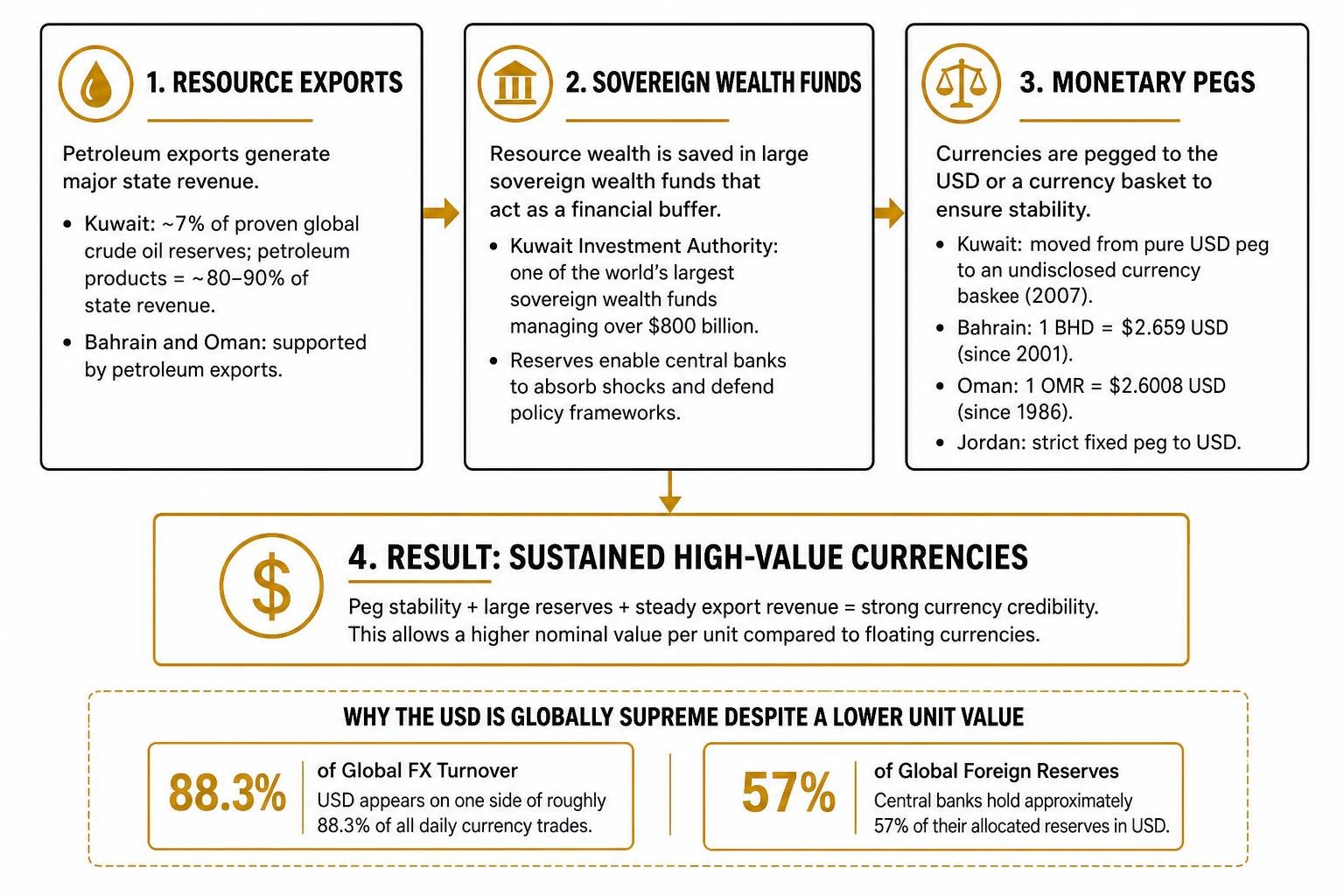
Gulf countries have deliberately paired high unit values with rigid peg frameworks. By pegging to the US dollar or currency baskets, resource-dependent nations eliminate foreign exchange risk for their oil sales, which are priced and settled globally in USD. Large sovereign wealth reserves act as an impenetrable financial buffer, allowing central banks to absorb market fluctuations and defend their peg ratios.
Conversely, the US dollar derives its undisputed global supremacy not from an inflated per-unit price, but from sheer market depth:
- 88.3% of Global FX Turnover: According to the Bank for International Settlements (BIS), the USD appears on one side of roughly 88.3% of all daily currency trades.
- 57% of Global Foreign Reserves: The International Monetary Fund (IMF) confirms that central banks hold approximately 57% of their allocated reserves in US dollars.
- Global Commodity Pricing: Global crude oil, metals, agricultural goods, and corporate debt issuance remain predominantly denominated in US dollars.
For businesses and treasuries navigating cross-border investments, understanding these underlying dynamics is as critical as knowing What Every Business Needs to Know About Debt Markets.
The Spectrum from Strongest to Weakest Currencies
Just as structural policy and commodity strength propel certain currencies to the top of the board, economic mismanagement, armed conflict, and sanctions can decimate currency purchasing power at the opposite end of the spectrum.
The Iranian rial (IRR) holds the rank of the weakest currency in the world, with operational open-market exchange rates exceeding 371,900 rials per US dollar. Reimposed international sanctions, severe geopolitical isolation, and domestic price inflation have crippled the currency’s external purchasing power.
Similarly, the Lebanese pound (LBP) has experienced severe depreciation following an ongoing sovereign banking collapse and debt default, wiping out the savings of local depositors.
When national monetary authorities print unrestricted quantities of local currency to finance budget deficits, hyperinflation sets in, eroding the value of the tender on official and secondary exchange markets. Traders frequently monitor parallel market valuations, as seen when the Dollar Edges Down Against Dong on Black Market trading corridors across developing economies.
Currency Stability, Safe Havens, and Global Trade Dynamics
When analyzing currencies, high exchange value must not be confused with market stability or liquidity. A currency like the Kuwaiti dinar is exceptionally valuable, but it is not easily traded or held in retail banks across the globe.
In foreign exchange markets, trading volume is concentrated heavily within the 7 major currency pairs:
- EUR/USD (The “Fiber” – accounting for nearly 25% of all daily trades)
- USD/JPY (The “Gopher”)
- GBP/USD (The “Cable”)
- USD/CHF (The “Swissie”)
- AUD/USD (The “Aussie”)
- USD/CAD (The “Loonie”)
- NZD/USD (The “Kiwi”)
Together, trades involving these primary pairs account for roughly 75% of total global forex market turnover.
While the Swiss franc remains the world’s most stable sovereign safe-haven asset due to disciplined monetary management by the Swiss National Bank, global commerce relies on diversified trade frameworks. Bilateral currency arrangements are continuously evolving as nations explore non-dollar settlement routes, a dynamic explored in detail in our breakdown where BRICS Currency Terms Demystified shows how emerging blocs re-engineer trade settlements. Similar strategic realignments emerge in Western trade discussions, as seen when the EU India Set for Historic Trade Deal Amid US Tariffs highlights the shifting currency demands of international supply chains.
Navigating Financial Decisions with the World Currency Ranking List
Understanding where currencies stand provides actionable value for everyday financial planning, corporate investments, and international wealth protection:
- International Travel Budgeting: Converting your domestic salary into high-value currencies like KWD, BHD, or GBP means your purchasing power is cut on paper. Budgeting for trips to Switzerland or the UK requires factoring in unfavorable conversion rates and premium local costs.
- Expatriate Compensation Packages: Professionals negotiating employment contracts in the Gulf region must evaluate whether salaries are denominated in local pegged currencies or foreign tender, as pegged stability guarantees consistent conversion value back to USD.
- Corporate Treasury Hedging: Importers and exporters must distinguish between floating currencies that demand forward derivative hedging (like EUR, GBP, or JPY) and stable fixed pegs where exchange risk is minimized.
- Asset Diversification: Holding capital across stable safe havens like the Swiss franc or gold-backed assets offers an effective hedge against domestic currency debasement.
Frequently Asked Questions About Currency Value and Strength
What is the strongest currency in the world in 2026?
The Kuwaiti dinar (KWD) is the strongest currency in the world, with a single unit trading at approximately $3.25 USD. Its value is sustained by massive petroleum revenues, substantial sovereign wealth reserves managed by the Kuwait Investment Authority, and a carefully managed currency basket peg.
Why does the US dollar rank tenth if it is the most powerful currency?
The US dollar ranks 10th purely in terms of nominal per-unit exchange value. Nominal value is simply a baseline unit measurement. The USD remains the most powerful and dominant currency on earth, representing roughly 88.3% of global foreign exchange market turnover and over 57% of all global foreign exchange reserves.
What is currently the weakest currency in the world?
The Iranian rial (IRR) and the Lebanese pound (LBP) are the weakest currencies in the world. The Iranian rial trades at operational rates exceeding 371,900 IRR per $1 USD due to international trade sanctions, structural hyperinflation, and persistent political unrest.
Conclusion
The global currency hierarchy reveals an intriguing contrast between nominal face value and macroeconomic power. While oil-backed dynamos like Kuwait, Bahrain, and Oman dominate the top of the per-unit exchange rate list through disciplined pegs and hydrocarbon exports, the US dollar, euro, and British pound provide the deep transactional liquidity that powers global commerce.
Whether you are managing multinational business liabilities, planning an overseas journey, or diversifying your long-term portfolio, tracking foreign exchange shifts is essential. For comprehensive macroeconomic analysis and continuous coverage of global financial markets, explore the complete Apex Observer News World Currency Rankings Guide to stay ahead of the latest currency developments.
The mysterious absence of bodies in Titanic’s wreckage
