

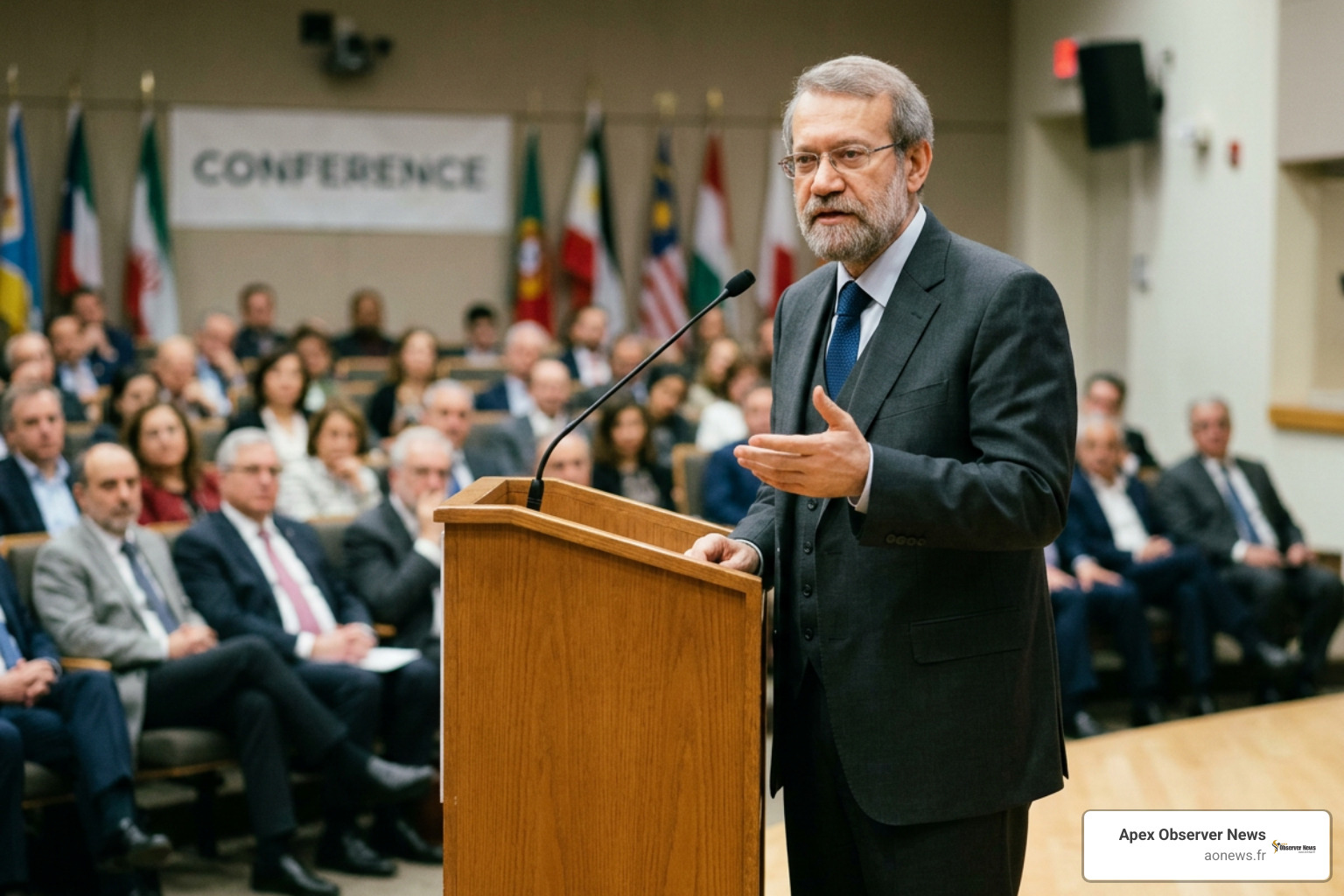
Who Was Ali Larijani and Why Did He Matter in Iran?
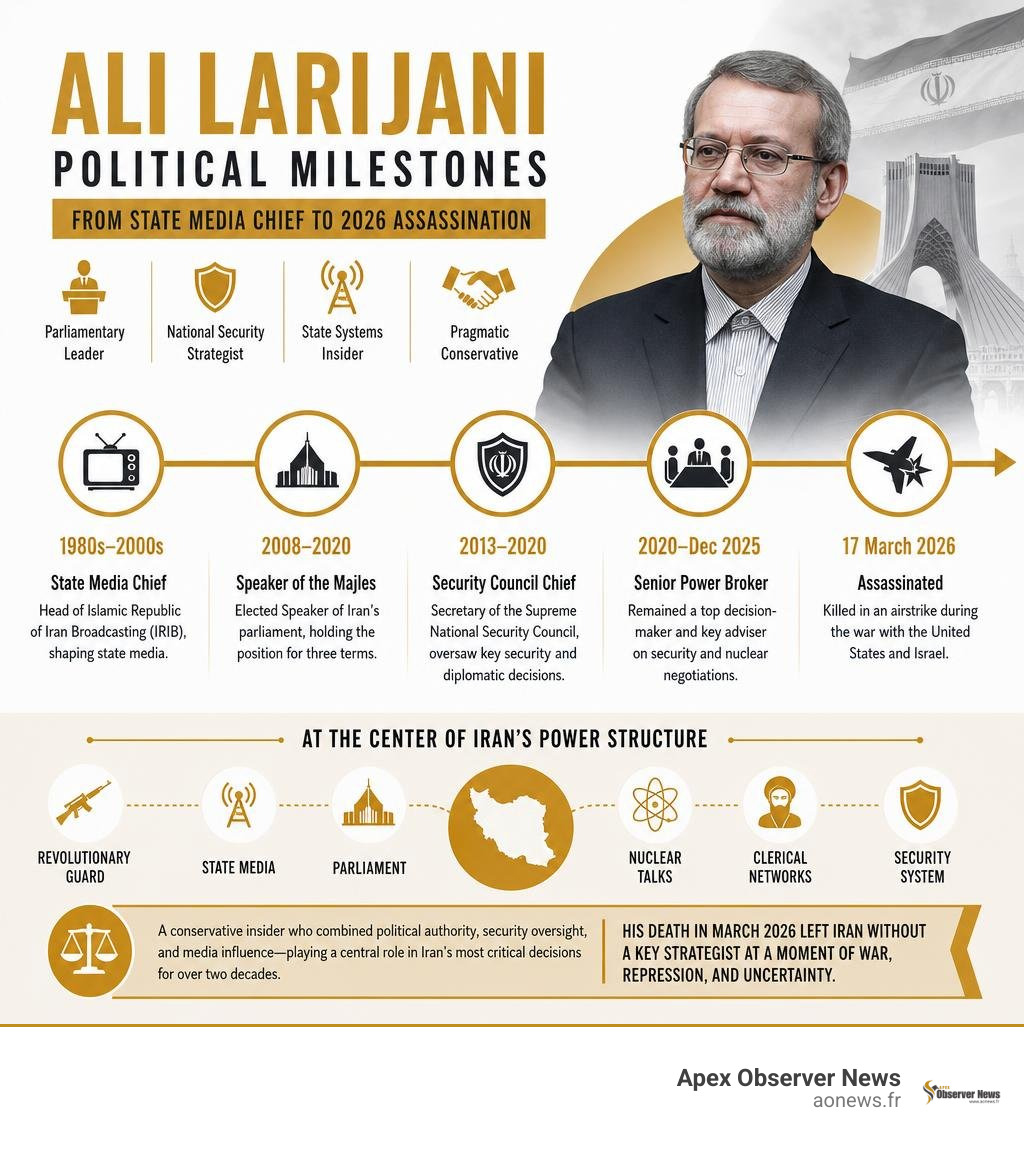
Ali Larijani was an Iranian politician, former parliamentary speaker, and national security official who became one of the country’s most influential insiders before he was assassinated in an airstrike on 17 March 2026.
- Key roles: Speaker of the Majles from 2008 to 2020, head of state broadcasting, and secretary of the Supreme National Security Council.
- Political standing: A conservative with a pragmatic approach to diplomacy and economic policy, but a hardline record on domestic dissent.
- Final period in power: He was widely described as Iran’s de facto leader from late December 2025 during the war with the United States and Israel.
- Legacy: His death removed a senior security strategist and negotiator at a moment of conflict, repression, and uncertainty in Iran.
Larijani’s career connected many of the biggest forces in modern Iranian politics: the Revolutionary Guard, state media, parliament, nuclear talks, powerful clerical networks, and the country’s security system. Understanding his rise helps explain both Iran’s wartime decision-making and the leadership vacuum that followed his killing.
I am Faisal S. Chughtai, founder of ActiveX and a digital researcher focused on making complex news, technology, and public-affairs topics easier to understand. In this guide, I break down Ali Larijani‘s political record and influence in clear, practical terms.
Ali larijani definitions:
Early Life, Philosophy, and Family Background
To understand how Ali Larijani navigated Iran’s complex power centers, we must first look at his intellectual background and family origins. Born in June 1957 (or 1958 according to international regulatory records) in Najaf, Iraq, Larijani grew up in an environment deeply steeped in Islamic scholarship and political influence. His father was Ayatollah Mirza Hashem Amoli, a high-ranking cleric who had taken refuge in Najaf before returning to Qom, Iran’s theological center.
Despite his traditional clerical lineage, Larijani chose an unorthodox academic path. He initially studied computer science and mathematics at Aryamehr University of Technology (now Sharif University of Technology), earning a B.S. degree. However, his life’s trajectory shifted when he met the influential Islamic scholar Morteza Motahhari. Following Motahhari’s guidance, Larijani switched his focus to Western philosophy. He married Motahhari’s daughter, Farideh Motahhari, at the age of 20, cementing his bond with the religious elite.
Larijani went on to obtain his Master’s degree and Ph.D. in Western philosophy from the University of Tehran. Remarkably, while serving in top military and intelligence roles, he published scholarly books analyzing complex Western thinkers, including German philosopher Immanuel Kant and modern analytic philosophers Saul Kripke and David Lewis. This rare blend of analytical scholarship and ideology earned him a reputation as an intellectual heavy in a political establishment dominated by traditional clerics and military generals.
| Life Phase / Role | Focus & Achievement | Institutional Impact |
|---|---|---|
| Academic Career | B.S. in Computer Science; Ph.D. in Western Philosophy | Published texts on Kant, Kripke, and Lewis |
| Early Security Service | Officer in the IRGC during Iran-Iraq War | Built deep ties within the military apparatus |
| Cultural Strategy | Minister of Culture; Head of IRIB (1994–2004) | Controlled state media narrative and propaganda |
| Parliamentary Leadership | Longest-serving Speaker of Majles (2008–2020) | Managed legislative priorities for 12 years |
| National Security | Secretary of SNSC (2005–2007; 2025–2026) | Directed wartime strategy and nuclear policy |
Ali Larijani and the ‘Kennedys of Iran’ Family Network
We cannot examine Larijani’s career without analyzing his powerful family ties. Frequently dubbed the “Kennedys of Iran” by international observers, the Larijani brothers formed one of the most powerful political dynasties in the Islamic Republic’s modern history.
Each brother occupied pivotal levers across Iran’s executive, legislative, judicial, and academic sectors:
- Sadeq Larijani: A senior cleric who served as the Head of the Iranian Judiciary (2009–2019) and later led the Expediency Discernment Council.
- Mohammad-Javad Larijani: A mathematician and diplomat who served as the Secretary-General of Iran’s High Council for Human Rights and international liaison for the judiciary.
- Fazel Larijani: A diplomat and academic official who represented Iran internationally as a cultural attaché.
- Mohammad-Baqer Larijani: A prominent medical academic who directed key university and medical administrative departments.
This formidable family network provided Ali Larijani with an unprecedented safety net and unmatched political access. Even when he faced bitter factional disputes with political rivals, his clan’s entrenched institutional power ensured he remained a vital fixture within state decision-making structures. For a deeper breakdown of his personal background and institutional appointments, you can consult the Ali Larijani Biography.
The Political Trajectory of Ali Larijani: Key Government Roles and Ideology
Larijani’s political ascent accelerated following the 1979 Islamic Revolution. He joined the Islamic Revolutionary Guard Corps (IRGC), serving in senior command roles during the bloody Iran-Iraq War. His transition into civil government occurred in 1992 when he was appointed Minister of Culture and Islamic Guidance.
In 1994, Supreme Leader Ayatollah Ali Khamenei appointed Larijani as the Director General of Islamic Republic of Iran Broadcasting (IRIB), a post he held for a decade until 2004. During his tenure at IRIB, Larijani transformed state broadcasting into an ideological megaphone. Under his leadership, state TV produced and broadcast controversial ideological programs such as Hoviyat (“Identity”), which broadcast forced prison confessions and targeted anti-regime intellectuals, dissidents, and secular writers.
His political footprint expanded dramatically when he served as Speaker of the Majles (Iranian Parliament) from 2008 to 2020. Holding the gavel for 12 consecutive years made him Iran’s longest-serving parliamentary speaker. In this role, he acted as a master bureaucrat, steering legislation, managing parliamentary rivalries, and bridging gaps between hardline clerics and pragmatic reformers. Those interested in his multifaceted rise as an influential regime insider can review the detailed analysis in Who was Ali Larijani, Iran’s unofficial strongman?.
Pragmatic Conservatism and Deng Xiaoping Economic Model
Throughout his career, Larijani belonged to the Principlist (conservative) camp, but political analysts frequently categorized him as a “pragmatic conservative.” Unlike radical populists, Larijani championed a strategic model inspired by China’s Deng Xiaoping.
This ideological framework emphasized:
- Economic Pragmatism: Opening Iran to foreign trade, negotiating international deals, and modernizing state infrastructure.
- Diplomatic Flexibility: Engaging in calculated talks with foreign adversaries, including European states and Asian powers, to mitigate sanctions.
- Strict Political Control: Uncompromising adherence to Velayat-e faqih (Guardianship of the Islamic Jurist) and complete suppression of domestic dissent.
Despite his deep loyalty to the Islamic Republic system, Larijani’s pragmatic approach caused friction with ultraconservative factions. When he ran in the 2005 Iranian presidential election, he finished sixth, securing just 5.94% of the vote (1,713,810 votes).
Years later, his rift with hardline groups culminated in a shock political dynamic: the Guardian Council disqualified Larijani from running in both the 2021 and 2024 presidential elections. Hardline institutions barred him due to his public critiques of rival figures like Ebrahim Raisi, clashes with IRGC commanders, and political rumors concerning his daughter residing in the United States.
De Facto Leadership, Protest Suppression, and Wartime Diplomacy
Despite his electoral disqualification, the regime turned back to Larijani when severe existential crisis struck. On 5 August 2025, President Masoud Pezeshkian appointed Larijani as Secretary of the Supreme National Security Council (SNSC)—a position Larijani had previously held from 2005 to 2007.
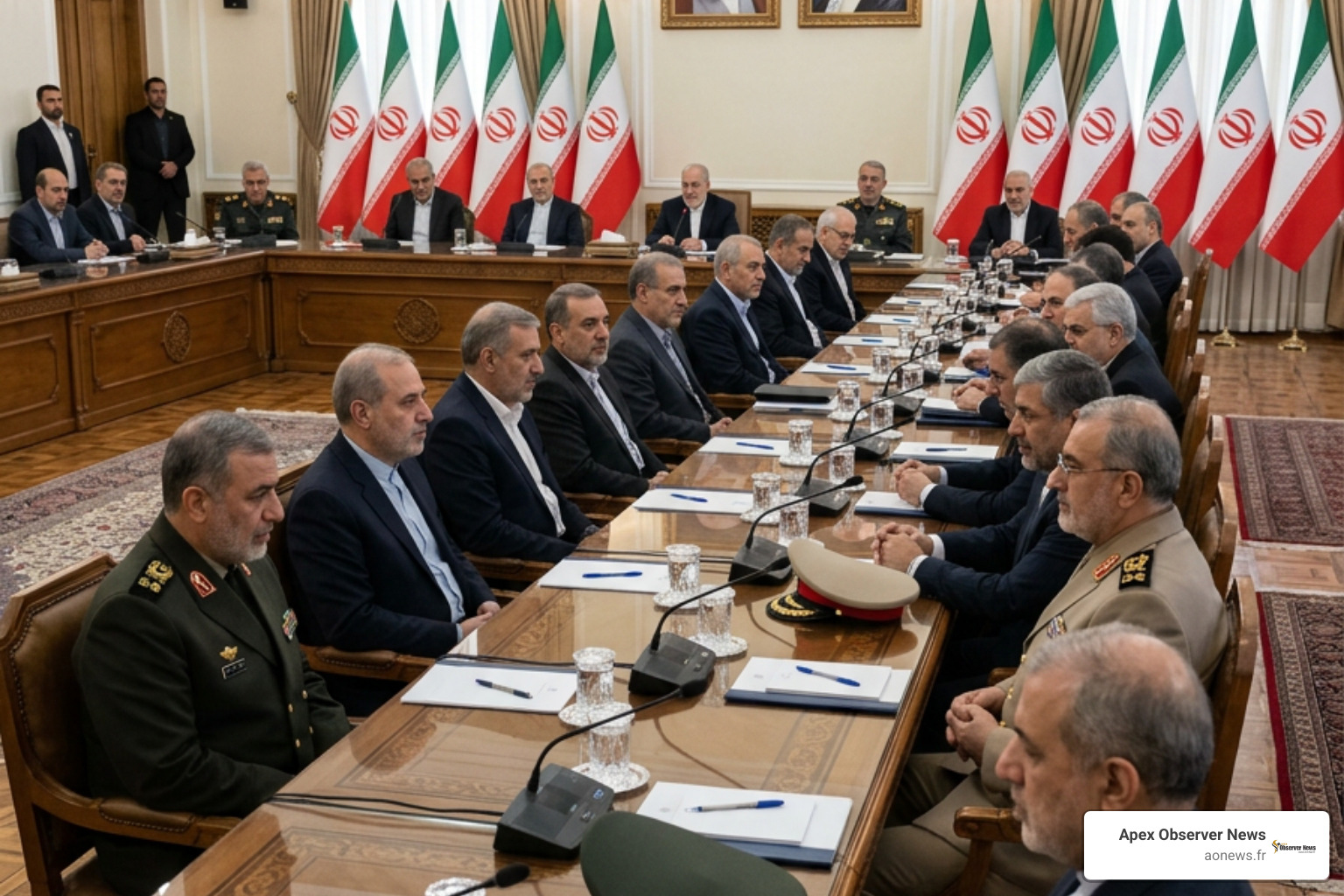
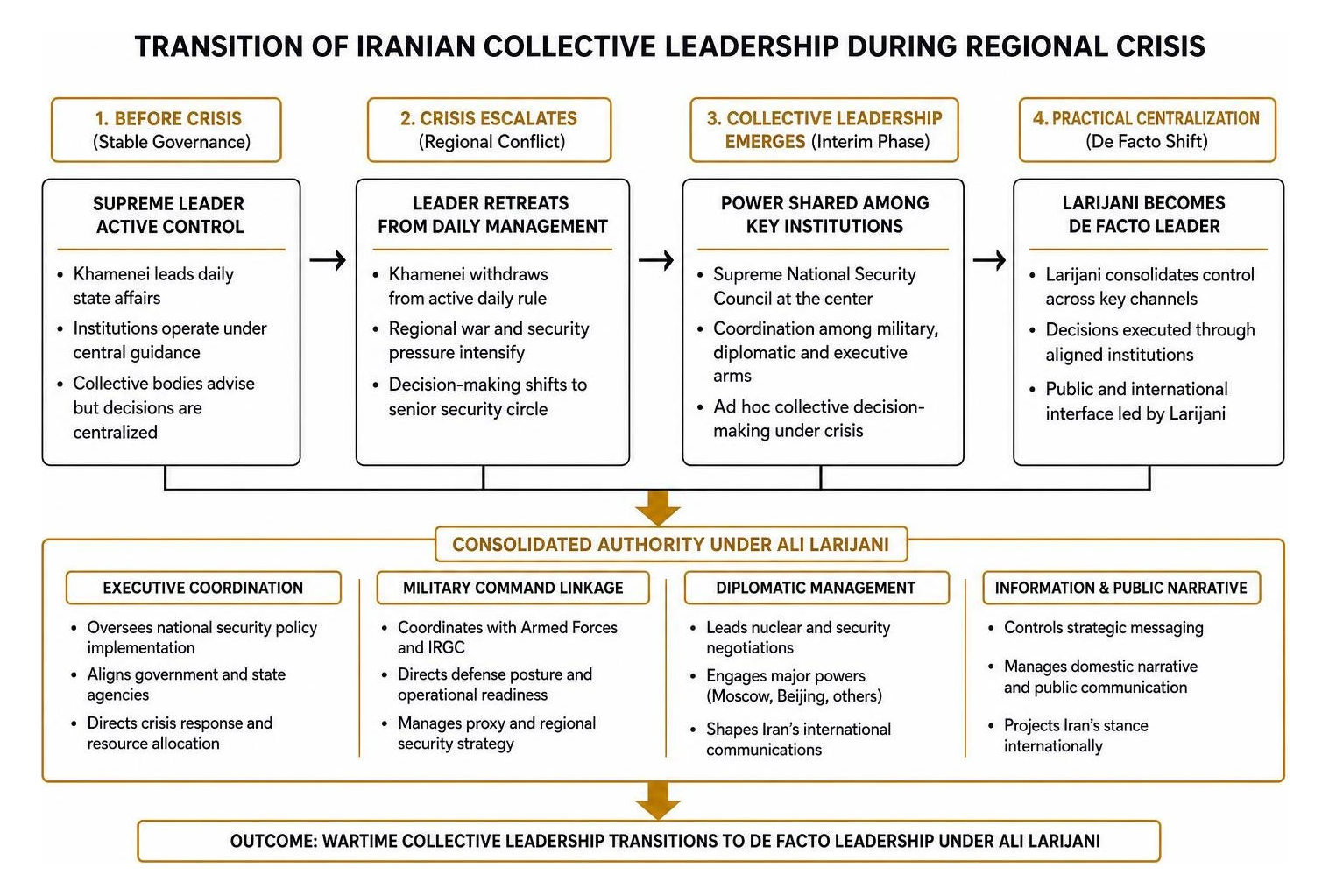
As Supreme Leader Ali Khamenei aged and withdrew from active daily governance amid escalating regional conflict, Iran transitioned toward a wartime collective leadership model. By 28 December 2025, Larijani had consolidated control across executive, military, and diplomatic channels, effectively operating as Iran’s de facto leader and public strongman.
Ali Larijani in Nuclear Negotiations and Security Strategy
During his earlier stint as chief nuclear negotiator (2005–2007), Larijani earned international recognition for his sharp, pragmatic negotiation tactics with Western powers. Although he initially criticized early concessions, he later played a key legislative role in facilitating the 2015 Joint Comprehensive Plan of Action (JCPOA) nuclear deal under President Hassan Rouhani. He was also instrumental in brokering the landmark 25-year, $400 billion strategic cooperation agreement with China.
When he reassumed command of the SNSC in August 2025, the geopolitical landscape was far more dangerous. With Iran’s regional proxy networks—including Hezbollah and Syrian logistics corridors—severely degraded by military strikes, Larijani identified the national nuclear program as Iran’s primary remaining deterrent lever. He coordinated defense mobilization while managing high-stakes diplomatic communications with Moscow and Beijing. You can read more about his strategic positioning during this crisis in the Al Jazeera Profile on Ali Larijani.
Crackdown on the 2025–2026 Protests and US Sanctions
While presenting a suave diplomatic face abroad, Larijani took a ruthless stance toward domestic unrest. During the widespread “January uprising” of 2026, driven by economic collapse and public anger, human rights organizations estimated that between 7,000 and 36,500 Iranian protesters were killed by security forces.
Multiple intelligence reports identified Larijani as the principal architect of this crackdown. Observers noted that he explicitly modeled the regime’s security response on China’s Tiananmen Square tactic—deploying overwhelming, indiscriminate military force to crush public protests before they could threaten state structures.
In response to his direct management of the violent suppression:
- US Sanctions: On 15 January 2026, the U.S. Department of the Treasury’s Office of Foreign Assets Control (OFAC) designated Larijani under human rights sanctions.
- International Listings: He was placed on Canadian autonomous sanctions lists and excluded from federal procurement frameworks due to his role in directing state violence.
Assassination in March 2026 and Strategic Aftermath
The intense crisis surrounding Larijani’s leadership reached a dramatic climax on the night between 16 March and 17 March 2026. At age 67, Larijani was killed in a targeted airstrike while meeting with military aides at a secret command hideout on the outskirts of eastern Tehran.
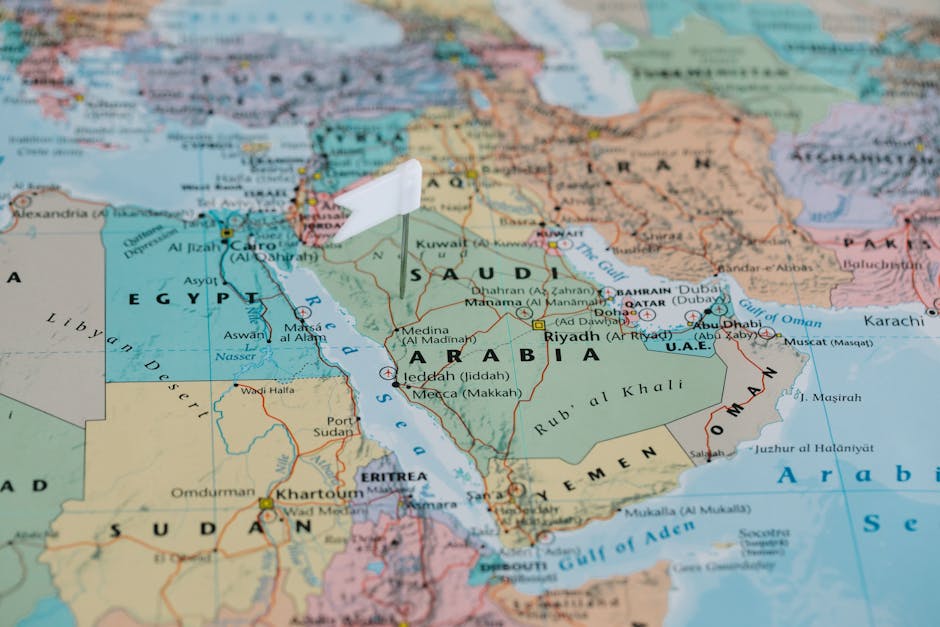
His sudden death sent shockwaves through Iran’s political and military establishment. An Iranian official reportedly described feeling physical terror upon confirming the news, realizing that foreign intelligence had penetrated the highest levels of the regime’s wartime hideouts. To examine his full biographical record and career timeline, review Ali Larijani on Wikipedia.
The immediate impact of Larijani’s assassination was profound:
- Strategic Leadership Vacuum: His death eliminated the primary bureaucrat capable of coordinating between clerical leaders, the IRGC military high command, and civil ministries.
- Loss of a Negotiator: As a pragmatic conservative who maintained functional diplomatic channels with China, Russia, and regional intermediaries, his absence removed the main figure capable of structuring a diplomatic exit strategy.
- Prolonged Regional Conflict: Geopolitical analysts emphasized that killing Iran’s top security strategist effectively locked the nation into an uncompromising, hardline war footing, complicating international efforts to achieve a ceasefire.
Frequently Asked Questions About Ali Larijani
Who was Ali Larijani and what were his main roles in Iran?
Ali Larijani was a senior Iranian politician, IRGC veteran, and scholar of Western philosophy. His major government roles included Director of IRIB (1994–2004), Speaker of the Majles (2008–2020), and Secretary of the Supreme National Security Council (2005–2007; 2025–2026).
How did Ali Larijani become Iran’s de facto leader in late 2025?
Following his appointment as SNSC Secretary in August 2025, Larijani filled a major operational power vacuum as Supreme Leader Khamenei withdrew from daily management during wartime. By late December 2025, Larijani managed military defense, domestic security, and foreign relations, making him Iran’s de facto operational leader.
How did the assassination of Ali Larijani impact the war with the US and Israel?
Larijani’s death removed Iran’s most experienced strategic coordinator and negotiator. His loss created a leadership vacuum within Tehran’s security apparatus, empowering ultraconservative military figures and prolonging the ongoing war by eliminating a key channel for diplomatic negotiation.
Conclusion
The political journey of Ali Larijani reflects the broader history of the Islamic Republic over the past four decades. From his beginnings as an academic studying Western philosophy to his roles as state media controller, parliamentary leader, and wartime strongman, Larijani consistently demonstrated a rare balance between ideological hardline control and pragmatic statecraft.
His death in March 2026 marked the end of an era for Iran’s political elite. By eliminating the chief architect of the regime’s wartime strategy and its most capable diplomatic negotiator, his assassination left a deep vacuum in Tehran. As we monitor regional developments at Apex Observer News, Larijani’s legacy remains a key reference point for understanding Iran’s domestic security policies, nuclear ambitions, and internal power struggles.
For more real-time coverage and analyses on global politics, security, and world events, visit our dedicated coverage hub at Apex Observer News Trends.
