

What Is a Freelance Business Consultant and What Do They Do?
A freelance business consultant is an independent professional who works with organizations to diagnose operational friction, uncover market gaps, and implement scalable growth strategies. Unlike traditional full-time hires, an independent advisor steps into an enterprise with fresh, objective eyes to tackle immediate challenges—such as optimizing supply chains, auditing financial systems, or launching a new product line—within a clearly defined project scope.
Daily work involves conducting operational audits, facilitating executive workshops, mapping standard operating procedures (SOPs), and analyzing key performance metrics. Through services like Business Consulting services and strategic advisory, these independent experts bridge the gap between high-level executive vision and tactical execution.
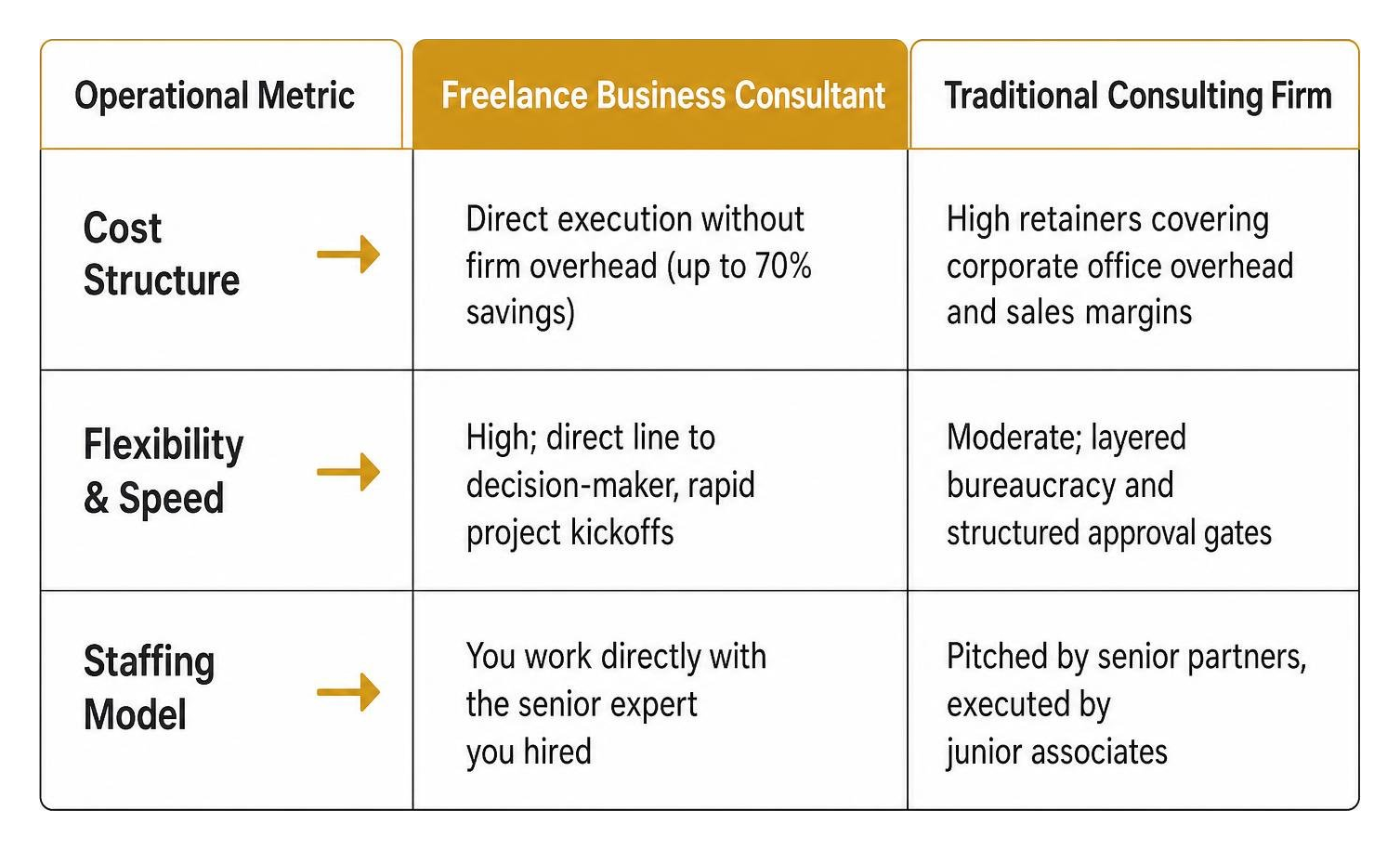
| Operational Metric | Freelance Business Consultant | Traditional Consulting Firm |
|---|---|---|
| Cost Structure | Direct execution without firm overhead (up to 70% savings) | High retainers covering corporate office overhead and sales margins |
| Flexibility & Speed | High; direct line to decision-maker, rapid project kickoffs | Moderate; layered bureaucracy and structured approval gates |
| Staffing Model | You work directly with the senior expert you hired | Pitched by senior partners, executed by junior associates |
| Project Focus | Highly targeted, outcome-oriented project delivery | Framework-heavy with incentives for firm “land and expand” strategies |
To see how these fundamental advisory concepts intersect with broad management practices, explore The Best Business Articles Examples You Should Read Today.
Freelance vs. Fractional Consulting: Key Differences
While both models operate outside standard corporate employment, the difference lies in integration and duration. A freelance business consultant is typically brought in as a project-based fixer to deliver a specific output within a pre-agreed timeframe—such as drafting an expansion plan or auditing software workflows.
Conversely, fractional leadership involves long-term, part-time integration into a company’s executive apparatus. A fractional COO or CFO acts as an in-house leader for months or years at a time, taking responsibility for ongoing team management and board-level strategy without the company absorbing a full-time executive salary package.
Pros and Cons of Hiring Independent Consultants
Choosing an independent advisor offers compelling financial and operational advantages:
- Up to 70% Cost Reduction: Businesses eliminate firm profit margins, corporate office overhead, and full-time employee benefits packages.
- Direct Outcome Focus: Independent experts focus entirely on solving the target problem rather than pushing upsells.
- Specialized Niche Knowledge: Companies can hire experts tailored precisely to their vertical, such as specialized DTC logistics or healthcare compliance.
- Agility: Onboarding happens in days rather than months, accelerating project momentum.
The trade-offs? Independent practitioners have finite bandwidth, meaning they cannot deploy massive junior analyst teams overnight. Furthermore, businesses must carefully vet individual portfolios rather than relying on a big-brand agency name.
Pricing Strategies: How Much Do Consultants Charge?
Pricing a consulting practice requires shifting from trading hours for dollars to pricing based on business impact. While Glassdoor reports average annual earnings of $79,454 for general independent consultants, top-tier strategy, finance, and operational advisors earn well into six figures.
A baseline formula for entry-level rate setting is the Wage Multiplier Formula: calculate the hourly rate of an equivalent full-time employee and multiply it by three. This multiplier covers essential self-employment costs:
- Non-billable administrative hours (sales, marketing, accounting).
- Overhead expenses (software, legal, insurance, office gear).
- Personal benefits (health insurance, retirement contributions, paid time off).
For example, if an in-house director earns $60/hour, your standard consulting baseline starts at $180/hour. High-stakes advisory—such as M&A prep or rapid turnaround turnarounds—commands premium hourly rates ranging from $500 to $1,000+.
Hourly, Retainer, and Project-Based Pricing Models
Selecting the right pricing architecture protects profit margins and sets clear expectations:
- Hourly Billing: Ideal for discovery phases or open-ended strategic support where scope is fluid. However, it can penalize efficiency.
- Project-Based Pricing: A fixed price for a defined outcome (e.g., $15,000 to audit and redesign an operational workflow). This rewards speed and expertise while simplifying client budgeting.
- Monthly Retainers: A recurring fee (e.g., $5,000/month) for ongoing strategic access or fractional oversight. Retainers provide predictable cash flow and set clear boundary limits for scope control.
How to Become a Freelance Business Consultant: Step-by-Step

Building a practice requires transitioning from an employee mindset to an enterprise mindset. Before pitching services, you need a firm administrative framework to protect personal assets and maintain legal compliance.
Step-by-Step Guide to Becoming a Freelance Business Consultant
- Define Your Specialized Niche: Rather than acting as a generalist, focus on target business problems (e.g., operational efficiency for local service businesses or go-to-market strategies for SaaS platforms).
- Setup Your Legal Entity: Register as an LLC (Limited Liability Company) or S-Corp to isolate business liability from personal wealth.
- Register for an EIN and Separate Banking: Obtain an Employer Identification Number from the IRS and set up a dedicated business bank account and credit card. Never mix personal and business finances.
- Prepare for Self-Employment Taxes: In the US, self-employed individuals pay a 15.3% self-employment tax (covering Social Security and Medicare) alongside standard income taxes. Set aside 30% of gross revenue into a tax reserve account for quarterly estimated tax payments.
- Establish Your Digital Infrastructure: Create a clean website, secure a custom domain email address, and assemble case studies demonstrating real past business outcomes.
- Execute Target Outreach: Draft clear, problem-focused pitch proposals and tap your professional network to land anchor clients.
To align your foundational setup with broader strategy frameworks, review The Ultimate Guide to Business Planning.
Key Skills Every Freelance Business Consultant Needs
Technical expertise alone will not sustain a solo practice. Sustainable success requires a balance of operational, analytical, and interpersonal capabilities:
- Analytical & Systems Thinking: The ability to look past surface symptoms to diagnose root structural bottlenecks.
- Financial Literacy: Mastery of margin analysis, cash flow forecasting, and unit economics.
- Adaptability & Positivity: Navigating client organizational pushback with diplomatic patience.
- Client Relationship Management: Establishing realistic project boundaries, setting clear communication rhythms, and maintaining complete transparency.
For a broader evaluation of necessary commercial competencies, check out The Complete List of Entrepreneurship Skills.
Pitching and Client Acquisition Strategies

Finding clients requires proactive business development rather than passive waiting. Successful practitioners maintain a rolling pipeline using multiple acquisition channels.
Early-stage consultants can leverage curated talent platforms like Best Freelance Business Consultants for Hire (Aug 2026) to build momentum and secure verified client reviews. Concurrently, tapping existing professional networks often yields initial project leads.
Building Thought Leadership and Authority
To attract premium clients inbound, position yourself as a subject matter expert:
- Publish Practical Case Studies: Write breakdown articles analyzing how you solved a specific business bottleneck and achieved measurable ROI (e.g., “How We Reduced Operating Costs by 25% in 90 Days”).
- Engage in Strategic Networking: Join regional commercial groups, speak at niche virtual summits, and maintain an active presence on professional platforms like LinkedIn.
- Produce Domain Content: Share actionable frameworks regularly. Guidance resources like The Strategic Guide to Using AI in Your Business Today demonstrate how staying updated on modern tools enhances client deliverables.
If you are looking for real-world positioning reference points across distinct verticals, review practitioner models like Fisk Consulting | Business Consultant for Service Founders, Business & Finance Consulting – Eric Frazier, Pedro Paulo Business Consultant – Strategic Solutions for Business Growth, Business & Marketing Consulting for Entrepreneurs | Brandi Gordon, Crista Freeman – Fractional COO/CFO, and Lyndsey Wray | Independent Chartered Management Consultant – Lyndsey Wray Consultancy. For actionable launch blueprints, refer to guides like The Ultimate Guide To Becoming A Freelance Consultant.
Common Mistakes to Avoid When Starting a Consulting Practice
Transitioning to independent work presents common operational traps that can derail revenue and cause burnout:
- Scope Creep: Accepting additional client requests without issuing formal change orders. Always define explicit deliverables in your master services agreement (MSA) and bill for additional requests.
- Underpricing Services: Charging low hourly rates out of fear of rejection. Underpricing signals low quality and leaves zero margin for non-billable administrative time.
- Co-mingling Business and Personal Finances: Using a single bank account creates severe legal tax liabilities and complicates expense auditing.
- Lack of Operating Systems: Running engagements on adrenaline rather than structured workflows. Use repeatable intake forms, weekly metrics scorecards, and standardized project templates.
- Neglecting Pipeline Development: Stopping all sales and networking outreach while fully booked on a project, leading to revenue drop-offs once the contract ends.
To review foundational risk management frameworks, study the Introduction to Entrepreneurship Survival Guide.
Frequently Asked Questions About Freelance Consulting
How much do freelance business consultants earn on average?
The average annual salary for general independent consultants sits around $79,454 according to Glassdoor data. However, earnings vary widely by field; specialized IT, strategy, and operational consultants with proven track records routinely cross six figures, earning between $120,000 and $250,000+ annually.
What is the difference between a consultant and a contractor?
A contractor is hired primarily for tactical execution—performing specific day-to-day tasks directed by in-house management. A consultant provides high-level strategic oversight, diagnosing systemic issues, proposing custom strategies, and guiding leadership on how to implement long-term solutions independently.
How long does it take to establish a profitable freelance consulting practice?
Plan for a minimum 12-month commitment. The first 3 to 6 months focus on business setup, positioning, and securing anchor clients. Months 6 through 12 usually bring client referrals, repeat engagements, and steady revenue stability.
Conclusion
Building a successful practice as a freelance business consultant combines deep functional expertise with sound business management. By establishing clear legal structures, setting prices based on value outcomes, avoiding common operational traps, and maintaining a consistent client pipeline, independent advisors can build high-earning, scalable practices.
As market dynamics favor agility and specialized skill sets, independent advisory remains one of the most rewarding career moves for experienced industry professionals. To continue building your toolkit, explore our comprehensive Apex Observer News freelancing hub.
