

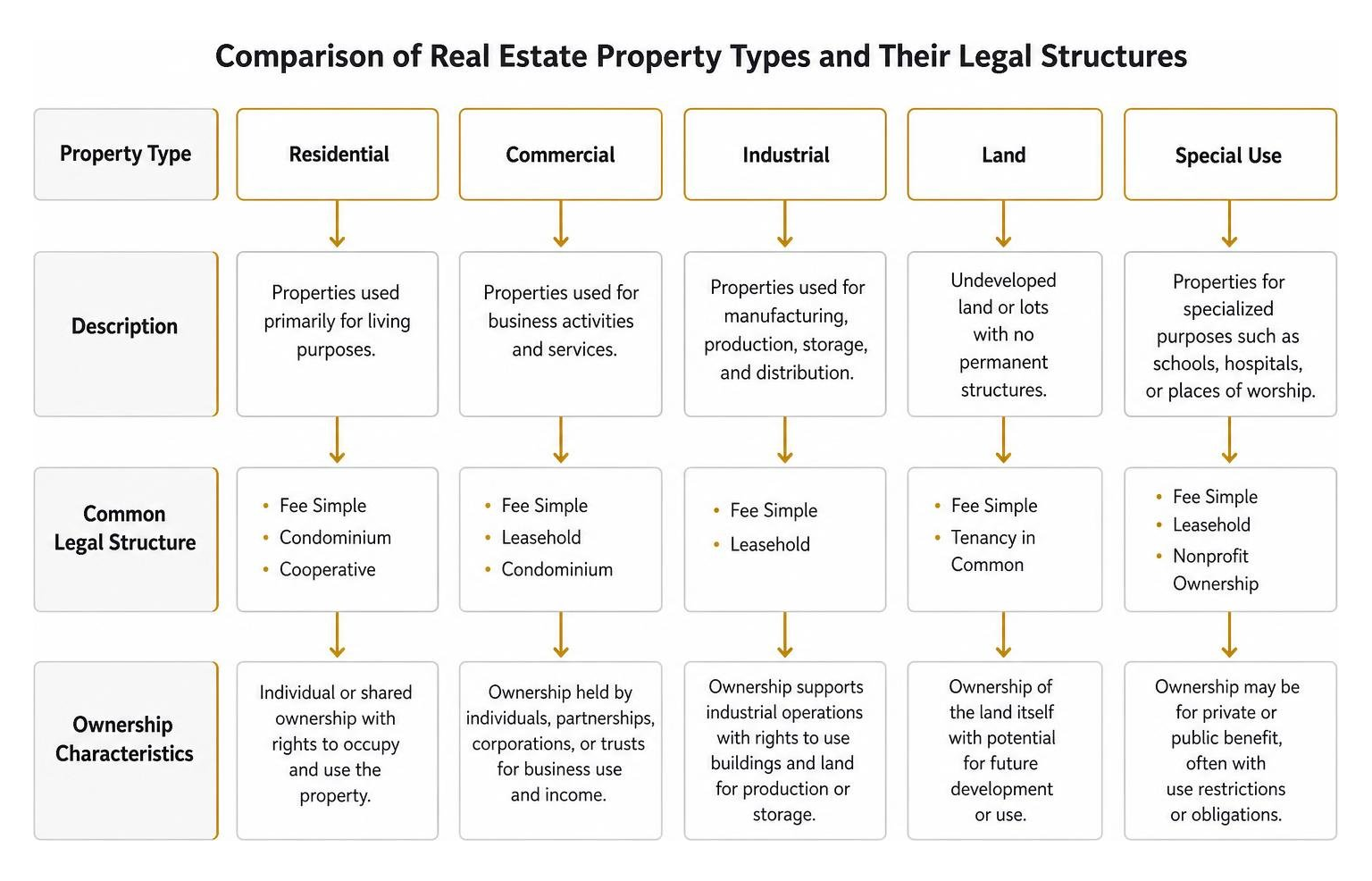
Defining Real Estate and Its Core Categories
At its simplest, real estate encompasses physical land, anything built upon it, and the natural resources permanently tied to it, such as crops, minerals, and water. Legally, the defining characteristic of real estate is its status as immovable property. You can review the basic legal and conceptual definitions on the Real estate – Wikipedia page.
To understand property rights, it helps to distinguish real estate from personal property. Personal property includes items not permanently attached to the land—such as vehicles, furniture, tools, and appliances. While personal property moves with you when you relocate, real estate remains fixed in place. For more details on industry structures, check out our section on real estate services.
Residential Property Varieties
Residential real estate comes in many forms to suit different lifestyles, budgets, and family sizes:
- Single-family homes: Detached houses built for one family unit, offering private yards and full ownership of both the building and the land beneath it.
- Multi-unit dwellings: Structures containing multiple separate living spaces, such as duplexes, triplexes, or apartment buildings.
- Condominiums (Condos): Individually owned units inside a shared building or complex. Owners hold title to their interior space while sharing ownership of common elements like lobbies, roofs, and pools.
- Townhomes: Multi-story homes that share one or two walls with adjacent properties but typically include individual ownership of the ground beneath the unit.
- Housing Cooperatives (Co-ops): Residential structures where residents do not own their physical units directly; instead, they purchase shares in a corporation that owns the entire property, which grants them a lease for their specific apartment.
Freelance SEO Consultant Rates: What You Should Expect to Pay
According to data from the Congressional Research Service, 65% of homes in the U.S. were owner-occupied in 2021, underscoring the enduring appeal of residential property ownership.
The Historical Evolution of the Industry
The legal foundation of modern land rights traces back to Roman legal concepts of property and Greek philosophy. Historically, land ownership was tied directly to sovereign authority or feudal systems before evolving into private ownership rights.
In American history, land acquisition dramatically reshaped the nation. The Louisiana Purchase of 1803 stands out as one of the largest property transactions in history: the U.S. acquired roughly 828,000 square miles from France for $15 million, which translates to approximately 4 cents per acre.

Economic cycles have also defined the sector’s history. Following the stock market crash of 1929, real estate values experienced a severe contraction, depreciating by roughly 50% over a four-year period during the Great Depression. Decades later, federal legislation transformed access to housing: the Fair Housing Act of 1968 (Title VIII of the Civil Rights Act) prohibited housing discrimination based on race, color, religion, or national origin.
The Historical Evolution of Real Estate
Professional organization played a crucial role in shaping modern transactions. The National Association of Realtors (NAR) was originally founded in 1908 as the National Association of Real Estate Boards. In 1916, the organization coined the term “realtor” to identify licensed members bound by a strict code of ethics.
To help stabilize housing finance after the Great Depression, the U.S. government created Fannie Mae in 1938, providing critical liquidity to the secondary mortgage market. You can explore more historical background in our tag on real estate history.
Navigating Modern Platforms and Professional Regulations
Today’s home search process relies heavily on digital aggregate platforms. Portals such as Zillow: Real Estate, Apartments, Mortgages & Home Values, Realtor.com®, and Redfin | Real Estate & Homes for Sale, Rentals, Mortgages & Agents aggregate thousands of listings across regions.
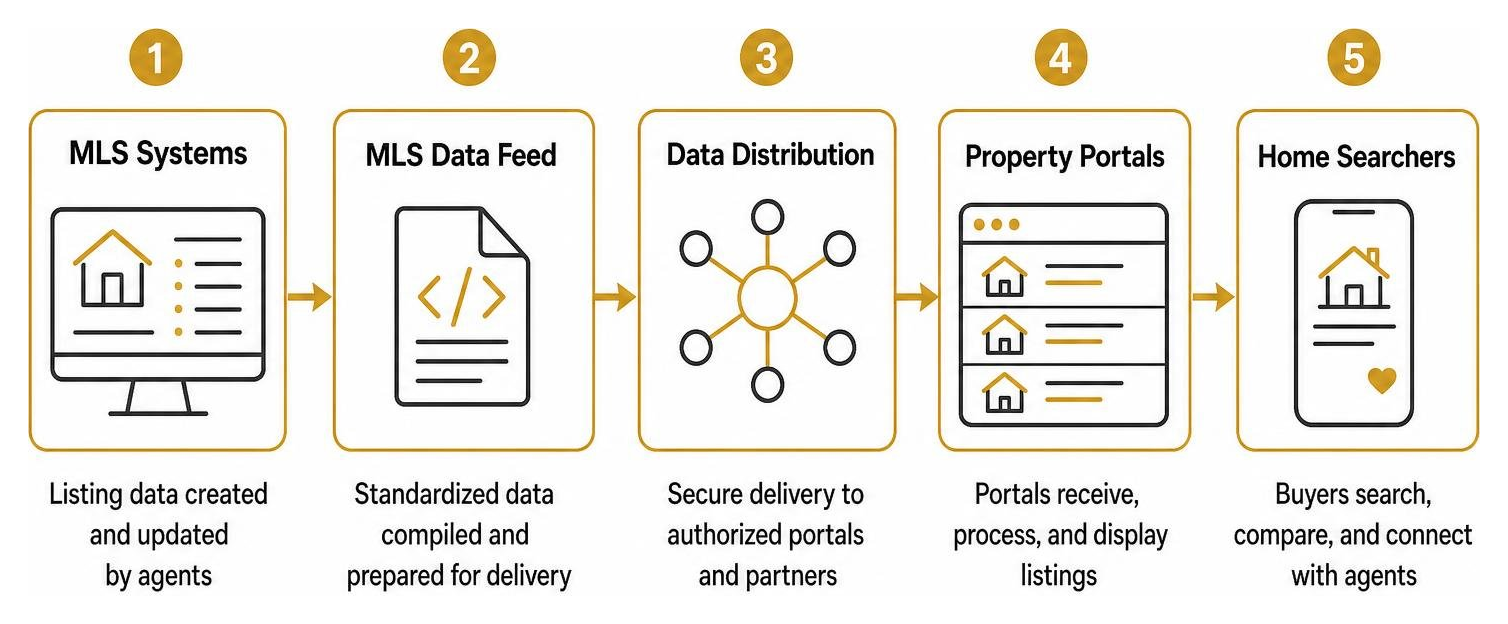
These platforms leverage direct feed integrations and Multiple Listing Service (MLS) agreements to maintain listing accuracy. Platforms like Zillow deliver personalized home recommendations based on search filters, location data, and saved properties, while Redfin offers tech-enabled brokerages with low-fee listing options.
State regulatory authorities protect consumers throughout these digital transactions. For instance, the California Department of Real Estate (DRE) safeguards public interests through licensing, regulatory enforcement, consumer alerts, and education. DRE provides public license verification tools to help buyers and sellers confirm an agent’s standing before signing agreements. Discover additional context on current market dynamics in our tag on housing market trends.
The Role of Technology in Modern Real Estate
Proptech has evolved rapidly since online listings emerged in 1999. Today, artificial intelligence aids in property valuation, automated customer assistance, and market forecasting. State regulators like the California DRE regularly publish advisories on AI integration to ensure consumer data privacy and ethical compliance.

However, digital listings bring new ethical dilemmas. The widespread use of digital photo editing in listings—such as digitally adding flames to a non-functional or disconnected fireplace—can mislead buyers. While minor adjustments like enhancing lighting are standard practice, altering physical property flaws can cross into misrepresentation. Buyers should always cross-reference photos against independent professional inspection reports. Learn more about technological shifts in urban housing via our resource on smart city technology.
Market Trends, Investment Strategies, and Environmental Impact
As we navigate 2026, global real estate markets reflect shifting economic signals. In Canada, home sales saw quiet activity in early 2026, though signs of a spring recovery have begun to emerge. The Bank of Canada kept its policy interest rate at 2.25% in its March 2026 update, stabilizing borrowing costs for buyers.
Investors evaluate several pathways for acquiring assets. While creating a separate Limited Liability Company (LLC) for each rental property offers liability protection, managing multiple entities across states creates substantial administrative hurdles, including annual filings, tax filings, and legal fees. Alternative vehicles like Real Estate Investment Trusts (REITs) offer liquid exposure to real estate without property management burdens. Check out our guide on REITs as investment weapons and explore broader opportunities under our tag for real estate investment.
Investors seeking distressed assets often use specialized platforms like Foreclosed Homes & Great Deals in Real Estate | RealtyTrac to locate pre-foreclosures, auctions, and bank-owned properties.
| Investment Structure | Primary Benefit | Administrative Burden | Asset Liquidity |
|---|---|---|---|
| Individual LLC per Property | Maximum asset isolation & personal asset protection | High (multiple state filings, tax returns, fees) | Low (requires traditional sales process) |
| Single Umbrella LLC | Centralized management for multiple units | Moderate (one legal entity to manage) | Low |
| Real Estate Investment Trusts (REITs) | High dividend yield & instant diversification | Low (handled like standard stock transactions) | High (traded on major stock exchanges) |
Beyond economics, real estate plays a critical role in global environmental sustainability. According to the International Energy Agency, real estate accounted for 39% of total global carbon emissions in 2019, with 11% resulting directly from the manufacturing of building materials. This footprint has sparked growing demand for green development, sustainable site assessments (ESAs), and energy-efficient building standards worldwide.
Global and Regional Market Insights
Market dynamics vary significantly by location:
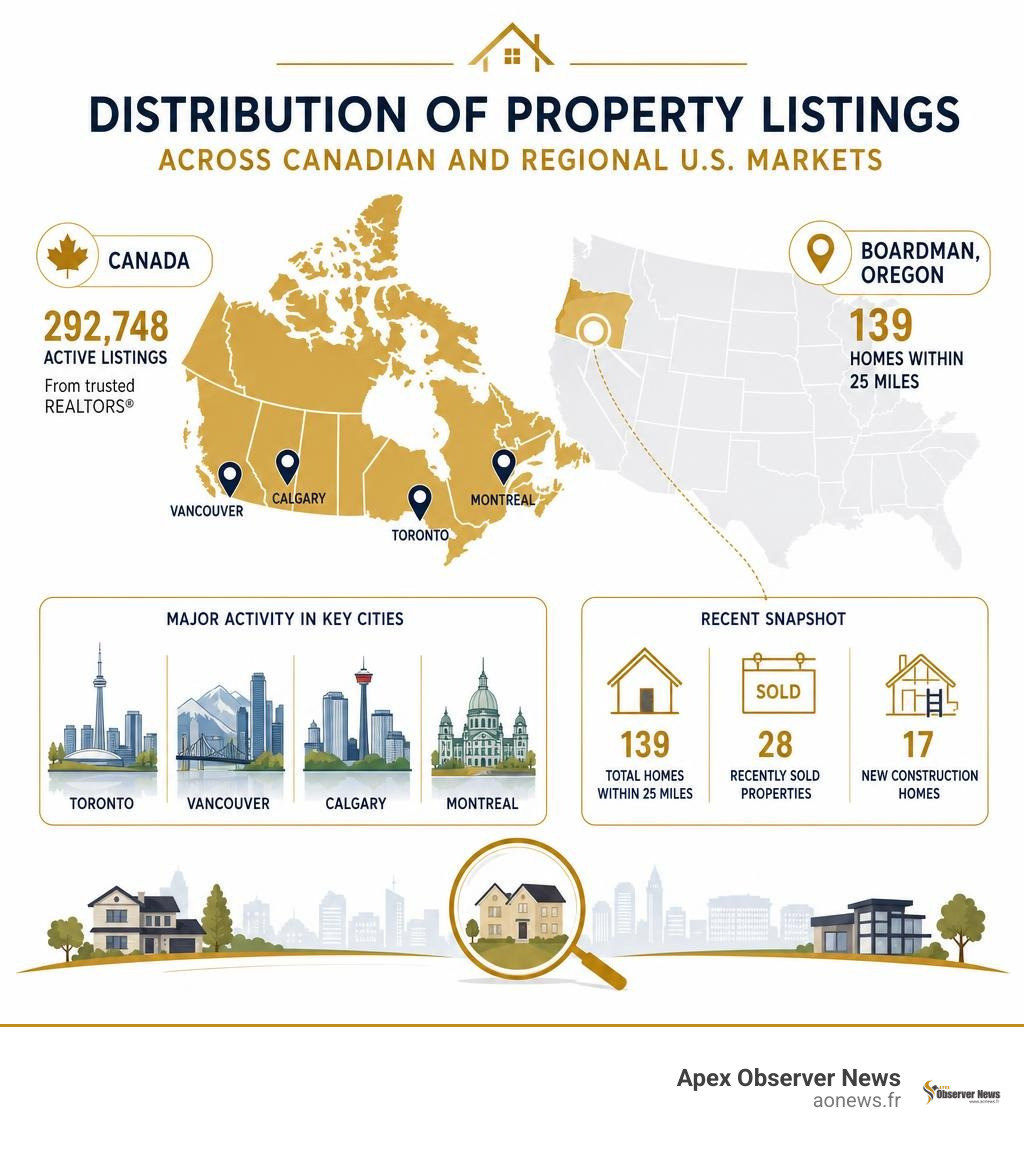
- Canada: Property portals feature around 292,748 active listings from trusted REALTORS®, with major activity centered in cities like Toronto, Vancouver, Calgary, and Montreal.
- Boardman, Oregon: Regional micro-markets display hyper-local activity, with recent snapshots showing 139 homes within 25 miles, including 28 recently sold properties and 17 new construction units.
Frequently Asked Questions

How do I verify a real estate license?
You can verify a practitioner’s license by accessing your state or provincial real estate licensing board’s official website (such as the California Department of Real Estate verification tool). Enter the agent’s name or license number to check their status, license history, and any past disciplinary actions.
What is the difference between an agent and a REALTOR®?
A real estate agent is a licensed professional authorized to assist buyers and sellers in real estate transactions. A REALTOR® is a licensed agent or broker who is an active member of the National Association of Realtors (NAR) or the Canadian Real Estate Association (CREA) and is bound by a strict formal Code of Ethics.
Are “we buy houses” companies a scam?
“We buy houses” companies are generally legitimate businesses operating as direct real estate investors, but they are not right for everyone. They purchase homes “as-is” for fast cash, which benefits sellers facing foreclosure or severe structural repairs. However, their offers typically fall $50,000 to $70,000 below market value compared to standard listing prices.
Conclusion
Navigating real estate requires understanding the distinct roles played by market platforms, legal frameworks, economic trends, and professional standards. Whether you are searching for your first single-family home, analyzing mortgage rates, or exploring investment structures, staying informed is essential to making sound decisions.
At Apex Observer News, we track major developments across real estate, finance, technology, and global markets. Explore our complete media coverage and latest updates by visiting our dedicated hub for global news.
