


ASTS Stock: A High-Risk Bet on Satellite-to-Phone Service
ASTS stock offers investors a direct way to invest in AST SpaceMobile’s plan to connect ordinary smartphones to satellites, without a special dish or new handset. The quick take: it is a high-risk, high-expectation growth stock. The company has promising carrier partnerships, a $1.3 billion backlog, and major launch and regulatory milestones ahead, but it is still spending far more than it earns.
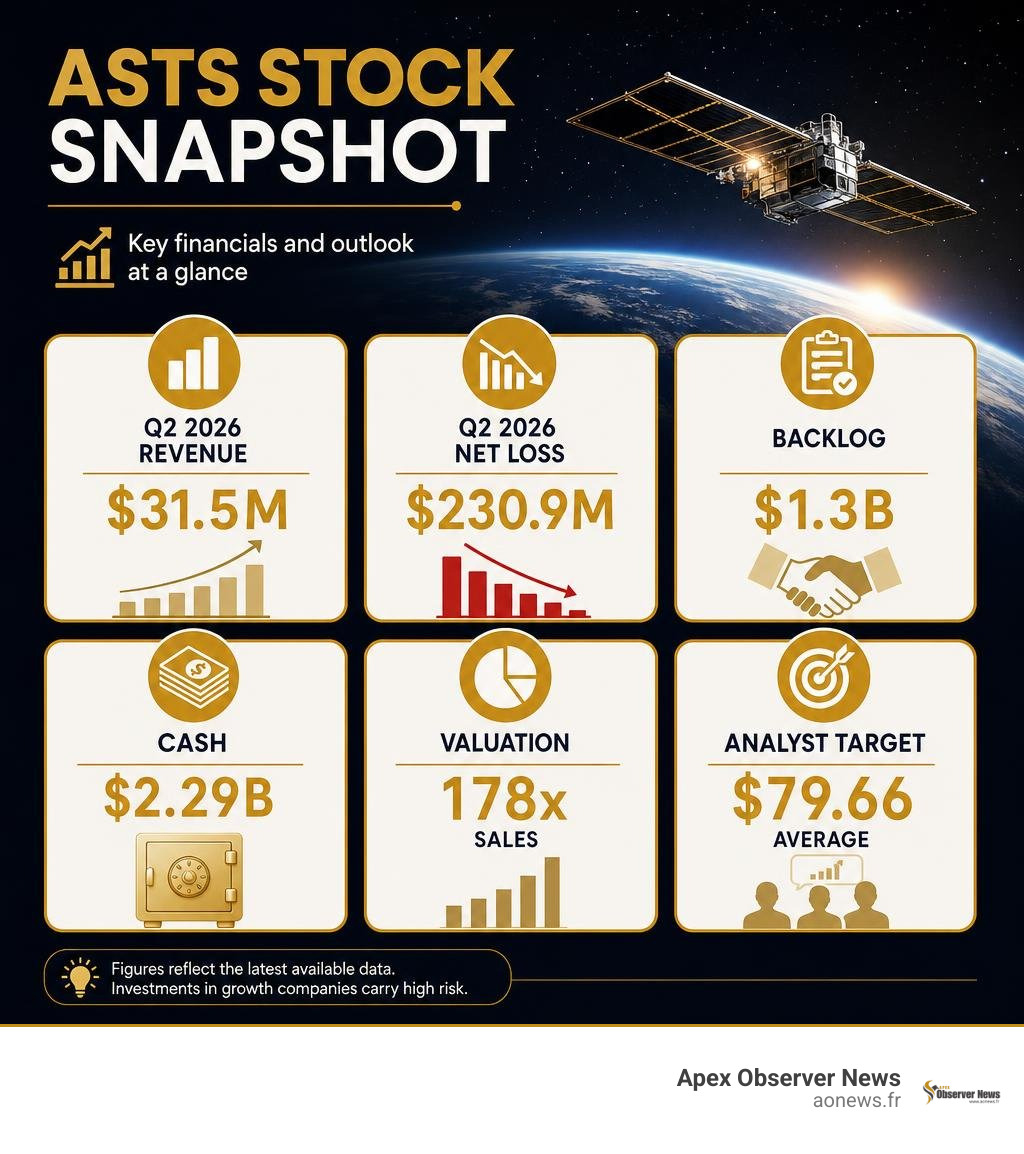
| ASTS stock snapshot | What it means |
|---|---|
| Q2 2026 revenue: $31.5 million | Revenue is growing but remains small for its valuation |
| Q2 2026 net loss: $230.9 million | Heavy satellite, research, and operating costs are still outweighing sales |
| Backlog: $1.3 billion | Demand commitments could support future commercial revenue |
| Cash: $2.29 billion | A meaningful funding cushion, though the network requires large ongoing investment |
| Valuation: about 178x sales | Investors are pricing in substantial future growth |
| Analyst target: $79.66 average | Wall Street sees upside on average, but targets and ratings vary widely |
AST SpaceMobile is building the BlueBird satellite network to extend 4G and 5G coverage into places where land-based towers do not reach. Its main investment question is simple: can the company launch, regulate, and scale this network fast enough to turn its large revenue promise into durable cash flow before costs, competition, or delays get in the way?
I am Faisal S. Chughtai, founder of ActiveX, with experience in digital research, technology-focused web strategy, and SEO analysis of fast-moving topics such as ASTS stock. In this guide, I will break down the facts investors should weigh before treating a satellite launch headline as an investment thesis.
Asts stock vocab explained:
Overview of AST SpaceMobile Technology and Market Position
At the heart of AST SpaceMobile is a bold mission led by Founder, Chairman, and CEO Abel Avellan: eliminating global cellular dead zones forever. Founded in 2017 and operating out of Midland, Texas, the company is constructing the world’s first space-based cellular broadband network designed to communicate directly with standard, unmodified mobile phones.
Instead of requiring consumers to buy expensive satellite dishes, specialized handheld units, or proprietary hardware, AST SpaceMobile’s low Earth orbit (LEO) BlueBird satellite constellation acts like giant cell towers operating from space.
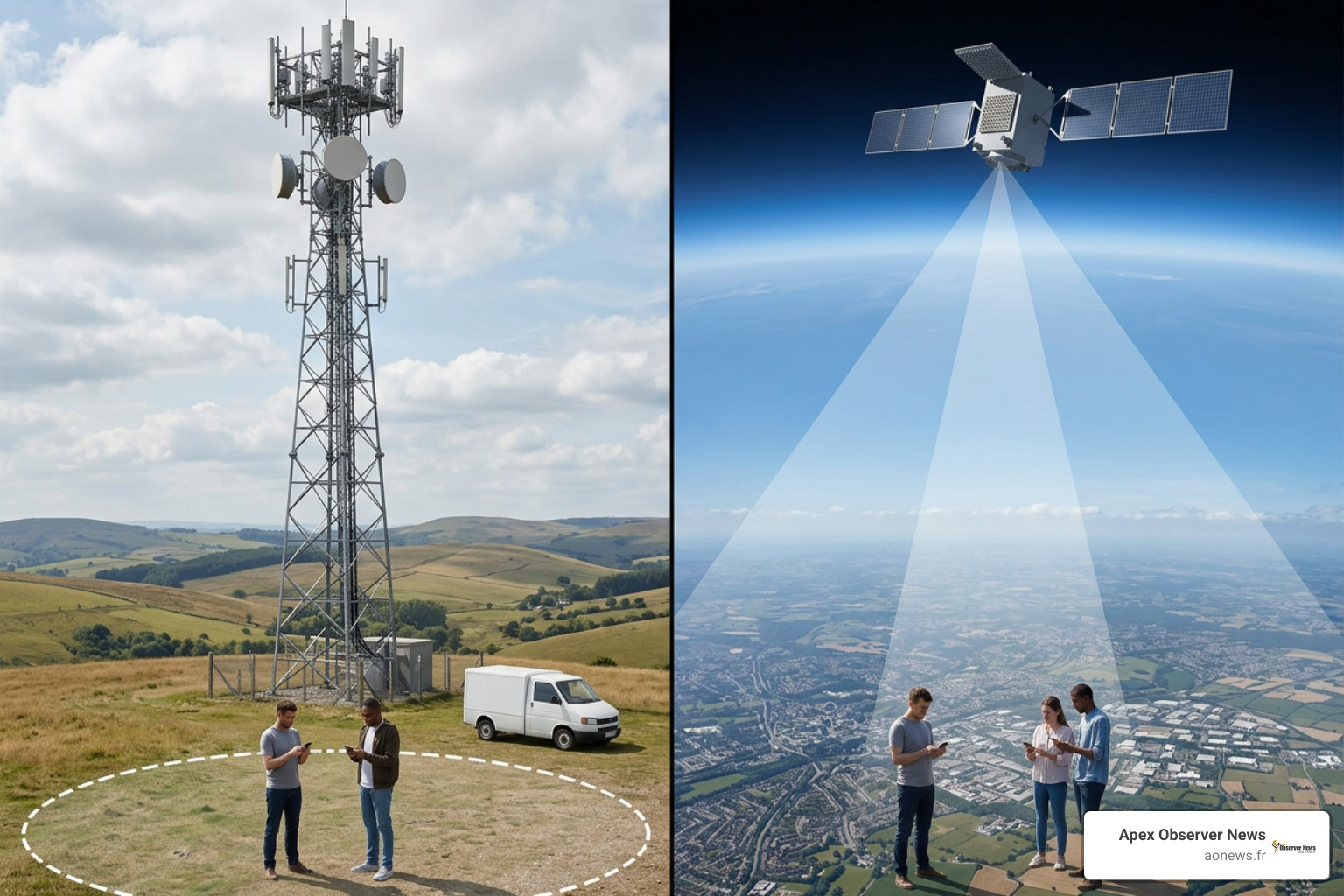
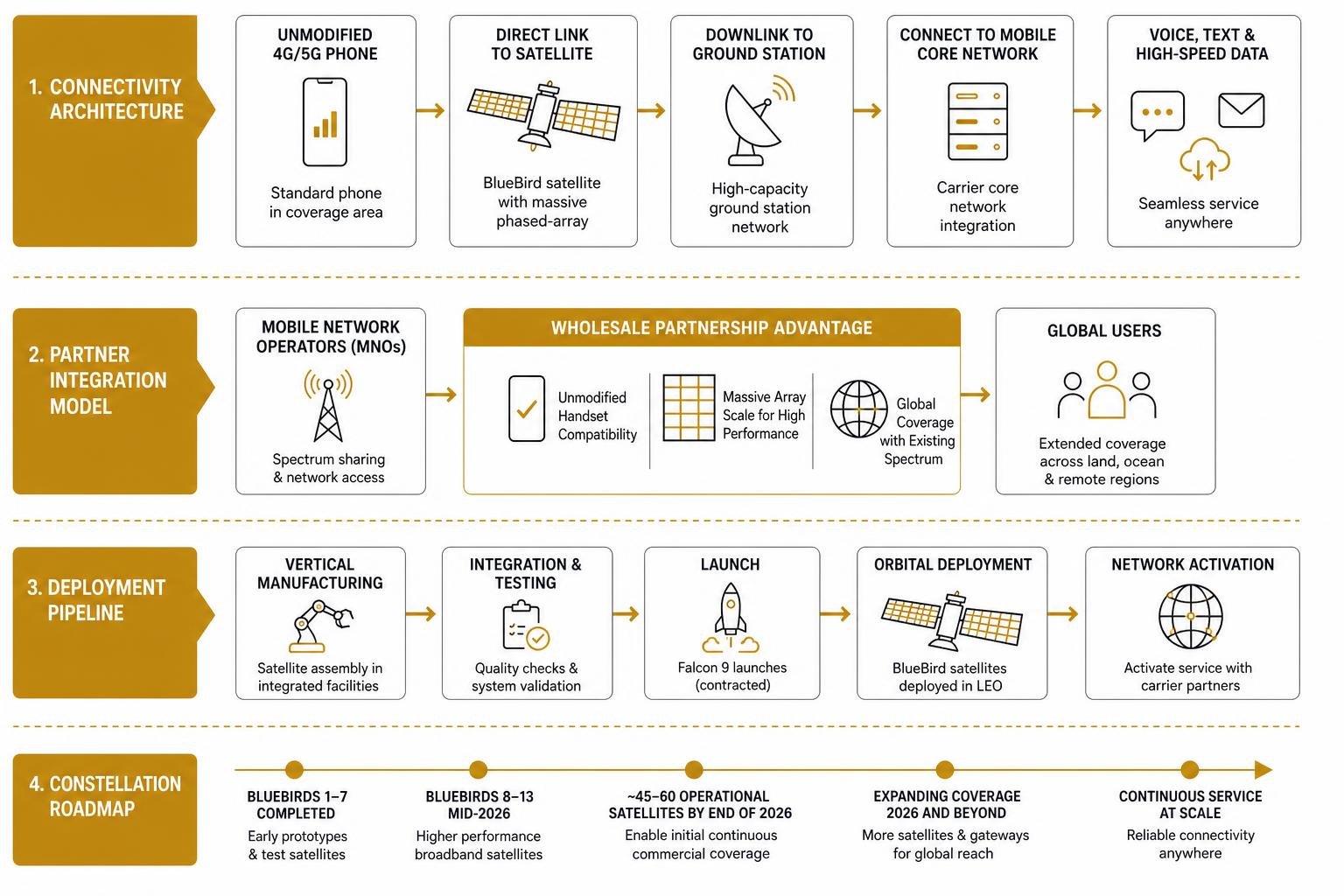
To route signals between space and your everyday cell phone, the architecture relies on two key components: orbital satellites featuring massive phased-array antennas and robust ground station infrastructure. When you step into a dead zone in the mountains or out at sea, your handset automatically connects to an overhead BlueBird satellite, which instantly relays voice, text, and high-speed 4G/5G data back down to terrestrial ground stations connected to your local mobile operator’s core network.
Comparing Direct-to-Cell Tech and ASTS Stock Advantages
What makes ASTS stock stand out to space technology investors is its architectural approach to direct-to-cell communications. Unlike legacy satellite providers that rely on dedicated spectrum and proprietary end-user hardware, AST SpaceMobile partners directly with existing Mobile Network Operators (MNOs).
- Unmodified Handset Compatibility: Consumers do not need a new phone or a satellite addon; their current 4G or 5G phone connects naturally.
- Massive Array Scale: BlueBird satellites deploy communications arrays measuring roughly 2,400 square feet. These massive arrays provide high signal gain, allowing standard phone antennas to receive high-speed broadband signals through low Earth orbit.
- Wholesale Spectrum Sharing: Partnering with major global telecommunications operators allows AST SpaceMobile to utilize its partners’ existing cellular radio spectrum rather than acquiring expensive separate spectrum licenses globally.
This wholesale model aligns mobile carriers as strategic partners rather than competitors. Telecommunications leaders like Vodafone, AT&T, Verizon, Deutsche Telekom, and Rakuten gain a turnkey solution to extend their coverage maps into ocean waters, rural stretches, and wilderness areas.
Constellation Deployment and Satellite Launch Milestones
To achieve continuous global commercial service, AST SpaceMobile must build and launch a full constellation of BlueBird satellites. Fabrication is centered at the company’s vertically integrated manufacturing facilities in Midland, Texas, where engineers assemble the complex phased-array electronics.
Launch cadence is the primary catalyst driving investor attention in August 2026:
- Falcon 9 Launches: AST SpaceMobile contracts with commercial launch providers—primarily SpaceX—to lift its heavy satellites into orbit.
- BlueBirds 8–13 Orbital Launches: Following the successful deployment of earlier units, launches of BlueBirds 8, 9, 10, and BlueBirds 11, 12, and 13 scheduled throughout mid-2026 are nearly doubling peak download speeds compared to prototype units.
- Constellation Roadmap: We are tracking the company’s stated goal of achieving 45 to 60 operational satellites in orbit by the end of 2026 to enable initial continuous commercial coverage in key targeted regions.
- International Test Trials: Live trials with international carrier partners have already demonstrated high-speed video calls, emergency service connectivity during power outages, and direct 5G data links directly from orbit to off-the-shelf smartphones.
Financial Performance and Revenue Trajectory for ASTS Stock
While the technology vision is impressive, reviewing ASTS stock requires looking closely at its financial numbers. As an early-stage space infrastructure builder, AST SpaceMobile generates limited commercial revenue while absorbing high research, development, and satellite assembly costs.
For Q2 2026, AST SpaceMobile reported disappointing revenue of $31.5 million—coming in below Wall Street consensus expectations—alongside a net loss of $230.9 million. Trailing twelve-month (TTM) revenue stands at $115.3 million, paired with a TTM net loss of -$618.76 million and an EBITDA of -$406.28 million. For real-time price updates and historic charts, you can check the AST SpaceMobile, Inc. (ASTS) quote on major market platforms while performing your broader stock analysis.
Capital expenditures (CapEx) for manufacturing satellite buses and paying rocket launch providers continue to weigh on short-term cash flows. Levered free cash flow over the trailing twelve months reached -$1.8 billion, with quarterly cash burn running near -$327 million. However, thanks to successful capital raises—including a $1.15 billion senior convertible note offering—AST SpaceMobile holds a solid cash war chest of approximately $2.29 billion (with pro forma cash reserves exceeding $3.4 billion), giving it capital runway to fund constellation assembly through its commercial launch phase.
Backlog Execution and Path to Commercial Profitability
Despite quarterly net losses, AST SpaceMobile’s fundamental bull case centers on its execution backlog. The company holds more than $1.3 billion in aggregate contracted revenue commitments and commercial agreements signed with tier-one mobile network operators globally.
Management has reaffirmed its strategic target of approaching $1 billion in annual revenue during its first full year of commercial service once a critical mass of BlueBird satellites is operational.
As commercial beta services launch, gross margins are expected to shift dramatically. Space networks carry massive upfront fixed capital costs to build and launch satellites, but once the constellation is in orbit, the incremental cost to process extra data traffic is minimal. Analysts tracking long-term earnings project that AST SpaceMobile could achieve positive earnings per share (EPS) by 2028 (projected around $0.42 per share), with long-term revenue potentially scaling toward several billion dollars by 2030.
Valuation Ratios and Financial Health of ASTS Stock
With a market capitalization of roughly $27.6 billion and a 52-week trading range of $36.08 to $133.86, ASTS stock trades at elevated growth multiples:
- Price-to-Sales (P/S) Ratio: 178.23x (TTM) to over 280x depending on reported quarterly share counts.
- Enterprise Value-to-Revenue: 191.72x.
- Debt-to-Equity Ratio: Approximately 124.86% to 156.91%, reflecting long-term debt liabilities taken on to fund factory growth.
- Price-to-Book (P/B) Ratio: 11.30x.
These metrics highlight that the market is valuing AST SpaceMobile on its future commercial expansion rather than current pre-profit trailing results. Understanding why growth stocks are leading the market charge helps explain why speculative investors are willing to pay a premium for high-upside space tech equities.
To manage capital dilution, management executed its $1.15 billion convertible senior notes offering due 2034 alongside capped call transactions. This structural setup effectively raises the conversion price to $149.20 per share, keeping potential share dilution below 2% while providing necessary debt funding.
Key Catalysts and Wall Street Consensus Outlook
Wall Street analysts maintain a generally bullish long-term perspective on ASTS stock, though price targets reflect high uncertainty across the space economy.

The consensus rating across Wall Street investment banks stands at Strong Buy / Buy, featuring an average 1-year price target of $79.66 (with targets ranging from a low of $42.50 to a high of $108.00). Brokerage firms like Piper Sandler, B. Riley, Scotiabank, Deutsche Bank, and Bank of America closely track company progress.
Key upcoming catalysts that could trigger price action include:
- FCC Regulatory Clearance: Winning key spectrum approvals, including experimental tests such as the 800 MHz band test approval, to validate direct-to-cell transmissions over U.S. airwaves.
- Commercial Beta Launch: Transitioning from pilot trials to paid commercial beta services with partner telecom networks.
- Launch Cadence Success: Flawless deployment and array unfolding of BlueBirds 8 through 13 on upcoming SpaceX Falcon 9 launches.
- Short Squeeze Dynamics: Short interest sits at 22.88% of float (with over 59.35 million shares shorted). Coupled with a high Beta of 2.74 to 3.69, positive execution news can trigger rapid upside rallies as short sellers scramble to cover positions.
For corporate updates, official SEC filings, and regulatory presentations, investors can visit the official Investors – AST SpaceMobile site.
Major Execution Risks and Capital Requirements
Every high-reward technology investment carries meaningful execution risks, and ASTS stock is no exception. Investors must weigh several critical risk factors before building a position:
- Manufacturing & Satellite Scaling Bottlenecks: Designing and assembling complex 2,400 sq ft phased-array satellites at scale in Midland, Texas, presents manufacturing challenges. Any component shortage or production delay directly impacts commercialization timelines.
- Launch Provider Dependencies & orbital Delays: The company relies on commercial rocket providers like SpaceX. Launch scrubbings, rocket availability issues, or launch failures could delay constellation deployment.
- Competitive Pressure from SpaceX Starlink: SpaceX is aggressively expanding its own Starlink Direct-to-Cell / Direct-to-Device constellation in partnership with carriers like T-Mobile. While AST SpaceMobile offers larger array designs and broader carrier neutrality, SpaceX commands its own launch infrastructure.
- Capital Intensity & Dilution Risk: With free cash flow running negative while capital expenditures remain high, AST SpaceMobile may eventually need additional equity offerings or debt facilities if satellite commercialization takes longer than anticipated.
- High Beta Volatility: Carrying a stock beta near 3.0, ASTS stock experiences wider price swings than the broader market, making disciplined risk management essential for short-term traders.
| Satellite Provider | Primary Technology Architecture | Array Scale & Size | Operator Business Model | Target Market |
|---|---|---|---|---|
| AST SpaceMobile (ASTS) | Direct-to-Cell cellular broadband | ~2,400 sq ft phased arrays | MNO wholesale spectrum partnership | Unmodified smartphones (4G/5G data & voice) |
| SpaceX Starlink Direct-to-Cell | Direct-to-Device eNodeB payloads | Smaller integrated satellite arrays | Exclusive carrier agreements & vertical integration | Text messaging rolling into voice/data |
| Lynk Global | Satellite-to-mobile cell towers | Standard smallsat phased arrays | Mobile operator roaming integration | Low-bandwidth text & emergency messaging |
Frequently Asked Questions About AST SpaceMobile
What caused the Q2 2026 net loss for AST SpaceMobile?
AST SpaceMobile reported a $230.9 million net loss in Q2 2026 primarily due to heavy capital expenditures required to manufacture BlueBird satellites, high research and development expenses to upgrade phased-array technology, rocket launch procurement costs, and pre-revenue operational overhead ahead of full constellation commercialization.
What is the analyst target price for AST SpaceMobile?
The Wall Street consensus target price for ASTS stock is $79.66, based on ratings from major financial institutions. Target price estimates range from a low of $42.50 to a high target of $108.00 per share, reflecting a consensus rating of Strong Buy to Buy among covering analysts.
What regulatory approvals does AST SpaceMobile need next?
To offer full commercial service, AST SpaceMobile requires formal regulatory approvals from national communications bodies. In the United States, this includes FCC spectrum operational authority and experimental approvals (such as testing in the 800 MHz band). Internationally, the company must secure landing rights, spectrum access authorizations, and telecommunications licensing across every sovereign country where its partner mobile network operators operate.
Conclusion: Is AST SpaceMobile Worth Buying in 2026?
At Apex Observer News, our analysis indicates that ASTS stock represents one of the most exciting, high-upside plays in the space economy today—but it requires patience and a strong appetite for volatility.
If AST SpaceMobile successfully deploys its BlueBird constellation, executes its $1.3 billion backlog, and launches commercial service alongside global carrier partners, the stock has room to grow toward analysts’ upper price targets. However, ongoing cash burn, high valuation multiples, regulatory steps, and intense competition from SpaceX mean investors should approach the stock as a speculative growth allocation rather than a conservative value hold.
For investors who believe space-based cellular broadband will transform global telecommunications, accumulating shares during pullbacks while maintaining strict position sizing offers an attractive risk-reward strategy. To keep up with broader financial trends and market sentiment, explore the stock market trends that are shaping 2026 to build a well-diversified portfolio.
