


Blockchain Technology: A Quick, Clear Overview
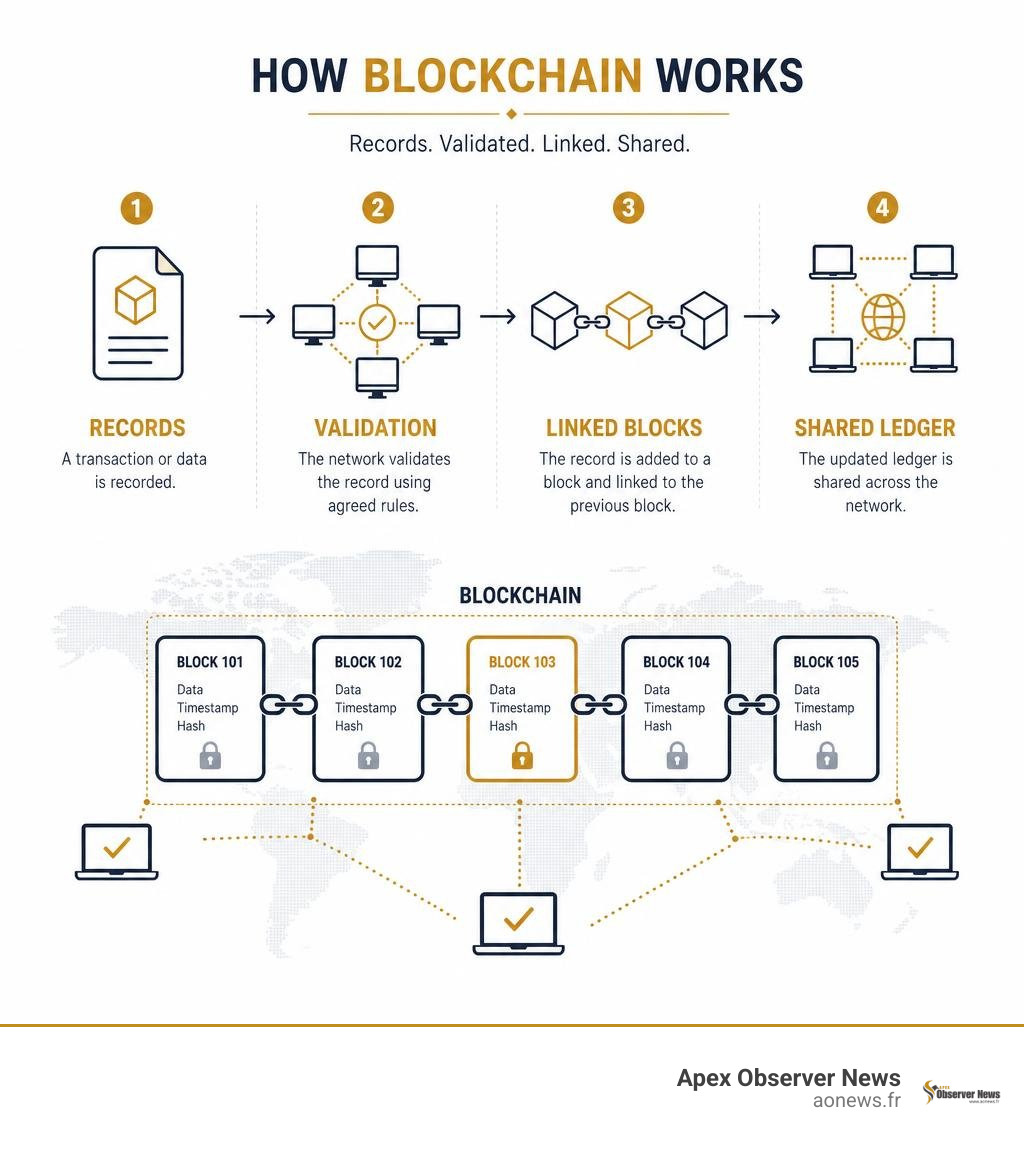
Blockchain technology is a shared digital ledger that records transactions or data in linked blocks across a network of computers. Once the network confirms a record, changing it is difficult because each block is protected by cryptography and connected to the records before it.
| In simple terms | What it means |
|---|---|
| Shared ledger | Multiple approved participants hold matching copies of the record. |
| Linked blocks | New records are grouped into blocks that connect to earlier blocks. |
| Network validation | Computers or authorized members check transactions before they are added. |
| Tamper-evident history | Editing an old record changes its cryptographic fingerprint and exposes the change. |
Blockchain began as the system behind Bitcoin after its 2008 design, but it now supports far more than cryptocurrency. Businesses and developers use it to track goods, automate agreements with smart contracts, verify digital ownership, and share records where several parties need the same trusted version of events.
It is not a magic fix, and it is not always better than a regular database. Its strongest use cases involve multiple organizations, limited trust between them, and a real need for a transparent, auditable record.
I am Faisal S. Chughtai, founder of ActiveX, with experience in app and web development, digital marketing, SEO, and managed digital infrastructure. That background helps me explain blockchain technology as a practical tool within the wider world of modern software, security, and online business.
Important blockchain technology terms:
What Is Blockchain Technology and How Does It Work?

At its core, blockchain technology functions as an append-only digital database distributed across a peer-to-peer network. Unlike a conventional relational database managed by a single system administrator who can edit, update, or delete entries at will, a blockchain prevents historical modifications. Once data is written into a block and verified by the network, it becomes virtually permanent.
To understand why this matters, think of traditional record-keeping. If two international companies exchange goods, both maintain separate ledger books. Reconciling those ledgers requires time, manual audits, and trusted middle parties like banks or escrow services. A blockchain replaces those fragmented siloes with a single, shared source of truth.
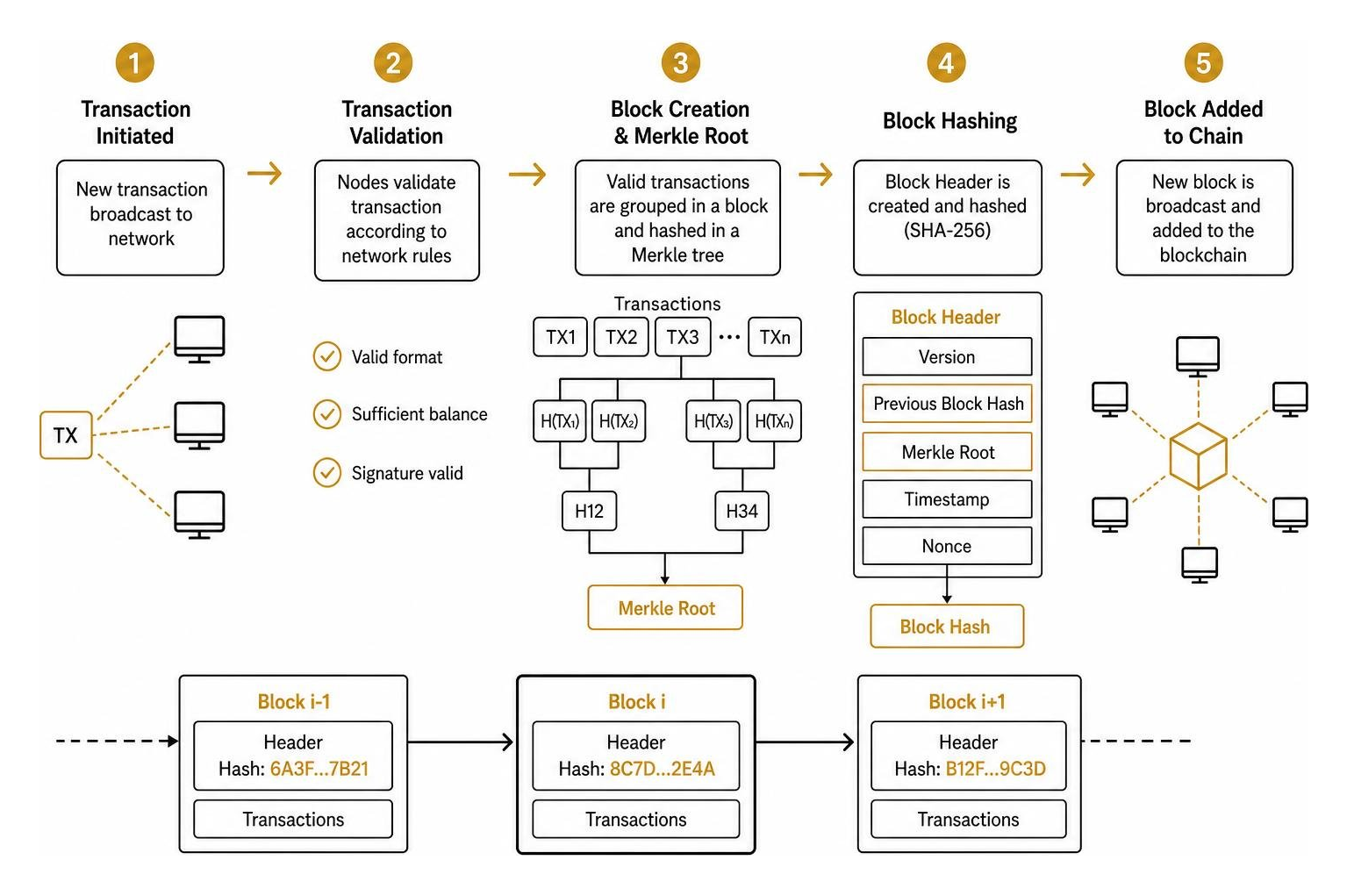
When a user initiates a transaction, the request is broadcast across the peer-to-peer network. Independent computers (called nodes) validate the details against predefined network rules. Validated transactions are bundled together into a discrete batch known as a block. Every newly created block contains a mathematical link to the block that came directly before it. As more blocks are appended over time, they form an unyielding cryptographic chain—hence the term blockchain.
As detailed in the comprehensive NIST technical overview of distributed ledgers, this distributed architecture eliminates single points of failure while creating a shared, tamper-evident transaction log.
Check Your FL Lotto Numbers Before the Next Beach Trip
Core Components of Blockchain Technology
To grasp the inner mechanics of blockchain technology, we must unpack its cryptographic engine. The system relies on four foundational components:
- Cryptographic Hash Functions: A hash function (such as SHA-256) takes an input of any size—whether it is a tiny text message or Leo Tolstoy’s War and Peace—and converts it into a fixed-length string of numbers and letters. The output is deterministic: the same input always yields the exact same hash code. However, altering even a single comma in the source text alters the resulting hash code completely.
- Merkle Trees: Within each block, individual transactions are hashed paired together iteratively to build a Merkle tree (or hash tree). First patented by Ralph Merkle in the 1970s, this binary tree structure condenses hundreds or thousands of transactions into a single top-level cryptographic hash called the Merkle root.
- Block Headers and Linking: Each block consists of a block header containing the Merkle root of its transactions, a precise timestamp, metadata, and crucially, the cryptographic hash of the preceding block header. This header chaining ensures that changing a historical transaction alters its block hash, breaking every subsequent connection down the line like a collapsing tower of blocks.
- Asymmetric Public-Key Cryptography: Participants interact with the network using pairs of mathematical keys. A public key acts as an open digital bank account number that anyone can see, while a private key functions as a secret signature key. When a participant broadcasts a transaction, they sign it using their private key, allowing recipient nodes across the globe to verify ownership mathematically without exposing the private key itself.
For a deeper enterprise architectural breakdown, read the official AWS explanation of blockchain technology.
Consensus Mechanisms and Cryptographic Security
Because no single server or central authority dictates what goes into a decentralized ledger, network participants must agree on the validity of transactions through an automated protocol known as a consensus mechanism. Without consensus, bad actors could spend the same digital token twice—a fundamental challenge known as the double-spending problem.
The two most widely deployed consensus models are:
- Proof of Work (PoW): Introduced by Bitcoin in 2008, PoW requires node operators (miners) to expend computational energy solving complex cryptographic puzzles. The first miner to solve the puzzle earns the right to add the next block and claim a network reward. Because altering historical blocks would require recalculating the proof of work for every subsequent block faster than the rest of the world combined, PoW offers formidable security against tampering.
- Proof of Stake (PoS): Rather than burning electrical power to solve computational puzzles, PoS selects network validators based on the number of native cryptographic tokens they lock up (stake) as collateral. If a validator approves fraudulent transactions, the network slashes and forfeits their staked assets. This economic penalty enforces honesty without massive energy overhead.
By distributing consensus across thousands of independent nodes, blockchains maintain strict fault tolerance. An attacker attempting to corrupt the ledger would need to seize control of more than 51% of the total network mining power or staked assets—a feat that is economically and logistically prohibitive on mature public networks.
Evolution and Network Types: From Bitcoin to Smart Contracts
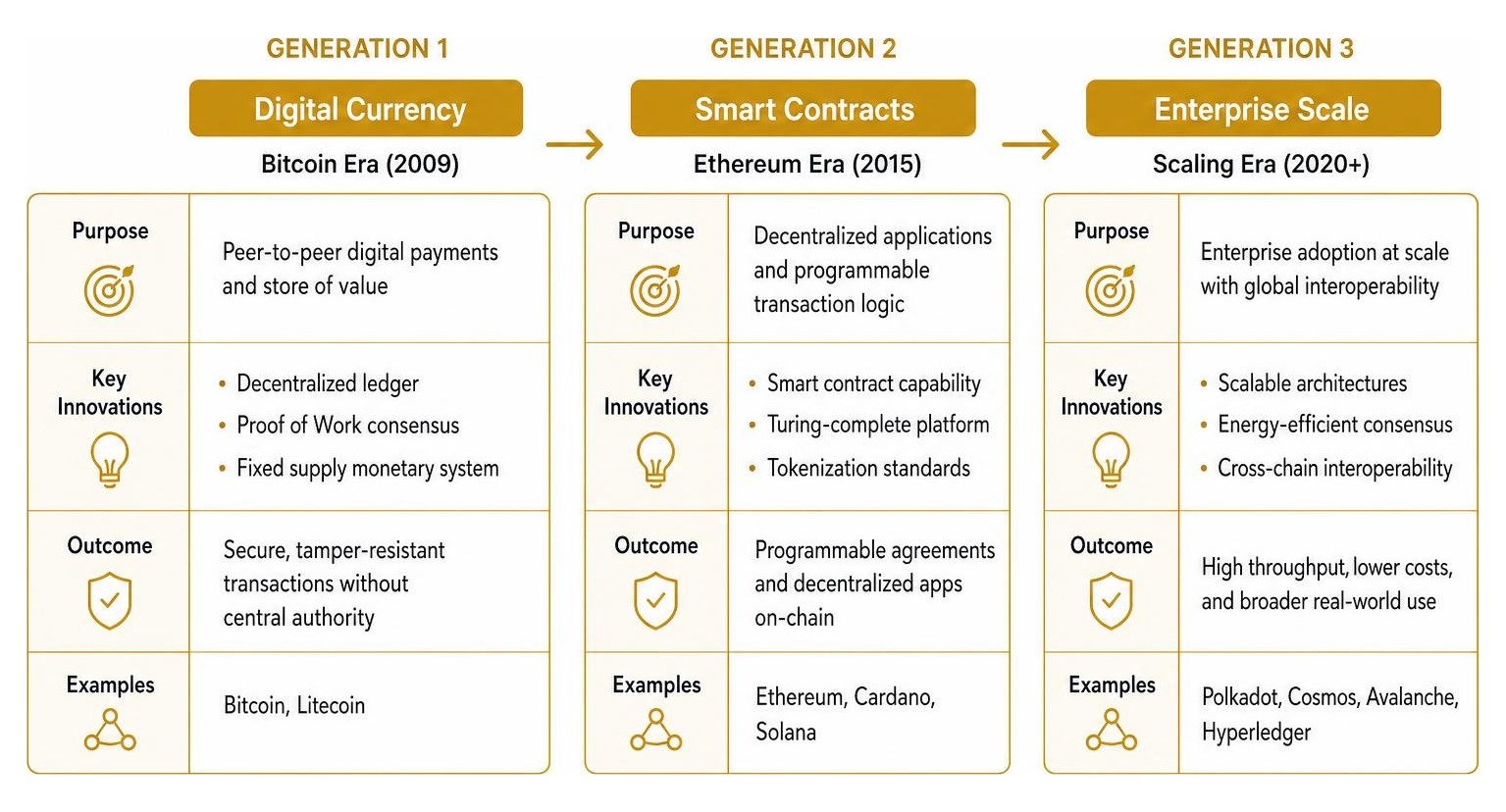
The evolution of blockchain technology is broadly categorized into three distinct generational leaps.
First generation systems focused strictly on digital peer-to-peer payments. In 2008, an anonymous researcher or group operating under the pseudonym Satoshi Nakamoto published the seminal Bitcoin whitepaper, launching the network in early 2009. Nakamoto solved the decades-old double-spending problem without needing a central bank by combining Merkle trees, asymmetric cryptography, and Proof of Work consensus.
Second generation systems introduced programmable logic. In 2015, Vitalik Buterin and the founding team behind Ethereum launched a public network capable of hosting smart contracts—self-executing digital programs stored on-chain that run automatically when predetermined conditions are satisfied.
Third generation systems focus on enterprise throughput, cross-chain communication, and energy efficiency, paving the way for scalable global applications.
History and Generations of Distributed Ledgers
| Generation | Focus | Key Characteristics | Primary Examples |
|---|---|---|---|
| Generation 1 | Digital Currency | Peer-to-peer electronic cash, double-spending prevention, fixed supply limits. | Bitcoin, Litecoin |
| Generation 2 | Programmable Logic | Smart contracts, decentralized applications (dApps), non-fungible tokens, DeFi protocols. | Ethereum, Solana |
| Generation 3 | Enterprise & Interoperability | High transaction throughput, zero-knowledge proofs, proof of stake, cross-chain bridges. | Hyperledger Fabric, Polkadot, Avalanche |
Public, Private, Permissioned, and Consortium Networks
Not all distributed ledgers are built for full public exposure. Depending on governance rules, privacy requirements, and operational goals, blockchain implementations fall into four structural categories:
- Public Blockchains: Fully permissionless and decentralized networks. Anyone can download the node software, view the entire transaction history, submit transactions, and participate in network consensus. (Examples: Bitcoin, Ethereum).
- Private Blockchains: Permissioned networks controlled by a single organizational entity. Access to read, submit, or validate data is restricted to verified users. While private blockchains lack the radical decentralization of public networks, they offer high transaction speeds, high throughput, and complete privacy.
- Permissioned Blockchains: Ledgers that enforce an identity and access management (IAM) layer over the network. Participants are assigned specific roles (e.g., read-only, validator, or writer) regardless of whether the network is public or private.
- Consortium Blockchains: Multi-organization permissioned networks governed by a pre-selected group of companies (such as a group of international logistics providers or banking partners). No single company controls the infrastructure; decisions require consensus among consortium members.
| Feature | Public Blockchain | Private Blockchain | Consortium Blockchain |
|---|---|---|---|
| Access Model | Open / Permissionless | Restricted / Single Owner | Group Restricted / Multi-Owner |
| Consensus Operators | Anyone in the world | Internal enterprise nodes | Designated industry partners |
| Speed & Throughput | Lower | Very High | High |
| Immutability | Extremely High | Modifiable by owner consensus | High among consortium members |
| Energy Efficiency | Variable (PoW vs PoS) | Highly Efficient | Highly Efficient |
Business Benefits and Industrial Use Cases

Businesses across the globe are moving past early experimental phases to deploy blockchain technology directly into practical operations. According to a PwC survey of global business executives, 84% reported having exposure to utilizing distributed ledgers. Meanwhile, PwC estimated that blockchain implementations could generate over $3 trillion in annual business value worldwide by 2030.
The key driver behind this corporate investment is operational efficiency. By providing a synchronized, tamper-evident log between independent partners, organizations dramatically cut administrative overhead, eliminate manual reconciliations, and accelerate cross-border workflows.
Business Advantages of Blockchain Technology
- Enhanced Security and Resilience: Because data is encrypted and replicated across a decentralized node topology, there is no single database server for cybercriminals to compromise.
- Automated Operations via Smart Contracts: By encoding logic into smart contracts, multi-step business transactions—such as customs clearance releases, insurance payouts, or royalty distributions—trigger automatically once conditions are met.
- Accelerated Auditing and Traceability: Audit teams spend months collecting invoices, receipts, and shipping manifests. A blockchain provides an immutable audit trail where every historic entry is time-stamped and verified.
- Privacy via Zero-Knowledge Proofs: Advanced cryptographic tools like zero-knowledge proofs (ZKPs) allow companies to prove a statement is true (such as verifying a customer holds sufficient funds) without disclosing the underlying sensitive data, fulfilling strict data compliance mandates like GDPR.
To discover how enterprise leaders deploy these frameworks, explore the IBM overview of enterprise blockchain.
Major Use Cases Across Industries
- Global Supply Chain and Logistics: Shipping goods across oceans involves freight forwarders, port authorities, and customs agencies. Tracking cargo via distributed ledgers offers real-time visibility. For instance, sensors monitoring cold-chain food shipments log temperature updates directly to a shared block, automatically flagging spoilage before goods reach store shelves.
- Financial Services and Settlements: International bank wire transfers traditionally take several business days to settle through clearing networks. Blockchain platforms execute cross-border settlements in seconds at a fraction of legacy transaction costs.
- Healthcare and Medical Records: Storing patient records on secure, permissioned blockchains allows medical providers to share encrypted health histories instantly while keeping control in the hands of the patient.
- Online Gaming and Provable Fairness: In the igaming sector, smart contracts allow platforms to deliver provably fair gameplay—allowing players to verify that slot machine or card game outcomes were not manipulated behind closed doors. Operators also utilize immutable ledgers to track player risk markers and ensure responsible gaming compliance.
- Tokenization of Real-World Assets: Real estate properties, intellectual property, and fine art are increasingly represented as digital tokens on-chain, enabling fractional ownership and secondary market liquidity.
Stay informed on industry trends with our coverage of latest crypto news updates, keep pace with non-fungible token innovations, and read about the broader institutional bitcoin movement.
Sustainability, AI Integration, and Interoperability Concerns
Despite its transformative potential, blockchain technology faces ongoing scrutiny regarding its power consumption, technical complexity, and data silo challenges.
Energy Consumption and Proof of Stake
Early media attention often focused on the carbon footprint of Proof of Work mining networks. At peak periods, global energy consumption for PoW mining rivaled the electrical grids of small nations.
However, the technology landscape underwent a major shift. In September 2022, Ethereum completed “The Merge,” transitioning its primary consensus architecture from Proof of Work to Proof of Stake. This single technical upgrade reduced the network’s electrical power consumption by more than 99.95%. Modern enterprise networks now rely almost exclusively on Proof of Stake, Proof of Authority (PoA), or Raft consensus models, delivering high throughput with negligible environmental impact.
Combining AI and Distributed Ledgers
The convergence of artificial intelligence (AI) and blockchain technology addresses critical bottlenecks in both fields. AI models require massive datasets to train, yet black-box machine learning algorithms suffer from explainability challenges.
By logging AI training data, decision pathways, and model updates onto an immutable blockchain ledger, developers establish verifiable data provenance. Furthermore, smart contracts can host autonomous AI agents capable of executing micro-transactions independently, while AI-powered auditing tools scan smart contract code in real time to catch vulnerabilities before deployment.
For strategic economic insights into these emerging digital shifts, examine the detailed McKinsey analysis of blockchain technology.
Frequently Asked Questions About Distributed Systems
What is the main difference between blockchain and Bitcoin?
The simplest way to understand the difference is through an architecture analogy: blockchain technology is the operating system (like iOS or Android), whereas Bitcoin is a specific application built on top of that operating system (like a mobile banking app).
Bitcoin was created in 2008 as a peer-to-peer electronic cash network and store of digital value. Blockchain, on the other hand, is the underlying distributed ledger infrastructure that keeps track of Bitcoin transactions—and can equally be used to track supply chain parts, process medical records, or power smart contracts. For market updates regarding crypto valuations, see our report on symbolic valuation announcements.
How secure is a blockchain against network attacks?
Blockchains are among the most secure database structures ever created due to asymmetric cryptography, distributed node duplication, and consensus validation. However, security varies based on architecture:
- 51% Attacks: If a single entity acquires more than half the mining power or staked tokens on a network, they could theoretically halt new transactions or attempt double-spending. On major public networks, acquiring 51% control requires billions of dollars, making it economically irrational.
- Smart Contract Bugs: While the underlying blockchain protocol may be secure, flaws written into a custom smart contract application can be exploited by hackers. This is why thorough third-party code audits are essential prior to launching any dApp.
To learn more about how shifting regional regulations impact Web3 development talent, review our guide on Web3 employment shifts.
What is blockchain interoperability and why does it matter?
Currently, many blockchains operate as isolated digital islands. An asset or data point recorded on Ethereum cannot naturally communicate with a record stored on Bitcoin or Hyperledger Fabric.
Blockchain interoperability refers to protocols and cross-chain bridges that allow distinct networks to exchange data and value seamlessly without needing centralized intermediaries. International standardization initiatives, such as ISO/TC 307, are establishing global framework guidelines to unite disparate ledgers into a friction-free multi-chain ecosystem.
Conclusion
At Apex Observer News, we track the evolution of global technologies reshaping business and digital culture. Blockchain technology has matured from an experimental protocol behind digital cash into a core component of modern enterprise infrastructure. By removing single points of failure, automating multi-party trust through smart contracts, and providing an immutable audit trail, distributed ledgers offer a modern foundation for transparent global commerce.
As public networks adopt green consensus models and private consortiums connect with AI platforms, the barriers to adopting distributed databases continue to fall. Organizations that identify their specific multi-party data friction points today will lead the digital transformations of tomorrow. Explore our dedicated media coverage to stay ahead of the latest technology trends.
