


The Mechanics Behind the AP Calc AB Score Calculator
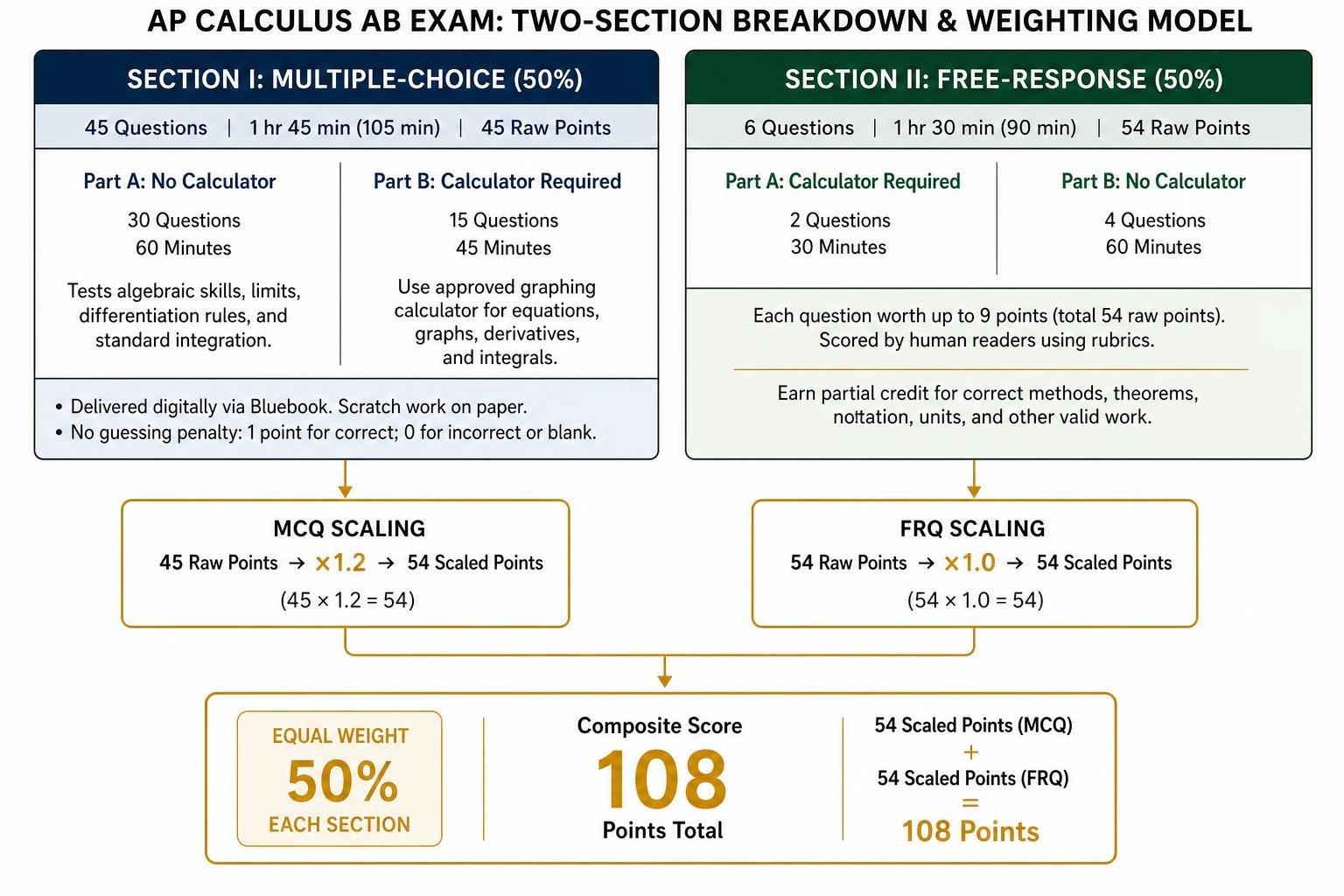
Understanding how your final grade comes together takes the mystery out of test day. The AP Calculus AB exam is built around two equally weighted sections: multiple-choice questions (MCQ) and free-response questions (FRQ). Each section contributes exactly 50% to your composite score.
When you complete a full-length practice exam, you do not simply average your percentages. Instead, scoring tools take your raw counts, scale them mathematically, and generate a projected score out of 108 points. Using an AP Calculus AB Score Calculator 2026 helps translate raw test numbers into a realistic performance benchmark.
Section I: Multiple-Choice Structure and Calculator Rules
Section I contains 45 multiple-choice questions and lasts 1 hour and 45 minutes (105 minutes total). It is split into two distinct sub-sections:
- Part A (No Calculator): 30 questions in 60 minutes. This part tests your core algebraic manipulation, differentiation rules, analytical limits, and standard integration techniques.
- Part B (Calculator Required): 15 questions in 45 minutes. You must use an approved graphing calculator to solve equations, compute numerical derivatives, graph complex curves, or evaluate definite integrals that cannot easily be solved by hand.
The exam operates on a hybrid digital format: multiple-choice questions are delivered via the College Board’s Bluebook application, while scratch work is completed on provided paper. Crucially, there is no guessing penalty. You earn one raw point for every correct answer, and incorrect or blank answers receive zero points.
Section II: Free-Response Scoring and Partial Credit
Section II consists of 6 free-response questions (FRQs) administered over 1 hour and 30 minutes (90 minutes total), worth a total of 54 raw points:
- Part A (Calculator Required): 2 questions in 30 minutes.
- Part B (No Calculator): 4 questions in 60 minutes.
Each FRQ is worth up to 9 points, evaluated by human readers using specific multi-part rubrics. Even if you reach an incorrect numerical final answer, you can secure substantial partial credit by writing clean setups, stating relevant calculus theorems (such as the Mean Value Theorem or Intermediate Value Theorem), including correct units, and using proper notation (such as Leibniz notation $frac{dy}{dx}$ and integral differentials $dx$). Free-response work is handwritten into a paper booklet.
The 108-Point Composite Formula Explained
Because Section I has 45 raw points and Section II has 54 raw points, the College Board applies a multiplier to ensure both sections contribute an equal 54 scaled points (50% each) toward the maximum composite of 108.
To calculate your scaled multiple-choice score: $$text{Scaled MCQ} = text{Raw MCQ Correct} times 1.2$$
When using exact scaling models (such as $frac{54}{45} = 1.2$, or the precise proportional constant $1.2272$ used on older standardized conversions), every correct multiple-choice answer is worth roughly 1.2 composite points.
The composite formula is: $$text{Composite Score} = (1.2 times text{MCQ Correct}) + text{Total FRQ Points}$$
For instance, if you get 32 multiple-choice questions right and earn 30 total points across the 6 FRQs, your composite score is: $$(1.2 times 32) + 30 = 38.4 + 30 = 68.4 text{ out of 108}$$
You can test different point combinations directly with the AP® Calculus AB Score Calculator to see how small gains across either section affect your overall standing.
AP Calculus AB Composite Score Cutoffs and Score Distributions
Once your composite score is calculated, it is mapped to the standard 1 to 5 AP scale. While the College Board recalibrates exact boundaries annually during standard-setting sessions, historical cutoffs provide dependable scoring targets.
| AP Score | Projected Composite Range (out of 108) | MCQ Target (out of 45) | FRQ Target (out of 54) | Typical Qualification Level |
|---|---|---|---|---|
| 5 | 71 – 108 | 34+ | 31+ | Extremely Well Qualified |
| 4 | 58 – 70 | 28 – 33 | 24 – 30 | Well Qualified |
| 3 | 43 – 57 | 22 – 27 | 17 – 23 | Qualified (College Credit Baseline) |
| 2 | 29 – 42 | 16 – 21 | 10 – 16 | Possibly Qualified |
| 1 | 0 – 28 | 0 – 15 | 0 – 9 | No Recommendation |
Estimated Composite Ranges for AP Scores 1 to 5
- Score 5 (Composite 71–108): Earning around 66% to 70% of total available points typically secures the highest grade. A student scoring 35 on MCQs and 30 on FRQs finishes comfortably at 72 points.
- Score 4 (Composite 58–70): Securing roughly 54% to 65% of composite points lands in the 4 range, demonstrating solid mastery across differential and integral calculus.
- Score 3 (Composite 43–57): The passing benchmark requires approximately 40% to 53% of total points. Scoring 24 MCQs right and earning 20 FRQ points yields a composite of 48.8.
- Scores 1 and 2 (Composite 0–42): Scores below 43 reflect gaps in fundamental calculus topics or incomplete free-response solutions.
Score Distributions and Year-Over-Year Trends
Performance on the AP Calculus AB exam has steadily improved over recent testing cycles. In 2025, a total of 285,891 students sat for the exam, achieving an overall pass rate (score 3 or higher) of 64.2% and a mean score of 3.21 (up from 2.93 in 2020).
The 2025 score breakdown was:
- Score 5: 20.3%
- Score 4: 28.9%
- Score 3: 15.0%
- Score 2: 22.8%
- Score 1: 13.0%

A notable trend in AP Calculus AB data is the statistical “valley” at score 3 (15.0%) compared to score 4 (28.9%) and score 2 (22.8%). This pattern indicates that students who grasp fundamental derivative and integral concepts often excel into the 4 and 5 range, while those who struggle with foundational notation or algebraic prerequisites fall directly into the 2 category.
Strategic Practice: Target Setting and Performance Optimization
Using practice exam data effectively requires more than checking an estimated score. To systematically raise your grade, analyze where your points originate and focus your review on high-yield curriculum areas.
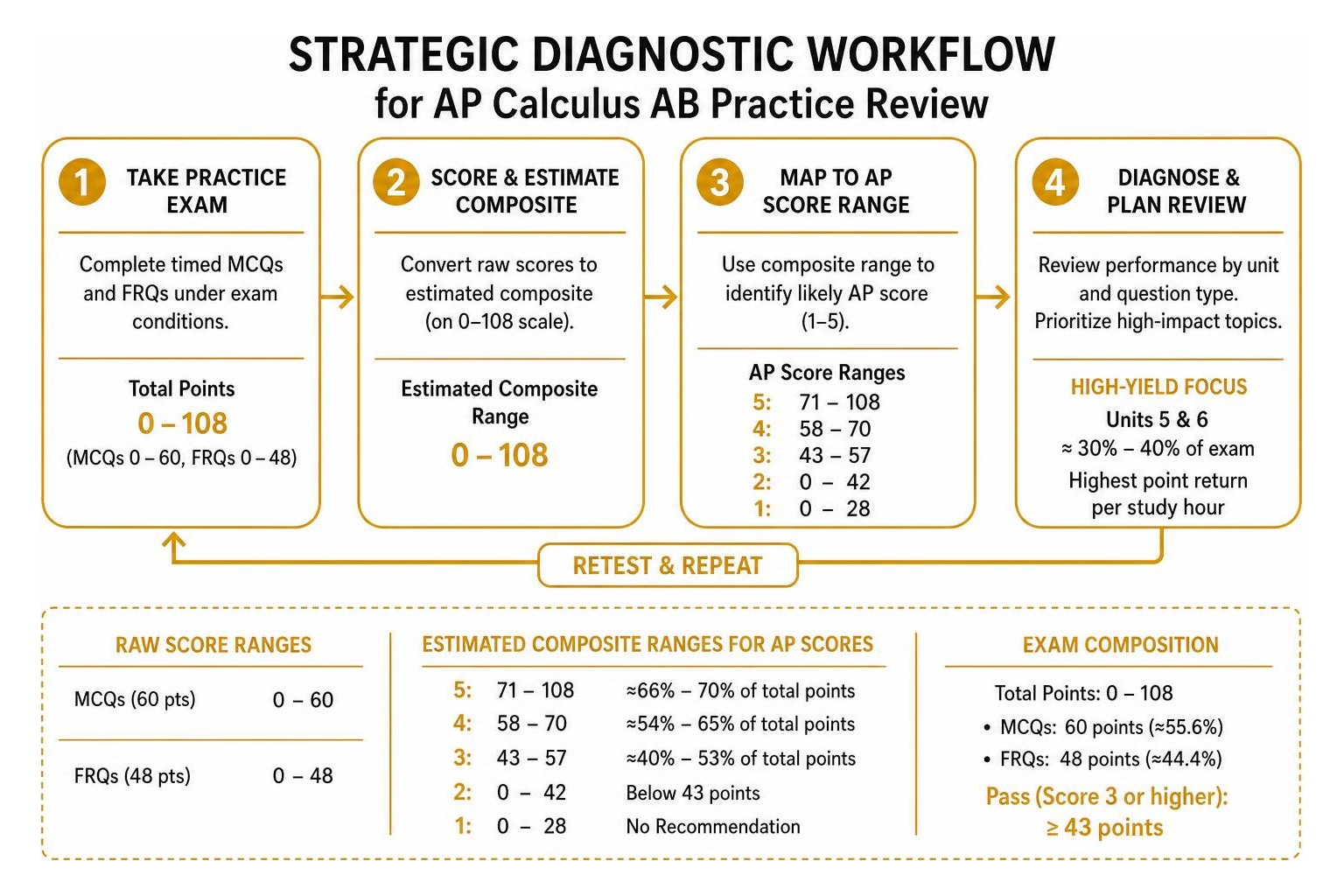
Units 5 (Analytical Applications of Differentiation) and 6 (Integration and Accumulation of Change) make up roughly 30% to 40% of the entire exam. Concentrating study sessions on rate/accumulation scenarios, area between curves, volumes of solids of revolution, and differential equations yields the highest point return per study hour.
| Feature | AP Calculus AB | AP Calculus BC |
|---|---|---|
| Total Units Covered | 8 Units (Limits through Diff. Equations) | 10 Units (Includes Parametric, Polar, Series) |
| Exam Duration | 3 hours, 15 minutes | 3 hours, 15 minutes |
| Questions | 45 MCQ / 6 FRQ | 45 MCQ / 6 FRQ |
| Calculus AB Subscore | No | Yes (Separate 1–5 AB Subscore given) |
| Advanced Topics | Basic Integration, Slope Fields | Taylor Series, Improper Integrals, Euler’s Method |
Step-by-Step Inputs Needed for an AP Calc AB Score Calculator
To get an accurate result from an online scoring tool, gather your diagnostic numbers precisely:
- Multiple-Choice (Part A): Tally correct answers from the 30 no-calculator questions.
- Multiple-Choice (Part B): Tally correct answers from the 15 calculator-active questions.
- Combine Section I: Sum Parts A and B for your raw MCQ total out of 45.
- Free-Response Rubric Points: Grade each of the 6 individual questions out of 9 points using official College Board scoring guidelines.
- Enter Section Scores: Input your raw MCQ (0–45) and raw FRQ (0–54) values to generate your composite score and estimated AP grade.
Accuracy and Limitations of an AP Calc AB Score Calculator
Scoring calculators offer strong predictive baselines, but keep these factors in mind:
- Yearly Curve Shifts: The exact cut score for a 5 fluctuates by a few points year to year depending on overall exam form difficulty.
- Standard Setting: The College Board applies statistical equating across administrations to maintain consistent score standards.
- Safety Margin Strategy: Always aim for 3 to 5 composite points above your target threshold during practice (e.g., target 75+ points if aiming for a 5) to account for exam-day stress and grading variance.
Common Diagnostic Mistakes to Avoid
- Lenient FRQ Self-Grading: Awarding yourself full credit for an answer without showing the required calculus setup (e.g., writing only the numerical value without the definite integral) inflates your projection.
- Violating Calculator Boundaries: Using a calculator on Section I Part A or Section II Part B during practice skews your diagnostic timing and readiness.
- Ignoring Timing Restraints: Taking untimed practice tests obscures pacing problems that emerge under actual 60- and 45-minute limits.
- Relying on Formula Sheets: The AP Calculus AB exam does not provide a formula sheet. You must memorize derivative rules, trigonometric values, integral formulas, and geometric area/volume relationships.
Frequently Asked Questions About AP Calc AB Scoring
Is there a guessing penalty on the AP Calculus AB exam?
No. There is no point deduction for incorrect answers. Your Section I score is based strictly on the total number of questions answered correctly. Never leave any multiple-choice bubbles blank on test day—eliminate obvious distractors and select an answer for every question.
When are the 2026 AP Calculus AB exam scores released?
The 2026 AP Calculus AB exam is scheduled for Monday, May 11, 2026, at 8:00 AM local time. Official scores will be released online through the College Board student portal starting Monday, July 6, 2026.
What are the main differences between AB and BC score calculators?
An AP Calculus AB calculator evaluates performance across 8 core units covering single-variable differential and integral calculus. An AP Calculus BC calculator accounts for additional topics—including series convergence tests, Taylor polynomials, polar coordinates, vector-valued functions, and advanced integration by parts—and generates both an overall BC score and an embedded AB Subscore.
Conclusion
Maximizing your AP Calculus AB score is a predictable process when you break down how the exam is scored. By pairing timed practice tests with realistic rubric grading, you can pinpoint weak spots, master high-yield topics, and enter exam day with confidence.
At Apex Observer News, our educational reporting is dedicated to providing clear, data-driven academic resources. To learn more about how we verify our educational data, review our fact-checking policy. Use your practice test results to guide your study plan, refine your problem setups, and secure your target score this May.
