

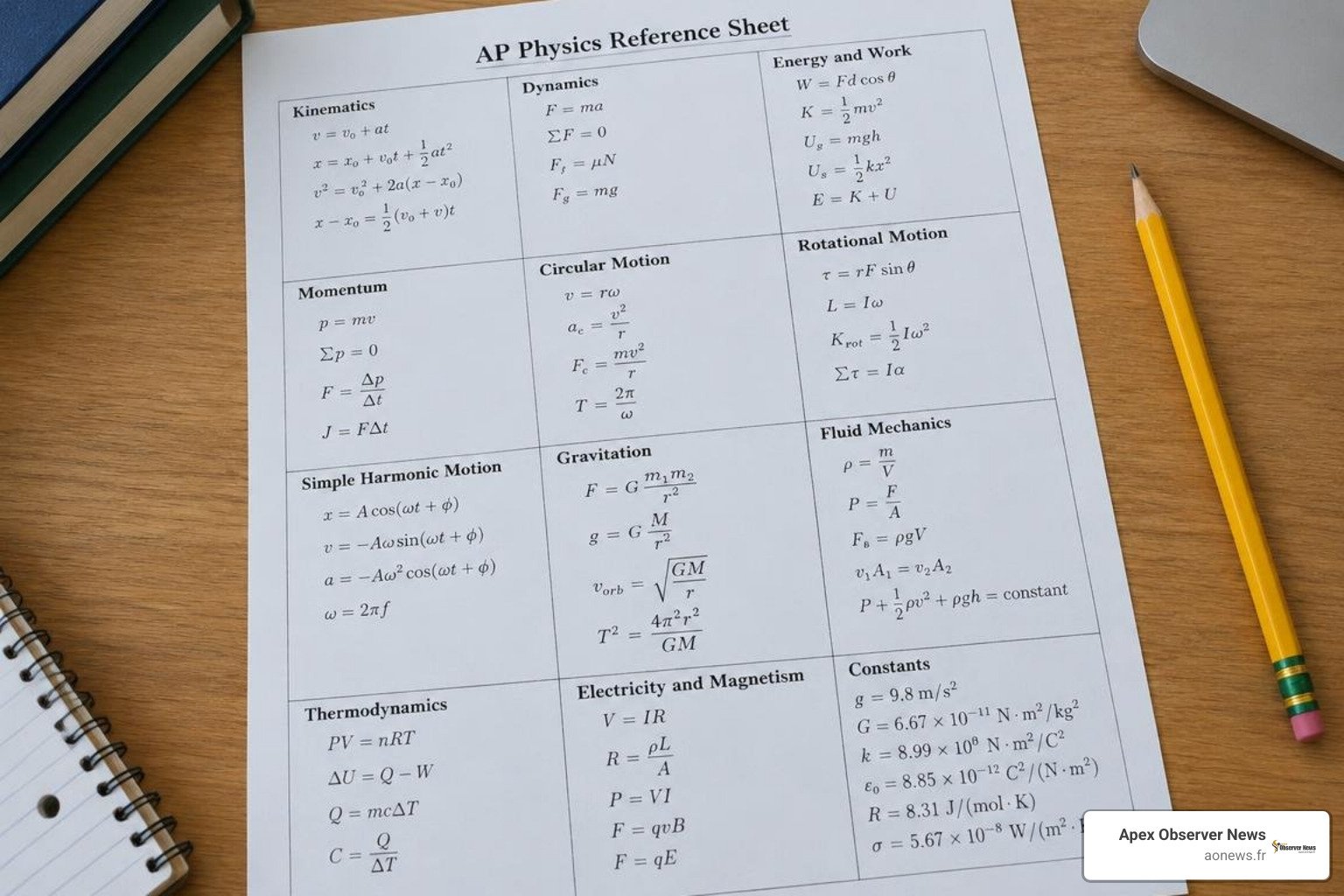
What Is Included on the Official AP Physics Formula Sheet?
When you open your exam booklet, the reference section is divided into clear functional zones. It is not just an arbitrary list of equations; it is a structured reference framework. It establishes standard physical constants, essential mathematical geometry formulas, fundamental unit prefix conversions, and mechanics formulas grouped by physical behavior.
Understanding the default exam assumptions is just as vital as knowing the formulas themselves. Unless a question explicitly states otherwise, the AP exam assumes:
- All reference frames are inertial.
- Air resistance and friction are negligible unless mentioned.
- Springs, strings, and pulleys are ideal (massless and frictionless).
- Fluids are incompressible and non-viscous.
- Pipes and conduits are completely filled.
Key Constants, Unit Prefixes, and Mathematical Conventions
At the top of the reference tables, you will find fundamental values used across multiple units:
- Universal Gravitational Constant ($G$): $6.67 times 10^{-11} text{ N}cdottext{m}^2/text{kg}^2$
- Acceleration Due to Gravity ($g$): $9.8 text{ m/s}^2$ (standard Earth surface magnitude)
- Atmospheric Pressure ($P_0$): $1.0 times 10^5 text{ Pa}$ (or $1.01325 times 10^5 text{ Pa}$)
Metric prefix multipliers are also detailed, ranging from tera ($10^{12}$), giga ($10^9$), mega ($10^6$), and kilo ($10^3$) down to centi ($10^{-2}$), milli ($10^{-3}$), micro ($10^{-6}$), nano ($10^{-9}$), and pico ($10^{-12}$).
For geometry, the tables provide surface area and volume equations for spheres ($A = 4pi r^2$, $V = frac{4}{3}pi r^3$), cylinders ($V = pi r^2 l$), and standard rectangular shapes. Trigonometric values for common angles ($0^circ, 30^circ, 37^circ, 45^circ, 53^circ, 60^circ, 90^circ$) are listed so you can resolve force vectors quickly without calculator errors.
Translational Mechanics: Kinematics, Forces, Energy, and Momentum
Translational mechanics forms the core foundation of AP Physics 1. Each of these core units typically accounts for 12% to 18% of the total exam score:
Kinematics (Constant Acceleration):
- $vx = v{x0} + a_x t$
- $x = x0 + v{x0} t + frac{1}{2} a_x t^2$
- $vx^2 = v{x0}^2 + 2ax (x – x0)$
Forces and Dynamics:
- Newton’s Second Law: $vec{a} = frac{sum vec{F}}{m}$
- Friction: $Ff le mus Fn$ and $Ff = muk Fn$
- Universal Gravitation: $Fg = G frac{m1 m_2}{r^2}$
Work, Energy, and Power:
- Kinetic Energy: $K = frac{1}{2} m v^2$
- Work: $Delta E = W = F_{parallel} d = F d costheta$
- Gravitational Potential Energy: $Delta U_g = m g Delta y$
- Power: $P = frac{Delta E}{Delta t} = vec{F} cdot vec{v}$
Linear Momentum and Impulse:
- Momentum: $vec{p} = m vec{v}$
- Impulse: $vec{J} = Delta vec{p} = vec{F}_{net} Delta t$
These equations are the building blocks for solving problems involving motion, forces, energy, and momentum. For example, the kinematic equations allow you to predict the position and velocity of an object under constant acceleration, while Newton’s second law connects forces to the resulting acceleration. The work-energy theorem and impulse-momentum theorem provide alternative approaches to analyzing motion, especially when forces vary or are not easily described. Understanding how to apply these relationships in different contexts is essential for success on the AP Physics 1 exam.
Rotational Motion, Oscillations, and Fluid Dynamics Formulas
Students can download the complete AP® Physics 1: Algebra-Based Equations Sheet to see how rotational motion, simple harmonic motion, and fluids are laid out side by side.
Navigating Rotation and Simple Harmonic Motion on the AP Physics Formula Sheet
Rotational dynamics accounts for 5% to 8% of the AP exam weighting and directly mirrors translational motion:
- Torque: $vec{tau}{net} = I vec{alpha} = vec{r} times vec{F}perp = r F sintheta$
- Rotational Kinetic Energy: $K_{rot} = frac{1}{2} I omega^2$
- Angular Momentum: $L = I omega$ (or $L = m v r sintheta$ for a point mass moving off-axis)
- Rotational Inertia: $I = sum mi ri^2$ (with specific object formulas provided when required)
For oscillations and simple harmonic motion (SHM):
- Hooke’s Law & Spring Potential Energy: $Fs = -k x$, $Us = frac{1}{2} k x^2$
- Period of a Spring-Mass System: $T_s = 2pi sqrt{frac{m}{k}}$
- Period of a Simple Pendulum: $T_p = 2pi sqrt{frac{L}{g}}$
Fluid Mechanics Principles and Pressure Equations
Fluid mechanics bridges statics and dynamic motion:
- Density and Pressure: $rho = frac{m}{V}$, $P = frac{F_perp}{A}$
- Hydrostatic Pressure: $P = P_0 + rho g h$
- Buoyant Force (Archimedes’ Principle): $Fb = rho{fluid} V_{submerged} g$
- Continuity Equation: $A1 v1 = A2 v2$ (Conservation of Mass)
- Bernoulli’s Equation: $P1 + frac{1}{2}rho v1^2 + rho g y1 = P2 + frac{1}{2}rho v2^2 + rho g y2$
AP Physics 1 vs. AP Physics 2 Reference Sheets: Key Differences
While AP Physics 1 emphasizes classical mechanics and foundational fluids, AP Physics 2 expands into thermodynamics, electricity, magnetism, optics, and quantum models. The AP Physics 2 formula sheet contains 138 equations and model relationships spanning 46 distinct topics across 7 units.
| Feature / Topic | AP Physics 1 Reference Sheet | AP Physics 2 Reference Sheet |
|---|---|---|
| Primary Scope | Mechanics, Rotation, Oscillations, Fluids | Thermal Physics, Electricity, Magnetism, Optics, Modern Physics |
| Total Relationships | ~25 core equations | 138 relationships across 46 topics |
| Thermodynamics | Not included | Ideal Gas ($PV=nRT$), First Law ($Delta U = Q + W$), Entropy |
| Electricity & Circuits | Not included | Coulomb’s Law, Electric Potential ($V$), Capacitors ($C=Q/V$), RC Circuits |
| Magnetism & Induction | Not included | Magnetic Force ($FB = qvBsintheta$), Faraday’s Law ($mathcal{E} = -frac{Delta PhiB}{Delta t}$) |
| Optics & Waves | Simple harmonic wave relationships | Snell’s Law ($n1sintheta1 = n2sintheta2$), Thin Lenses, Diffraction |
| Modern & Nuclear | Not included | Photon Energy ($E=hf$), Photoelectric Effect, Nuclear Decay |
| Provided Constants | $G, g, P_0$ | Coulomb Constant ($k$), Planck’s Constant ($h$), Speed of Light ($c$), Electron Charge ($e$) |
How to Effectively Apply Physics Equations on Exam Day
Success on AP exams relies on choosing the correct underlying physics model before calculating any numbers.

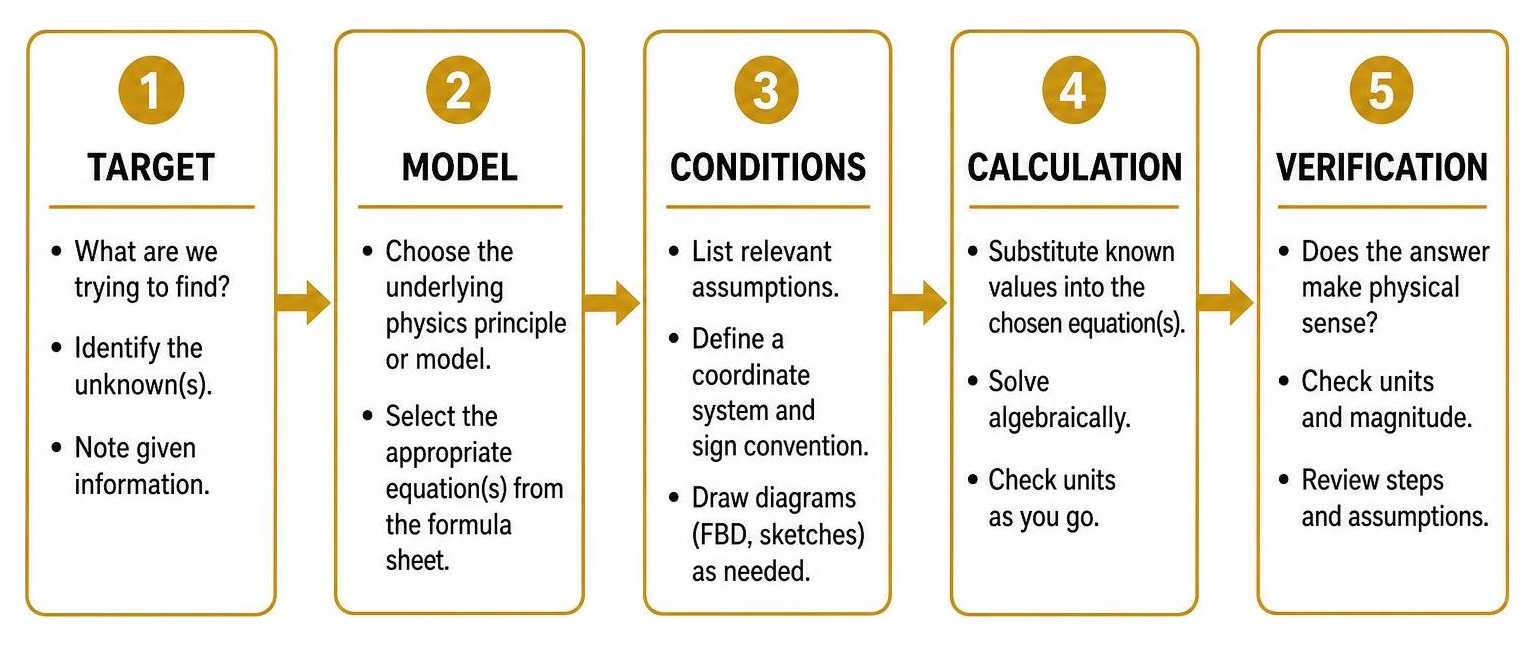
Best Practices for Using the AP Physics Formula Sheet During Testing
- Model First, Calculate Second: Before searching for an equation, state the fundamental principle governing the scenario (e.g., Conservation of Angular Momentum or Conservation of Mechanical Energy).
- Establish Coordinate Systems: Explicitly define positive and negative directions for forces, velocities, and rotational torques to avoid sign errors.
- Sketch Free-Body Diagrams (FBDs): Draw all force vectors acting on the system before applying $Sigma F = ma$.
- Solve Algebraically First: Isolate your target variable algebraically before plugging in numbers. This reduces calculation errors and earns partial credit on Free-Response Questions (FRQs).
- Check Limiting Cases and Units: Verify that your final algebraic expression yields the expected SI units and behaves logically at extreme values (e.g., when mass or friction approaches zero).
Common Mistakes and Equation Selection Traps to Avoid
- Frictional Force Confusion: Using $Ff = mus Fn$ as an equality rather than an upper bound ($F{f,text{max}} = mus Fn$). Static friction only equals the applied force necessary to prevent motion.
- Elastic vs. Inelastic Collisions: Assuming kinetic energy is conserved in every collision. Total momentum is always conserved in isolated systems, but kinetic energy is conserved only in perfectly elastic collisions.
- Kinematics with Variable Acceleration: Using $v = v_0 + at$ on systems where acceleration changes with position or time (such as simple harmonic oscillators where $a(x) = -frac{k}{m}x$).
- Sign of Work: Confusing positive and negative work done by conservative versus non-conservative external forces.
Frequently Asked Questions About the Physics Reference Tables
Do you have to memorize formulas for the AP Physics exam?
No. The official formula sheet is provided during both Section I (Multiple-Choice) and Section II (Free-Response) of the exam. Your focus should be on understanding what each variable represents and knowing when specific equations apply.
Where can you find and download the official equation sheet?
The College Board publishes the official formula tables within the AP Physics Course and Exam Description (CED) on AP Central and inside your AP Classroom portal.
Why are some standard physics formulas missing from the sheet?
The sheet provides foundational models rather than every specialized derivation. Specific case formulas (such as the normal force on an inclined plane, $F_n = mgcostheta$) are omitted because students are expected to derive them using Newton’s laws and vector components.
Conclusion
Mastering the AP Physics formula sheet comes down to strategic problem modeling, conceptual fluency, and steady practice. By familiarizing yourself with the reference sheet’s layout and default conventions well before test day, you can navigate both multiple-choice and free-response sections with speed and precision.
At Apex Observer News, we provide verified educational insights and academic breakdowns to support your learning journey. We hold our reporting and study guides to strict standards of editorial accuracy, which you can review in our fact-checking policy. Use the official tables throughout your homework and practice exams to build lasting confidence for test day.
