


How an AP Score Calculator Predicts Your Grade
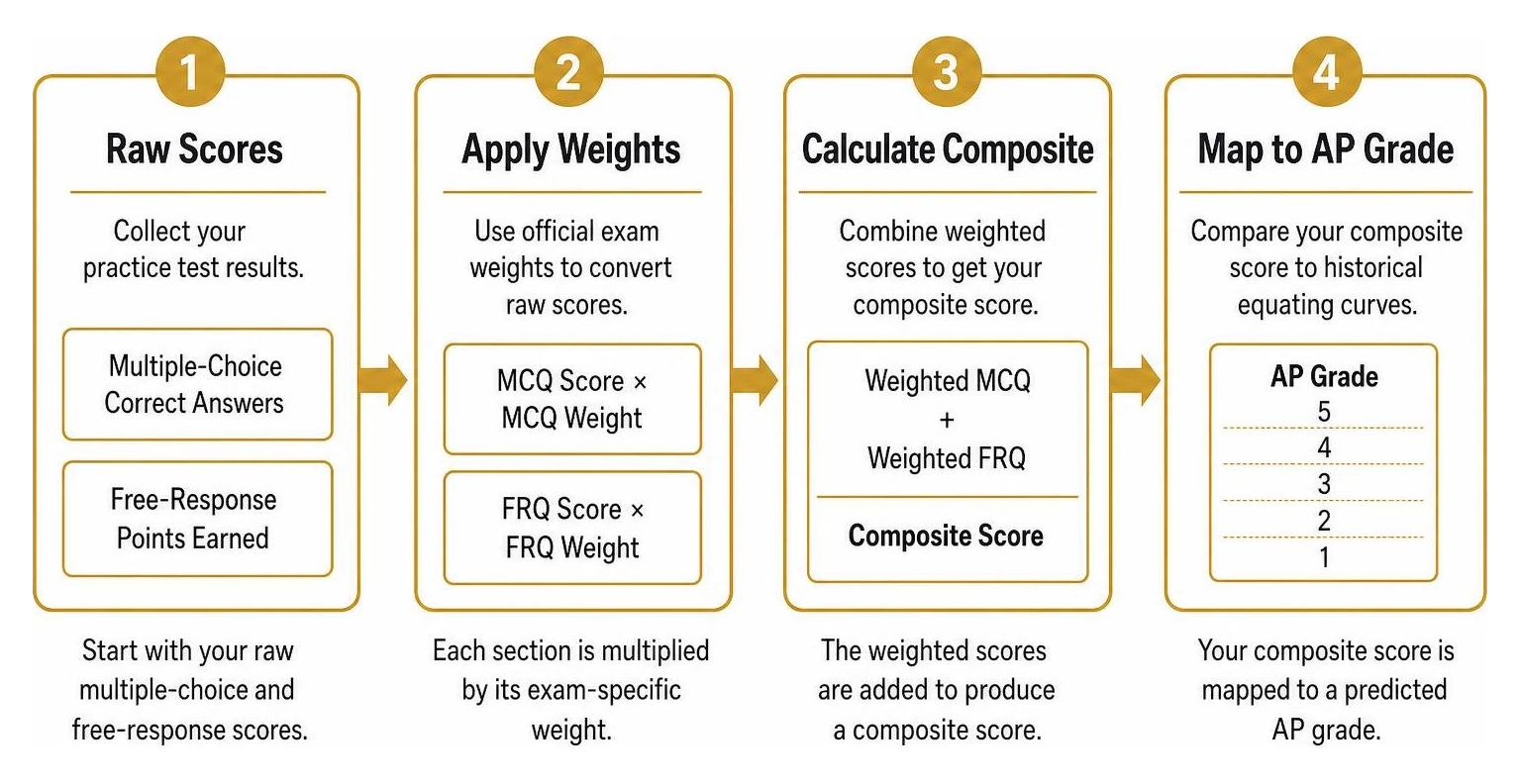
Understanding how raw practice points convert into an official score is one of the most effective ways to optimize your exam preparation. When you complete an Advanced Placement practice test, your raw scores—the number of correct multiple-choice questions (MCQs) and points earned on free-response questions (FRQs)—do not directly correspond to standard school letter grades. Instead, they pass through a mathematical weighting formula to generate a scaled composite score.
Every AP subject assigns distinct weights to its testing components. For example, some exams split performance evenly at 50% multiple-choice and 50% free-response, while others lean heavily toward written analysis or factual recall. An interactive AP score calculator automates this process by applying official College Board multipliers to your raw scores, modeling an estimated composite score, and mapping that value against historical equating curves.
The following table summarizes the structural differences, section balances, and composite point baselines across major AP exam disciplines:
| AP Subject | Multiple-Choice Format | MCQ Weight | Free-Response Format | FRQ Weight | Total Composite Base |
|---|---|---|---|---|---|
| AP English Language | 45 Questions | 45% | 3 Essays (18 pts max) | 55% | 100 Points |
| AP US History | 55 Questions | 40% | SAQs, DBQ, LEQ (22 pts max) | 60% | 100 Points |
| AP Calculus AB / BC | 45 Questions | 50% | 6 FRQs (54 pts max) | 50% | 108 Points |
| AP Biology | 60 Questions | 50% | 6 FRQs (2 long, 4 short) | 50% | 120 Points |
| AP Psychology | 75 Questions | 66.7% | 2 FRQs | 33.3% | 100 Points |
| AP Chemistry | 60 Questions | 50% | 7 FRQs (46 pts max) | 50% | 100 Points |
| AP Macro / Microeconomics | 60 Questions | 66.7% | 3 FRQs (1 long, 2 short) | 33.3% | 90 Points |
| AP Computer Science Principles | 70 Questions | 70% | Create Performance Task | 30% | 100 Points |
Step-by-Step Guide to Using an AP Score Calculator
To get an accurate projection from an online model, follow a standardized procedure rather than estimating arbitrary percentages:
- Enter Your Raw Multiple-Choice Score: Input the exact count of correct responses. Do not convert this number into a percentage first, as the scoring multipliers require raw integer counts.
- Input Free-Response Point Totals: Tally the points earned on each essay, short-answer question, or problem set using official College Board scoring rubrics.
- Apply Section Multipliers: The tool scales each section based on its overall contribution to the exam. For instance, on a 100-point composite scale where MCQs count for 45%, each of the 45 correct answers is multiplied by 1.0.
- Evaluate Your Composite Percentage: Your weighted multiple-choice and free-response figures are combined to establish a final composite score.
- Map to the 1–5 Scale: The composite total is evaluated against estimated score thresholds to identify your predicted performance band.
Weighting Differences Across Math, History, and Science
Section weighting varies significantly across academic departments. In STEM subjects like AP Calculus AB and AP Calculus BC, the structure is a balanced 50-50 split between 45 multiple-choice questions and 6 comprehensive free-response problems (9 points each, for 54 total points). AP Chemistry similarly balances 60 multiple-choice questions with 46 free-response points split across 3 long and 4 short analytical problems.
Conversely, history exams—including AP US History, AP European History, and AP World History—place the majority of their weight on written demonstration. Multiple-choice questions account for only 40% of the composite, while the remaining 60% is distributed across Short Answer Questions (SAQs at 20%), a Document-Based Question (DBQ at 25%), and a Long Essay Question (LEQ at 15%). A student who struggles on the multiple-choice section can still secure a 4 or 5 by executing strong thesis arguments and historical evidence in their written responses.
In contrast, AP Psychology and both AP Economics exams (Macroeconomics and Microeconomics) allocate 66.7% (two-thirds) of their total grade to multiple-choice performance and only 33.3% to free-response questions. In AP Macroeconomics, the free-response section is further divided: the long FRQ accounts for 50% of the section’s value, while the two short FRQs contribute 25% each. Meanwhile, AP Computer Science Principles features the lowest free-response share in the entire AP course catalog at just 30%.
AP Score Cutoffs and Score Distributions in 2026
The College Board evaluates composite scores against performance standards set by subject panels. For 22 out of 33 standard AP subjects using a normalized 100-point composite model, the general threshold estimates follow this distribution:
- Score of 5 (Extremely Well Qualified): 68 – 100 composite points
- Score of 4 (Very Well Qualified): 54 – 67 composite points
- Score of 3 (Qualified / Passing): 40 – 53 composite points
- Score of 2 (Possibly Qualified): 26 – 39 composite points
- Score of 1 (No Recommendation): 0 – 25 composite points
Certain subjects operate on unique point scales. AP Biology evaluates performance on a 120-point composite scale, while Art History, Music Theory, Statistics, Precalculus, and World Languages use tailored scoring models.
Composite thresholds demonstrate that AP exams do not require classroom-style 90% averages to earn the highest mark. In most subjects, earning roughly 65% to 75% of the total available weighted points places a student comfortably in the 5 range.
| Subject | Composite Base | Est. 5 Cutoff | Est. 4 Cutoff | Est. 3 Cutoff | % Scoring 3+ (2026) | % Scoring 5 (2026) |
|---|---|---|---|---|---|---|
| AP Chinese Language | Subject-Specific | ~75% | ~63% | ~50% | 85% | 48% |
| AP Calculus BC | 108 Points | ~63% | ~51% | ~39% | 78% | 46% |
| AP Calculus AB | 108 Points | ~68% | ~54% | ~40% | 62% | 22% |
| AP Biology | 120 Points | ~72% | ~58% | ~45% | 66% | 16% |
| AP US History | 100 Points | ~70% | ~56% | ~42% | 72% | 13% |
| AP Music Theory | Subject-Specific | ~70% | ~57% | ~44% | 59% | 19% |
| AP Computer Science Principles | 100 Points | ~70% | ~58% | ~44% | 64% | 10% |
Data from the 2026 testing administration highlights notable variation in outcome distributions. AP Chinese Language and Culture recorded the highest qualification rate, with 85% of test-takers earning a 3 or higher. AP Calculus BC produced a 46% rate of 5s, driven largely by self-selected, advanced mathematics cohorts. By contrast, AP Computer Science Principles recorded a 5 rate of only 10%, and AP Music Theory registered the lowest overall pass rate (3 or higher) at 59%.
Across higher education, a score of 3 is widely recognized as passing, qualifying students for general college credit or course advancement at broad-access universities. However, highly competitive institutions frequently require a 4 or 5 for subject-area credit or prerequisite exemptions.
Guessing Strategy and Multiple-Choice Scoring
Since May 2011, the College Board has eliminated all guessing penalties across every AP exam. Your raw multiple-choice score is calculated strictly as the total number of correct answers. Incorrect answers and omitted questions both receive zero points.

Because there is no fractional penalty for an incorrect selection, you should never leave a multiple-choice question blank. If you run short on time during an exam section, bubbling in a uniform response for all remaining questions mathematically maximizes your expected point total. Pacing routines should ensure you leave at least 60 seconds at the end of the section to verify that every bubble is filled.
Limitations of Any AP Score Calculator
While a free AP score predictor provides helpful benchmarking during study sessions, these tools have specific limitations:
- Unpublished Annual Cutoffs: The College Board does not release real-time composite boundary figures for active exam administrations.
- Psychometric Equating: Raw cutoffs shift by several points each year through psychometric equating to compensate for subtle differences in exam difficulty between test forms.
- Borderline Ambiguity: If your practice composite score sits within 2 to 3 points of a score cutoff (e.g., scoring 67 when a 5 begins at 68), your actual result could fall on either side of the boundary.
- Practice Material Calibration: Unofficial third-party practice exams may not fully match the calibration, tone, or difficulty of official test forms.
Practical Strategies to Maximize Your AP Composite Score
Using score conversion dynamics can help make your study sessions more efficient. Rather than studying all topics equally, focus your time where point gains will have the greatest impact on your composite score.
- Administer a Diagnostic Benchmark: Complete a full-length, previously released College Board practice exam under strict time limits.
- Calculate Your Starting Baseline: Convert your section totals into an estimated composite score to see where you stand relative to your target band.
- Target High-Yield Sections: In subjects with heavy FRQ weightings (such as AP History at 60%), prioritize essay structure and rubric criteria to capture high-leverage points.
- Simulate Digital Testing: For exams taken on the digital testing platform, practice pacing on screen to get comfortable with the interface.

How to Accurately Grade Practice Free-Response Questions
Self-scoring free-response work requires an objective, conservative approach. Students often grade their own practice writing too generously, creating unrealistic composite estimates.
To ensure your practice scores reflect official standards:
- Use Official Scoring Guidelines: Grade your answers using the exact scoring commentaries and rubrics released for that specific exam year.
- Enforce Binary Criteria: Points on history rubrics (such as contextualization, thesis, and evidence) are awarded on an all-or-nothing basis. If your thesis does not make a historically defensible, evaluative claim, do not award the point.
- Apply the “Trained Reader” Standard: When evaluating short-answer or essay questions, award points only if the required terminology, historical evidence, or mathematical steps are clearly stated. If an answer is vague or ambiguous, score it as zero.
Turning Score Estimates into Targeted Study Plans
After grading your practice test and running your numbers through a calculator, evaluate your score breakdown to guide your study plan:
- Analyze the Section Gap: If your multiple-choice accuracy is 75% but your free-response performance is below 50%, shift your study time away from flashcards and toward timed essay drafting.
- Identify Low-Effort Point Gains: On exams like AP Calculus AB or AP Chemistry, review common multi-step problem formats to ensure you consistently earn method and setup points on free-response questions.
- Schedule Recalculation Milestones: Re-evaluate your composite score every two to three weeks following full-length practice sessions to monitor your progress toward target thresholds.
Frequently Asked Questions About AP Scoring
When are AP scores officially released and how can students check them?
Official AP exam scores are released in early July each year. Students can access their complete score reports online through their College Board accounts. Scores for all subjects taken during the May administration are published simultaneously, alongside scores from previous exam years.
What is the College Board’s official stance on score calculators?
The College Board does not build, endorse, or publish official AP score calculators. The organization considers all third-party scoring calculators to be unofficial estimation tools. The College Board uses statistical equating to adjust raw-to-composite score boundaries each year, ensuring consistent achievement standards across different test forms.
Why do different online calculators yield different composite results?
Different online calculators may show slightly different results for two main reasons: the underlying data models they use and how frequently they update their presets. Some calculators rely on older historical score curves from prior exam formats, while others use conservative, updated models based on current subject frameworks. Differences of a few percentage points across tools reflect varying estimates of annual score boundaries.
Conclusion
Calculating your estimated AP composite score is an effective way to track progress, pinpoint academic weaknesses, and set realistic goals before test day. By understanding section weights, avoiding blank answers on multiple-choice sections, and applying strict rubric criteria to free-response practice, you can focus your study time where it makes the biggest difference.
At Apex Observer News, our editorial team tracks educational data, testing policy changes, and academic developments. We maintain strict reporting integrity in accordance with our fact-checking standards to deliver reliable, up-to-date guidance for students navigating college-preparatory benchmarks. Use these scoring frameworks as diagnostic guides, focus your practice on high-yield areas, and approach test day with confidence.
