


2026 Nissan Leaf Review: A Strong Budget EV With Clear Trade-Offs
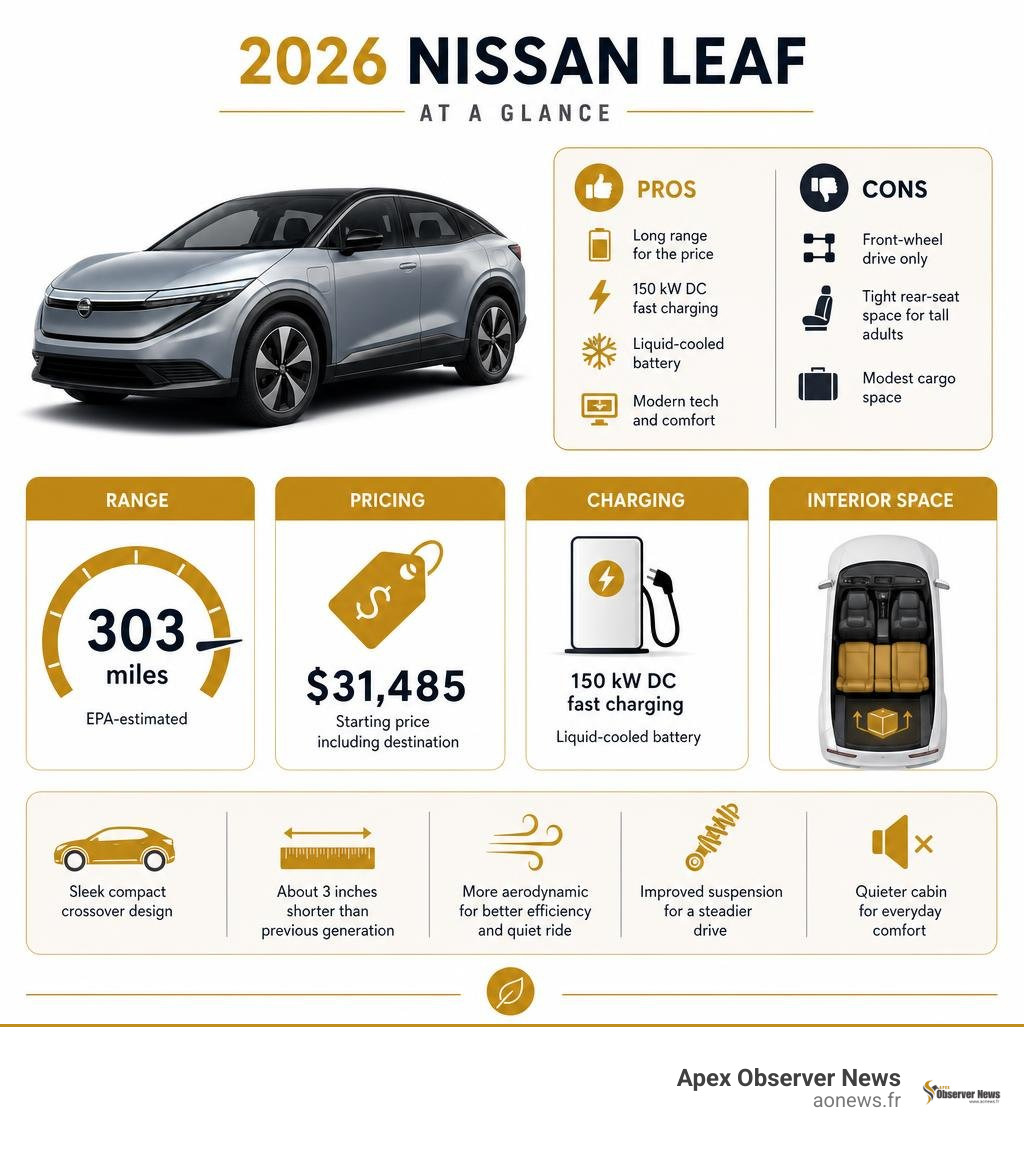
This Nissan Leaf review finds that the redesigned 2026 model is a practical choice for drivers who want long range without a high EV price. Starting at $31,485 including destination, the Leaf S+ offers an EPA-estimated 303 miles of range, while the liquid-cooled battery and 150 kW DC fast charging fix two of the biggest weaknesses of older Leafs.
The trade-offs are simple: it is front-wheel drive only, rear-seat room is tight for tall adults, and cargo space is modest for a family crossover. But for commuting, errands, and occasional road trips, the new Leaf delivers unusually strong range, modern charging access, and useful technology for the money.
The third-generation Leaf also moves away from the old hatchback shape toward a sleeker compact crossover. It is actually about 3 inches shorter than before, yet its more aerodynamic body, improved suspension, and new EV platform aim to make it quieter, steadier, and easier to live with every day.
I am Faisal S. Chughtai, founder of ActiveX, with experience in technology, digital publishing, and SEO-focused consumer research. In this Nissan Leaf review, I break down the specs and real-world compromises that matter before you buy.
Learn more about nissan leaf review:
2026 Nissan Leaf Review: Powertrain, Range, and Charging Architecture
The 2026 Nissan Leaf introduces a dedicated electric vehicle platform equipped with a 75-kWh battery pack and an active liquid cooling system. This thermal architecture replaces the passive air cooling of previous generations, maintaining stable cell temperatures during prolonged highway cruising and rapid replenishment cycles.
Understanding Electric Vehicle Battery Costs 101 highlights how pack density and thermal controls dictate vehicle retail prices, and Nissan has managed to deliver modern hardware while anchoring the segment’s entry price point.
Motivating the front wheels is a 160-kW permanent-magnet synchronous electric motor producing 214 horsepower and 261 lb-ft of torque. The drivetrain provides instant, smooth off-the-line response tailored for merging, passing, and stop-and-go urban traffic.
Freelance SEO Consultant Rates: What You Should Expect to Pay
Battery Thermal Management and NACS DC Fast Charging
Nissan has retired the outdated CHAdeMO standard in North America in favor of a dual-port configuration. The passenger-side fender houses an SAE J3400 (NACS) DC fast-charging port, granting native access to widespread high-speed fast chargers without clunky adapters. On the driver-side fender, a standard J1772 port handles Level 1 and Level 2 AC home charging.
With liquid cooling keeping pack temperatures within ideal operational windows, the 2026 Leaf sustains a peak fast-charging rate of 150 kW. This allows the battery to charge from 10% to 80% in 35 minutes. Independent highway tests demonstrate that a 15-minute quick stop can add over 110 miles of driving range.
Real-World Range and Efficiency Across Trims
Efficiency across the lineup is rated at an impressive 33 kWh per 100 miles. Range figures vary by trim level due to differences in standard equipment, wheel diameters, and aerodynamic tire selections.
| Trim Level | Base Price (with Dest.) | Battery Capacity | EPA-Estimated Range | Real-World 75-mph Highway Range |
|---|---|---|---|---|
| S+ | $31,485 | 75 kWh | 303 Miles | ~265 Miles |
| SV+ | $35,725 | 75 kWh | 288 Miles | ~255 Miles |
| Platinum+ | $40,485 | 75 kWh | 259 Miles | 250 Miles |
During 75-mph steady highway evaluation, the top-spec Platinum+ achieved 250 miles on a full charge, closely tracking its official EPA estimate and demonstrating predictable energy management across varying elevations.
Design, Platform Upgrades, and Driving Dynamics

Built on a dedicated EV platform, the 2026 Leaf adopts a crossover silhouette with a curb weight of 4,367 pounds on fully equipped trims. The low center of gravity provided by the floor-mounted 75-kWh pack improves lateral stability compared to the outgoing hatchback.
Exterior Crossover Transformation and Aerodynamics
The vehicle is approximately 3 inches shorter in overall length, 0.8 inches wider, and 0.4 inches lower than the second-generation model. Despite its raised stance, it achieves a slippery drag coefficient of 0.26.
Key aerodynamic and design elements include:
- Flush-mounted pop-out door handles to smooth airflow along the flanks.
- An aerodynamic rear roof spoiler designed to reduce high-speed wake turbulence.
- A full-width front LED light bar paired with stacked rectangular taillights—an Easter egg motif referencing the Japanese counting sequence “ni-san” (2-3).
Handling, Steering Precision, and Suspension Performance in This Nissan Leaf Review
The Leaf’s driving dynamics benefit from moving the electric power steering assist motor directly onto the steering rack. This change eliminates the vague on-center feel of earlier models, providing direct turn-in and predictable tracking through sweeping curves.
A multilink independent rear suspension reduces chassis impact harshness over broken pavement by roughly 30%. In straight-line acceleration testing, the 214-hp motor propels the Leaf Platinum+ from 0 to 60 mph in 6.9 seconds, passing the quarter-mile mark in 15.4 seconds at 93 mph.
Braking combines standard hydraulic discs with regenerative steering-wheel paddles. Nissan utilizes an updated multi-level e-Pedal system; however, drivers should note that regenerative braking disengages below 7 mph, requiring the driver to press the physical brake pedal to come to a complete halt rather than offering full true one-pedal stopping.
Interior Space, Cargo Practicality, and Everyday Tech

Inside the cabin, Nissan’s Zero Gravity seats provide long-distance spinal support, while extensive acoustic glass and insulated floor panels keep road rumble minimal. Routine maintenance remains straightforward for prospective owners, and knowing How to Replace Cabin Air Filter in 5 Easy Steps ensures the cabin stays fresh through changing seasons.
Infotainment, Google Built-In, and Electrochromic Glass Roof
The dashboard features dual 14.3-inch high-definition digital screens under a single curved glass pane. The infotainment system integrates Google Built-In, providing native Google Maps route planning with automated EV charging stops and battery pre-conditioning.
Additional tech highlights include:
- Electrochromic Panoramic Roof: Dims from transparent to fully opaque at the touch of a button, blocking glare without requiring a mechanical roller shade.
- Bose Audio with Headrest Speakers: Delivers targeted audio and navigation cues directly to the driver.
- Vehicle-to-Load (V2L) Capability: Supplies up to 1.9 kW of external power to run camping gear, power tools, or mobile appliances.
- Connected Services: Essential remote telematics are complimentary for the first year, after which full connected navigation packages require a recurring subscription.
Cabin Room, Seating Ergonomics, and Cargo Capacity Trade-Offs
While the packaging maximizes space efficiently, compact crossover exterior dimensions force several practical trade-offs:
- Rear Footroom Constraints: The underfloor battery packaging raises the cabin floor, leaving minimal space beneath the front seats for rear passengers’ shoes.
- Taller Passenger Headroom: The sloping rear roofline limits rear headroom for occupants over six feet tall.
- Rear Cargo Room: The trunk offers 20 cubic feet behind the second row, expanding to 55.5 cubic feet with the 60/40 split-folding rear seats laid flat.
- No Front Trunk (Frunk): The front hood area is fully occupied by the front-drive inverter, motor, and thermal hardware, leaving zero storage under the hood.

Trim Breakdown and Ownership: Which Model Offers the Best Value?
Navigating subcompact EV pricing requires balancing battery size, tech features, and convenience. While larger crossovers like the one detailed in our Tesla Model Y Review provide extra volume, the Leaf’s low purchase price offers an unmatched cost-per-mile ratio for commuters.
S+ vs. SV+ vs. Platinum+: Value Analysis in Our Nissan Leaf Review
- S+ ($31,485): The price-to-range leader. Features standard 17-inch aero wheels, the 75-kWh battery delivering an EPA-rated 303 miles, standard Nissan Safety Shield 360, and dual digital displays.
- SV+ ($35,725): The balanced sweet spot. Adds ProPilot Assist lane-centering adaptive cruise, a high-efficiency cabin heat pump, heated front seating, and Google Built-In functionality while offering 288 miles of range.
- Platinum+ ($40,485): The luxury package. Includes 19-inch alloy wheels (lowering range to 259 miles), the electrochromic dimming glass roof, Bose audio, multi-color ambient lighting, and V2L power export ports.
Daily Driving Verdict: Pros, Cons, and Key Compromises
Pros:
- Lowest starting price among 300-mile electric vehicles in the segment.
- Modern 150 kW NACS DC fast charging eliminates previous CHAdeMO bottlenecks.
- Liquid thermal management protects battery longevity.
- Direct rack-mounted steering and quiet cabin acoustics.
Cons:
- Front-wheel drive only; no all-wheel-drive dual-motor option is available.
- Tight rear legroom and limited under-seat foot space for tall passengers.
- Multi-level e-Pedal does not bring the car to a full stop without manual brake application.
- Cold-weather battery heater is an optional $300 add-on on lower trims.
Frequently Asked Questions About the 2026 Nissan Leaf
What is the real-world charging speed and port setup on the 2026 Leaf?
The 2026 Leaf features a dual-port setup: a passenger-side NACS DC port for 150 kW fast charging (10% to 80% in 35 minutes) and a driver-side J1772 port for standard Level 2 AC home charging.
How does the 2026 Leaf prevent previous battery degradation issues?
Nissan replaced the old passive air-cooling design with an active liquid-cooled thermal management system. This actively circulates coolant to protect the cells during heavy loads, backed by an 8-year/100,000-mile capacity retention warranty.
Which 2026 Nissan Leaf trim level offers the best balance of range and price?
The SV+ at $35,725 represents the best overall balance. It provides an EPA-estimated 288 miles of range, a standard heat pump for cold-weather efficiency, Google Built-In navigation, and ProPilot Assist driver assistance.
Conclusion
The third-generation 2026 Nissan Leaf successfully reinvents itself, transforming from an aging budget hatchback into a modern, long-range electric crossover. By addressing historical shortcomings with an active liquid-cooled 75-kWh pack, standard NACS fast charging, and up to 303 miles of range at an accessible starting price, it sets a strong benchmark for entry-level EV ownership. Explore more automotive insights and in-depth vehicle evaluations by browsing our automotive expert reviews and EV buying guides.
Imran Khan ex-wife Jemima Goldsmith wedding, sons walk her down the aisle
