


If you want to know how to successfully study, stop rereading and start testing yourself. The five methods below are quizzing yourself, spacing your sessions, mixing problem types, explaining ideas in your own words, and protecting your focus. Self-quizzing and spacing suit anyone facing an exam. Mixed practice suits math and science students. Explaining suits dense reading subjects, and the focus routine suits anyone who sits down to study and drifts.
Most students already put in the hours. The problem is that the most common habits, rereading notes, highlighting, and one long session the night before, feel productive without building much lasting memory. Studying effectively means choosing methods that make your brain work harder in the moment, so the material is still there on exam day.
This article gives you five methods, each with the reason it works and a concrete way to start. They apply whether you study at home, in a library, or for a high-stakes test like an AP exam. You can use all five together, or pick one and build from there.
1. Quiz yourself instead of rereading
Quizzing yourself, often called retrieval practice, is the single best answer to how to study effectively for exams. Pulling information out of memory strengthens it far more than looking at it again.

Why it works
Rereading creates a feeling of familiarity. You recognize the words, so you assume you know the content. An exam does not ask you to recognize anything. It asks you to produce an answer from nothing, and only recall practice trains that skill.
Quizzing also shows you what you do not know while you still have time to fix it. A missed flashcard on Tuesday is useful information. A missed question on exam day is just a lost point.
How to do it
- Close your notes and write everything you remember about a topic for five minutes.
- Turn every heading in your notes into a question, and answer it from memory.
- Say your flashcard answer out loud before you flip the card.
- Do practice problems and past exam questions. For AP courses, the College Board publishes past free-response questions.
- Mark what you missed, then quiz those items again the next day.
Testing yourself is not a way to check your studying. It is the studying.
2. Space your sessions across days
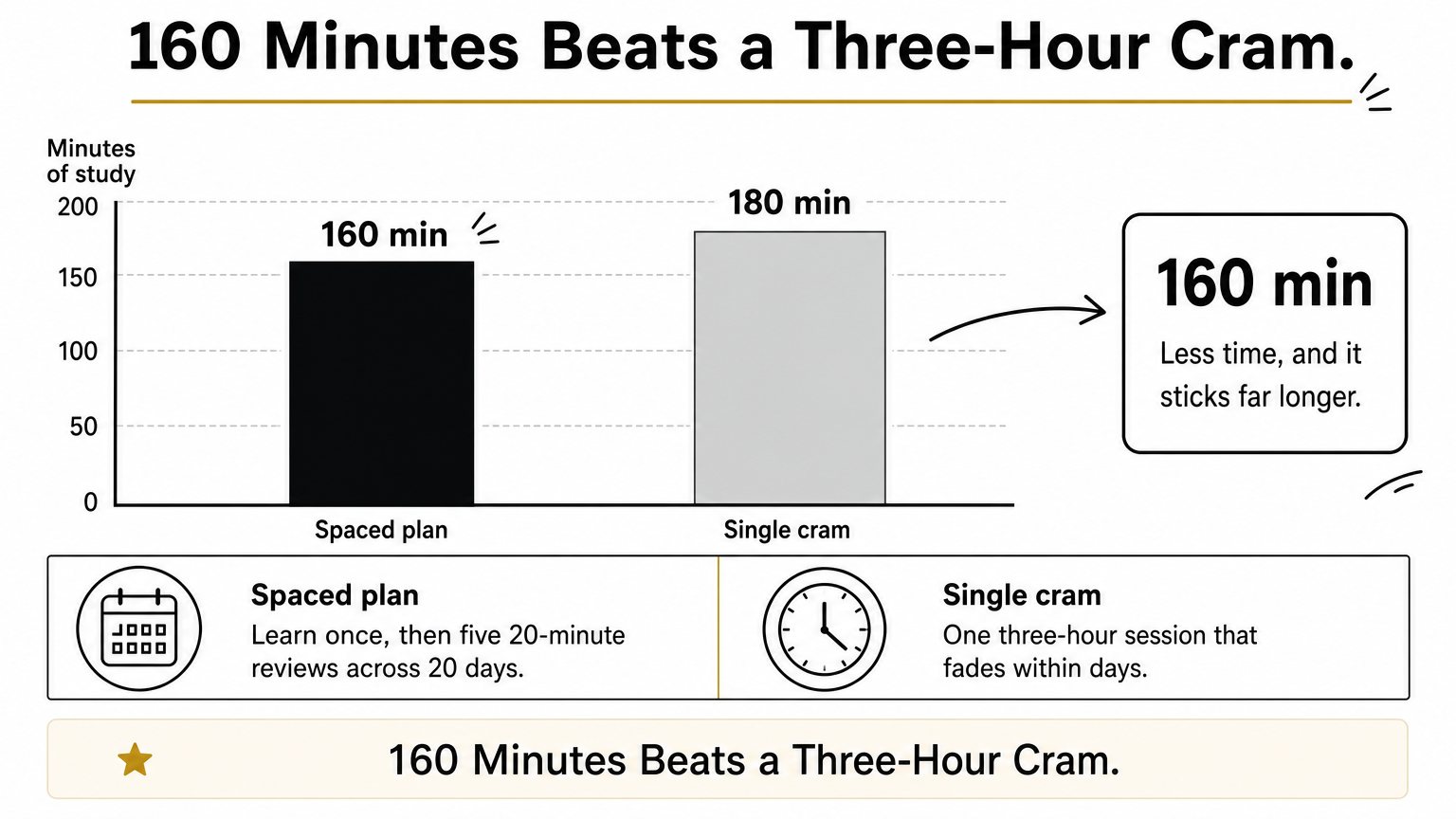
Spacing means splitting your study into several shorter sessions spread over days or weeks. It beats a single long session because forgetting is what makes the next review effective.
Why it works
Cramming can get you through tomorrow morning, but the material fades within days. Each time you return to a topic after a gap, you have to work to retrieve it, and that effort tells your memory the information matters. Short gaps feel easy, so make them longer each time.
Named shortcuts such as the 2/3, 5/7 rule or the 3-2-1 method are packaged versions of this idea. Use one if it gets you to start, but the principle underneath is what counts: review, wait, review again.
How to do it
Here is a sample plan for an exam three weeks away, for one topic:
| Day | Task | Time |
|---|---|---|
| 1 | Learn the material | 60 min |
| 2 | Quiz from memory | 20 min |
| 4 | Quiz again | 20 min |
| 8 | Quiz again | 20 min |
| 15 | Quiz again | 20 min |
| 20 | Final mixed review | 20 min |
That adds up to 160 minutes (60 plus five reviews of 20), spread across 20 days. It is less than a single three-hour cram, and it sticks far longer. Put the dates in your calendar on day 1, so the schedule decides for you.
Several short reviews with gaps between them beat one long session, every time.
3. Mix up problem types while you practice
Interleaving means shuffling different types of problems or topics in one session instead of finishing one type before starting the next. It is one of the most efficient ways to study anything built on problem solving.
Why it works
When you do ten problems of the same kind in a row, you always know which method to use. That feels smooth, but exams do not label their questions. Mixed practice forces you to identify the problem type first, and that identification is often the hardest step.
Studies on math learning have found that students who practice in mixed order usually score better on later tests than those who practice in blocks, even though blocked practice feels easier during the session. Expect mixed practice to feel harder. That difficulty is the point.
How to do it
- After finishing a chapter, build a review set with a few problems from each earlier chapter.
- Before solving each problem, write down its type and the method you plan to use.
- Alternate subjects in a longer session, for example 45 minutes of chemistry, then 45 of history.
- Use cumulative practice tests, not end-of-unit quizzes, in the final weeks.
If every problem in your session looks the same, your practice is easier than your exam.
4. Explain each idea in your own words
If you cannot explain an idea simply, you do not understand it yet. Explaining out loud or on paper is how to study effectively when the material is dense, conceptual, or full of cause and effect.
Why it works
Reading lets you skim past gaps without noticing them. Explaining does not. The moment you stumble, you have found a gap. This approach, often called the Feynman technique, also forces you to connect new ideas to what you already know, which makes recall easier later.
Structured reading methods such as SQ3R (survey, question, read, recite, review) work for the same reason. They push you to question and restate the text instead of passively absorbing it.
How to do it
- Read one section, then close the book.
- Explain it out loud as if teaching a friend who has never heard of the topic.
- Note every place you hesitated, used vague words, or skipped a step.
- Go back to the text for just those gaps, then explain again.
- Ask "why" and "how" about each fact, and link it to an earlier topic.
A study partner makes this stronger. Take turns explaining a topic, and let the listener ask questions.
You understand a topic only when you can explain it without looking.
5. Protect your focus with short, planned blocks
Good methods fail when your attention is split, so the last step in how to efficiently study is to set up the conditions. Plan a specific time, a specific task, and a space where distractions cannot reach you.
Why it works
Switching between your notes and your phone costs more than the seconds it takes. Each switch breaks your concentration and makes you restart mentally. Short blocks with real breaks keep your attention high, and sleep is when your brain consolidates what you studied, so an all-nighter works against you.
If you have ADHD, the same principles apply, with adjustments. Use shorter blocks of 10 to 15 minutes, one clearly defined task per block, and movement during breaks. For formal support, talk to your school or a medical professional.
How to do it
- Write the plan before you sit down, such as "Chapter 6 practice problems, 45 minutes."
- Use 25 minutes of work and a 5-minute break (the Pomodoro method), and take a longer break every four rounds.
- Put your phone in another room, not just face down.
- To study effectively at home, use one fixed spot, preferably a desk and not your bed.
- Stop at a regular time and sleep.
Decide what you will study before you sit down, not after.
Start with one method
To successfully study, build your sessions around recall, spread them out, mix the problem types, explain ideas in your own words, and guard your focus. You do not need all five on day one. Start with self-quizzing and a simple review calendar, and add the others as they become habits.
If you are preparing for an AP exam, you can put these methods to work on specific material. Find AP exam study guides, score calculators, and test-day resources at AONews and use them as review checkpoints.
