

To use an AP English Language score calculator, you need four numbers: your multiple-choice score out of 45 and three essay scores out of 6 each. The calculator weights multiple choice at 45% and the essays at 55%, adds them into a composite out of 100, and maps that composite to a 1 to 5 AP score. You can do the same math by hand in about two minutes, and the steps below show you how.
The hard part is not the arithmetic. Students enter an inflated essay score, trust a curve that is only a guess, and end up either panicking or coasting. College Board does not publish cut scores ahead of time, and they shift a little each year. Every AP Lang calculator, whether it is labeled 2026 or 2027, gives an estimate. How honestly you grade your own essays moves the result more than which tool you pick.
AONews publishes AP exam guides, including score calculators and conversion curves for other courses, and this one works the same way. First you will see how the score is built. Then four steps: score your multiple choice, grade your essays, calculate the composite, and convert it to a 1 to 5 score you can act on.
How the AP Lang score is built
The AP English Language and Composition score is a weighted composite of two exam sections, converted to a 1 to 5 scale. Knowing the weights lets you check any calculator instead of trusting it blindly.
The two sections and their weights
Section I is 45 multiple-choice questions based on passages. Section II is three free-response essays. Each essay is scored from 0 to 6, so the essays total 18 raw points. That 18 is stretched to fill 55% of the composite, which makes each essay worth about 18.3% of your score.
| Section | Format | Time | Raw points | Weight |
|---|---|---|---|---|
| I. Multiple choice | 45 questions | 1 hour | 45 | 45% |
| II. Free response | Synthesis, rhetorical analysis, argument | 2 hours 15 minutes, including a 15-minute reading period | 18 (6 per essay) | 55% |
Wrong multiple-choice answers do not cost you points, so a blank is never better than a guess.
One essay point is worth about three multiple-choice questions, so the essays decide more than most students expect.
Why every calculator gives an estimate
College Board sets the cut points after scoring, so that a 3 means the same level of performance from year to year. A calculator can only borrow the curve from earlier exams. The section weights and essay rubrics have stayed the same in recent years, so that borrowed curve is a reasonable guide. Still, treat any result as accurate to within about 4 or 5 composite points.
Step 1. Score your multiple-choice section
Count the questions you answered correctly. That number, from 0 to 45, is your multiple-choice raw score. You subtract nothing for wrong answers.
Make the practice count
Your score only means something if the practice resembled the exam. Sit all 45 questions in one hour, with no phone and no pauses. Ask your teacher to assign a full-length set through AP Classroom, or use the sample questions in the official AP English Language course page. A 15-question quiz scored at 12 correct does not equal 36 out of 45, because stamina matters in the last 15 questions.
Enter correct answers only, and only from a timed full set.
Step 2. Grade your three essays
Score each essay from 0 to 6 using the official rubric, which is the same structure for all three questions. Be strict. Self-graded essays are the biggest source of error in any score estimate.

The 6-point rubric
| Row | What it rewards | Points |
|---|---|---|
| A. Thesis | A defensible thesis that answers the prompt, not a restatement of it | 0 to 1 |
| B. Evidence and commentary | Specific evidence, plus explanation of how it supports your line of reasoning | 0 to 4 |
| C. Sophistication | A nuanced understanding of the rhetorical situation or tension, sustained through the essay | 0 to 1 |
For synthesis, evidence means using at least three of the provided sources. For rhetorical analysis, it means naming the writer’s choices and explaining their effect. For the argument essay, it means your own examples and reasoning.
Grade conservatively
Give the sophistication point only when the whole essay shows it, not when one clever sentence does. Most strong student essays land at 4 or 5, and a 6 is rare. If you are torn between two scores, record the lower one. Better still, have a teacher or classmate grade the essay too, then compare the result against the scoring commentary and sample responses on AP Central.
When you doubt an essay score, pick the lower number.
Step 3. Calculate your composite score
Add your multiple-choice score to your weighted essay points. The essay total is multiplied by 55 ÷ 18, which is about 3.056, so that the three essays together fill 55 of the 100 composite points.
The formula
Composite = MC correct + (Essay 1 + Essay 2 + Essay 3) × 3.056
This table gives the weighted value of common essay totals, so you can skip the multiplication.
| Essay total (out of 18) | Weighted points (out of 55) |
|---|---|
| 0 | 0 |
| 3 | 9.2 |
| 6 | 18.3 |
| 9 | 27.5 |
| 12 | 36.7 |
| 15 | 45.8 |
| 18 | 55.0 |
A worked example
Say you answered 30 of 45 multiple-choice questions correctly. You scored 4 on the synthesis essay, 4 on the rhetorical analysis, and 3 on the argument. Your essay total is 11, which is worth 11 × 3.056 = 33.6 weighted points. Your composite is 30 + 33.6 = 63.6 out of 100.
Composite means multiple-choice correct plus essay total times 3.056.
Step 4. Convert your composite to a 1 to 5 score
Compare your composite with the approximate cut ranges below. These are planning ranges based on how the curve has tended to fall, not official numbers. Real cut scores move by a few points each year.
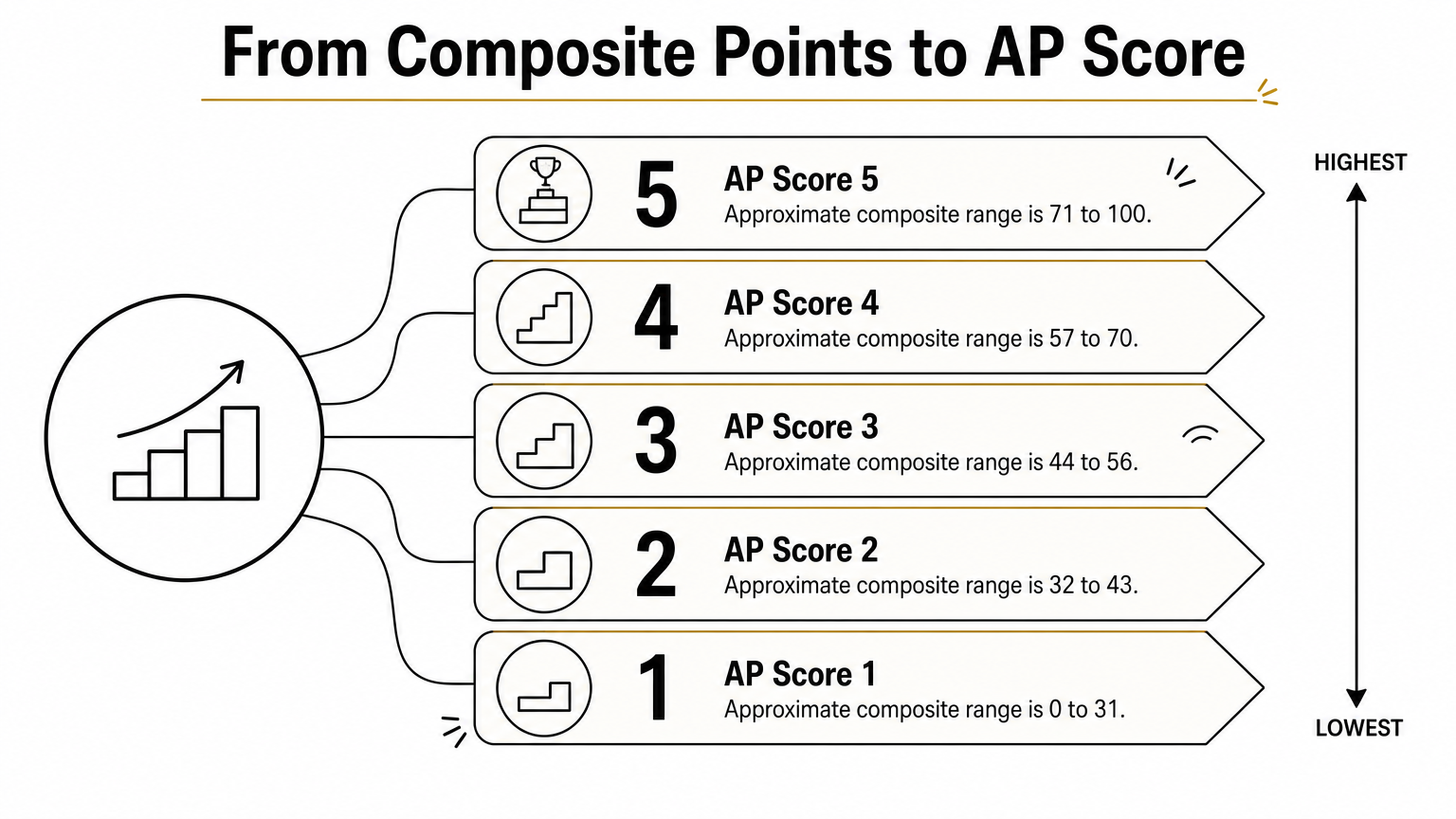
| AP score | Approximate composite |
|---|---|
| 5 | 71 to 100 |
| 4 | 57 to 70 |
| 3 | 44 to 56 |
| 2 | 32 to 43 |
| 1 | 0 to 31 |
How different score mixes land
| Student | MC correct | Essays | Composite | Likely score |
|---|---|---|---|---|
| A | 25 | 3, 3, 3 | 52.5 | 3 |
| B (the example above) | 30 | 4, 4, 3 | 63.6 | 4 |
| C | 35 | 5, 4, 4 | 74.7 | 5 |
Student B sits in the middle of the 4 range, but Student A is only about 4 points from a 4.
What to do with your estimate
If your composite is within 4 or 5 points of a cut line, treat the outcome as open and plan accordingly. Then work on whichever section gains points fastest. Raising one essay by a single rubric point adds about 3 composite points, the same as three more multiple-choice questions. The cheapest gains are usually the thesis point and the evidence-and-commentary row, because both are teachable habits. Run the calculation again after each full practice test and watch the trend, not a single result.
Near a cut line, one essay point can change your score.
Turning your estimate into a plan
An AP Lang score estimate takes four steps. Count multiple-choice correct answers, grade each essay out of 6 against the rubric, apply the 45% and 55% weights, and compare the composite with the approximate cut ranges. Grade strictly, and treat the answer as a range, not a promise.
Use the number to decide where your next hour of practice goes. If you want more score calculators, exam schedules, and study guides for other courses, browse the AP exam guides on AONews.
