


Breaking Global Trade War News: US Escalates Tariffs on Sixty Economies
Trade relations across the globe face renewed volatility this October 2026 as Washington rolls out an aggressive expansion of its tariff regime. The United States has unveiled plans to levy broad import duties ranging from 10% to 12.5% on goods originating from 60 economies. This expansive measure represents a significant departure from historic baseline duty rates of 2% to 5%, signaling an era of heightened protectionism.
As these measures take shape, corporate supply chains face acute restructuring pressures. Analysts tracking the direct impact on the US economy warn that universal baseline tariffs risk inflating input costs across manufacturing sectors while raising retail prices for end consumers.
White House Threatens EU Over Technology Penalties
Beyond blanket import duties, Washington has opened a contentious regulatory front with Brussels. The White House issued an explicit warning to the European Union, threatening retaliatory tariffs in direct response to European regulatory fines levied against American technology corporations.
This friction intensified following substantial penalties imposed by Brussels on major tech firms, including a high-profile €500 million fine over digital market practices. Washington views these regulatory enforcement actions as disguised trade barriers designed to penalize American innovation. Readers following our economic news headlines will recognize this strategy: tariffs are no longer confined to traditional industrial disputes; they are now actively deployed as leverage in digital and antitrust policy negotiations.
Broader 10% to 12.5% Duties Target Global Supply Chains
The newly announced 10% to 12.5% duties target a wide array of intermediate components and finished goods. Multinational manufacturers that previously diversified production into secondary manufacturing hubs are finding that few regions remain insulated from the crosshairs of trade policy.
These sweeping tariffs complicate global trade by removing low-tariff shelters. Companies that shifted sourcing to partner economies are now forced to re-evaluate their entire landed-cost calculations, prompting legal and procurement teams to scramble for alternative logistical arrangements.
US-China Flashpoints: Critical Minerals and Rising Maritime Port Fees

The fragile commercial balance between Washington and Beijing has fractured once again. Despite previous negotiation rounds, bilateral tensions have escalated into direct regulatory retaliation across critical raw materials and maritime logistics. Even as China’s trade surplus continues to reflect massive global manufacturing output, targeted restrictions are severing essential trade arteries.
Rare Earths Reignite US-China Global Trade War News
The primary catalyst behind the latest escalation centers on critical minerals. Beijing enacted stringent export controls on processed rare earth elements—materials vital for electric vehicle drivetrains, semiconductor manufacturing, and defense avionics.
China currently controls over 90% of the world’s processed rare earth capacity, giving it tremendous leverage in geopolitical negotiations. In response to Beijing’s fresh export curbs, the US administration threatened retaliatory tariffs of up to 100% on select Chinese product categories just weeks ahead of a bilateral trade negotiation deadline. This flashpoint threatens to disrupt downstream tech manufacturers worldwide who rely on unhindered access to raw mineral inputs.
Maritime Port Fees Squeeze Pacific Shipping Routes
Maritime commerce is bearing the immediate operational brunt of this friction. The trade conflict escalated to maritime logistics when both nations enacted reciprocal port fee hikes on commercial ocean vessels.
Container ships moving across transpacific lanes face substantial new surcharges upon docking. These fees function as a backdoor tariff on physical shipping capacity. Ocean freight carriers are passing these surcharges directly to cargo owners, driving up the landed cost of Asian imports and threatening to reduce overall import volumes landing on the US West Coast.
EU-China Trade Pact: Hybrid Vehicle Quotas and Trade Defence Dilemma

While US-China relations deteriorate, Brussels and Beijing have pursued an alternative diplomatic track. After exhaustive negotiations, the European Union and China reached a managed-trade agreement governing clean energy automotive imports and select consumer products.
Automotive Quotas and Agricultural Duty Concessions
The cornerstone of the EU-China pact is a strict country-specific quota system on automotive imports. China agreed to cap its hybrid car exports to the EU market at 350,000 units annually across a four-year period, incorporating a fixed annual adjustment rate of 6%. This cap represents a sharp reduction from projected Chinese hybrid deliveries, which were on track to reach up to 800,000 units in 2026.
In exchange for auto import limits and smoothed rare-earth export licensing for European manufacturers, the EU secured reciprocal duty exemptions for European exporters:
- Car parts: Streamlined entry with duty relief for European tier-one automotive suppliers.
- Footwear: Targeted tariff reductions protecting European apparel brands.
- Olive oil: Duty liberalisation securing Mediterranean agricultural access to Chinese consumer markets.
- Ice cream: Tariff exemptions saving dairy exporters millions annually (proving that even dairy treats find space in high-stakes trade pacts).
These tariff liberalisation measures are estimated to save European businesses at least €225 million in duties. However, European trade officials point out that Chinese automotive imports to the bloc represent roughly €15 billion—a small figure when measured against the EU’s total bilateral trade deficit of €360 billion with Beijing, where the EU runs an imbalance exceeding €1 billion every single day.
Brussels Debates Stronger Trade Defence Toolkit Ahead of December Summit
The agreement has triggered sharp debate inside European institutions. Several member-state representatives fear the temporary de-escalation will undermine political momentum within the European Council to enact stronger trade defence instruments.
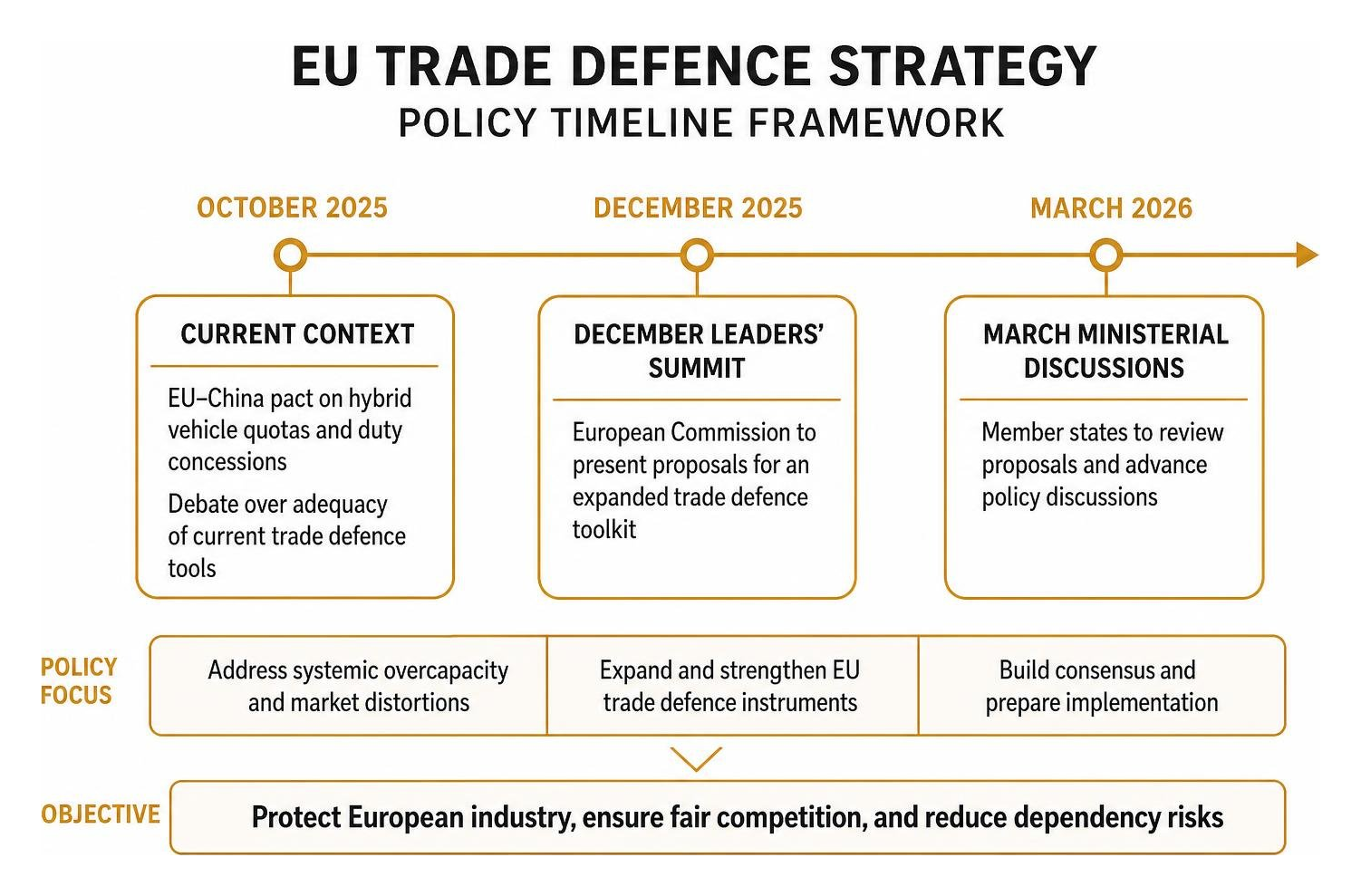
European Commission officials are preparing proposals for an expanded trade defence toolkit ahead of the December leaders’ summit, followed by ministerial discussions in March. While German industrial stakeholders welcomed the hybrid quotas for insulating domestic auto producers from aggressive pricing, trade hawks argue that piecemeal deals do not solve systemic overcapacity. As covered across the latest global headlines, Brussels faces a delicate balancing act between protecting its industrial core and avoiding open tariff conflict.
Compliance Pressures and Global Market Reaction
Operating across borders in late 2026 requires unprecedented regulatory agility. Corporate compliance officers, logistics directors, and general counsels must reconcile direct contradictions between Western export controls and Beijing’s anti-foreign-sanctions framework.
| Regulatory Domain | United States Enforcement Policy | China Counter-Regulatory Framework | Corporate Operational Impact |
|---|---|---|---|
| Advanced Semiconductors & AI | BIS export license restrictions; audits; ban on remote cloud AI chip rentals. | Data security reviews; domestic substitution mandates for critical software. | Mandatory supply-chain tracing, chip inventory audits, and segregated IT infrastructure. |
| Critical Raw Materials | Tariffs up to 100% on targeted goods; domestic mineral processing subsidies. | Export licensing quotas; restrictions on heavy rare earth exports. | Secondary supply sourcing, elevated procurement costs, alternative material R&D. |
| Maritime & Logistics | Reciprocal vessel port fees on Chinese-operated container fleets. | Mirror port surcharges on US-flagged and US-linked commercial cargo vessels. | Rerouted shipping corridors, increased landed freight surcharges, extended lead times. |
| Cross-Border Sanctions | Entity List expansions, capital investment bans, outbound investment screening. | Anti-Foreign Sanctions Law enforcement targeting complying multinationals. | Conflicting legal exposure, increased compliance spending, corporate restructuring. |
Export Controls and AI Chip Restrictions Create New Normal
The enforcement landscape has shifted from passive border checks to active commercial policing. The US Department of Commerce’s Bureau of Industry and Security (BIS) has levied hundreds of millions of dollars in fines against multinational technology corporations for export license violations involving semiconductor manufacturing equipment.
Furthermore, US regulators are moving to close cloud computing loopholes that historically allowed Chinese technology entities to remotely access advanced artificial intelligence processors hosted in third-party data centers across Southeast Asia. Businesses are now operating in an environment where conflicting legal mandates are no longer exceptional anomalies, but a permanent feature of international commerce. Navigating these requirements dominates ongoing commercial headlines as enterprises double their legal and supply-chain auditing budgets.
Market Volatility and Investor Fallout in Global Trade War News
Global capital markets have responded to these compounding measures with heightened volatility. Equity indices across North America, Europe, and Asia have seen sharp swings, particularly within the semiconductor, consumer technology, and automotive sectors.
Investors are pricing in systemic margin compression caused by dual supply shocks: rising freight costs from maritime fees and elevated raw-material expenses driven by critical mineral curbs. The broader pressures facing the global economy highlight growing risks of sticky core inflation, leaving central banks with limited flexibility as they balance supply-driven price pressures against slowing cross-border trade activity.
Frequently Asked Questions About the 2026 Trade War
What are the main terms of the EU-China hybrid car agreement?
The pact establishes an import ceiling of 350,000 Chinese hybrid vehicles into the European Union per year for four years, featuring a 6% annual adjustment formula. In exchange, Beijing eased rare-earth export approvals for EU industrial buyers and granted duty relief on European car parts, footwear, olive oil, and ice cream, generating over €225 million in tariff savings.
Why did rare earths spark new US tariffs against China?
China controls more than 90% of global processed rare earth production. When Beijing introduced strict new export curbs on these critical minerals, Washington responded by threatening retaliatory tariffs of up to 100% on Chinese goods to force a policy reversal ahead of broader trade negotiation deadlines.
How will new port fees and technology fines impact consumers?
Reciprocal US-China maritime port fees raise the cost of ocean freight, which shipping lines pass along to importers, eventually raising consumer prices on imported household items and electronics. Simultaneously, potential US tariff retaliation over EU tech regulatory penalties threatens to make imported consumer goods more expensive on both sides of the Atlantic.
Conclusion
The global trading system in October 2026 is defined by managed trade pacts, expanding baseline tariffs, and aggressive regulatory enforcement. While the EU-China agreement demonstrates that targeted diplomacy can resolve specific sector disputes like automotive imports, it leaves broader structural trade imbalances largely untouched. Concurrently, intensifying US tariff measures and US-China disputes over critical minerals and maritime logistics point toward sustained friction across global markets.
Businesses must build resilient, diversified supply chains and invest heavily in regulatory compliance to navigate this fragmented landscape. At Apex Observer News, our editorial team continues to track these fast-moving developments in real time, delivering rigorous reporting in accordance with our transparent fact-checking policy. Stay tuned to our coverage as international trade policies evolve ahead of upcoming summits.