
Top Education Technology News Today: Breakthroughs in AI Tutoring Systems
Today’s top education technology news centers on adaptive AI tutoring systems that deliver personalized instruction, real-time cognitive scaffolding, and human-like dialogue. Two major initiatives are leading the conversation: Microsoft Research’s synthetic student simulator, StudentSim, and IIT Kharagpur’s expansive NDLI-FERMI platform. These systems are moving past rigid multiple-choice chatbots to support active problem-solving rather than replacing student effort.
The pursuit of personalized instruction has long been considered the holy grail of modern pedagogy. For decades, educators have strived to deliver tailored, one-on-one guidance aligned with Lev Vygotsky’s famous zone of proximal development—the sweet spot where instruction meets a student’s immediate capabilities and gently pushes them further. These innovations complement a wider ecosystem of modern digital education tools that teachers rely on to build structured, blended learning environments.
| Tutoring Metric / Benchmark | Microsoft StudentSim | GPT-5.4 Baseline | Maia2 (Domain Baseline) | Supervised Fine-Tuned Baseline |
|---|---|---|---|---|
| Behavioral Fidelity (Chess) | 0.5150 | 0.2316 | 0.4535 | N/A |
| Guidance Responsiveness (Chess) | 0.9067 | 0.7186 | 0.2721 | N/A |
| Chess Tutor Expert-Rated Accuracy | 90.5% | 71.6% | N/A | 75.7% |
Microsoft StudentSim and the Rise of Synthetic Learner Simulators
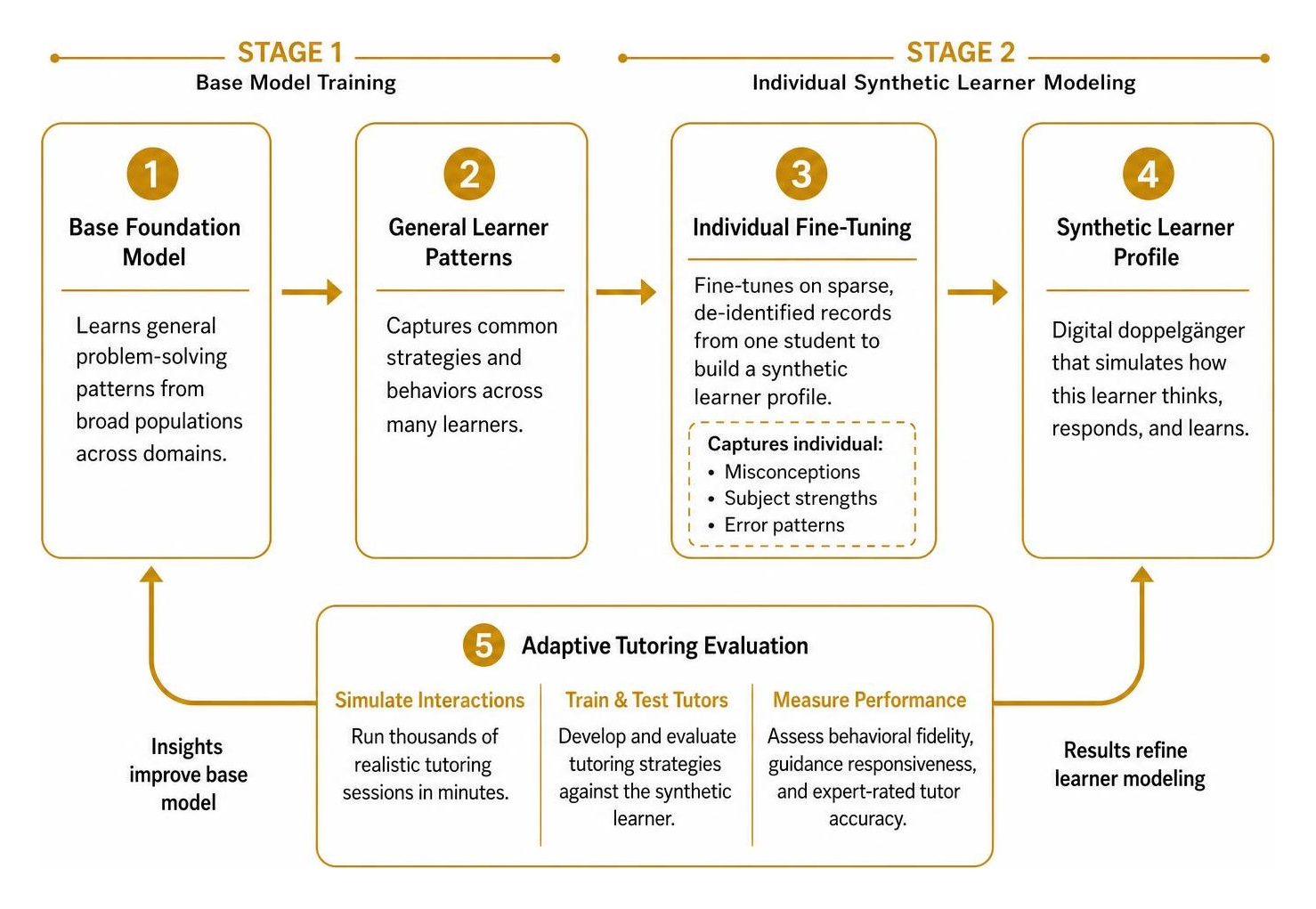
A persistent bottleneck in building effective pedagogical algorithms has always been the evaluation cycle. Gathering large cohorts of human students to test an experimental tutoring system is notoriously slow, costly, and bound by understandable privacy safeguards. Microsoft Research’s StudentSim bypasses this challenge by building synthetic learner profiles grounded in real, de-identified student data.
StudentSim uses a two-stage training pipeline. First, a base foundation model identifies general problem-solving patterns across broad populations. Second, the model fine-tunes on sparse, de-identified records from individual students to construct a “digital doppelgänger.” This simulated profile reflects an individual learner’s specific misconceptions, subject strengths, and emotional or cognitive error patterns.
Through this breakthrough, developers can now simulate thousands of realistic tutoring interactions in minutes instead of months. When benchmarked across domains including mathematics, second-language English writing, and chess, StudentSim significantly outperformed standard commercial models:
- High Behavioral Fidelity: StudentSim achieved a score of 0.5150 in replicating authentic human decision pathways in chess, far ahead of GPT-5.4’s 0.2316.
- Responsive Guidance Adaptation: It recorded a 0.9067 guidance responsiveness score (compared to GPT-5.4’s 0.7186 and Maia2’s 0.2721), accurately updating its simulated knowledge when offered hints.
- Expert-Validated Tutor Performance: Reinforcement-learning tutors trained against StudentSim feedback scored a 90.5% accuracy rating from human domain experts, outperforming both supervised baselines (75.7%) and GPT-5.4 simulated pipelines (71.6%).
IIT Kharagpur NDLI-FERMI Platform Democratizing Socratic Learning
While Microsoft tackles the back-end training pipeline, researchers in India are taking scaffolded learning directly to millions of underserved students. On September 30, 2026, the Indian Institute of Technology Kharagpur launched a major public initiative to provide free AI tutoring and competitive exam preparation.
Integrated directly into the National Digital Library of India (NDLI)—which hosts more than 130 million educational resources and serves over 10 million registered learners—the NDLI-FERMI platform is designed specifically to democratize competitive exam preparation for the Graduate Aptitude Test in Engineering (GATE) and Joint Admission Test for Masters (JAM).
Rather than handing out direct solutions, NDLI-FERMI implements a guided Socratic method. Through an intuitive “Scan & Ask” feature, students can upload photographs of complex engineering, chemistry, or mathematical problems. The system then provides step-by-step cognitive scaffolding, offering strategic hints, identifying conceptual misunderstandings, and prompting the student to take the next logical step independently. This approach ensures students build real mastery without having to pay for expensive private coaching services.
The AI Campus Illusion: How Student Adoption Outpaces Institutional Readiness
Despite the success of standalone tutoring breakthroughs, a sharp divide has emerged between grassroots student use and institutional adoption. Higher education is currently navigating an “Institutional AI Readiness Gap” as student engagement rapidly outpaces institutional adaptation.
Recent multi-campus research across millions of learning management system (LMS) interactions illustrates this divide:
- Widespread Student Use: 90% of higher-education students report using AI tools in their coursework at least occasionally.
- Faculty Engagement Lag: 61% of educators report using AI in teaching environments.
- Enterprise Blind Spots: 94% of higher-education staff have leveraged generative AI tools for work tasks over the past six months, yet only 54% are aware of institutional policies governing their use.
- Absence of ROI Tracking: Only 13% of surveyed institutions actively measure the return on investment (ROI) or learning efficacy of the software platforms they procure.
- A Weak Evidence Base: While 75% of the Top 40 higher-ed software tools claim some research backing, only 43% offer evidence that extends beyond basic vendor-funded customer case studies.
Many institutions are exploring AI-driven automated grading and evaluation systems to ease administrative burdens, but enterprise-level LMS tool suites continue to lag behind the generative tools students use every day on their laptops and phones.
Cognitive Fitness vs. AI Reliance: Preserving Critical Thinking in 2026
The emergence of AI assistance across every step of the learning journey has prompted cognitive scientists to examine how offloading mental effort affects student retention and long-term problem-solving stamina.
A growing body of research suggests that when learners rely on automated systems to skip the natural friction of troubleshooting, their capacity for deep focus and persistence declines.
The UC Berkeley Persistence Study and Educational AI Literacy
A controlled study of 1,222 participants conducted by researchers at UC Berkeley revealed direct evidence of this cognitive friction trade-off, demonstrating that brief exposure to automated problem-solving tools can alter a learner’s immediate work habits.
The study showed that using an automated AI helper for just 10 minutes significantly impaired a participant’s focus and persistence on challenging tasks immediately afterward. When students turn to instant answer generators, they bypass the productive struggle that builds grit, metacognitive monitoring, and deep comprehension.
To counter this pattern, schools are shifting away from simple tool instruction and moving toward structured AI literacy programs centered on several core competencies:
- Algorithmic Mechanics and Limitation Literacy: Understanding how large language models predict outputs, why they produce plausible hallucinations, and where training biases originate.
- Socratic Prompt Engineering: Learning to prompt models for guided feedback, counterarguments, and concept outlines rather than finished answers.
- Cognitive Effort Self-Regulation: Developing the self-awareness to work through tough problems independently before consulting automated tools.
- Data Privacy and Ethics: Evaluating how input prompts are stored, identifying synthetic media, and navigating intellectual property questions.
Why Education Technology News Today Emphasizes Human-Centered Pedagogy
In response to cognitive persistence studies and hardware-driven cheating concerns, education leaders are refocusing on human-centered pedagogy.

Technology is most effective when it serves as a supplement to dedicated human instructors rather than an automated replacement. Today’s most forward-thinking classrooms use AI for low-stakes practice and routine administrative tasks, freeing up faculty time for in-depth Socratic debates, hands-on collaborative workshops, and direct mentorship. By designing lessons that balance modern digital support with independent problem-solving, educators can help students use AI responsibly while keeping their critical thinking sharp.
Frequently Asked Questions About Education Technology Trends
How are AI tutors like StudentSim changing personalized instruction?
AI frameworks like Microsoft StudentSim generate realistic digital learner profiles based on de-identified student data. These synthetic profiles model authentic human mistakes, misconceptions, and learning styles across subjects like mathematics, writing, and strategy. By letting developers test and refine tutoring systems against realistic student behaviors in minutes, these platforms accelerate the design of responsive, Socratic tutors without requiring slow, expensive human trials.
What did the UC Berkeley study discover regarding AI and student persistence?
The UC Berkeley study evaluated 1,222 participants and found that relying on automated AI assistance for as little as 10 minutes noticeably reduced a learner’s willingness to stick with difficult intellectual tasks. By removing the normal friction of problem-solving, immediate AI assistance can erode cognitive persistence and focus. This highlights the need for balanced AI literacy programs that teach students when to seek guidance and when to work through challenges on their own.
How are universities securing exams against emerging AI wearable technologies?
Following incidents involving AI-enabled smart frames during university entrance exams, higher-education institutions have updated their testing security. Schools are rolling out physical eyewear screening checkpoints, using secure testing rooms with localized frequency monitoring, and moving toward authentic assessment methods—such as interactive oral defenses, handwritten blue-book exams, and project-based portfolios—that require students to demonstrate real-time reasoning without digital aids.
Conclusion
The education technology landscape in October 2026 is defined by a central challenge: harnessing powerful, personalized AI tools while protecting the cognitive independence and academic integrity of learners. Whether through Microsoft’s high-fidelity StudentSim research, IIT Kharagpur’s open-access NDLI-FERMI Socratic tutor, or updated campus policies designed to address wearable cheating devices, institutions are moving past uncritical tool adoption toward purposeful, evidence-based integration.
At Apex Observer News, our mission is to deliver rigorous, verified journalism covering the technological innovations shaping our society. As digital learning tools continue to evolve, preserving critical thinking, closing the faculty training gap, and keeping instruction human-centered will remain essential to building an effective, equitable educational ecosystem. For more on our editorial standards and reporting methodology, explore the Apex Observer News fact-checking policy.