


Why the Different Types of Stock Brokers Matter
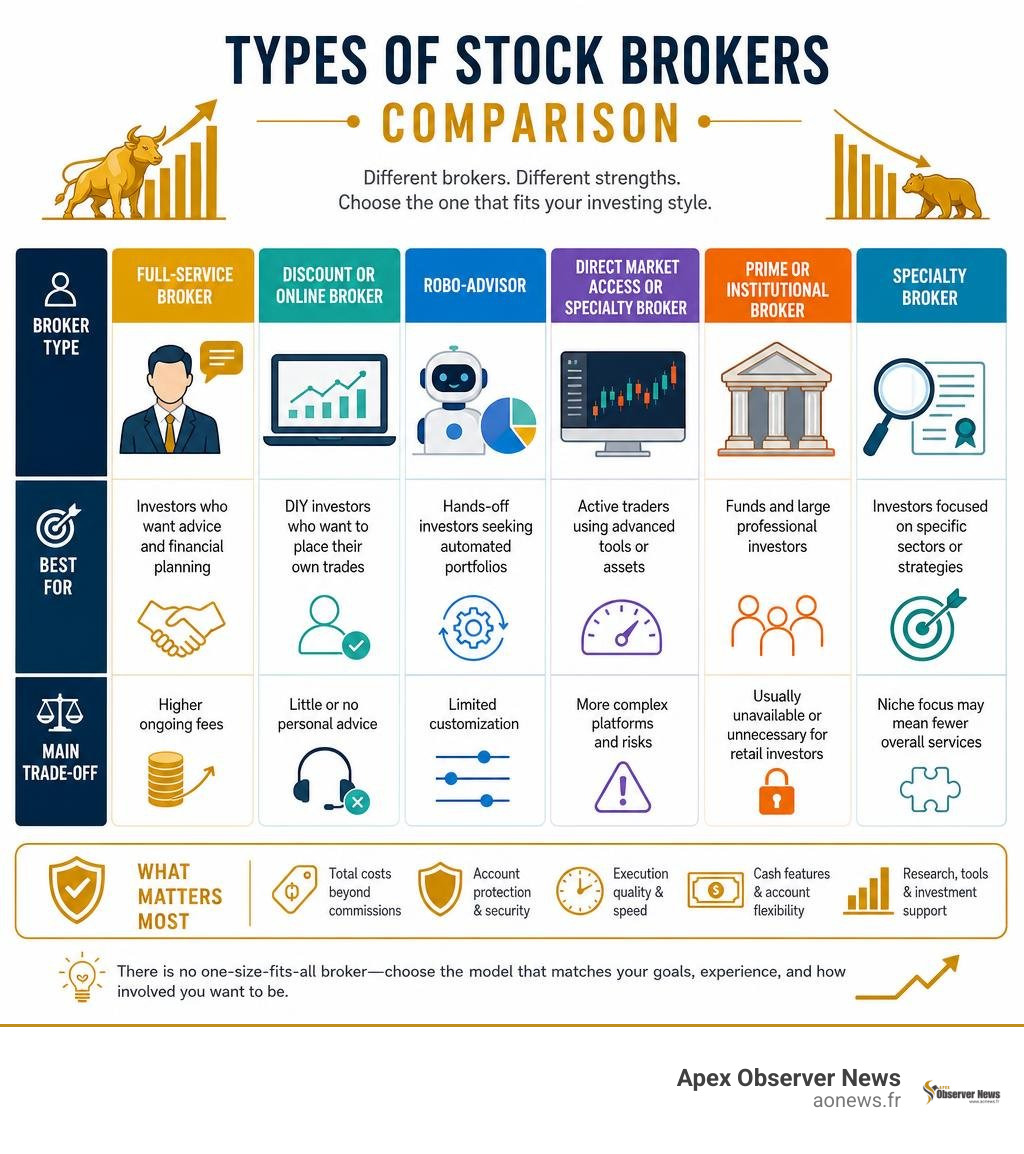
The different types of stock brokers range from simple low-cost trading apps to firms that provide personal advice, portfolio management, and complex institutional trade services. A broker gives investors regulated access to buy and sell securities; the right model depends on how much help, speed, research, and control you need.
| Broker type | Best for | Main trade-off |
|---|---|---|
| Full-service broker | Investors who want advice and financial planning | Higher ongoing fees |
| Discount or online broker | DIY investors who want to place their own trades | Little or no personal advice |
| Robo-advisor | Hands-off investors seeking automated portfolios | Limited customization |
| Direct market access or specialty broker | Active traders using advanced tools or assets | More complex platforms and risks |
| Prime or institutional broker | Funds and large professional investors | Usually unavailable or unnecessary for retail investors |
Modern online trading has made buying stocks far easier, often with $0 commissions on U.S. stock and ETF trades. But “zero commission” does not mean a broker earns nothing. Service quality, order execution, account protections, cash features, and extra fees can matter just as much as the price of placing a trade.
I am Faisal S. Chughtai, founder of ActiveX, with experience in digital platforms, app and web development, and SEO. That work has helped me explain the different types of stock brokers in clear, practical terms for people comparing digital financial services.
Different types of stock brokers further reading:
- brokerage firm for stock trading
- stock market broker
- brokerage and trading
Fundamentals of Stock Broking: Roles, Regulatory Bodies, and Broker vs. Dealer
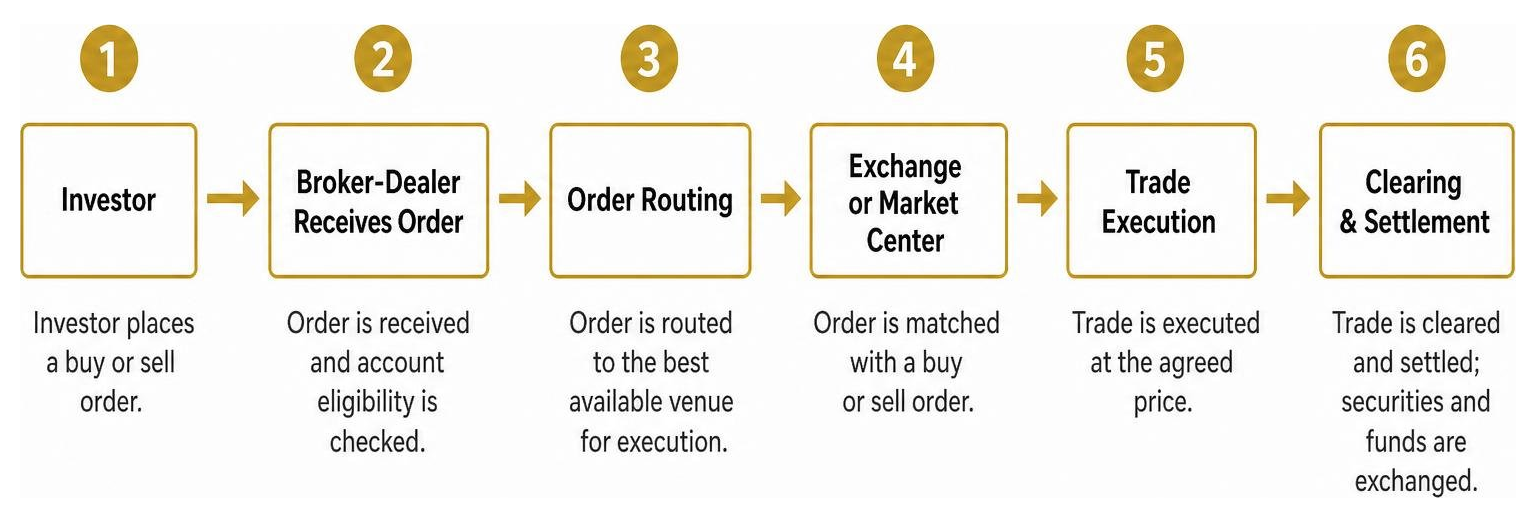
To understand how retail and institutional investing function, we first need to look at what a stockbroker actually does behind the scenes. At its core, a stockbroker serves as the vital intermediary connecting individual investors with centralized financial markets like the New York Stock Exchange (NYSE), Nasdaq, or global exchanges. Individual retail investors cannot simply walk onto an exchange floor or submit raw API orders to match trades directly; law and market rules require licensed financial intermediaries to facilitate order execution, handle clearing, and manage custody.
When you master Brokerage Firm 101: Stock Trading Essentials, you quickly notice that financial institutions often operate in dual roles: acting as both brokers and dealers. Knowing the legal and functional distinction between these capacities is crucial:
- Agent Capacity (Broker): When acting as a broker, the firm acts purely as an agent on behalf of the client. It routes the investor’s buy or sell order to an exchange, market maker, or alternative trading system, finding a matching counterparty without taking personal ownership of the underlying assets. The broker earns revenue through explicit commissions or transactional fees.
- Principal Capacity (Dealer): When acting as a dealer, the firm trades for its own proprietary account (its “house” account). Instead of just matching buyers and sellers, the dealer acts as the direct counterparty to the trade—buying securities from clients or selling shares directly from its own private inventory. Dealers generate profits through the bid-ask spread—the price difference between what they are willing to pay for a stock and what they sell it for.
Because most modern financial institutions perform both duties depending on client demands and market liquidity, they are legally classified as broker-dealers. You can explore a deeper breakdown of this dual structure through resources like What Is a Broker-Dealer? Two Types, What They Do, and Regulation and What Is a Broker-Dealer? — 3 Stocks on Fire.
Given that brokers hold access to vast amounts of retail capital, strict government oversight is mandatory across every global jurisdiction:
- United States: The Securities and Exchange Commission (SEC) enforces overarching federal securities legislation, while the Financial Industry Regulatory Authority (FINRA) provides day-to-day oversight of brokerage firms and tests advisors through licensing credentials like the Series 7 and Series 63 exams.
- United Kingdom: The Financial Conduct Authority (FCA) regulates conduct, ensuring fair competition and customer protection.
- India: Share brokers must register with the Securities and Exchange Board of India (SEBI) under the SEBI Act of 1992. Investors can directly consult resources such as How to Use the SEBI Broker List to Verify Your Trader to confirm registration status before sending funds.
Beyond licensing rules, statutory investor protection schemes provide vital backstops against firm insolvency or operational fraud:
- US Accounts: The Securities Investor Protection Corporation (SIPC) protects investors against the financial failure of a broker-dealer up to $500,000 per customer (which includes a $250,000 limit for cash balances). Crucially, SIPC does not protect against normal stock market volatility or investment losses.
- UK Accounts: The Financial Services Compensation Scheme (FSCS) covers eligible investment claims up to £85,000 per person per firm if an FCA-authorized firm fails.
- EU Accounts: European frameworks mandate a baseline under the Investor Compensation Schemes Directive, granting protection up to a minimum threshold of €20,000 per claimant.
These multi-tiered safety nets safeguard client assets by requiring firms to maintain strict segregation between corporate cash and customer securities.
Exploring the Primary Different Types of Stock Brokers
The financial services landscape is not one-size-fits-all. Financial providers design distinct models targeting varying investor demographics, account balances, and experience levels. Whether an investor wants hand-held wealth management, ultra-fast day trading, or automated portfolio balancing, there is a dedicated broker category designed to meet those goals. To see how these categories compare side-by-side, check out What Are Stock Brokers? Definition & Types (2026).
| Feature | Discount / Online Brokers | Full-Service Brokers | Robo-Advisors |
|---|---|---|---|
| Primary Audience | Self-directed retail investors & traders | High-net-worth individuals & families | Passive investors seeking low-effort strategy |
| Trade Execution | Instant digital order placement | Manual or managed portfolio execution | Algorithmic rebalancing via software |
| Human Advisory | Minimal to none (self-serve support) | Dedicated wealth manager / advisor | Limited phone support or automated bot |
| Average Cost | $0 stock/ETF trades; low option fees | 1.0% – 1.5% AUM or commission fees | 0.15% – 0.35% annual management fee |
| Account Minimums | Usually $0 | $25,000 – $100,000+ | $0 – $500 |
| Extra Services | Basic charting, stock screeners, news | Estate planning, tax strategy, IPO access | Automatic tax-loss harvesting |
Retail Powerhouses: Discount and Online Different Types of Stock Brokers
Discount and online brokers form the backbone of modern retail stock trading. Following the U.S. deregulation of fixed commission fees on May 1, 1975 (known in Wall Street history as “May Day”), discount firms emerged to give investors a cheaper alternative to high-cost financial advisors. Instead of paying hefty commissions for unwanted market advice, cost-conscious individuals could place straightforward buy and sell orders at a fraction of the traditional cost.
With the rise of internet access and high-speed mobile technology, discount brokerages transformed into modern online platforms. Today, established online firms offer:
- Zero-Commission Trading: Most mainstream online discount brokers charge $0 in explicit commissions for trading online U.S.-listed stocks and ETFs.
- Fractional Share Purchases: Investors can buy fractions of shares (sometimes starting with as little as $1), opening up expensive mega-cap shares to investors with limited starting capital.
- Intuitive Mobile Apps & Web Portals: User-friendly interfaces feature integrated stock charts, earnings calendars, real-time news streams, and paper trading tools that let beginners practice strategies with virtual cash before committing real funds.
By removing structural friction, modern online platforms allow everyday retail investors to participate in global wealth generation directly from their smartphones. To learn how to navigate these cost-saving platforms safely, read our guide on The Zero-Commission Dream: A Guide to Free Stock Trading.
Full-Service Advisors and Automated Robo-Advisors
At the opposite end of the service spectrum from discount apps sit traditional full-service brokers. Full-service firms do far more than execute simple market transactions; they offer holistic financial care. When working with a traditional full-service firm, clients gain access to a dedicated professional or team that assists with custom financial planning, active wealth management, tax optimization strategies, estate planning, and exclusive access to initial public offerings (IPOs).
To explore the broader firm structures behind these options—including wirehouses, regional broker-dealers, and registered investment advisors—consult Types of Brokerage Firms: Wirehouses, Discount Brokers, RIAs | 2026 | AdvisorGuide.
The average full-service stockbroker in the U.S. earned a median annual salary of $161,399 as of mid-2024, reflecting the specialized institutional, legal, and financial expertise expected of them. However, this high-touch service comes with matching costs. Full-service firms typically charge client accounts between 1.0% and 1.5% in annual Assets Under Management (AUM) fees. On a $1,000,000 portfolio, an annual AUM fee translates to $10,000 to $15,000 every year, making full-service brokers best suited for high-net-worth individuals and families managing complex multi-generational wealth.

For investors who want automated portfolio building without full-service advisory costs, robo-advisors offer an ideal middle ground. Robo-advisors use computer algorithms to construct, balance, and manage diversified portfolios built primarily from low-cost ETFs.
- Risk Onboarding: You complete a short risk questionnaire detailing your investment goals, timeline, and loss tolerance.
- Automated Asset Allocation: The platform automatically buys an index-focused portfolio aligned with your target risk profile.
- Continuous Rebalancing: Algorithms monitor your portfolio around the clock, automatically rebalancing asset ratios and using tax-loss harvesting to offset taxable capital gains.
With annual management fees usually ranging between 0.15% and 0.35% of AUM, robo-advisors provide tech-focused investors with automated wealth building at a small fraction of traditional wealth management costs.
Institutional, Specialty, and Niche Brokerage Models
While discount platforms, full-service firms, and robo-advisors serve everyday individual investors, the broader financial industry relies on highly specialized brokerage infrastructure to keep global markets moving efficiently.
Advanced Execution Tools Across Different Types of Stock Brokers
- Specialty Brokers: These intermediaries focus exclusively on niche financial asset classes that require specific margin accounting, specialized execution protocols, or unique regulatory compliance. Examples include futures commission merchants (FCMs) for derivatives and energy markets, dedicated currency/forex platforms, and commodities brokers.
- Direct Market Access (DMA) Brokers: High-frequency traders, quantitative day traders, and active scalpers often bypass standard retail brokers to use Direct Market Access software. DMA brokers give sophisticated clients low-latency execution tools that route orders directly into exchange limit order books, avoiding intermediate wholesale market makers.
- Prime Brokers: Large hedge funds, pension systems, and private equity institutions rely on prime brokers (typically hosted within Tier-1 global investment banks) to run their operations. Rather than just trading shares, a prime broker provides bundled institutional infrastructure: centralized trade clearing, cross-margin financing, multi-custody settlement, consolidated risk reporting, and large-scale securities lending so hedge funds can borrow stocks for short-selling strategies.
Understanding this balance between retail interfaces and institutional back-end support gives investors a clear view of market structure. You can trace how modern brokers evolved from historical open-outcry trading floor networks into today’s digital execution hubs by reading the historical background on Stockbroker – Wikipedia and Types of Brokers in the Stock Market – Enrich Money.
How Modern Stock Brokers Make Money and How to Choose the Right One
One of the most common questions new investors ask is: If discount brokers charge $0 in trading commissions, how do they turn a profit?
Zero-commission trading is not free; instead, brokers shifted their primary revenue models away from client transaction charges toward secondary monetization channels behind the scenes:
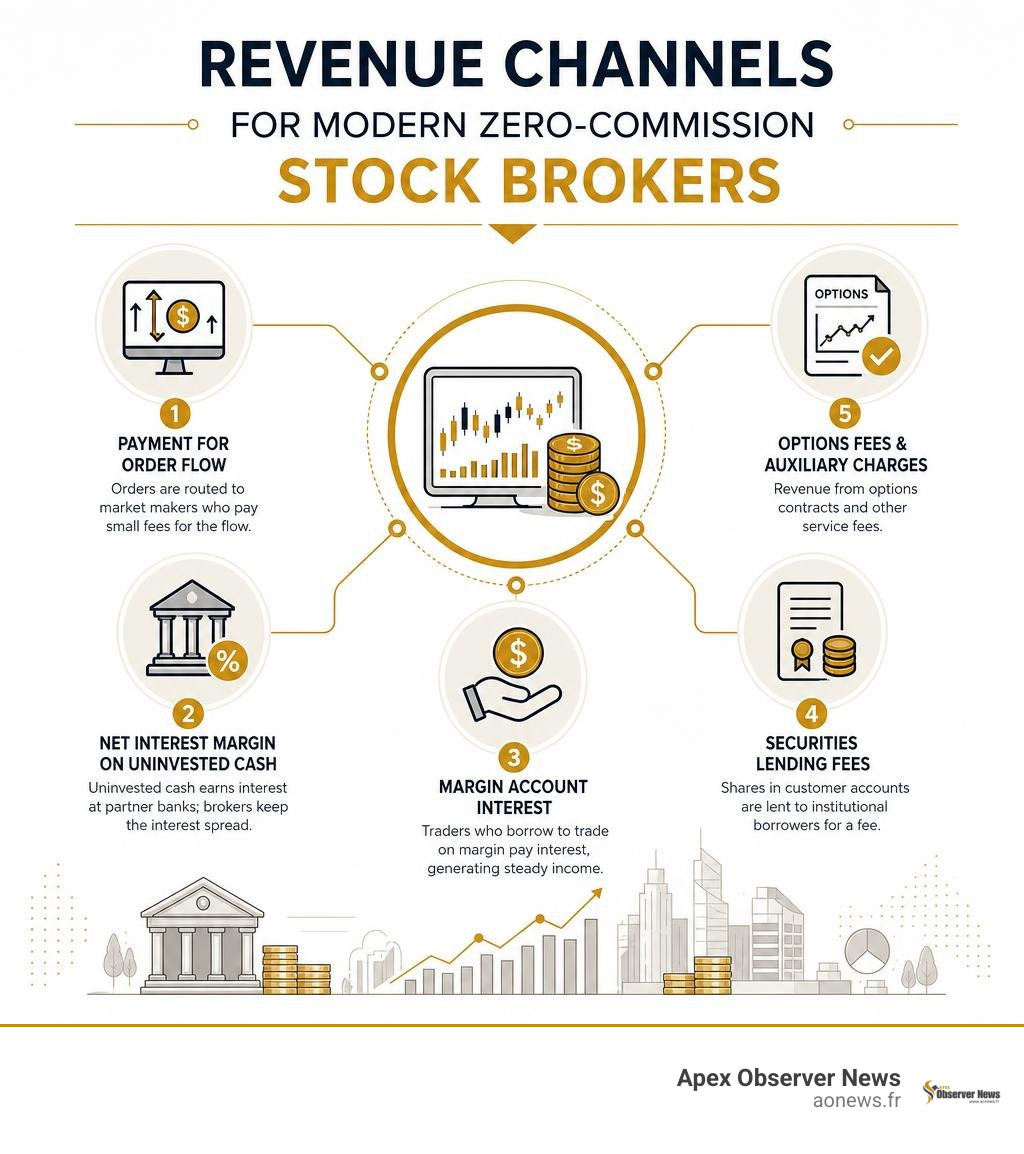
- Payment for Order Flow (PFOF): Retail brokers route non-directed market orders to high-volume market makers instead of directly to public exchanges. These wholesale firms pay the retail broker small fractions of a cent per share (often $0.001 to $0.004) in exchange for handling retail order volume.
- Net Interest Margin on Uninvested Cash: Uninvested cash sitting in retail brokerage accounts earns interest. Brokerages deposit these funds with partner banks or central reserve accounts, earning higher yields while paying account holders lower standard rates, pocketing the net interest spread.
- Margin Account Interest: Active traders who borrow capital to trade on margin pay annualized interest rates (often between 6% and 12%), creating steady income for the broker.
- Securities Lending Fees: Brokers lend out fully paid shares held in customer accounts to institutional short sellers, earning borrowing fees and rebate spreads on the underlying trades.
- Options Fees & Auxiliary Charges: While standard equity trades carry $0 commissions, many platforms charge $0.50 to $0.65 per contract on options transactions, alongside fees for paper account statements, wire transfers, and foreign exchange conversions.
Choosing the right partner among these different types of stock brokers requires matching platform features directly to your experience, budget, and long-term goals. For an in-depth breakdown of this evaluation process, review The Ultimate Guide to Picking Your First Stock Market Broker.
When picking your ideal trading platform, run through this selection checklist:
- Trading Frequency & Strategy: Are you a long-term buy-and-hold investor looking for automated ETF index contributions, or an active day trader who requires customizable charting tools and fast order routing?
- Total Cost of Ownership: Look beyond baseline stock commissions. Evaluate per-contract options pricing, foreign currency conversion spreads, margin borrowing rates, and inactivity fees.
- Platform Usability & Educational Resources: Test the mobile app interface, paper trading simulators, screening tools, and live customer service availability before depositing capital.
- Cash Sweep APY Rates: Check how much interest the platform pays on uninvested cash sweeps to ensure idle balances continue working for you.
- Asset Class Availability: Verify that the broker offers access to all the asset classes you plan to hold, including international stocks, fixed-income bonds, mutual funds, fractional shares, and options contracts.
For further regulatory definitions and detailed guidance on matching brokerage features to client profiles, explore What is a brokerage firm? | Fidelity, Types of Brokers – New Rules of Investing, and Understanding Brokers: Types, Roles, Regulations & Examples.
Frequently Asked Questions About Stock Brokers
What is the difference between a broker and a dealer?
A broker acts purely as an agent for clients, executing orders on public exchanges and matching buyers with external sellers without taking personal ownership of the underlying assets. A dealer acts as a principal trading for its own account, buying and selling securities directly from its private inventory and generating revenue through the bid-ask spread. Most modern financial institutions operate dual-purpose models known as broker-dealers.
How do zero-commission stock brokers make money?
Zero-commission brokerages earn revenue through alternative channels: Payment for Order Flow (PFOF) paid by wholesale market makers, net interest margins captured on client cash sweep accounts, margin lending interest rates, share lending fees charged to short sellers, per-contract options fees, and foreign currency conversion markups.
What protection exists if a stockbroker becomes insolvent?
If a registered brokerage firm fails in the U.S., the Securities Investor Protection Corporation (SIPC) protects customer assets up to $500,000 per client, including up to $250,000 for cash balances. In the UK, the Financial Services Compensation Scheme (FSCS) covers investment claims up to £85,000 per firm, while EU rules mandate baseline investor protection up to €20,000. These programs safeguard accounts against firm insolvency, but do not cover standard market losses resulting from stock declines.
Conclusion
Finding your place among the different types of stock brokers comes down to honest self-assessment. Beginners and cost-conscious investors can build diversified, low-cost portfolios using online discount platforms or robo-advisors. Active traders require direct market access tools and advanced execution speed, while high-net-worth families often benefit from the tailored estate planning, tax guidance, and personalized portfolio oversight that full-service wealth managers provide.
To continue evaluating specific providers, read through An Honest Review of Top Stock Broker Companies. By aligning your investment style with the right brokerage model, you establish a secure financial foundation built to support your long-term goals.
For ongoing news updates, market analyses, and financial guides, Explore Stock Market Insights right here on Apex Observer News.

[…] different types of stock brokers […]