

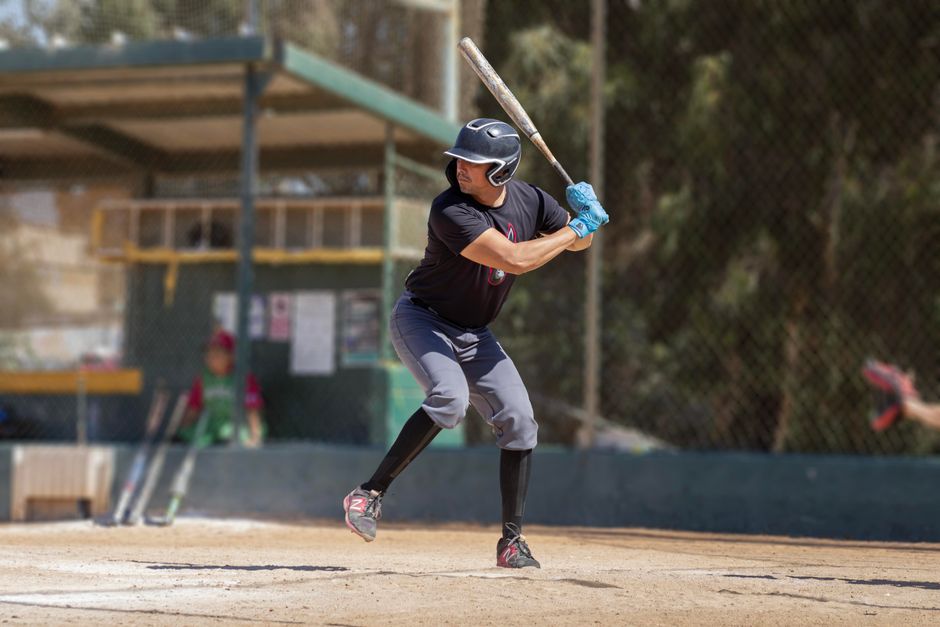
Baseball Basics: The Game in One Minute
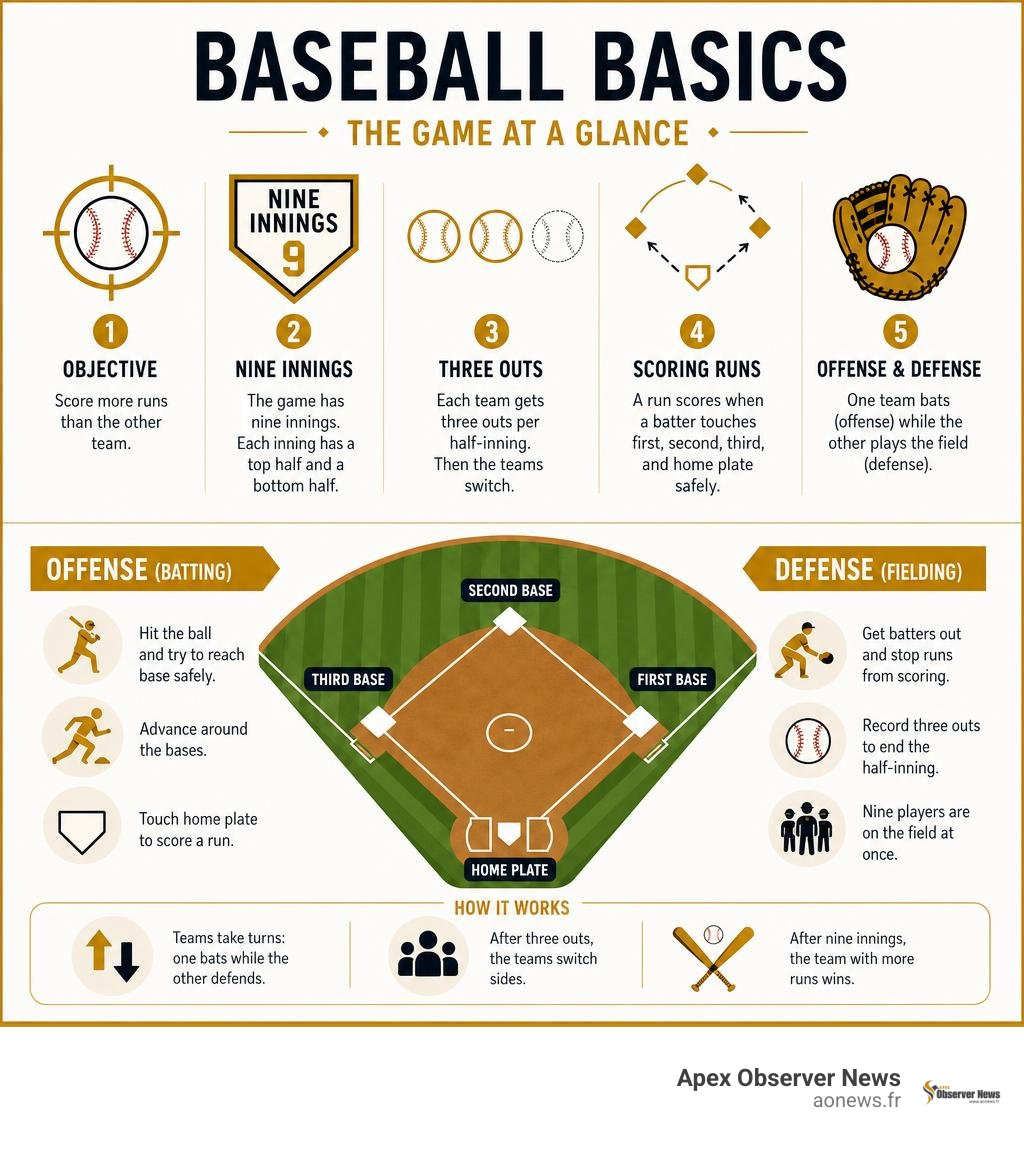
Baseball is a bat-and-ball sport where two teams take turns hitting and fielding, trying to score more runs than the other team. A run counts when a batter safely travels around first, second, and third base and reaches home plate.
- Goal: Score runs and record outs to stop the other team from scoring.
- Teams: Nine defensive players are on the field at once, while a batting lineup takes turns at the plate.
- Game format: Most professional games last nine innings. Each inning has a top half for the visiting team and a bottom half for the home team.
- Outs: Each team gets three outs per half-inning.
- No standard game clock: A game ends after the required innings, unless the score is tied and extra innings are needed.
From the 90-foot basepaths to the pitcher-catcher duel, baseball blends team planning with highly individual moments. Its rules are simple to state, but its strategy, park differences, player roles, history, and modern data give fans something new to notice every game.
I am Faisal S. Chughtai, founder of ActiveX, with experience making complex digital, SEO, and news topics easier to follow for busy readers. In this Baseball guide, I bring that same clear, practical approach to the game’s essential terms, rules, and current context.
Core Rules, Field Layout, and Gameplay Mechanics of Baseball
Understanding baseball begins with the spatial layout of the diamond and the core mechanics that govern every pitch. The playing field is divided into fair and foul territory, bounded by two perpendicular foul lines extending outward from home plate.
The infield consists of a square diamond measuring exactly 90 feet on each side. At each corner sits a base: first base, second base, third base, and home plate. In the center of the infield lies the pitcher’s mound, an elevated dirt hill 10 inches above home plate. Atop the mound is the pitcher’s plate (or rubber), located precisely 60 feet, 6 inches from the rear point of home plate—a standard dimension established back in 1893.
The strike zone is an imaginary three-dimensional prism suspended over home plate. Its vertical boundaries span from the midpoint between the top of the batter’s shoulders and the top of their uniform pants down to the hollow below the kneecap. When a pitcher throws a ball that passes through this zone without the batter hitting it, the umpire calls a strike. If the ball passes outside this zone and the batter does not swing, it is called a “ball.”
- Three Strikes: Three strikes result in a strikeout, recording an out against the batter.
- Four Balls: Four balls result in a base on balls (a walk), granting the batter automatic entitlement to first base.
- Fair vs. Foul: A batted ball that settles in fair territory between home and first or third base, or lands fair in the outfield, allows the batter to run. A ball landing outside the lines is foul.
To maintain structure across all levels of competition, games follow strict governing guidelines detailed in the official Official Baseball Rules.
Structure of a Baseball Game: Innings, Scoring, and Timing
A regulation adult or Major League Baseball (MLB) game is structured into nine distinct segments called innings. Each inning is split into two halves:
- Top Half: The visiting team bats (offense) while the home team fields (defense).
- Bottom Half: The roles reverse; the home team bats while the visiting team fields.
A half-inning continues until the defensive team records three outs against the offensive batters and baserunners. A run is scored when an offensive player successfully advances counter-clockwise touching first, second, and third base, and safely reaches home plate before three outs are made. If the home team leads after the top half of the ninth inning, the game ends immediately because the home team does not need to bat.

Unlike timed sports like basketball or football, baseball traditionally operates without a game clock. A game cannot end on a simple stall tactic; the trailing team always gets its full allotment of outs. However, to keep game tempo active and avoid modern delays, recent structural updates have introduced strict timing limits between pitches. In 2023, pitch clocks successfully shortened the average MLB game length by 24 minutes compared to previous 3-hour-plus marathons. To learn more about modern game pace regulations, check out The Ultimate Guide to 2026 MLB Rule Updates.
Essential Gear and Equipment
Executing the mechanics of baseball requires specialized equipment designed for player safety and performance.
- Baseball Bats: Standard adult wood bats are turned from solid timber (such as ash, maple, or birch). According to official specifications, bats cannot exceed 2.61 inches in diameter at the thickest section or 42 inches in total length. Pine tar or grip enhancements may be applied to the handle up to a maximum limit of 18 inches. Amateur and youth leagues frequently utilize certified aluminum or composite bats. Dive into equipment fundamentals with our guide on Baseball Bat 101.
- The Baseball: A regulation baseball weighs between 5.0 and 5.25 ounces, measuring 9.0 to 9.25 inches in circumference. It consists of a cushioned cork sphere wound tightly with yarn and encased in stitched white cowhide.
- Fielding Gloves and Mitts: Every fielder wears a leather glove tailored to their defensive position. Catchers wear heavily padded, fingerless mitts to absorb high-velocity pitches, while first basemen use flexible, claw-like mitts designed for scooping low throws.
- Protective Gear: Batters are required to wear rigid protective helmets when entering the batter’s box and on the basepaths. Catchers wear full armor, including a face mask, chest protector, and shin guards. Batters also rely on specialized gloves to improve bat handle traction and protect hands against friction; explore top-performing options in The Best Batting Gloves to Help You Swing for the Fences.
Team Positions, Player Roles, and Strategic Gameplay
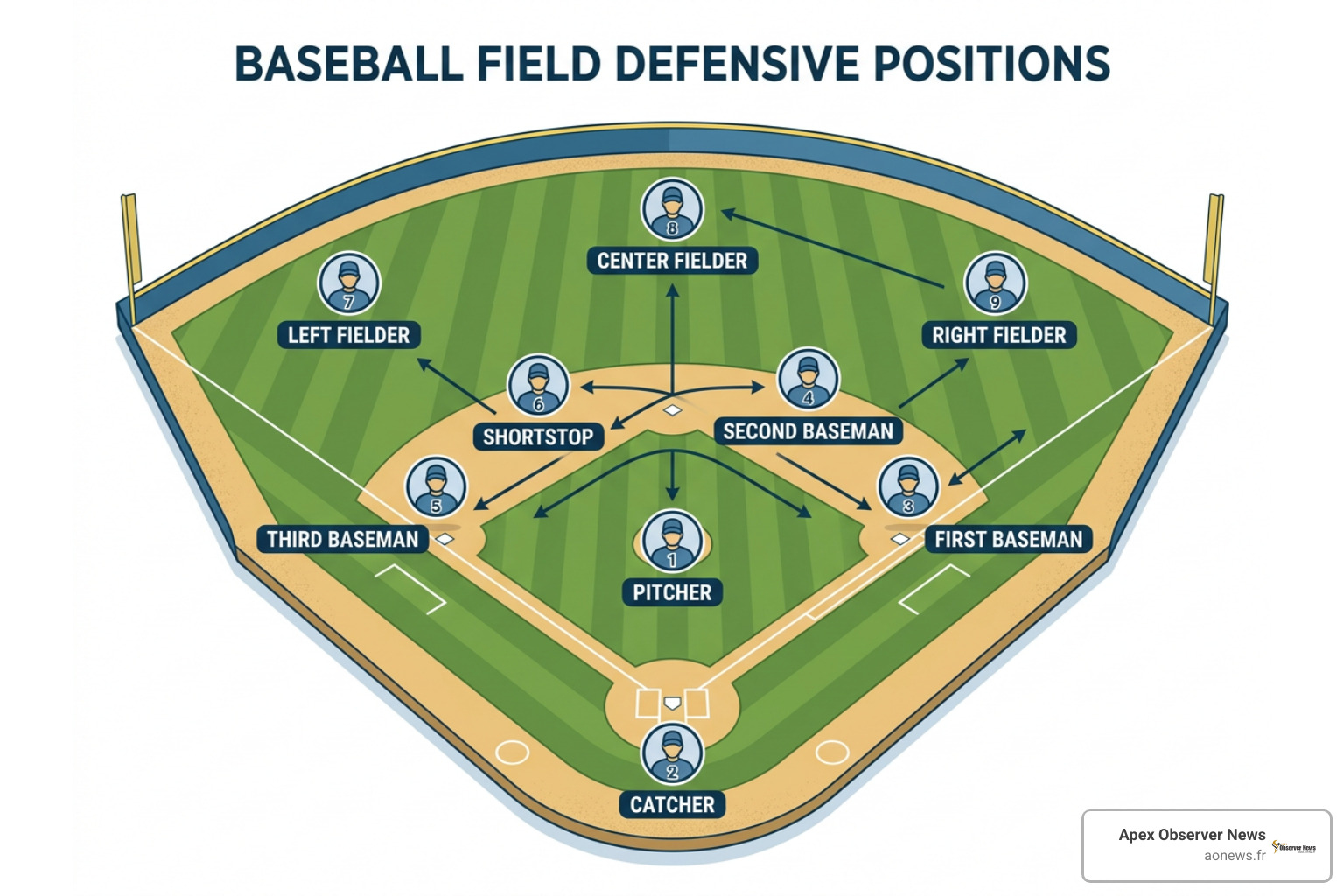
A standard active MLB team roster features 26 players, though only nine defensive players take the field simultaneously. The game is orchestrated on the field by the team’s manager, supported by specialized bench, hitting, and pitching coaches.
Pitchers, Catchers, and Infield Responsibilities
The dynamic between the pitcher and catcher (collectively called the “battery”) serves as the heartbeat of defensive strategy. The pitcher initiates every action by throwing from the rubber atop the mound.
The starting pitching rotation generally consists of four to five starters who rotate starting duties every few days. Once a starter exits, responsibility shifts to the bullpen—a specialized group of middle relievers, setup men, and closers tasked with finishing late innings. Managing these arms effectively is critical to success; track high-leverage bullpen leaders in our article on Pitching Perfection and the 2026 Save Leaders. Teams often refine their pitching mechanics and hitting timing during practice with dedicated devices like those in our breakdown of Top Rated Baseball Pitching Machines for 2026 Practice.
The four infielders occupy crucial dirt territory:
- First Baseman: Responsible for fielding batted balls on the right side and receiving throw-outs from other infielders.
- Second Baseman: Covers central infield gaps, participates in turning double plays, and covers second base during steals.
- Shortstop: Positioned between second and third base, this range-demanding position requires a strong arm to field high-volume ground balls.
- Third Baseman: Guards the “hot corner,” requiring lightning reflexes to handle high-velocity pull shots down the foul line.
Outfielders, Designated Hitters, and Platoon Matchups
The outfield consists of three positions spread across fair territory:
- Left Fielder: Covers the field behind the third-base side, fielding deep fly balls and cutoffs.
- Center Fielder: Typically the fastest outfielder, tasked with covering the vast expanse of deep center field and taking charge on fly balls.
- Right Fielder: Requires a powerful throwing arm to throw out baserunners attempting to advance from first to third base on deep hits.
Offensively, the designated hitter (DH) rule allows a team to deploy an offensive specialist to bat in place of the pitcher without taking a fielding position. This rule maintains consistent offensive firepower throughout the batting order.
Managers constantly seek strategic edges through platoon matchups. Because right-handed batters generally track left-handed pitching more effectively (and vice versa), managers alter starting lineups and deploy pinch-hitters late in games to exploit opposite-handed pitcher-batter matchups.
Small-ball tactics also play a vital role in close games:
- Sacrifice Bunt: A batter intentionally deadens the ball in front of home plate to advance a teammate to the next base, conceding an out.
- Stolen Base: A runner takes off for the next base during the pitcher’s delivery, attempting to beat the catcher’s throw.
- Hit-and-Run: A baserunner starts running with the pitch while the batter actively attempts to hit the ball into the open space left by covering infielders.
History, Global Impact, and Cultural Legacy of Baseball
The roots of baseball trace back to 18th-century British bat-and-ball games like rounders, stoolball, and tut-ball. The earliest recorded reference to “Base Ball” appears in a 1749 English publication detailing a game played in Surrey featuring the Prince of Wales.
In North America, early variants spread rapidly during the early 19th century, with a documented early game taking place in Beachville, Ontario, in June 1838. The game’s modern codification emerged in New York City through Alexander Cartwright and the Knickerbocker Baseball Club, who established standardized field rules in 1845. The Knickerbockers played the first officially recorded U.S. game on June 19, 1846, in Hoboken, New Jersey.
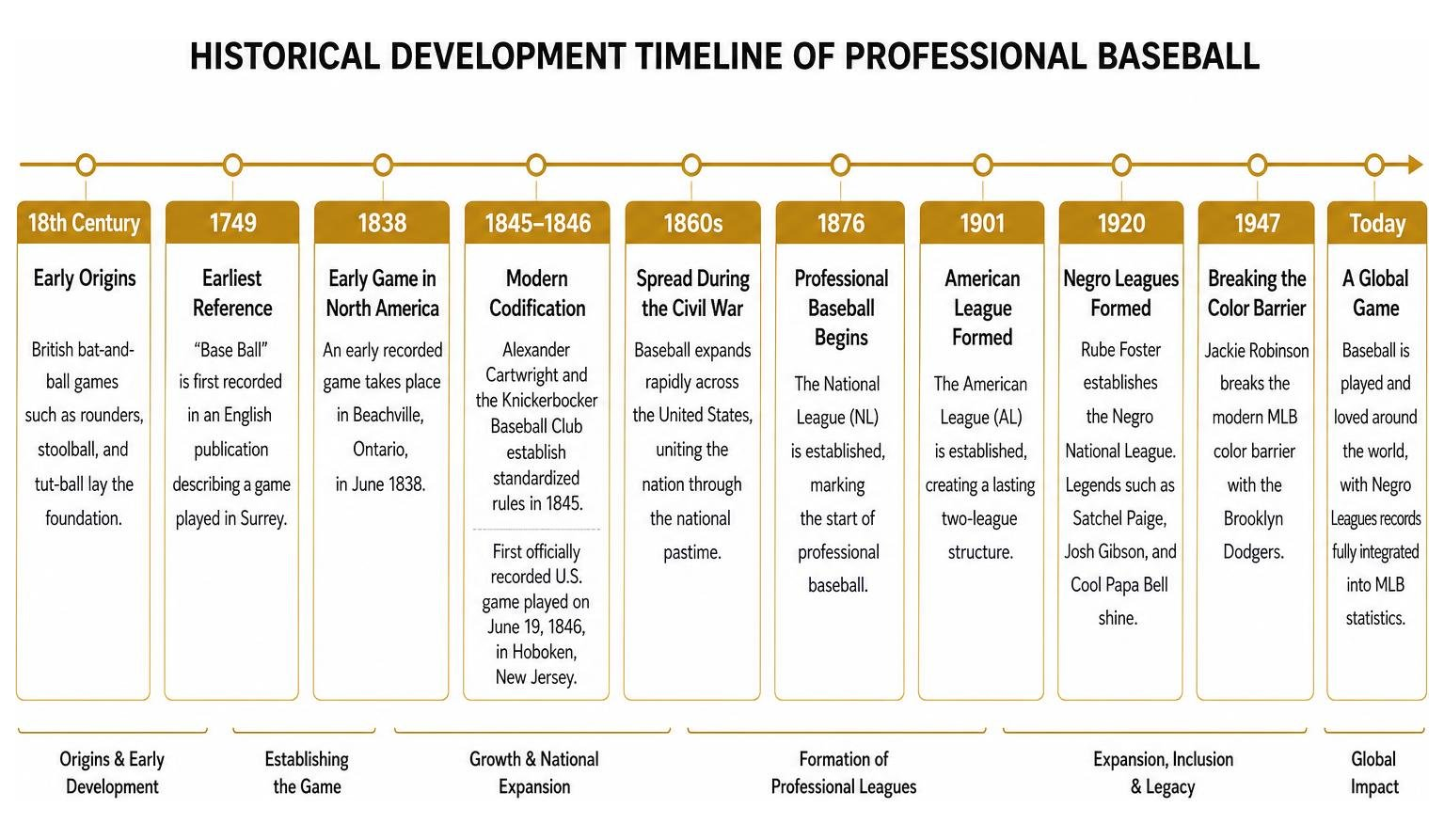
The sport expanded rapidly across the United States during the American Civil War, serving as a unifying national pastime. Professional leagues developed shortly thereafter, culminating in the establishment of the National League in 1876 and the American League in 1901.
For decades, racial segregation excluded Black players from Major League rosters, leading to the creation of the Negro Leagues in 1920 under the leadership of Rube Foster. Players like Satchel Paige, Josh Gibson, and Cool Papa Bell established legendary records. In 1947, Jackie Robinson broke the modern MLB color barrier with the Brooklyn Dodgers. Today, historical records from the Negro Leagues are fully integrated into official Major League statistics. To dive into comprehensive historical data, explore Baseball History on Wikipedia.
The Global Reach of Baseball: From Asia to Latin America
While deeply tied to American heritage, baseball is a truly global phenomenon with active participation in over 80 countries.
Latin America has long been a primary engine of talent for Major League Baseball. In 2017, Opening Day rosters featured 83 players from the Dominican Republic, along with 97 combined players born in Venezuela, Cuba, and Puerto Rico. Furthermore, top teams in the Mexican League frequently outdraw traditional soccer clubs in local regional attendance.
In East Asia, baseball commands massive fanbases:
- Japan: Nippon Professional Baseball (NPB) stands as one of the premier sports leagues globally. In 2007, NPB generated approximately $1 billion in combined revenue across twelve teams, drawing around 20 million fans to stadiums.
- South Korea: The KBO League features high-octane stadium energy and top-tier competition.
- China: In 2019, MLB estimated that there were over 21 million active baseball fans across China.
Worldwide youth development remains vibrant. Little League Baseball oversees programs for over 2 million participants across 80-plus nations. In Australia, baseball pipeline development is accelerating rapid growth, evidenced by over 30 Australians playing U.S. college baseball in 2026—a significant jump from just six in 2020.
Pop Culture, Literature, and Legendary Icons
Few sports have penetrated popular culture as thoroughly as baseball. Everyday conversations regularly borrow diamond terminology, including idioms such as “touching base,” “ballpark figure,” “out of left field,” “swing and a miss,” and “step up to the plate.”
In cinema and literature, classic stories like Field of Dreams, The Natural, Moneyball, and A League of Their Own capture the sport’s emotional depth. Multi-sport cultural icons like Bo Jackson bridged the gap between professional sports and global pop culture; learn more about his legacy in Everything You Need to Know About Bo Jackson Baseball.
Fantasy sports also share deep roots with the sport. Originating as the “Rotisserie League” in the late 20th century, fantasy baseball transformed fan engagement. By 2008, nearly 30 million people in the U.S. and Canada participated in fantasy sports, spending over $800 million annually on the hobby.
Analytics, Park Design, and the Modern 2026 MLB Era

One of baseball’s most distinct characteristics is that playing fields do not possess uniform outer dimensions. While infield baselines are strictly fixed at 90 feet, outfield wall distances and fence heights vary wildly from park to park.
Park factors significantly shape gameplay strategy:
- Asymmetrical Fences: Boston’s Fenway Park features the famous 37-foot-high “Green Monster” wall in left field just 310 feet from home plate, transforming potential flyouts into wall-scraping doubles.
- Stadium Altitude: At Denver’s Coors Field, thin mile-high air reduces drag on batted balls and flattens breaking pitches, giving hitters a clear physical advantage.
- Wind and Climate: Open-air venues like Chicago’s Wrigley Field experience daily shifts in wind directions that drastically alter home run probabilities.
Traditional Statistics vs. Modern Sabermetrics
Evaluating player performance has evolved beyond basic traditional metrics through the advent of sabermetrics—the empirical analysis of baseball statistics. Modern statistical tracking uses high-speed camera systems (Statcast) to measure exit velocity, launch angles, and pitch spin rates.
| Metric Type | Abbreviation | Metric Name | What It Measures |
|---|---|---|---|
| Traditional | BA | Batting Average | Hits divided by official at-bats |
| Traditional | ERA | Earned Run Average | Average earned runs allowed by a pitcher per 9 innings |
| Traditional | RBI | Runs Batted In | Runs scored directly as a result of a batter’s plate appearance |
| Sabermetric | WAR | Wins Above Replacement | Comprehensive metric measuring a player’s total contribution over a replacement-level player |
| Sabermetric | WPA | Win Probability Added | Measures how much a player’s action increased or decreased their team’s chance of winning a specific game |
| Sabermetric | OPS+ | On-Base Plus Slugging Plus | Normalized metric adjusting on-base and slugging percentages for league average and park factors |
The database maintained by MLB Stats and Leaderboards indexes complete career performance records for 23,755 Major League players, providing fans with access to both traditional box scores and advanced sabermetrics.
Current State of Major League Baseball and the 2026 Season
As we navigate the 2026 Major League Baseball season, fan interest and engagement continue to reach strong heights. MLB attendance reached 71.3 million fans in 2024, representing its highest mark since 2017.
The 2026 season highlights ongoing technological integration through the Automated Ball-Strike (ABS) challenge system. Rather than replacing home plate umpires entirely, the ABS system allows teams a limited number of real-time challenges per game. Players, catchers, and managers can challenge a ball-or-strike call instantly, with computer-tracked optical camera results displayed on stadium video boards within seconds.
To track real-time scores, division races, and daily standings throughout the season, check out our live coverage tools:
- Stay updated on game outcomes via MLB Baseball Scores Today.
- Track active pennant races on the Major League Baseball Scoreboard.
- Tune into daily game broadcasts using Never Miss a Pitch with Todays Baseball TV Schedule.
Frequently Asked Questions About Baseball
How does scoring work in baseball?
A team scores a run when an offensive batter or baserunner legally advances counter-clockwise around first, second, and third base, and touches home plate. Runs can be scored via hit combinations, sacrifice flies, base hits, walks with the bases loaded, wild pitches, or directly through a home run (hitting the ball over the outfield fence in fair territory).
Why does baseball not use a traditional game clock?
Baseball was built around the principle of equal opportunity: each team receives a set allotment of 27 outs (across nine innings) to construct its offense. The absence of a countdown clock ensures that a trailing team cannot be timed out by an opponent running down the clock, guaranteeing a chance to stage a comeback regardless of the score.
What is the Automated Ball-Strike (ABS) challenge system used in 2026?
The ABS challenge system in 2026 allows batters, catchers, and pitchers to challenge human umpire ball-and-strike calls in real time. When a challenge is triggered by a player tap on their helmet or chest, the hawk-eye camera system immediately projects the precise ball flight location relative to the electronic strike zone onto the stadium screen, upholding or overturning the call within seconds.
Conclusion
At its core, baseball remains a timeless contest of strategy, skill, and athleticism. From the fundamental geometry of the 90-foot diamond to the strategic depth of modern sabermetrics, the game balances simple core objectives with rich tactical nuances.
As a digital media news aggregator, we at Apex Observer News are dedicated to delivering real-time sports updates, analytical breakdowns, and comprehensive coverage across major professional leagues. Whether you are tracking daily division standings, reviewing rule adjustments, or following international tournament play, stay connected with us at our dedicated Apex Observer News Baseball Hub for up-to-the-minute coverage.
