

Is WW3 Already Here? What You Need to Know Right Now
WW3 — or World War 3 — is no longer just a Cold War fear. It’s a question dominating headlines, search engines, and dinner tables in 2026.
Quick answer: Has WW3 officially started?
| Question | Short Answer |
|---|---|
| Is WW3 officially declared? | No — no world leader has formally declared WW3 |
| Are major powers in active conflict? | Partially — via proxy wars, strikes, and alliances |
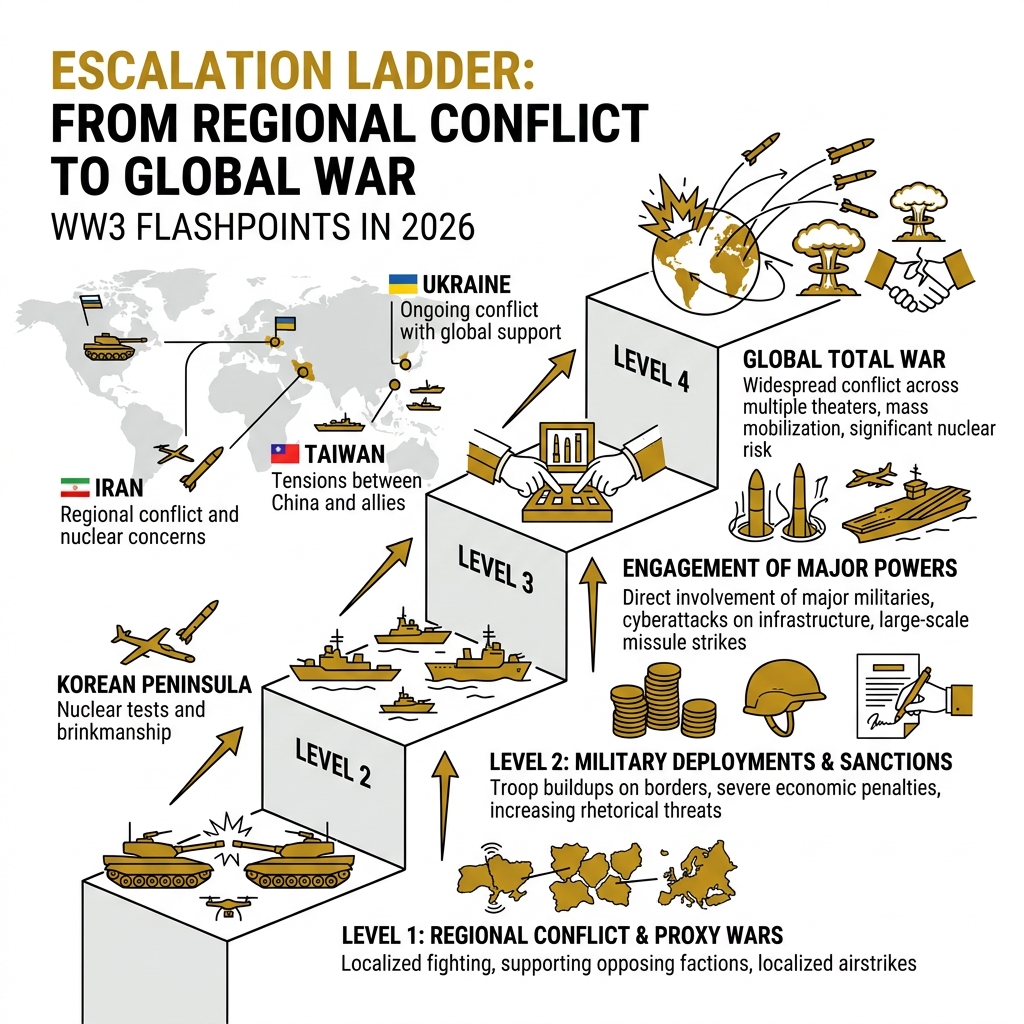
| What are the biggest flashpoints? | Ukraine, Iran, Taiwan, Korean Peninsula |
| Could it escalate to nuclear war? | Possible — Russia has made explicit nuclear threats |
| What do experts say? | Many say we’re in the early stages of a broader global conflict |
The world right now looks like this: U.S. and Israeli strikes hitting Iran. Russian missiles raining on Ukraine. China eyeing Taiwan. North Korea supplying weapons to Russia. These aren’t isolated events — they’re connected.
Ukrainian President Volodymyr Zelensky has said it plainly: Putin has already started World War III. The only question, in his words, is how much territory he seizes before the world stops him.
And Zelensky isn’t alone. Estonian lawmaker Marko Mihkelson put it bluntly: “We have entered the waiting room of World War Three.”
History offers a sobering parallel. World War II wasn’t recognized as a world war while it was starting. Japan invaded Manchuria in 1931. Italy took Ethiopia in 1935. Germany expanded from 1936 to 1938. Nobody called it WW2 yet — until it was undeniable. A Gallup poll from December 1950 found that more than half of Americans already believed World War III had begun — during the Korean War.
We may be living through a similar moment of delayed recognition right now.
I’m Faisal S. Chughtai, founder of ActiveX and a digital strategy expert who has tracked global conflict narratives and their impact on media and search trends — including the explosive rise of ww3 as one of the most searched topics worldwide. I’ll break down everything you need to know, clearly and without the noise.
Ww3 further reading:
Global Flashpoints: From Ukraine to the Middle East
When we look at the globe today, the term “isolated conflict” feels like a relic of the past. The primary flashpoints currently risking escalation to ww3 are interconnected through technology, resources, and shared adversaries.
The Russo-Ukrainian War remains the most direct confrontation between a major power and Western-backed forces. Russia currently holds approximately 20% of the Donetsk region, and President Zelensky has warned that Vladimir Putin will not stop at Ukraine. He views the defense of his nation as a victory for the entire world, arguing that allowing Russia to succeed would invite further aggression across Europe.
In the Middle East, the 2026 Iran war has seen a dramatic spike in tension. Following U.S. and Israeli strikes on Tehran, Iranian missiles were launched in multiple directions, targeting U.S. bases in Kuwait, Oman, Qatar, Saudi Arabia, and Turkey. This “axis” of conflict has caused massive insecurity in the Persian Gulf, with oil prices surging toward $100 a barrel and gasoline prices in the United States increasing by 20% in just two weeks.
The Role of Major Powers and Alliances
The risk of a global conflict is amplified by the “spaghetti chart” of modern alliances. Unlike the relatively simple blocs of the Cold War, today’s world involves complex mutual defense pacts and proxy wars that can draw dozens of nations into a single spark.
- NATO: The alliance remains a cornerstone of Western defense, but its involvement in Ukraine—even accidentally—could spur a “full” response. White House officials have warned that direct conflict between NATO and Russia would be ww3.
- Russia-North Korea Pact: A significant shift occurred with the ratification of a mutual defense treaty between Russia and North Korea. North Korea has already sent hundreds of ballistic missiles to Russia, and thousands of its troops have been reported on the front lines.
- Proxy Wars: Major powers are increasingly using smaller conflicts to test new weapons and drain their rivals’ resources. From the Middle East to Eastern Europe, these proxy battles are becoming “linked sets of conflicts” that share military tech and intelligence.
Territorial Tensions in the Indo-Pacific
While Europe and the Middle East burn, the Indo-Pacific remains a “looming battlefront.” China has reaffirmed its threat of military force to take Taiwan, and the military threat is considered much more credible today than it was 20 years ago.
We are seeing increased reports of Chinese infiltration and spying in Taiwan, leading to tougher counter-measures from Taiwanese leaders. The South China Sea is another “powder keg,” where maritime disputes involve not just China and Taiwan, but also the Philippines, Vietnam, and Malaysia. Analysts suggest that if the U.S. becomes too deeply entangled in Iran or Ukraine, it could provide the perfect window for a Chinese move on Taiwan—a “black swan” event that many fear would be the definitive trigger for ww3.
Modern Warfare: How Technology Increases the Risk of ww3

The weapons of today are a far cry from the trenches of 1914 or the carrier battles of 1942. Modern warfare is defined by speed, invisibility, and automation, which significantly lowers the time leaders have to make life-or-death decisions.
The Role of AI and Cyber Attacks in a Potential ww3
Artificial Intelligence is no longer science fiction; it is a critical component of modern defense. However, think tanks like the RAND Corporation have warned that A.I. could lead to a nuclear war by 2040. The risk lies in “algorithmic escalation,” where autonomous units or AI-driven decision-making systems might misinterpret an adversary’s move and launch a retaliatory strike before a human can intervene.
Cyber warfare has already become a standard feature of modern conflict. Russia has conducted extensive cyberattack activity in Ukraine, targeting digital infrastructure and communication networks. In a full-scale ww3 scenario, we would likely see:
- Satellite Disruption: Knocking out GPS and military communications.
- Infrastructure Sabotage: Targeting power grids, water supplies, and financial systems.
- Information Warfare: Using AI to spread massive amounts of disinformation to paralyze a population’s response.
Tactical Nuclear Weapons and NATO Sharing
The specter of nuclear weapons remains the ultimate deterrent—and the ultimate risk. Currently, the U.S. maintains approximately 180 tactical B61 nuclear bombs deployed in Europe under NATO nuclear sharing agreements. These are hosted in countries like Germany, Italy, Turkey, and the Netherlands.
While the “Mutually Assured Destruction” (MAD) doctrine prevented a hot war during the 20th century, the introduction of hypersonic missiles—which can travel at five times the speed of sound and bypass existing defense systems—has made the nuclear balance much more fragile. Russia’s recent use of hypersonic ballistic missiles in Ukraine was seen as a direct warning to the West that the “red lines” of the past are blurring.
Historical Lessons: Avoiding the Nuclear Precipice
To understand our current risk, we must look back at the “close calls” of the 20th century. History shows that we often avoid disaster not just through strategy, but through the courage of individuals who refuse to follow orders.
Diplomatic De-escalation and Ceasefires
During the Cuban Missile Crisis in 1962, the world was minutes away from nuclear war. The crisis was averted in part because of the “hotline” established between Washington and Moscow, allowing for direct, real-time communication between leaders.
Other lessons come from:
- Able Archer 83: A NATO exercise that the Soviet Union misinterpreted as a real nuclear first strike. It was a stark reminder of how “war games” can lead to accidental escalation.
- The Norwegian Rocket Incident (1995): A research rocket was mistaken for a U.S. nuclear missile, leading President Boris Yeltsin to activate his nuclear briefcase. Fortunately, the error was identified before a launch occurred.
- Stanislav Petrov: In 1983, this Soviet officer ignored a satellite warning of an incoming U.S. missile strike, correctly identifying it as a computer error. His decision likely saved billions of lives.
The Evolution of Sovereign States
The world today is vastly more complex than it was during the World Wars. In 1913, there were approximately 61 sovereign states, dominated by a few major European empires. Today, there are 195 countries, each with its own national interests, military capabilities, and alliances. This 220% increase in sovereign actors means there are many more potential flashpoints where a local dispute can spiral into a global crisis.
The Human and Economic Cost of Global Conflict
A full-scale ww3 would be an unprecedented catastrophe for the human race. Beyond the immediate casualties of war, the secondary effects on the global economy and environment would be devastating.
Economic Consequences of a Global ww3
We are already seeing the “energy price shock” unleashed by the Iran conflict. With oil selling for around $100 a barrel, U.S. gasoline prices have jumped significantly, thrusting Americans back into a 1970s-style era of insecurity.
- Supply Chains: A conflict in the Taiwan Strait would halt the production of semiconductors, effectively ending the modern tech industry overnight.
- Market Collapse: Global stock markets would likely face a total meltdown as investors flee to safe-haven assets like gold.
- Inflation: Shortages of food and energy would lead to hyper-inflation, making basic goods unaffordable for billions.
Environmental Impact and Nuclear Winter
The most terrifying consequence of a nuclear ww3 is not the blast, but the aftermath. A 2022 study published in Nature Food found that a full-scale nuclear war between the U.S. and Russia would kill more than 5 billion people—just from starvation.
- Soot Injection: Nuclear explosions would send 150 million tons of soot into the upper atmosphere.
- Climate Disruption: This soot would block sunlight, dropping global temperatures by over 10°C (18°F).
- Crop Failure: The “nuclear winter” would cause a total collapse of global agriculture, leading to a famine that would last for years.
The Great Debate: Has World War III Already Begun?
This is the question that divides analysts, leaders, and the public. Are we seeing “piecemeal” regional wars, or are the gears of a global conflict already in motion?
Expert Perspectives on Regional vs. Global War
Some analysts argue that we are already in the early stages of ww3. They point to the fact that the U.S., Russia, China, Iran, and North Korea are all involved in the same set of linked conflicts.
- Pope Francis has repeatedly warned that the world is in a “third war, fought piecemeal.”
- Jamie Dimon, CEO of JPMorgan Chase, stated in late 2024 that “World War III may have already begun” due to the coordination between hostile actors.
- The Counter-Argument: Other experts believe these conflicts are still containable. They argue that as long as there is no direct military engagement between the U.S. and Russia or China, the world is not in a “World War.” They view current events as a return to “Great Power Competition” rather than a global war.
Public Perception and the Gallup Poll
Public fear is at an all-time high. A recent YouGov poll found that half of Britons believe ww3 is likely in the next 5 to 10 years. This mirrors the sentiment of December 1950, when more than half of Americans believed the third world war had already started during the Korean War.
The rise of digital media and real-time news aggregation, like what we provide at Apex Observer News, means that the public is more aware of global tensions than ever before. However, this also leads to “Global Anxiety” thresholds reaching 98%, as people constantly search for updates on potential escalations.
Frequently Asked Questions about ww3
What are the primary triggers for a third world war?
The most likely triggers include a Chinese invasion of Taiwan, a direct NATO-Russia clash in Eastern Europe, or a miscalculation during the ongoing Iran-Israel conflict. “Black swan” events—unpredictable incidents like an accidental missile launch or a major assassination—could also trigger a rapid escalation through mutual defense pacts.
Can modern diplomacy prevent a nuclear escalation?
Yes, but it requires active engagement. Historical tools like the “hotline” and arms control treaties are essential. However, many current treaties have been abandoned or suspended. Re-establishing these channels and extending agreements to include rising powers like China is critical for de-escalation.
Is the world currently in a “piecemeal” global conflict?
Many leaders, including Pope Francis and President Zelensky, believe so. While we haven’t seen a single formal declaration of war between all major powers, the level of military tech sharing, financial support, and proxy fighting suggests that the world’s major conflicts are no longer truly separate.
Conclusion
At Apex Observer News, our mission is to keep you informed with real-time news aggregation across all sectors—from the latest in tech to the shifting lines of global geopolitics.
The question of whether ww3 has started is more than an academic debate; it is a call for global stability and de-escalation. While the statistics and flashpoints are sobering, history also shows that diplomacy, individual courage, and international pressure can pull the world back from the brink.
As we navigate this uncertain future, staying informed is your best defense. We will continue to curate the most important headlines to help you understand the world as it changes, one headline at a time.
For more updates on global news and real-time headlines, visit our global news category.
