

Why AI in Agriculture Is Redefining How We Feed the World
AI in agriculture is the use of artificial intelligence — including machine learning, computer vision, and generative AI — to make farming smarter, more efficient, and more sustainable.
Here’s a quick snapshot of what AI is doing on farms right now:
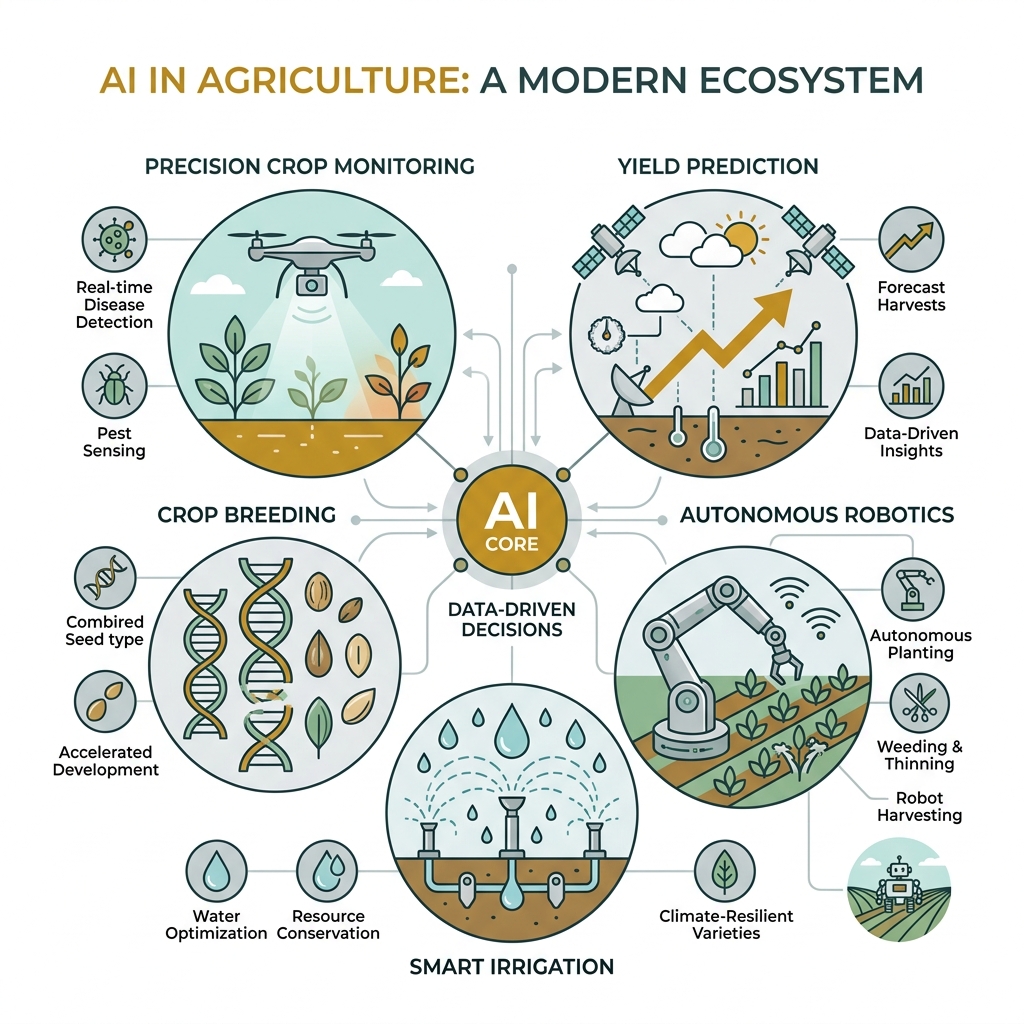
| AI Application | What It Does |
|---|---|
| Precision crop monitoring | Detects disease, pests, and stress in real time |
| Yield prediction | Forecasts harvests using weather, soil, and satellite data |
| Autonomous robotics | Handles planting, weeding, and harvesting with minimal labor |
| Smart irrigation | Adjusts watering automatically based on soil moisture and weather |
| Crop breeding | Accelerates development of climate-resilient varieties |
The pressure on global food systems is real. The world’s population is on track to hit 10 billion by 2050 — and agricultural production needs to grow by roughly 60% to keep up. At the same time, climate change is already cutting into yields. Row crop output is expected to drop by 11% due to worsening weather and pest pressure.
Meanwhile, 160,000 farms have disappeared in the US alone since 2017. The people who remain are being asked to do more with less land, less labor, and less predictable weather.
AI isn’t a magic fix. But it’s becoming one of the most powerful tools farmers have ever had access to.
I’m Faisal S. Chughtai, founder of ActiveX, with deep experience tracking the intersection of emerging technology and real-world applications — including AI in agriculture and its role in reshaping digital and data-driven industries. In this guide, I’ll break down exactly how AI is transforming farming, from the field to the enterprise.
Ai in agriculture vocabulary:
The Rapid Evolution of ai in agriculture
The transition from “experience-driven” farming—where a farmer relies on their gut feeling and family traditions—to “data-driven” agriculture is moving at a breakneck pace. We are currently witnessing a massive surge in the market for ai in agriculture. In 2023, the market was valued at approximately USD 1.7 billion. Experts project it will skyrocket to USD 4.7 billion by 2028. If we look further out to 2034, some estimates suggest the market could hit nearly USD 17 billion.
But the real story isn’t just the size of the tech market; it’s the value it creates for the world. According to research from McKinsey, AI has the potential to create USD 100 billion in value “on the acre” (direct production) and another USD 150 billion for the broader agricultural enterprise. This isn’t just about fancy gadgets; it’s about a fundamental shift in how we manage the $4 trillion global food industry.
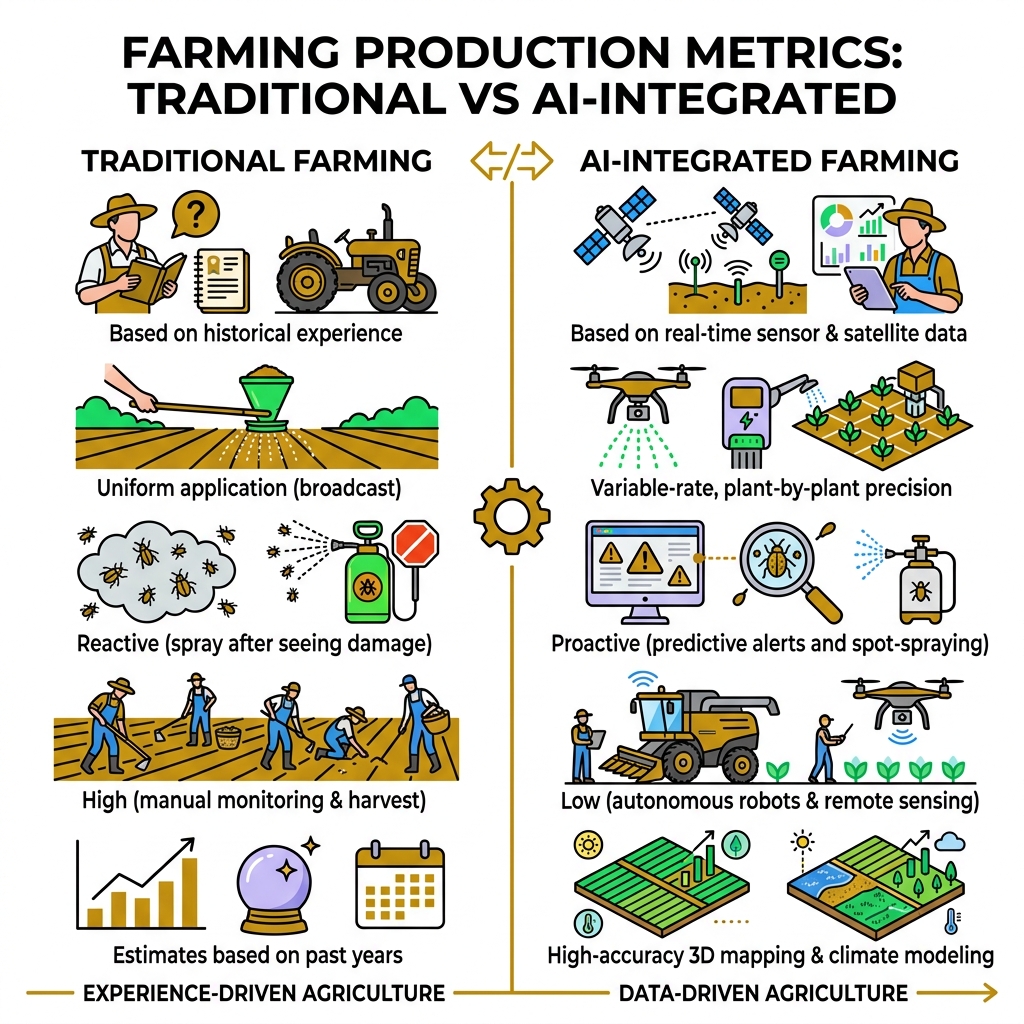
| Metric | Traditional Farming | AI-Integrated Farming |
|---|---|---|
| Decision Making | Based on historical experience | Based on real-time sensor & satellite data |
| Resource Use | Uniform application (broadcast) | Variable-rate, plant-by-plant precision |
| Pest Management | Reactive (spray after seeing damage) | Proactive (predictive alerts and spot-spraying) |
| Labor Dependency | High (manual monitoring & harvest) | Low (autonomous robots & remote sensing) |
| Yield Forecasting | Estimates based on past years | High-accuracy 3D mapping & climate modeling |
Primary Benefits: Yields, Costs, and Sustainability
Why are we seeing such a massive push for ai in agriculture? Because the stakes are incredibly high. To feed a projected population of 10 billion, we need a 60% boost in production. However, we are running out of new land to clear. We have to make the land we already have work harder and smarter.
Boosting Yields and Managing Climate Risk
Climate change is the ultimate “wild card” for farmers. In Maharashtra, India, simulations by ClimateAi found that extreme heat and drought could lead to a 30% decrease in tomato output over the next two decades. AI helps mitigate these risks by providing long-range, ultra-localized weather forecasts that go far beyond the standard 14-day window. This allows farmers to adjust their planting schedules and choose seed varieties that can handle the coming heat.
Slashing Costs and Resource Waste
In the past, if a farmer wanted to fertilize a field, they sprayed the whole thing. AI changes that. By using computer vision and GPS, machines can now identify individual plants that need nutrients and ignore the ones that don’t. This “site-specific” management reduces the cost of chemicals and prevents excess nitrogen from leaching into our water systems.
Key Technologies Powering the Digital Farm
The “brain” of the modern farm is AI, but it needs “eyes” and “hands” to work. This is where the integration of IoT, big data, and robotics comes in.
- IoT Sensors: These are buried in the soil or worn by livestock to provide a constant stream of data on moisture levels, temperature, and animal health.
- Big Data: AI thrives on information. By crunching decades of soil samples, historical weather patterns, and genomic data, AI can spot trends no human could ever see.
- Drones and Satellites: Satellite imagery and drones equipped with AI allow us to monitor crop health in real-time from the sky. These systems can detect signs of stress, disease, or pest infestations weeks before they are visible to the naked eye.
Precision Crop Monitoring with ai in agriculture
One of the most impressive feats of ai in agriculture is its ability to “see” like an expert agronomist, but at a massive scale. Computer vision models have already demonstrated over 90% accuracy in detecting diseases like apple black rot. They can also identify tiny insects—including flies, bees, and moths—with similar precision.
Platforms like Syngenta’s Cropwise are already operating at a global scale. In just five years, this AI-powered system has grown to cover over 70 million hectares in more than 30 countries, connecting data and tools to help farmers make better decisions every single day.
Autonomous Robotics and Weed Control
Weeds are the silent thieves of the farm, stealing water and nutrients from crops. Traditionally, farmers used “blanket” herbicide spraying. Now, robotic field workers use computer vision to distinguish between a weed and a crop by analyzing the shape, color, and size of the leaves.
This technology isn’t just about being “green”—it’s a response to a massive labor crisis. With 160,000 farms disappearing since 2017 and a shrinking rural workforce, robots like the FRAIL-bot (which helps pickers by transporting heavy trays) can increase picking efficiency by 25%, allowing the remaining human workers to focus on more skilled tasks.
Generative AI and the Future of Agricultural R&D
While analytical AI is great at making predictions, Generative AI is taking things a step further by helping us “design” the future of food. In Research and Development (R&D), Gen AI can synthesize millions of data points to simulate testing scenarios that would take years to perform in a real greenhouse.
A great example is the company Avalo, which used AI to develop a new variety of broccoli specifically for vertical farming. Traditionally, broccoli takes over 120 days to harvest outside. The AI-designed variety can be harvested in just 37 days—making it 5x faster and 50x cheaper to produce than traditional competitors.
Overcoming Barriers to ai in agriculture Adoption
Despite the excitement, the path to a fully AI-integrated farm isn’t without hurdles. We must address several key challenges:
- The Digital Divide: There is a growing gap between large-scale operations that can afford these tools and smallholder farmers who produce a third of the world’s food.
- High Upfront Costs: While AI saves money in the long run, the initial investment in sensors, robots, and software can be daunting.
- Data Privacy: Farmers are rightfully protective of their data. Ensuring they retain ownership and control is vital for building trust.
- Technical Expertise: You shouldn’t need a PhD in computer science to run a farm. We need tools that are simple, mobile-friendly, and integrate with existing machinery.
To ensure everyone benefits, we need more research on AI equity for smallholders to find ways to scale these technologies responsibly in low- and middle-income countries.
Frequently Asked Questions about AI Farming
How does AI increase crop yields?
AI increases yields by optimizing every stage of the plant’s life. It helps select the best seeds for the local soil, predicts the perfect time to plant, monitors for diseases early enough to stop them, and ensures the plant gets exactly the right amount of water and fertilizer. It essentially removes the “guesswork” from farming.
What are the main challenges for AI adoption in farming?
The biggest barriers are high initial costs, a lack of reliable rural broadband (you can’t run cloud AI without a signal!), and a shortage of technical training. There is also a cultural hurdle; many farmers are hesitant to trust an algorithm over their own decades of experience.
Can smallholder farmers benefit from agricultural AI?
Absolutely. In fact, digital agriculture amplified by AI has the potential to boost the agricultural GDP of low- and middle-income countries by more than $450 billion annually. The key is developing “low-tech” interfaces—like SMS-based advice or simple smartphone apps—that bring the power of AI to the farmer’s pocket without requiring expensive machinery.
Conclusion
The future of ai in agriculture is not about replacing farmers; it’s about empowering them. By shifting the farmer’s role from manual laborer to a “manager of smart systems,” we can build a food system that is more resilient to climate change and capable of feeding 10 billion people.
At Apex Observer News, we believe that staying ahead of these trends is crucial for anyone in the business of food, tech, or sustainability. As we move toward 2050, the most successful farms won’t just be the ones with the best soil—they’ll be the ones with the best data.
Best Practices for Getting Started with AI:
- Start Small: Don’t try to automate everything at once. Start with a single use case, like soil moisture monitoring or pest detection.
- Focus on Data Quality: AI is only as good as the data you give it. Ensure your sensors are calibrated and your records are accurate.
- Prioritize Security: Work with technology partners who have clear data ownership agreements and robust cybersecurity.
- Stay Human: Use AI to enhance your expertise, not replace it. The best results come when human intuition and machine intelligence work together.
For more insights on how technology is reshaping our world, keep following the-future-of-food-and-artificial-intelligence-on-the-farm.

One thought on “Why Your Next Farmer Might Be an Algorithm”
Comments are closed.