

The 2026 Retail Sales Growth Forecast Is Stronger Than Most People Expected
The retail sales growth forecast for 2026 is turning heads — and for good reason. Here’s a quick snapshot of where the major projections stand right now:
| Source | 2026 Forecast | Projected Total |
|---|---|---|
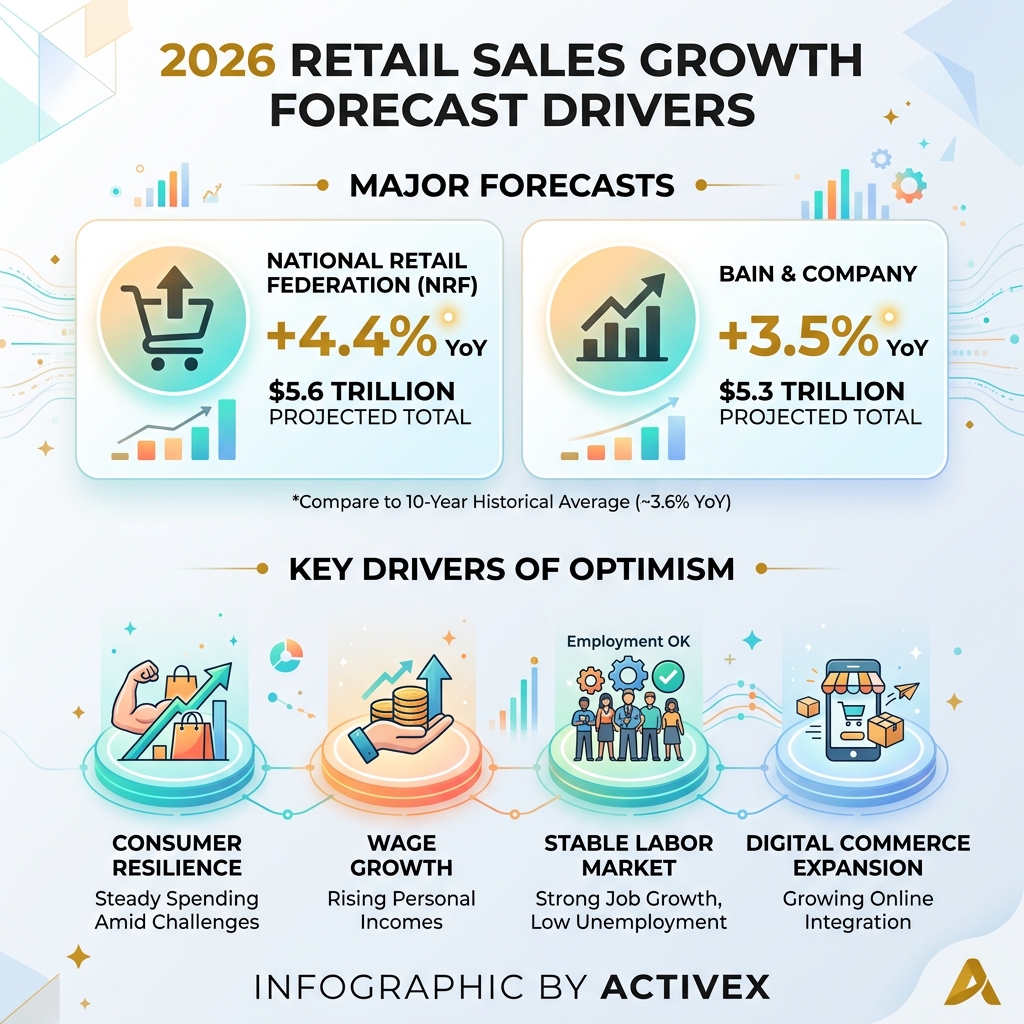
| National Retail Federation (NRF) | +4.4% YoY | $5.6 trillion |
| Bain & Company | +3.5% YoY | $5.3 trillion |
| 10-Year Historical Average | ~3.6% YoY | — |
| US Census Bureau (Jan 2026 actual) | +3.2% YoY | $733.5B (monthly) |
The bottom line: Most forecasters expect solid retail growth in 2026, above the long-run average — driven by consumer resilience, wage growth, and a stable labor market.
Despite rising fuel costs, geopolitical tensions, and shaky consumer sentiment, spending has held up. The NRF — the nation’s largest retail trade group — is projecting the strongest growth since 2022. That’s a surprisingly upbeat signal in a complicated economic environment.
As NRF president Matthew Shay put it, consumer spending remains a “steady and reliable engine of growth” — and the data so far backs that up.
I’m Faisal S. Chughtai, founder of ActiveX, with years of experience tracking digital commerce trends and helping businesses navigate the evolving retail sales growth forecast landscape. Let’s break down exactly what’s driving this optimism — and where the real risks lie.
Retail sales growth forecast terms you need:
The 2026 Retail Sales Growth Forecast: Major Projections
When we look at the numbers for 2026, there is a palpable sense of “cautious optimism” among the major players. We aren’t just seeing a return to normal; we are seeing a retail environment that is learning to thrive despite constant global “hiccups.”
The National Retail Federation (NRF) has come out with one of the most bullish outlooks, predicting that annual retail sales will grow 4.4% over 2025, reaching a staggering $5.6 trillion. This is particularly impressive when you realize it excludes the often-volatile sectors like auto dealers, gas stations, and restaurants. This forecast suggests that even as the world feels a bit wobbly, our collective urge to click “add to cart” remains unshaken.
This optimism isn’t just a shot in the dark. It’s backed by recent data from the US Census Bureau. In January 2026, advance estimates showed retail and food services sales reached $733.5 billion. While that was a tiny 0.2% dip from a very strong December 2025, it was a solid 3.2% jump compared to January 2025. This indicates a Stable Growth Trajectory Consistent with ML Projections that many analysts have been tracking for months.
Analyzing a Key Retail Sales Growth Forecast
What makes the NRF’s 4.4% figure so significant? To put it in perspective, the average annual growth over the last decade (if we ignore the wild “pandemic years” of 2020–2022) has been about 3.6%. So, we are looking at a year that is expected to perform significantly better than the historical norm.
According to NRF’s chief economist Mark Mathews, this forecast is built on a foundation of real growth, not just “inflation growth.” Because goods inflation has started to cool in certain sectors, more of that 4.4% represents actual items moving off shelves rather than just higher price tags. We’ve seen Nation’s largest retail group forecasts 4.4% gain in headlines recently because it signals that the American consumer is still the “engine that could.”
Comparing Conservative vs. Optimistic Outlooks
Of course, not everyone is wearing rose-colored glasses. While the NRF is aiming high, Bain & Company offers a slightly more tempered retail sales growth forecast. They expect US retail sales to grow by 3.5% year-over-year in 2026, totaling around $5.3 trillion. This is a slight step down from the 4.0% growth seen in 2025.
Why the difference? Firms like Bain are keeping a closer eye on “volume expansion.” They worry that as consumers become more value-conscious, they might buy the same amount of “stuff” but opt for cheaper, private-label versions, which keeps total revenue growth modest. We see these nuances explored in reports like the US Retail Sales Projections and Retail Context— February 2026, which highlights how shifting consumer sentiment can act as a “drag” even when the labor market is strong.
Economic Engines and Headwinds Shaping the Year

What is actually fueling this growth? It isn’t just magic; it’s a combination of policy and persistence. One of the biggest “engines” for 2026 is the Working Families Tax Cut Act. These tax cuts are expected to put more disposable income directly into the pockets of the people most likely to spend it.
We are also seeing a very resilient employment market. With unemployment projected to stay below 4.5% throughout 2026, people feel secure enough in their jobs to keep spending. Wage growth is another major factor—when people see their paychecks growing faster than the cost of a gallon of milk, they tend to feel a bit more adventurous with their discretionary spending.
However, we have to acknowledge the elephant in the room: nearly a quarter of US households are still living paycheck to paycheck. This creates a “bifurcated” market where high-income households are driving luxury and premium growth, while everyone else is hunting for deals.
Geopolitical Risks and the Iran War
No retail sales growth forecast is complete without looking at the “wildcards.” Currently, the biggest wildcard is the geopolitical tension in the Middle East, specifically the Iran war. This conflict has already sent ripples through the global economy, with oil prices surging nearly 50% since the hostilities began.
When oil goes up, gasoline prices are “following close behind.” This acts as a hidden tax on every consumer. If you’re spending $20 more to fill up your tank every week, that’s $20 you aren’t spending at a retail store. Retailers are also bracing for supply chain disruptions, as shipping routes become more dangerous or expensive to navigate.
Inflation and the Retail Sales Growth Forecast
While we’ve seen some easing, inflation hasn’t totally left the building. In February 2026, US wholesale prices came in at 3.4%—hotter than many economists expected. This was driven largely by a sharp increase in food costs.
This creates a weird “mood” for consumers. Even if the data says the economy is growing, “consumers’ mood” has remained somewhat downbeat. There is a disconnect between how people feel (stressed about prices) and how they act (they keep buying things anyway). This disconnect is one of the most fascinating parts of the 2026 outlook.
Sector-Specific Trends and the AI Revolution
Not all retail is created equal in 2026. If you want to see where the real action is, look at “nonstore retailers”—basically, e-commerce. According to Census Bureau data, this sector saw a massive 10.9% year-over-year jump in early 2026. This trend isn’t just a US phenomenon; we are seeing massive E-commerce Growth in Pakistan and other emerging markets as digital infrastructure matures.
Retailers are leaning heavily into major sales events to keep the momentum going. We saw record-breaking Cyber Monday Deals recently, and the Boxing Day Sales Forecast suggests that the “thirst for a bargain” is a global constant.
The Role of AI in the Retail Sales Growth Forecast
2026 is the year AI moves from “cool experiment” to “essential employee.” We are seeing the rise of “Agentic AI”—AI agents that don’t just answer questions but actually perform tasks, like finding the best price for a pair of sneakers and completing the purchase for you.
Industry experts estimate that by 2030, AI agents could handle 25% of all global e-commerce sales. Already, some retailers are seeing 15-20% of their referral traffic coming from AI chats like ChatGPT rather than traditional search engines. This is why many say the US economy has become “hooked” on AI spending; retailers are investing billions into hyper-personalization and Retail Media Networks (RMNs) to ensure they are the ones the AI agents recommend.
Value-Seeking and Income Bifurcation
As we mentioned, the consumer base is splitting. On one side, you have high-income earners who are still spending on travel and luxury. On the other, you have the “value-seekers.” Interestingly, 70% of retail executives now view deal-driven habits as a “structural” change, not a temporary phase.
This has led to a boom in private-label brands. Shoppers realize that the store-brand cereal tastes pretty much the same as the name brand but costs 30% less. For entrepreneurs looking at How to Start Ecommerce Business ventures, the focus is shifting toward finding the Best Selling Products on Daraz or Amazon that offer maximum value for a lower price point.
Global Perspectives and Trade Policy
The retail sales growth forecast isn’t just about what’s happening in our backyard. Global trade policies are causing “unprecedented” disruption. The World Trade Organization (WTO) has warned that rising tariffs are reshaping the map of global commerce.
Many companies are currently scrambling to respond to new trade barriers, with 95% of retail executives expecting rising costs due to these policies. This is forcing a massive “supply chain restructuring,” with retailers moving production closer to home (nearshoring) to avoid the volatility of long-distance shipping and potential tariff wars.
China and Europe: Divergent Paths
The global picture is a bit of a mixed bag. In China, the property slump has been worse than expected, and economic growth momentum slowed significantly in late 2025. This has a direct impact on global retail, as China is both a major manufacturer and a massive consumer market.
Meanwhile, Europe is facing its own set of challenges. The EU recently lowered its outlook for 2026 due to higher-than-forecast US tariffs. However, it isn’t all bad news; the EU has finalized €176 billion in defense loans, which provides some fiscal stimulus, and the latest Monetary policy statement from the ECB suggests a focus on stabilizing the economy to encourage consumer spending.
Frequently Asked Questions about the Retail Sales Growth Forecast
What is the latest retail sales growth forecast for 2026?
The most widely cited forecast comes from the NRF, which predicts a 4.4% increase in annual retail sales, bringing the total to approximately $5.6 trillion. Other firms, like Bain & Company, are slightly more conservative, projecting a 3.5% growth rate.
How did US retail sales perform in early 2026?
According to the US Census Bureau, retail sales in January 2026 reached $733.5 billion. While this was a 0.2% decrease from December 2025, it represented a 3.2% increase over January 2025, showing that the market remains on a stable growth path.
What are the biggest risks to the 2026 retail outlook?
The primary risks include geopolitical conflicts (specifically the Iran war), which can drive up fuel and shipping costs. Other concerns include “sticky” inflation in food prices, rising tariffs that disrupt trade, and a softening labor market that could eventually dampen consumer confidence.
Conclusion
At Apex Observer News, we’ve been watching these shifting tides, and the overarching theme for 2026 is adaptability. The retail sales growth forecast may be surprisingly bright, but it isn’t a “free pass” for retailers. Success this year depends on strategic AI integration, a deep understanding of the value-seeking consumer, and the resilience to navigate a complex global trade environment.
The American consumer has proven time and again that they are willing to spend—as long as retailers provide the right mix of value, convenience, and innovation. For more insights on how these trends are impacting your world, be sure to check out our Latest Business Headlines.
We’ll be here to keep you updated as the data rolls in. For now, it seems the retail engine is humming along quite nicely.
