

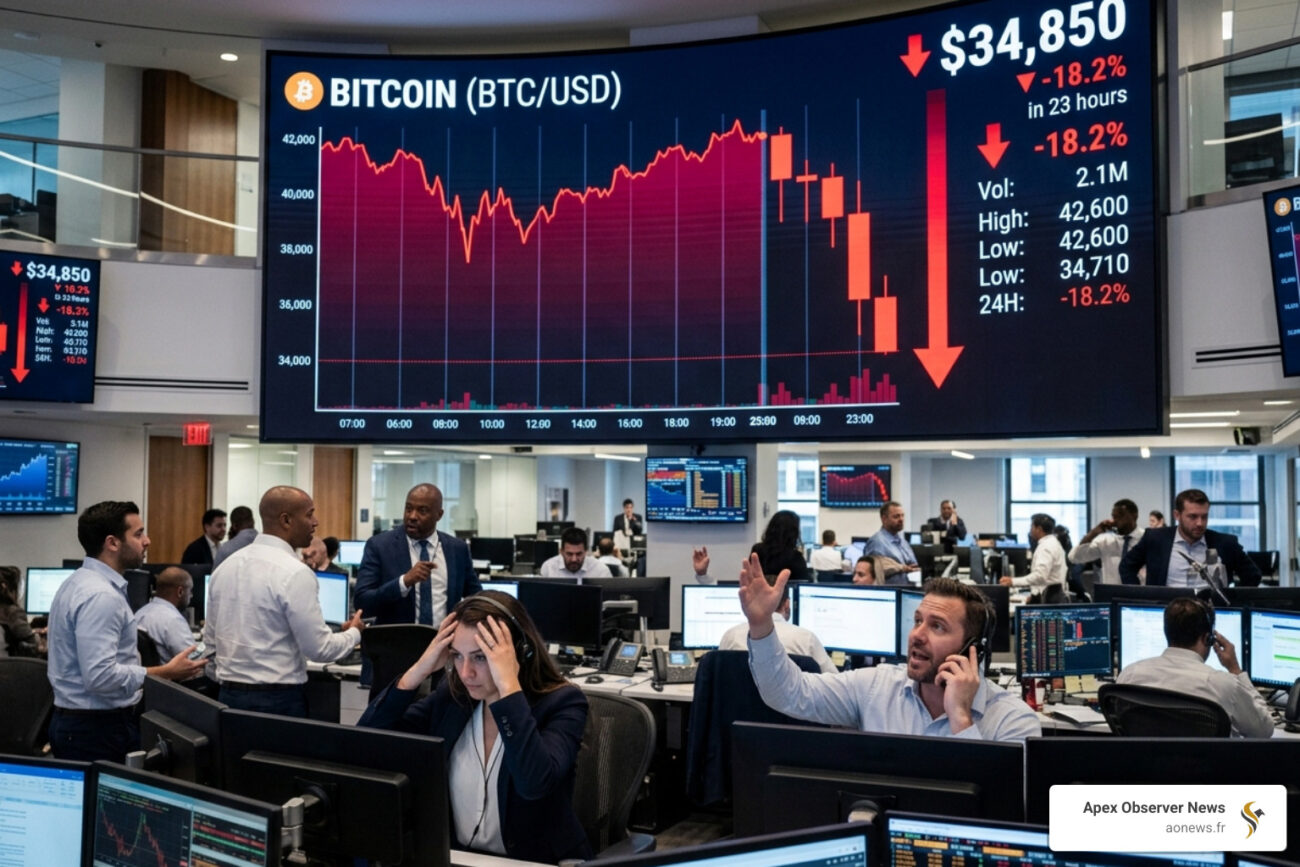
The Crypto Crash Explained: What Happened and Why It Matters
The crypto crash that unfolded between late 2025 and early 2026 is one of the most dramatic market collapses in digital asset history. Here is a quick breakdown of what happened:
Key facts at a glance:
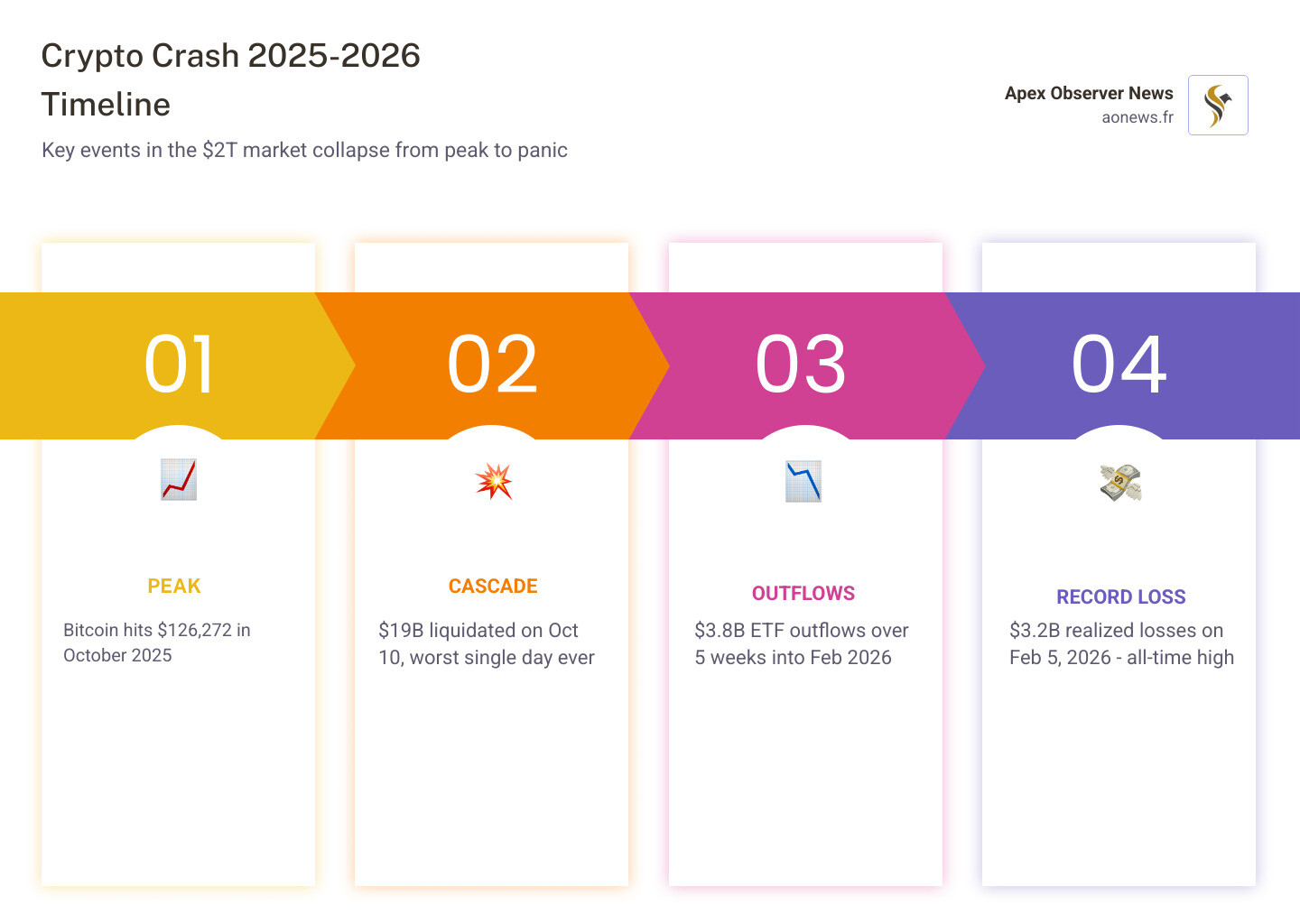
- Bitcoin’s peak: $126,272 (October 2025)
- Bitcoin’s drop: Down to ~$60,000-$65,000 (-48% to -52%)
- Total market cap lost: Over $2 trillion (from $4.4T to $2.3T)
- Single worst day: $19 billion in crypto leverage liquidated on October 10, 2025
- Record losses: $3.2 billion in realized losses on February 5, 2026 — an all-time record
- ETF outflows: $3.8 billion over five consecutive weeks through February 2026
- Investor sentiment: Fear & Greed Index hit 11 — Extreme Fear, lowest since 2022
The six main causes driving the crash:
- Trump’s global tariff shocks triggering risk-asset sell-offs
- Tech stock weakness pulling crypto prices lower
- Record leveraged position liquidations cascading across exchanges
- Institutional Bitcoin ETF holders flipping from buyers to sellers
- Bitcoin breaking below its 365-day moving average for the first time since 2022
- Geopolitical tensions driving capital toward safer assets like gold
This wasn’t a random dip. It was a perfect storm of macroeconomic pressure, structural leverage failures, and evaporating institutional demand — all hitting at once, with no circuit breakers to slow the fall.
Unlike traditional stock markets, crypto trades 24/7 with no automatic trading halts. When confidence cracked, the sell-off fed on itself fast.
I’m Faisal S. Chughtai, founder of ActiveX and a digital markets strategist who has tracked multiple crypto crash cycles across branding, web infrastructure, and financial tech ecosystems. In this guide, I’ll walk you through exactly what broke, why it matters beyond crypto, and what safeguards the financial system urgently needs.
Crypto crash word roundup:
Anatomy of the 2025-2026 Market Downturn

To understand the current crypto crash, we have to look back at the euphoria of early October 2025. Bitcoin had just smashed through all-time highs, reaching a staggering $126,272. The narrative was invincible: institutional adoption was here, the “digital gold” thesis was proven, and the regulatory environment seemed poised for a golden age.
Then came the “10/10 cascade.” On October 10, 2025, the market was blindsided by a 100% China tariff threat from the Trump administration. In the blink of an eye, $19 billion in leveraged positions were wiped out. This wasn’t just a correction; it was a structural failure. Bitcoin plummeted, eventually losing nearly half its value and breaking below the $70,000 psychological support level—a price point not seen since the previous year.
The volatility was further fueled by the Trump administration signing the GENIUS Act into law. While intended to establish a strategic Bitcoin reserve and position the U.S. as a digital asset leader, the immediate market reaction was one of “sell the news.” Investors began to worry that the government’s involvement would lead to increased centralized control or that the reserve would be used as a political tool rather than a stabilizing force.
Beyond Washington, global macro forces were at play. The “Yen carry trade”—a strategy where investors borrow yen at low interest rates to buy high-yielding assets—began to unravel as the Bank of Japan shifted its policy. This forced a massive deleveraging event that hit Hong Kong hedge funds particularly hard. These funds had built massive, risky positions in out-of-the-money Bitcoin ETF options. When the market turned, their forced liquidations created a “death spiral” that pushed prices even lower. For those looking to dive deeper into these shifts, you can find more info about crypto market trends on our dedicated business hub.
Structural Failures: Leverage, Liquidations, and ETF Outflows
The sheer speed of the crypto crash highlighted deep cracks in the market’s plumbing. In traditional finance, circuit breakers pause trading during extreme volatility. In crypto, the “margin engines” are automated and ruthless. When Bitcoin’s price dropped, it triggered a chain reaction of unified margin liquidations. This means that if a trader’s Ethereum position went underwater, the exchange would automatically sell their Bitcoin to cover the debt, dragging the whole market down together.
This “margin spiral” was exacerbated by Automatic Deleveraging (ADL). On platforms like Binance, if a liquidation cannot be filled in the open market, the system forcibly closes the profitable positions of other traders to maintain the exchange’s solvency. This effectively punished the “winners” to pay for the “losers,” creating a massive trust deficit.
Institutional players weren’t immune. SEC regulatory filings for major corporate holders showed that as Bitcoin dipped below $76,000, even the largest treasury positions began to sit in unrealized losses. This led to a dramatic shift in the Spot Bitcoin ETF landscape. After months of record-breaking inflows, the market saw $3.8 billion in net outflows over five consecutive weeks in early 2026.
Interestingly, even as some fled, others saw a long-term play. We saw reports of Vanguard finally dipping a toe into crypto waters as the bounce past $91,000 suggested a temporary floor. However, the recovery was hampered by the CLARITY Act deadlock in the U.S. Senate. Banking sector lobbyists successfully stalled the bill over concerns regarding stablecoin rewards, leaving the industry in a state of regulatory limbo. This uncertainty even caused the stablecoin USDe to briefly lose its $1 peg on certain exchanges, trading as low as $0.60 and triggering a whole new wave of unnecessary liquidations.
Comparing the Current Decline to Historical Market Cycles
Is this crypto crash different from the “crypto winters” of 2018 or 2022? Yes and no. While the percentage drawdown is currently less severe than the 80%+ drops seen in the past, the dollar value wiped out is significantly higher because the market has grown so much.
| Metric | 2018 Crash | 2022 Crash | 2025-2026 Crash |
|---|---|---|---|
| Trigger | Regulatory Crackdowns | FTX/Luna Collapse | Tariffs/Macro/Leverage |
| BTC Drawdown | ~84% | ~78% | ~52% (so far) |
| Duration | ~12 Months | ~13 Months | 5+ Months (ongoing) |
| Key Support | 200-Week MA | $15,500 | 365-Day MA |
| Sentiment | Disbelief | Depression | Extreme Fear |
In 2018, the crash was largely driven by an Initial Coin Offering (ICO) bubble and a lack of infrastructure. In 2022, it was the “contagion” of fraudulent entities like FTX. The 2026 decline, however, is a “macro crash.” It proves that Bitcoin is no longer an isolated experiment; it is now deeply correlated with tech stocks and global liquidity.
The technical damage is undeniable. Bitcoin broke below its 365-day moving average—a level that had held as support for years. This breakdown prompted a warning from legendary investor Michael Burry (of “The Big Short” fame), who noted that “sickening scenarios” were now within reach due to cascading effects. Furthermore, the “digital gold” narrative took a massive hit. While Bitcoin fell 40% over the year, physical gold futures gained 61%, showing that in times of true geopolitical crisis, investors still prefer the yellow metal over the digital one. For a broader look at how these events connect to global policy, see our report on global crypto regulation updates.
Lessons for Investors and the Future of Digital Assets
If there is a silver lining to this crypto crash, it is the “cleansing” of the market. High-leverage “weak hands” have been flushed out, and the “get rich by Tuesday” era has likely ended. We are entering a phase of “Structural Maturity.”
For investors, the lessons are clear:
- The 1% Rule: Never risk more than 1% of your total portfolio on a single high-leverage trade.
- Dollar-Cost Averaging (DCA): Buying the dip in small, consistent increments is historically the only way to survive these cycles.
- Risk Management: Stop-loss orders are not optional when trading a 24/7 market with no trading halts.
Despite the carnage, the fundamentals remain surprisingly strong. Institutional infrastructure is more robust than ever, with ETFs holding over $165 billion in assets. Even amid the downturn, we saw the HashKey IPO move forward despite market pressure, signaling that long-term capital is still betting on the technology.
The “Strategic Bitcoin Reserve” concept, while currently a source of volatility, provides a potential long-term floor for the asset. If governments begin to hold Bitcoin as a reserve asset alongside gold, the scarcity models (like Stock-to-Flow) suggest a significant upside in the next expansion phase. For those new to the space, we recommend checking out the ultimate guide to crypto to build a solid foundation before the next bull run.
Frequently Asked Questions about the crypto crash
Why is the crypto crash happening right now?
The crash is the result of a “perfect storm.” Macroeconomic hawkishness (higher interest rates) and sudden tariff shocks from the U.S. administration have pulled liquidity out of all risk assets. This was amplified by forced liquidations of over-leveraged hedge funds and a high correlation with a tech stock sell-off. Additionally, hype-driven events like the Pi Coin value announcements often lead to “sell the news” events that drain liquidity from the broader market.
When will the market recover from the current crypto crash?
Historical recovery timelines suggest that “crypto winters” typically last about 13 months, though the worst of the price action often bottoms out sooner. Analysts at Bernstein expect a bottom in the $60,000 range in the first half of 2026. Investors should watch for a return to net positive ETF inflows and the Bitcoin Fear & Greed Index moving above 25. Most projections point toward a sustained recovery beginning in Q3 2026.
Is Bitcoin still a safe haven after the crypto crash?
The “safe haven” or “digital gold” debate is currently at a crossroads. While Bitcoin failed to act as a store of value during the 2025 tariff shocks (falling while gold rose), its long-term scarcity remains unchanged. There are only 21 million coins, and institutional demand, while currently reversing, has a history of returning stronger after every major deleveraging event.
Conclusion
At Apex Observer News, we have seen this story before. Every crypto crash feels like the end of the world, yet the underlying blockchain technology continues to evolve and integrate into the global financial system. The 2025-2026 downturn is a painful but necessary reminder that the “wild west” of crypto needs better safeguards—not to stifle innovation, but to protect the system from its own volatility.
The path to recovery will require more than just higher prices; it will require the passage of clear legislation like the CLARITY Act and the implementation of better exchange-level protections to prevent margin spirals. Until then, the best safeguard is a well-informed investor. Stay updated with business and crypto news at Aonews.fr to ensure you are ready for whatever the market throws at us next. In crypto, the only thing more certain than a crash is the resilience of the network itself.
