


Why Technology Shapes Everything You Do
Technology is the use of knowledge, tools, and systems to solve problems and improve life. Here’s a quick breakdown:
| Aspect | What It Means |
|---|---|
| Definition | Applying knowledge to create tools, systems, or processes |
| Purpose | Solve problems, save time, improve quality of life |
| Scope | Covers everything from fire-making to artificial intelligence |
| Impact | Shapes economy, society, environment, and culture |
From the wheel to Wi-Fi, technology has been the driving force behind every leap in human progress. It is not just gadgets and apps. It is any tool or system humans build to make life easier, safer, or more connected.
Think about your morning alone. Your alarm, your coffee maker, your news feed — all of it runs on layers of technology built over thousands of years of human ingenuity.
That is what makes it so fascinating. And so worth understanding.
I’m Faisal S. Chughtai, and I’ve spent years working in the technology sector, focusing on digital innovation and development — fields powered by technology at their core. In this guide, I’ll walk you through everything you need to know, from its ancient roots to its fast-approaching future.
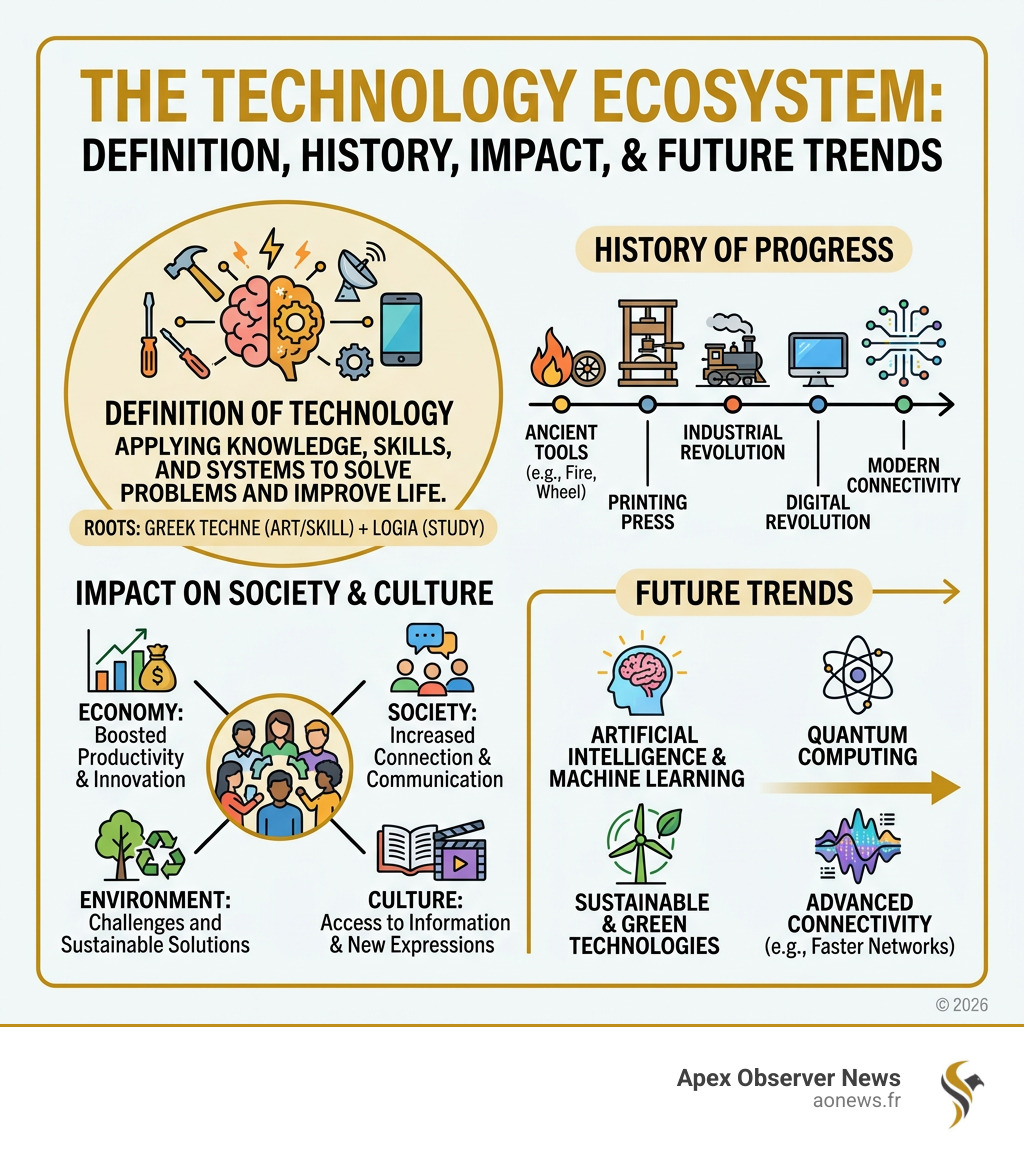
Defining Technology: From Ancient Craft to Modern Science
To truly understand technology, we have to look back at where the word itself comes from. It isn’t a modern buzzword coined in Silicon Valley; its roots are deeply philosophical. The word is derived from two Greek terms: τέχνη (techne), meaning art, skill, or craft, and -λογία (logia), meaning the study of or a branch of knowledge.
In its the original definition, technology was described as the systematic treatment of an art or craft. It wasn’t just about the tool itself, but the knowledge required to create and use it. As noted by American physicist Harvey Brooks, technology is the application of scientific and other organized knowledge to practical tasks by ordered systems that involve people and organizations, living things, and machines.
We like to think of it as a systematic way of doing things to achieve reproducible purposes. If you can do it once, it’s a fluke; if you can build a system to do it every time, that’s technology.
Philosophically, there are two main ways to look at how this affects us:
- Technological Determinism: The belief that technology is the primary driver of social change and that it develops according to its own internal logic, independent of human will.
- Social Construction: The view that human actions and social context determine how a technology is developed and used.
At Apex Observer News, we see it as a blend of both. While a new gadget might change how we consume news, it is our human desire for information that drives us to build the gadget in the first place.
A Journey Through Time: Major Milestones in Human Innovation
The history of technology is essentially the history of our species. It didn’t start with the computer; it started when the first hominid realized a sharp rock could cut better than a fingernail.
The Dawn of Innovation
In the prehistoric era, the control of fire was perhaps the single most important technological breakthrough. It provided warmth, protection, and a way to cook food, which led to brain development. Following this, the Neolithic Revolution brought about agriculture. The Evolution of the Axe and other stone tools allowed humans to clear forests and build permanent settlements.

As civilizations grew, so did the complexity of their tools. Irrigation systems in Mesopotamia allowed for surplus food, which in turn allowed people to become philosophers, scientists, and engineers instead of just foragers. The invention of the wheel and Roman aqueducts proved that technology could bridge vast distances and sustain massive urban populations.
The Industrial and Digital Revolutions
Fast forward to the 15th century, and the printing press revolutionized how knowledge was shared. This paved the way for the Industrial Revolution in the 18th century. Steam power replaced muscle power, leading to a massive spike in productivity and the birth of the modern world.
The 20th century brought the communication revolution—radio, television, and eventually the internet. Today, the value of a patent is often higher than the value of physical land, as intellectual property becomes the primary currency of the global economy. Scientific literature citations show an exponential growth in how we build upon the “shoulders of giants” to create the next big thing.
The Double-Edged Sword: Impact on Society, Economy, and Nature
While we love the convenience of a smartphone, we must acknowledge that technology is a double-edged sword. It has the power to solve our greatest problems, but it can also create new ones.
On one hand, technology has driven unprecedented economic growth and raised the standard of living globally. On the other hand, industrialization has led to environmental pollution, deforestation, and resource depletion. Cutting Through Environmental Issues highlights that while tech is often blamed for climate change, it is also our only hope for solving it through climate engineering and renewable energy.
| Factor | Industrial Efficiency (Traditional) | Environmental Footprint (Modern Tech) |
|---|---|---|
| Energy Source | Coal and Oil | Solar, Wind, and Nuclear |
| Waste Management | Landfills / Ocean dumping | Circular economy / Recycling tech |
| Resource Use | Extractive and Finite | Regenerative and Efficient |
| Carbon Impact | High Emissions | Moving toward Net Zero |
The Evolution of Technology in the Workplace
The workplace is where we feel the impact of technology most acutely. There is a constant tension between job creation and “technological unemployment.” According to The Future of Jobs Report 2020, the robot-to-worker ratio is increasing rapidly.
While about 85 million jobs may be replaced by automation by 2025, the report also suggests that 97 million new roles may emerge. These new roles require different skill sets, leading to “skill gaps” that we must bridge through education. Automation experts suggest that while repetitive tasks are being handed over to machines, human creativity and emotional intelligence are becoming more valuable than ever.
National Security and Global Conflict
In the modern era, the battlefield has moved online. National security now involves protecting against digital warfare and crypto laundering. Financial Technology and National Security explores how digital currencies and decentralized finance can be used both to bypass sanctions and to secure financial systems.
Privacy concerns have also skyrocketed as surveillance spending increases worldwide. Data protection is no longer just a “tech issue”—it is a fundamental human rights issue in the 21st century.
The Future of Technology: AI, Ethics, and the Next Frontier
We are currently standing at the threshold of the “Intelligence Age.” Artificial intelligence (AI) is no longer science fiction; it is the engine behind our recommendations, our medical diagnoses, and our cars.
Industry leaders like Yann LeCun and companies like Nvidia are pushing the boundaries of what machines can learn. The rise of open-weight models means that powerful AI tools are becoming accessible to everyone, not just big corporations.
In hardware, the race for the 1,000-mile battery is heating up. While there have been reported stumbles in the battery industry and the EV market has seen some cooling, the long-term trend toward electrification remains strong. Innovation lessons from these factory plans show that the path to a sustainable future is rarely a straight line.
Ethical Frontiers in Emerging Technology
We must confront The Many Ethical Implications of Emerging Technologies. It isn’t just about whether we can build something, but whether we should.
- AI Ethics: How do we prevent bias in algorithms?
- Genetic Engineering: Should we edit the human genome to eliminate disease?
- Nanotechnology: How do we manage the risks of microscopic machines?
- Transhumanism: Where is the line between human and machine?
The concept of the “singularity”—the point where AI surpasses human intelligence—poses an existential risk that philosophers and scientists are debating today. A “roboethics roadmap” is becoming essential to ensure that as we enhance human performance, we don’t lose our humanity in the process.
Frequently Asked Questions about Technology
What is the simplest definition of technology?
In its simplest form, technology is the application of knowledge to create a tool or a process that solves a problem. Whether it’s a hammer used to drive a nail or an algorithm used to sort data, if it’s a “how-to” applied to a “what-for,” it’s technology.
How does technology affect the environment?
It’s a mix. Early industrial technology caused significant damage through carbon emissions and waste. However, modern technology is the key to sustainability. From satellite tracking of deforestation to high-efficiency solar panels and carbon capture systems, we are using our ingenuity to fix the problems our previous inventions caused.
Will AI eventually replace all human jobs?
While AI will automate many tasks—especially those that are repetitive or data-heavy—it is unlikely to replace all jobs. History shows that technology usually shifts the nature of work rather than eliminating it. We will see a greater demand for roles that require empathy, complex problem-solving, and creative thinking—things AI still struggles to replicate.
Conclusion
From the first sharpened stone to the latest neural network, technology is the ultimate expression of human ingenuity. It is our way of saying that the world as it is isn’t quite enough—that we can make it faster, better, and more connected.
At Apex Observer News, we believe that staying informed about these changes is the first step in navigating them. The future of technology isn’t something that just happens to us; it’s something we build together. As we look toward the next frontier, our responsibility is to ensure that innovation is both sustainable and ethical.
The journey of progress is far from over. In fact, with the pace of change today, we’re just getting started. For the latest updates on how technology is reshaping your world—from the latest Apple releases to breakthroughs in green energy—keep your eyes on us.
Want to stay ahead of the curve? Explore our pillar pages for more in-depth guides on the tools shaping our tomorrow.
