


AI and Data Science Are Not the Same Thing — Here’s Why It Matters
AI and data science are two of the most talked-about fields in tech right now — but they are not the same thing, and confusing them can cost you real decisions.
Here is the quick breakdown:
| Data Science | Artificial Intelligence | |
|---|---|---|
| Goal | Extract insights from data | Mimic human reasoning and decision-making |
| Scope | Narrower, pre-defined outcomes | Broader, open-ended tasks |
| Methods | Statistics, visualization, modeling | Algorithms, neural networks, LLMs |
| Output | Predictions, reports, dashboards | Autonomous actions, generated content |
| Example | Forecasting next month’s sales | A chatbot answering customer questions |
Both fields overlap through machine learning — but not all AI uses machine learning, and not all data science involves AI.
Right now, the two are colliding fast. According to Anaconda’s State of Data Science report, 68% of companies are already building new products with AI, and 83% of IT workers are actively upskilling to keep up. Yet despite all the automation hype, 82% of data scientists say they still deliver measurable business value that machines alone cannot replicate.
So before you write off your data science team — or your data science career — it is worth understanding exactly where these two fields meet, where they differ, and why the human in the loop still matters.
I’m Faisal S. Chughtai, founder of ActiveX and a digital strategist with hands-on experience building and managing AI-powered web and app solutions — including work directly at the intersection of AI and data science. Let’s unpack what the numbers and the noise actually mean for you.
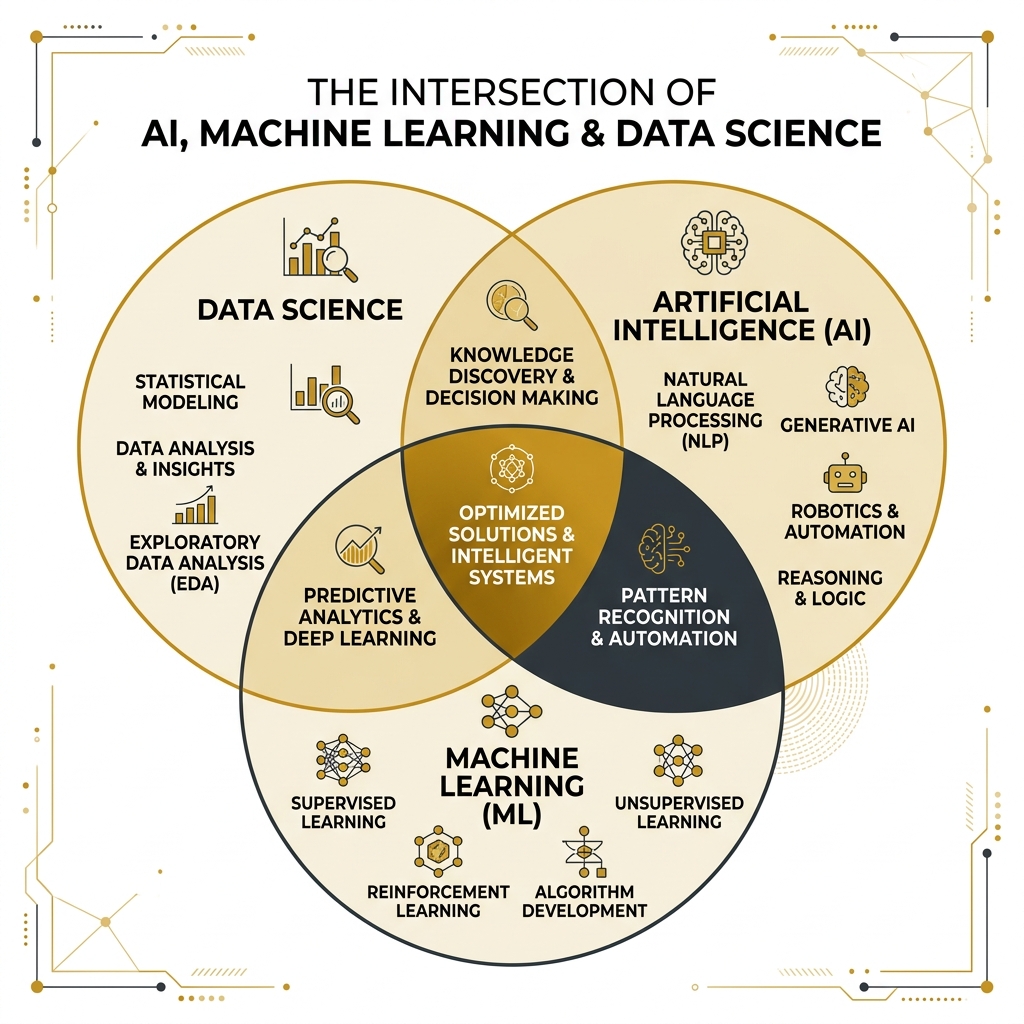
Basic ai and data science vocab:
Defining the Divide: AI and Data Science Compared
When we look at the tech landscape today, it is easy to think that ai and data science are just two names for the same thing. In reality, they are more like cousins who share a lot of DNA but have very different career paths.
Data science is an interdisciplinary field. It is the “detective work” of the digital age. We use statistical tools, computer science, and domain knowledge to study data and extract meaningful insights. The goal is usually pre-determined: “Tell me why our customers are leaving” or “Predict how many umbrellas we will sell in April.” It relies heavily on data cleaning, exploratory analysis, and visualization to help humans make better decisions.
Artificial Intelligence, on the other hand, is about creating systems that can solve cognitive problems. It is the “mimicry” of human intelligence. While data science wants to explain the world, AI wants to act in it. AI uses algorithms to learn, recognize patterns, and perform tasks like speech recognition or image classification.
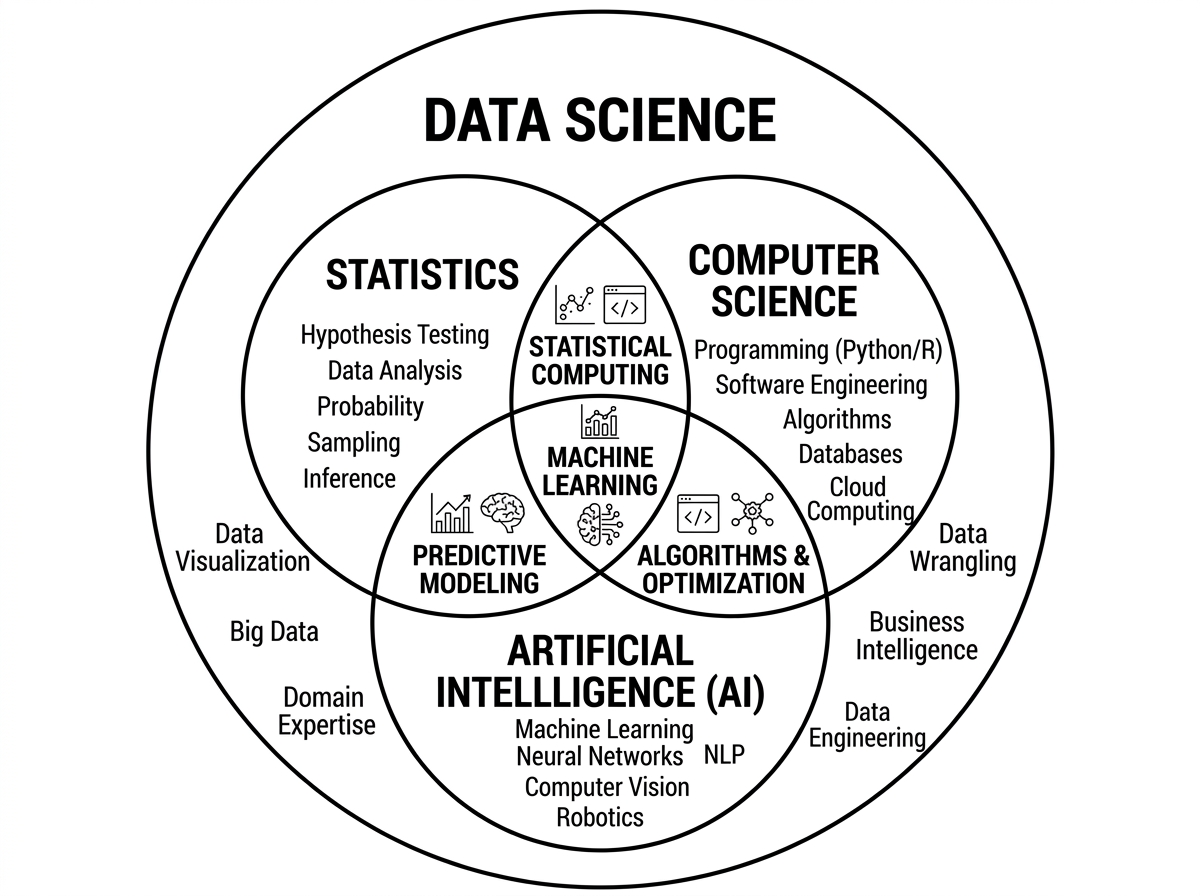
The confusion often stems from Machine Learning (ML). ML is a subset of both fields. In data science, we use ML to build predictive models. In AI, ML is the engine that allows a software to “learn” without being explicitly programmed for every scenario. However, not all AI uses machine learning, and not all data science solutions require a complex neural network. Sometimes, a simple linear regression—a staple of statistics—is all a data scientist needs to provide immense value.
Furthermore, the physical world is seeing these fields merge in fascinating ways. For instance, how AI and robotics work together shows us that while data science might analyze the efficiency of a factory line, AI is the brain actually moving the robotic arm.
The Impact of Generative AI and Data Science Productivity
The arrival of Large Language Models (LLMs) like ChatGPT and Gemini has fundamentally shifted the day-to-day life of data professionals. We are no longer just writing code from scratch; we are prompting it.
Research on how generative AI boosts productivity suggests that skilled knowledge workers can see efficiency gains of up to 40% on specific tasks. For a data scientist, this means spending less time on “boilerplate” code—the repetitive setup code required for every project—and more time on high-level strategy.
Generative AI helps us in three main ways:
- Code Generation: Tools like GitHub Copilot can suggest entire blocks of Python or SQL code, allowing us to build data apps and models significantly faster.
- Automated Reporting: Just as a summarizer tool helps writers, generative AI can take complex data findings and draft a summary for executive leadership in plain English.
- Data Augmentation: When we don’t have enough real-world data to train a model, AI can generate “synthetic data” that mimics real patterns, helping us overcome data scarcity.
While 45% of data scientists admit to having some job security concerns due to these tools, the reality is that 70% are already upskilling. They aren’t being replaced; they are being supercharged.
Navigating Careers in AI and Data Science
If you are looking to enter this field, the “Data Scientist” and “AI Engineer” paths offer different flavors of work.
A Data Scientist typically focuses on the “why.” They spend their time cleaning data, performing exploratory data analysis (EDA), and building models to find insights. They need to be great communicators because they have to explain their findings to managers who might not know a p-value from a pizza.
An AI Engineer (or ML Engineer) is more focused on the “how.” They take the models built by data scientists and figure out how to deploy them to millions of users. They deal with things like Docker, Kubernetes, and cloud scaling. If a data scientist builds the engine, the AI Engineer builds the car around it and ensures it can run at 100 mph on the highway.
To help you choose, you can consult an AI and Data Scientist Roadmap which outlines the necessary skills. Generally, you’ll need:
- Python/R: The bread and butter of programming.
- SQL: Essential for talking to databases.
- Math & Stats: Understanding the logic behind the algorithms.
- Domain Expertise: Knowing the industry you are working in.
Whether you are interested in a beginner’s guide to narrow AI or deep diving into neural networks, the career progression is robust, with high demand across finance, healthcare, and retail.
How AI Enhances the Data Science Workflow
AI isn’t just a product we build; it’s a tool we use to build better products. By integrating AI into the standard data science workflow, we can remove the “grunt work” that used to take up 80% of our time.
One of the most practical applications is in data cleaning. We’ve all been there: messy spreadsheets with missing values and inconsistent formatting. Modern AI tools can now automatically identify anomalies and suggest transformations. According to a practical guide to AI in data science workflows, embedding AI directly into development environments allows us to generate visualization code using natural language. Instead of writing 50 lines of code for a scatter plot, we can simply type “Show me a trend of sales vs. marketing spend by region.”
In the business world, this is transformative. We see this in the strategic guide to using AI in business, where AI-powered dashboards allow non-technical stakeholders to ask questions directly. Imagine a CEO asking a dashboard, “Why did our churn rate spike in October?” and the AI surfacing the relevant data points instantly. This “self-service” analytics reduces the bottleneck on the data team and speeds up decision-making across the board.
The Human Element: Why Algorithms Can’t Fly Solo
Despite the impressive stats—like China’s AI publications jumping to over 273,000 in 2024—technology alone cannot solve human problems. This is where the “Data Scientist” remains irreplaceable.
Algorithms are excellent at finding patterns, but they are terrible at understanding context. An AI might find a correlation between ice cream sales and shark attacks, but it takes a human to realize that both are caused by “summer,” not by sharks having a sweet tooth.
Ethical judgment is another area where machines fail. Navigating the complex landscape of AI ethics requires a human touch to ensure models aren’t biased against certain demographics. If a hiring AI is trained on historical data that is biased, it will simply automate that bias. Data scientists act as the ethical gatekeepers, auditing models for fairness.
Furthermore, AI’s impact on the future of science highlights the need for interpretability. In fields like medicine, we can’t just have a “black box” tell us a patient has a disease; we need to know why the model thinks so. Human experts provide the “Einsteinian” leap—the ability to reason through abstract concepts and thought experiments that don’t yet exist in the data. This is why ethics matter in AI; we must ensure the technology serves humanity, not the other way around.
Frequently Asked Questions about AI and Data Science
What is the fundamental difference between data science and AI?
Data science is a broad field focused on extracting insights and meaning from data using various tools (statistics, visualization, and ML). AI is a specific goal: creating systems that can perform tasks that usually require human intelligence. Think of data science as the “study” and AI as the “application.”
Can I become a data scientist without a computer science degree?
Yes! While a background in CS, Math, or Stats is helpful, many professionals transition into ai and data science through bootcamps, online certifications (like those from MIT or Coursera), and hands-on projects. Portfolios on platforms like GitHub often carry as much weight as a diploma in today’s job market.
How is generative AI changing the job market for data professionals?
It is shifting the focus from “coding” to “curating.” Data professionals are becoming “AI-augmented.” There is a high demand for people who can bridge the gap between technical AI tools and business strategy. While some entry-level “data cleaning” roles may be automated, the demand for high-level data architects and AI engineers is surging.
Conclusion
The future of ai and data science isn’t about machines replacing humans; it’s about humans becoming more capable through machines. We are entering an era of “human-in-the-loop” systems where the speed of AI meets the wisdom of data science.
At Apex Observer News (Aonews.fr), we see this trend every day in the headlines we curate. Companies that succeed won’t be the ones with the most powerful AI, but the ones with the best strategic governance and the most skilled people to guide those tools. Whether you are a business leader or an aspiring student, the goal is to stay curious and keep upskilling.
The algorithms are ready. Are you? Explore more on Artificial Intelligence to stay ahead of the curve.
