

The 2026 Emerging Markets Growth Forecast: What You Need to Know Right Now
The emerging markets growth forecast for 2025-2026 points to steady, resilient expansion that is outpacing the developed world by a wide margin. Here’s the quick answer:
| Metric | 2025 Estimate | 2026 Forecast |
|---|---|---|
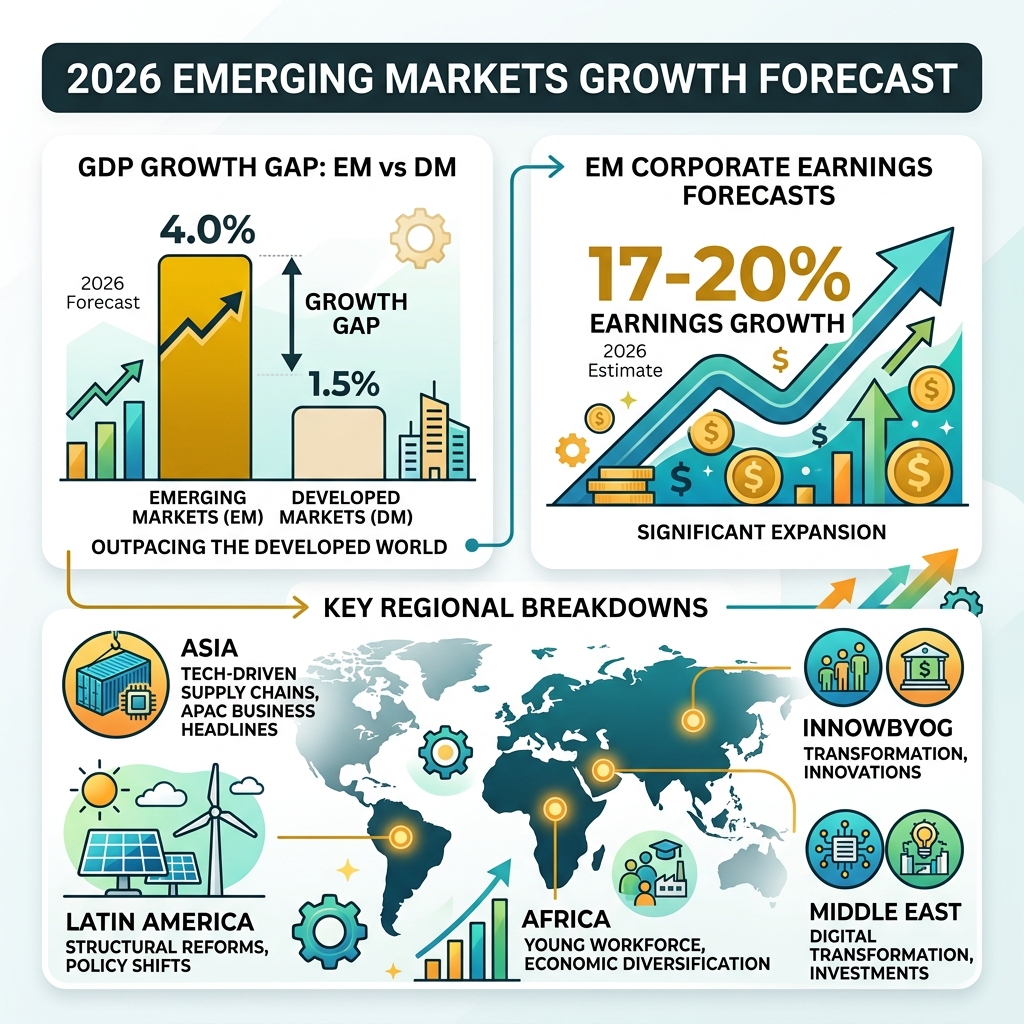
| EMDE GDP Growth | 4.2% | 4.0% |
| EMDE ex-China GDP Growth | ~3.7% | 3.7% |
| Global GDP Growth | 2.7% | 2.6% |
| EM Inflation | ~6% | ~5% |
| EM Corporate Earnings Growth | 12-14% | ~17-20% |
| MSCI EM Index Return (2025) | 33.6% | Constructive outlook |
The short version: Emerging markets are growing roughly twice as fast as developed economies. They represent 40% of global GDP and 70% of real global growth, yet remain significantly underweighted in most investor portfolios.
That gap is closing fast.
A combination of forces is reshaping the global economic map in 2026. AI-driven supply chain shifts, a weaker US dollar, policy reforms, and a young and growing workforce are all pointing in the same direction: the growth engine of the world economy is increasingly found outside the US and Europe.
Meanwhile, 1.2 billion young people are expected to reach working age in emerging and developing economies by 2035. That’s not a short-term trend. That’s a structural shift playing out over decades.
I’m Faisal S. Chughtai, founder of ActiveX, with hands-on experience tracking global digital and economic trends that directly shape the emerging markets growth forecast across technology, trade, and investment landscapes. In the sections ahead, we’ll break down exactly where the growth is, which markets lead, and what it means for investors and observers alike.
Essential emerging markets growth forecast terms:
The Consensus Emerging Markets Growth Forecast for 2026

When we look at the broad consensus for 2026, the word that keeps coming up is “resilience.” Despite the noise of trade wars and geopolitical shuffling, the emerging markets growth forecast remains remarkably steady. Major institutions like the World Bank and the IMF suggest that Emerging Market and Developing Economies (EMDEs) will see a GDP growth rate of approximately 4.0% in 2026.
This stability is a bit of a “Goldilocks” scenario for many regions. While advanced economies are projected to grow at a more modest 2.6% to 2.7%, the EM world is maintaining a significant growth premium. According to the World Economic Outlook Update, the global economy is holding steady amid divergent forces, but it is the emerging sector that is providing the heavy lifting for real global growth.
One of the most encouraging signs in our emerging markets growth forecast is the cooling of inflation. After several years of price volatility, inflation in many EM regions (particularly in Asia) is projected to decline toward 5% in 2026. This disinflation gives central banks the “green light” to ease monetary policy, supporting domestic demand and making local debt more attractive. For a deeper dive into these shifts, check out our more info about global economy trends.
Regional GDP Growth Comparisons (Forecasted 2026)
| Region/Country | Projected GDP Growth | Primary Driver |
|---|---|---|
| India | 6.4% | Domestic Consumption & Digital Reform |
| China | 4.8% | High-Tech Exports & Green Energy |
| Brazil | < 2.0% | Commodity Prices & Fiscal Reform |
| Mexico | 1.5% | Near-shoring & US Trade Links |
| EMDE Aggregate | 4.0% | Structural Resilience |
Why India and ASEAN are central to the emerging markets growth forecast
We cannot talk about the emerging markets growth forecast without putting India and the ASEAN bloc front and center. India is widely expected to be the fastest-growing major economy in 2026, with a projected GDP expansion of 6.4%. Why? It’s a “perfect storm” of positive factors: a young workforce (with 1.2 billion youth entering the EM labor market by 2035), massive infrastructure spending, and a digital transformation that is bringing hundreds of millions of people into the formal economy.
Furthermore, we are seeing a significant “South-South” trade movement. Countries are diversifying their trade partners to reduce reliance on any single Western power. This is evident in regions like South Asia, where initiatives like the Pakistan fiscal stability boost are helping stabilize local economies, allowing them to participate more fully in regional manufacturing hubs.
How AI infrastructure shapes the emerging markets growth forecast
Artificial Intelligence isn’t just a Silicon Valley story; it is a core pillar of the emerging markets growth forecast. The infrastructure required to run AI—data centers, power supplies, and specialized hardware—is increasingly being sourced from and built within emerging markets.
China, for example, leads in 57 out of 64 critical technologies, including power infrastructure vital for AI data centers. Even as trade tensions persist, our China trade surplus analysis shows that their exports in EV batteries and power equipment remain robust. The semiconductor cycle, particularly in Taiwan and South Korea, is also a defining force. These nations aren’t just participants; they are the “enablers” of the global AI boom, providing the high-bandwidth memory and advanced logic chips that the world’s tech giants crave.
Structural Drivers: AI, Semiconductors, and the Energy Transition
The structural narrative of 2026 is dominated by what we call the “Double S-Curve” of AI. Initially, AI investments drive massive capital expenditure (capex). We’ve seen hyperscalers commit trillions of dollars to data centers, and only a fraction of that has been deployed so far. This creates a massive tailwind for the emerging markets growth forecast, specifically for tech leaders in North Asia.
Taiwan and South Korea are the clear beneficiaries here. Taiwan currently controls roughly 60% of the world’s semiconductor capacity and a staggering 90% of leading-edge chips. South Korea is seeing unprecedented demand for High-Bandwidth Memory (HBM). However, this growth comes with challenges. A Gartner AI power shortage report predicts that power shortages could restrict up to 40% of AI data centers by 2027, which actually benefits EM countries that export energy storage batteries and power grid equipment.
Beyond AI, the energy transition is a massive driver for the emerging markets growth forecast. The shift to green energy requires an astronomical amount of copper, lithium, and other “green minerals” found primarily in emerging markets.
- Copper: Essential for EV wiring and renewable grids.
- Lithium & Cobalt: Vital for the battery supply chain.
- Manufacturing: China remains the global leader in EV battery production, controlling 40% of the market through giants like CATL.
Regional Leaders and the China vs. EM Ex-China Divergence
One of the most important trends we are tracking is the divergence between China and the rest of the emerging world. Historically, “Emerging Markets” was often treated as a proxy for “China.” That is no longer the case. In 2026, the emerging markets growth forecast is increasingly “EM ex-China.”
While China faces structural headwinds—such as a cooling property market and demographic shifts—it is pivoting toward high-value technology and exports. However, for investors seeking high-octane growth, the “performance engine” has shifted toward India, Mexico, and Southeast Asia.
The Rise of Frontier Markets
We also shouldn’t overlook frontier markets. In 2025, frontier markets delivered returns of 41% in USD terms, outperforming many established indices. These markets offer low correlation with the US S&P 500, providing a diversification benefit that is hard to find elsewhere.
Top-Performing Frontier and Emerging Regions:
- India: The undisputed leader in domestic-led growth.
- Vietnam & Indonesia: Beneficiaries of supply chain diversification away from China.
- Mexico: The “near-shoring” king, benefiting from its proximity to the US.
- Gulf States (Saudi Arabia, UAE): Rapidly diversifying away from oil into tech and tourism.
- Poland: Increasing its defense budget to 5% of GDP, stimulating local industrial growth.
To understand how these countries maintain their edge, you can read our fiscal stability insights. The shift toward “South-South” trade—trade between emerging nations themselves—is creating a buffer against Western geopolitical risks.
Investment Outlook: Valuations, Risks, and Trade Tensions
From an investment perspective, the emerging markets growth forecast for 2026 is underpinned by attractive valuations. EM equities currently trade at a significant discount compared to developed markets.
- PEG Ratio: EM markets sit at a PEG ratio of 0.9x, compared to 1.5x for the US.
- Earnings Growth: Corporate earnings in EM are expected to grow by roughly 20% in 2026, outpacing the S&P 500’s projected 14.5%.
- Dividend Yields: Many EM companies offer higher dividend yields than their Western counterparts, providing a “carry” for patient investors.
However, we must address the “elephant in the room”: trade tensions. US tariffs and trade policy remain a primary risk. We’ve seen “trade front-loading” in 2025—where companies rushed to ship goods before new tariffs took effect—which may lead to a slight cooling in 2026. However, EM economies have proven remarkably adaptable. As noted in the Franklin Templeton EM Outlook, many EM countries are less reliant on US exports than they were a decade ago.
Key Risks to Watch:
- Currency Volatility: A stronger-than-expected US dollar can pressure EM debt and imports.
- Geopolitical Flares: Tensions in the Middle East or the Taiwan Strait remain wildcards.
- Domestic Policy: In some regions, housing market impacts or political elections can shift the investment climate overnight.
- Corporate Governance: While improving (especially in South Korea and India), governance remains a hurdle for some international investors.
Frequently Asked Questions about Emerging Markets
Which emerging market will grow the fastest in 2026?
India is the clear frontrunner in the emerging markets growth forecast for 2026. With a projected GDP growth of 6.4%, it is benefiting from a massive young workforce, aggressive digital transformation, and strong domestic demand that makes it less vulnerable to global trade shocks.
How do US tariffs affect the emerging markets growth forecast?
Tariffs certainly create friction, but they also trigger “export diversion.” When one path is blocked, trade flows through others—such as Vietnam or Mexico (near-shoring). While we might see some volatility due to front-loading effects, the overall resilience of EM supply chains has been a highlight of recent economic data.
Is it better to invest in EM ex-China?
Many analysts now favor an “EM ex-China” approach for growth. While China is a vital global player, it faces structural headwinds in its property market. By diversifying into EM ex-China, investors gain exposure to the “performance engines” of the world, such as Taiwan’s tech sector, Korea’s manufacturing, and India’s consumer boom.
Conclusion
At Apex Observer News, we believe the emerging markets growth forecast for 2026 and beyond reveals a fundamental shift in the global order. These nations are no longer just “developing”—they are becoming the pivotal players in the global economy, controlling the resources vital for the AI revolution and the energy transition.
From the semiconductor labs of Taipei to the bustling financial districts of Mumbai, the growth is real, structural, and increasingly independent of traditional Western cycles. While risks like geopolitics and trade tensions persist, the long-term resilience and attractive valuations of these markets make them impossible to ignore. Stay tuned to our latest business news and headlines for real-time updates on these global shifts. We are committed to bringing you the most accurate, aggregated news to help you navigate this changing world.
