

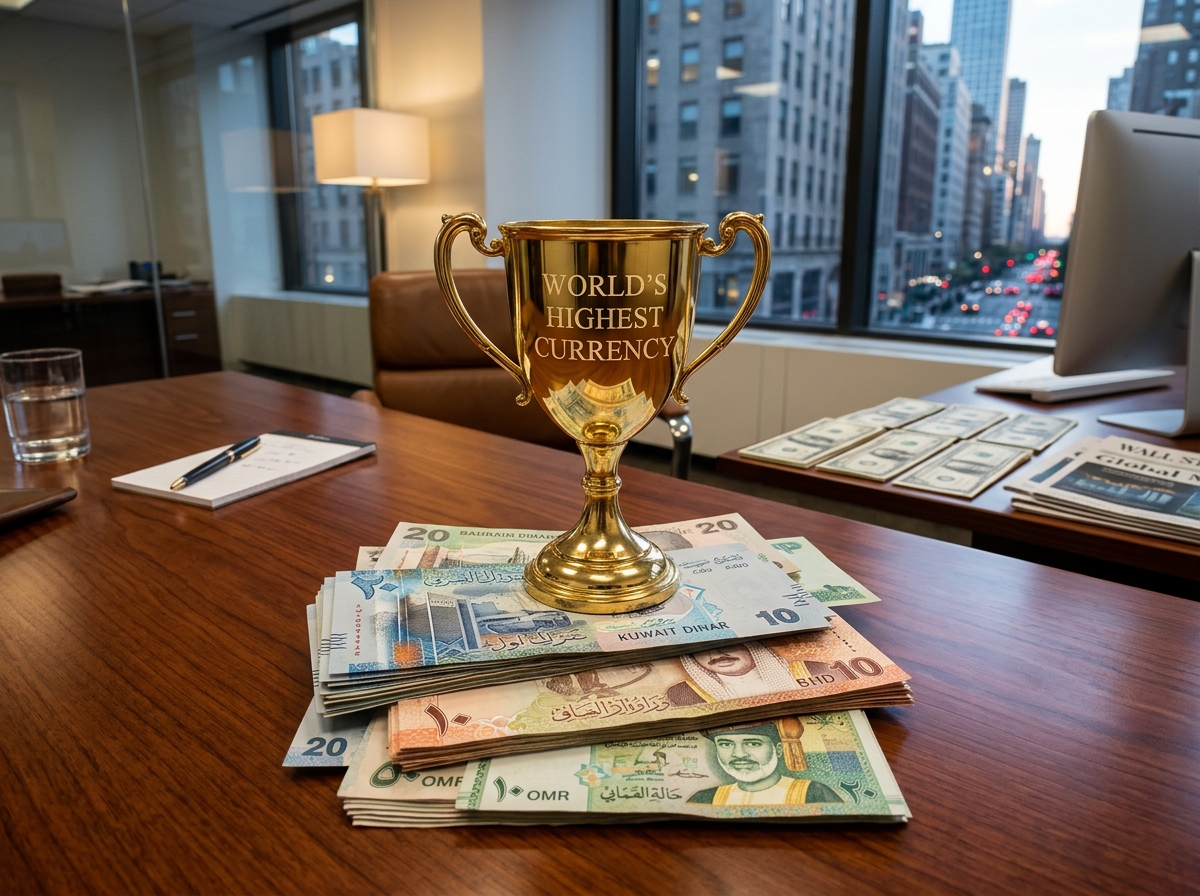
The Highest Currency in the World List: What You Need to Know
The highest currency in the world list ranks global currencies by their exchange value against major benchmarks like the US Dollar (USD) or British Pound (GBP). Here is the current top 10 for 2026:
| Rank | Currency | Code | Value vs USD | Value vs GBP |
|---|---|---|---|---|
| 1 | Kuwaiti Dinar | KWD | $3.27 | £2.46 |
| 2 | Bahraini Dinar | BHD | $2.65 | £2.00 |
| 3 | Omani Rial | OMR | $2.60 | £1.96 |
| 4 | Jordanian Dinar | JOD | $1.41 | £1.06 |
| 5 | British Pound Sterling | GBP | $1.37 | £1.00 |
| 6 | Gibraltar Pound | GIP | $1.37 | £1.00 |
| 7 | Swiss Franc | CHF | $1.25 | £0.96 |
| 8 | Cayman Islands Dollar | KYD | $1.20 | £0.90 |
| 9 | Euro | EUR | $1.17 | £0.86 |
| 10 | US Dollar | USD | $1.00 | £0.75 |
Exchange rates as of early 2026.
Most people assume the US Dollar or British Pound tops this list. They don’t. Not even close.
The Kuwaiti Dinar has held the top spot for decades, driven largely by Kuwait’s vast oil reserves and careful monetary policy. Three of the top four currencies come from the Middle East — a region where petroleum wealth and fixed exchange rate policies have created some of the world’s most valuable money.
There are 180 currencies recognized as legal tender across UN member states and their dependencies. But currency strength isn’t just about how popular a currency is — the Euro is used by 44 countries, and the US Dollar by 19, yet neither comes close to the Kuwaiti Dinar in raw exchange value.
It’s also worth remembering: a high exchange rate doesn’t always mean a wealthy or powerful economy. Japan has the world’s third-largest economy, yet the Yen is worth a fraction of a single US Dollar. Currency value and economic size are two very different things.
I’m Faisal S. Chughtai, founder of ActiveX, with hands-on experience in digital marketing, SEO, and financial content — including in-depth research into the highest currency in the world list and the economic forces that shape it. In the sections below, we’ll break down exactly what makes these currencies so valuable and what that means for you.
Determinants of Currency Strength

When we look at the highest currency in the world list, it is easy to get caught up in the numbers. But what actually makes one piece of paper worth three times more than another? At Apex Observer News, we track these shifts closely, and several core economic pillars determine these valuations.
Economic and Political Stability
A currency is essentially a “share” in a country’s economy. If a nation is politically stable and its economy is growing, investors want to hold its currency. This demand drives up the value. Conversely, war or political upheaval can cause a currency to plummet.
Inflation and Interest Rates
Low inflation usually means a currency’s purchasing power is preserved. Central banks also use interest rates as a lever; higher interest rates often attract foreign capital seeking better returns, which strengthens the local currency. However, if inflation is too high, those gains are wiped out.
Foreign Exchange Reserves
Countries with massive foreign exchange reserves can intervene in markets to prop up their own money. This is a major factor for Middle Eastern nations that stockpile billions in “petrodollars.”
Balance of Trade and Debt
If a country exports more than it imports, there is a constant demand for its currency to pay for those goods. High levels of government debt, on the other hand, can lead to inflation or a loss of confidence, weakening the currency. While the dollar remains the world’s primary reserve currency, its value is often lower than others on this list because of the sheer volume in circulation and the US trade deficit.
The Definitive Top 10 Rankings for 2026
To understand the highest currency in the world list, we have to look past the “famous” currencies. While we use the dollar for most global trade, it only ranks 10th in terms of individual unit value.
1. Kuwaiti Dinar (KWD)
The undisputed king. One KWD buys $3.27. Why? Because Kuwait sits on roughly 7% of the world’s proven oil reserves. With a small population and a massive sovereign wealth fund (estimated at over $800 billion), the government has no need to devalue its currency.
2. Bahraini Dinar (BHD)
Bahrain’s currency is pegged to the USD but at a much higher value. One BHD is worth $2.65. As a major financial hub in the Persian Gulf, Bahrain maintains this strength through its significant oil exports and a highly developed banking sector.
3. Omani Rial (OMR)
Ranking third, the Omani Rial is worth $2.60. Like its neighbors, Oman’s strength comes from oil, but the government has also been praised for its prudent fiscal policies and successful efforts to diversify the economy into tourism and logistics.
4. Jordanian Dinar (JOD)
This is an interesting entry. Jordan doesn’t have the vast oil reserves of Kuwait or Oman, yet its Dinar is worth $1.41. The strength here is artificial but stable; the government pegs the JOD to the USD to maintain economic stability and attract foreign investment.
5. British Pound Sterling (GBP)
The oldest currency still in use. While it has seen volatility since Brexit, the Pound remains a heavyweight at $1.37. London’s status as a global financial capital ensures constant demand for the Sterling.
6. Gibraltar Pound (GIP)
Gibraltar is a British Overseas Territory, and its pound is pegged at par (1:1) with the British Pound Sterling. Because of its status as a financial services and gaming hub, it maintains a top-tier position on the highest currency in the world list.
7. Swiss Franc (CHF)
Often called the “safe-haven” currency. Switzerland’s neutrality, secretive banking history, and low inflation make the Franc a favorite for investors during times of global crisis. When gold-prices-rise, the Swiss Franc often follows suit as a stable store of value.
8. Cayman Islands Dollar (KYD)
Another offshore financial powerhouse. The KYD is worth $1.20. With no income tax, capital gains tax, or corporation tax, the Cayman Islands attract massive amounts of foreign capital, supporting a high currency value.
9. Euro (EUR)
The Euro is the official currency of 20 of the 27 EU member states. While it is the second most traded currency globally, its value against the dollar ($1.17) is kept in check by the diverse economic health of its many member nations.
10. US Dollar (USD)
The world’s “greenback.” While it is the benchmark for all others, its high circulation means it sits at the bottom of the top 10. It is involved in 88% of all daily forex trades, making it the most liquid currency on earth.
Breaking Down the highest currency in the world list
When we look at this list, two themes emerge: Oil and Stability.
Kuwait’s dominance is a direct result of “petrodollars.” Since oil is priced in USD, when oil-prices-rise-sharply-in-market-trading-after-attacks-in-middle-east-disrupt-supply, Kuwait’s revenues skyrocket, further backing the Dinar.
Switzerland represents the other side of the coin. It isn’t rich in natural resources, but it is rich in trust. The Swiss National Bank (SNB) maintains massive reserves, and the country’s debt-to-GDP ratio is incredibly low compared to the US or UK. This is why, when gold-prices-rise, investors often flock to the Franc as a digital alternative to the yellow metal.
Why Oil and Pegged Rates Drive the highest currency in the world list
If you’ve ever wondered why the Middle East dominates the top of the highest currency in the world list, the answer is buried deep underground. Petroleum is the lifeblood of the global economy, and for countries like Kuwait, Bahrain, and Oman, it accounts for the vast majority of government revenue.
The Power of Petroleum
The price-of-oil has a direct correlation with currency strength for exporters. When prices are high, these nations accumulate massive trade surpluses. This allows them to build “Sovereign Wealth Funds”—essentially giant national savings accounts that back the value of their currency. For example, Kuwait’s oil revenues allow it to maintain a tax-free society with almost zero unemployment, which creates an incredibly stable environment for the Dinar.
Fixed vs. Floating Rates
Most major currencies, like the USD or GBP, “float,” meaning their value is determined by the open market. However, many on the highest currency in the world list use a pegged exchange rate.
- Bahrain and Oman peg their currencies directly to the US Dollar. This provides a predictable environment for international trade and prevents the wild swings often seen in emerging markets.
- Jordan uses a peg to maintain confidence despite lacking the resource wealth of its neighbors.
- The Cayman Islands peg their dollar to the USD at a fixed rate of 1.20, ensuring stability for the thousands of hedge funds and banks located there.
While these pegs provide stability, they require the country to hold massive amounts of dollar reserves to maintain the exchange rate if the market tries to push the value down.
Economic Impact: The Pros and Cons of High Valuation
Having a currency at the top of the highest currency in the world list sounds like a win, but it is a double-edged sword. At Apex Observer News, we often report on how these valuations affect the average person and the broader business world.
The Advantages (The Pros)
- Lower Import Costs: A strong currency means you can buy more goods from abroad for less money. This helps keep domestic inflation low.
- Purchasing Power: Citizens of Kuwait or Bahrain enjoy incredible purchasing power when they travel abroad. Their money goes much further in London, New York, or Paris.
- Stability: High-value currencies reduces the risk of inflation, providing a “safe” environment for savers.
The Disadvantages (The Cons)
- Hurts Exports: This is the big one. If your currency is too expensive, the goods you produce become too pricey for other countries to buy. This is why Japan often tries to weaken the Yen—to make their cars and electronics more competitive globally.
- Tourism Impact: It is very expensive for foreigners to visit countries with strong currencies. You won’t find many “budget travelers” in Kuwait City or Zurich.
- Economic Dependence: Many strong-currency nations become “one-trick ponies.” Because their currency is so high, it is hard to develop a manufacturing sector, leading to a heavy reliance on oil or financial services.
Protecting Your Savings
If you live in a country with a volatile currency, you might look at the highest currency in the world list with envy. Many individuals protect their wealth by diversifying into gold or holding accounts in safe-haven currencies like the Swiss Franc. Diversification is the key to surviving global economic shifts.
Conclusion
At Apex Observer News, we believe that understanding the highest currency in the world list is about more than just knowing who is #1. It is about understanding the global “fear and greed” index. Whether it is the oil-backed strength of the Kuwaiti Dinar or the safe-haven reputation of the Swiss Franc, these values reflect the world’s trust in a nation’s future.
As we move through 2026, we expect to see continued volatility. With oil-prices-rise-sharply-in-market-trading-after-attacks-in-middle-east-disrupt-supply, the gap between the Middle Eastern dinars and the rest of the world may even widen. Stay tuned to our business section for real-time updates on these global economic shifts.
Why is the US Dollar not #1 on the highest currency in the world list?
The US Dollar is the most powerful currency, but not the most valuable per unit. Because there are trillions of dollars in circulation globally (it makes up 56% of all foreign exchange reserves), the “supply” is much higher than that of the Kuwaiti Dinar. Its value is kept at a level that supports global trade dominance rather than a high per-unit price.
Is a high-value currency always a sign of a rich country?
No. Nominal value is just a number. For example, Japan is a global economic superpower, yet 1 USD equals about 150 Yen. Japan chooses to keep its currency value lower to boost its massive export industry. A high-value currency often reflects controlled inflation and resource wealth, but not necessarily the total size of the economy (GDP).
How can individuals protect their investments from currency volatility?
The best strategy is diversification. This includes:
- Holding assets in different currencies (like USD, EUR, or CHF).
- Investing in commodities like gold.
- Exploring digital assets. For more, check out our More info about business and crypto news page to see how the landscape is changing in 2026.
