

The Man Running the World’s Most Valuable Tech Company
Tim Cook is the CEO of Apple Inc. — one of the most influential business leaders on the planet. Here’s a quick snapshot:
| Detail | Info |
|---|---|
| Full Name | Timothy Donald Cook |
| Born | November 1, 1960, Mobile, Alabama |
| Role | CEO of Apple since August 24, 2011 |
| Education | BS Industrial Engineering, Auburn University; MBA, Duke University |
| Net Worth (2025) | ~$2.6 billion |
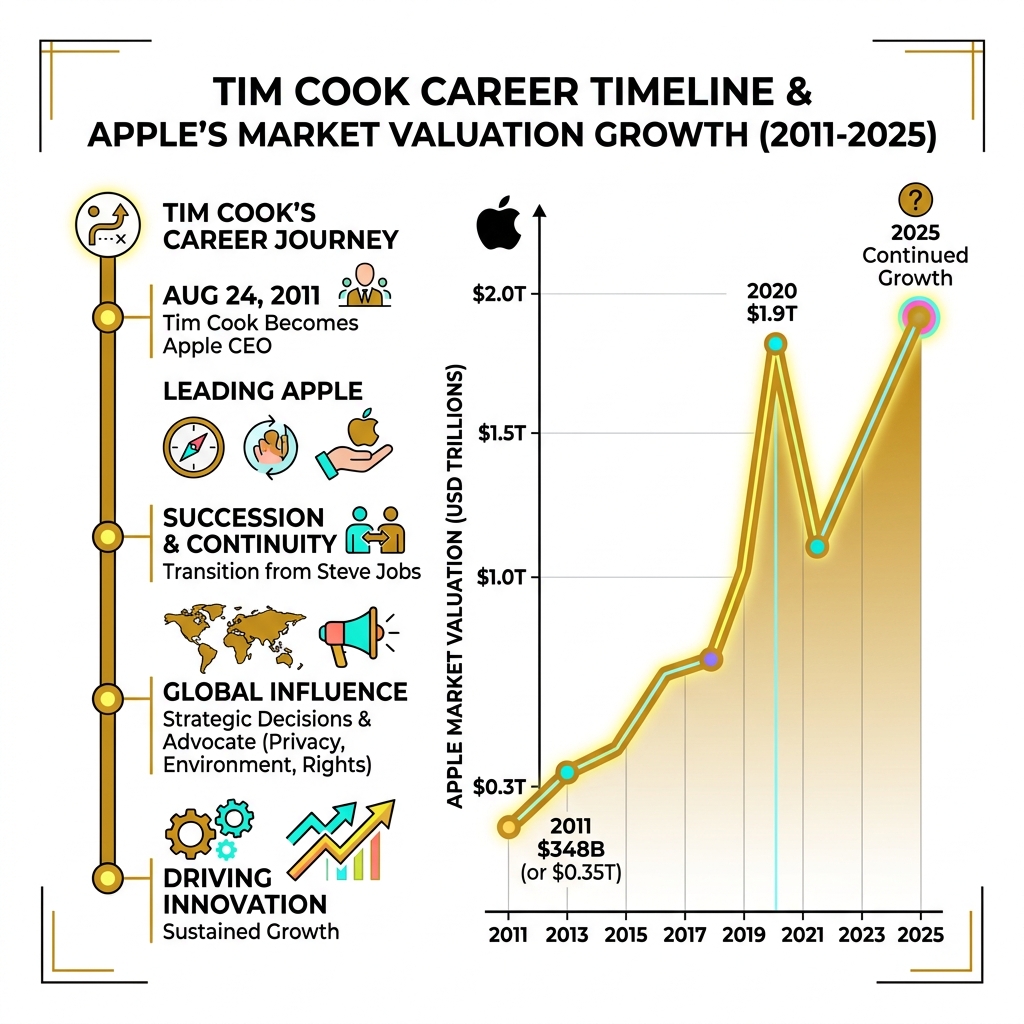
| Apple’s Market Value | Grew from $348B (2011) to $1.9T (2020) under his leadership |
Cook didn’t follow the safe path to get here. In 1998, after just a five-minute meeting with Steve Jobs, he walked away from a stable role at Compaq — on pure gut instinct. That decision changed the course of Apple history.
Since taking over as CEO, he has doubled Apple’s revenue and profit, steered the company through massive global challenges, and become a vocal advocate for privacy, LGBTQ rights, and the environment.
I’m Faisal S. Chughtai, founder of ActiveX — a digital branding and tech solutions company — and I’ve spent years tracking the strategies of leaders like Tim Cook who sit at the intersection of technology, operations, and global influence. Read on for a complete breakdown of his life, career, and legacy.
Tim cook glossary:
Early Life, Education, and the Road to Cupertino
Before he was the face of a trillion-dollar empire, Tim Cook was a young man growing up in the coastal city of Mobile, Alabama. Born on November 1, 1960, he spent his formative years in the nearby town of Robertsdale. His father worked in a shipyard, and his mother worked at a pharmacy, instilling in him a grounded, hardworking Southern upbringing. At Robertsdale High School, Cook’s academic prowess was already evident; he graduated as the class salutatorian in 1978.
He took his talents to Auburn University, where he earned a Bachelor of Science in Industrial Engineering in 1982. This degree would prove foundational to his future “operational genius” status, teaching him how to optimize complex systems. But Cook didn’t stop there. He moved on to Duke University’s Fuqua School of Business, where he was named a Fuqua Scholar—an honor reserved for those in the top 10% of their class. You can learn more about his ongoing ties to the university through Tim Cook’s academic background at Duke University.

Cook’s career before Apple was a steady climb through the ranks of the tech industry’s heavy hitters. He spent 12 years at IBM, eventually serving as the director of North American Fulfillment for the Personal Computer Company. From there, he moved to Intelligent Electronics as the Chief Operating Officer of the Reseller Division. Just before joining Apple, he had a brief six-month stint at Compaq as the Vice President of Corporate Materials.
Then came the meeting that changed everything. In 1998, Apple was on the brink of bankruptcy. Steve Jobs was looking for someone to overhaul the company’s disastrous manufacturing and distribution wings. Despite his colleagues telling him he was crazy to leave a top-tier performer like Compaq for a “sinking ship,” Cook followed his intuition. He later remarked that within five minutes of talking to Jobs, he wanted to throw caution to the wind and join the team. It was a rare moment where logic took a backseat to a gut feeling.
The Operational Genius of Tim Cook
When Tim Cook arrived at Apple as the Senior Vice President for Worldwide Operations, the company was a logistical mess. Inventory was sitting in warehouses for months, losing value every day. Cook applied his industrial engineering background with ruthless efficiency. He famously compared tech products to dairy, saying, “if it gets past its freshness date, you have a problem.”
He implemented several key strategies that saved Apple:
- Inventory Reduction: He slashed the amount of time inventory sat on the books from months to just a few days.
- Contract Manufacturing: He closed Apple’s own factories and moved production to contract manufacturers like Foxconn, shifting the risk and increasing scalability.
- Flash Memory Strategy: He correctly predicted the importance of flash memory and signed massive, long-term deals with suppliers years in advance, ensuring Apple had the parts it needed while others struggled.
This operational mastery allowed Apple to maintain high profit margins even as they scaled. Whether it was managing the iphone-11-price-in-pakistan or coordinating the massive global launch of the iphone-16-pro-max, Cook’s fingerprints are all over the logistics. By 2005, he was promoted to Chief Operating Officer, where he essentially ran the company’s day-to-day business while Jobs focused on the “big picture” and design.
Leading Apple into the Post-Jobs Era
The Transition of Tim Cook as CEO
The tech world held its breath on August 24, 2011, when Steve Jobs officially resigned due to failing health, naming Tim Cook as his successor. Jobs passed away just six weeks later. Critics were skeptical; many wondered if an “operations guy” could lead a company built on creative vision.
However, Cook didn’t try to be Steve Jobs. Instead, he evolved the role. While Jobs was known for micromanagement and a “top-down” approach, Cook fostered a more collaborative culture. He restructured the executive team in 2012 following the rocky launch of Apple Maps, which led to the departure of Scott Forstall. This move signaled that Cook valued teamwork and integration over individual brilliance.
Under his watch, Apple’s financial growth has been nothing short of staggering. By 2020, the company’s market capitalization reached $1.9 trillion, and by 2025, Apple remained the second-largest technology company by revenue globally, bringing in $416 billion. He has also expanded the ecosystem with hits like the rugged new Apple Watch Ultra 3 and niche software like the new app to explore the world of classical music.
| Feature | Steve Jobs Style | Tim Cook Style |
|---|---|---|
| Approach | Visionary & Micromanager | Operational & Collaborative |
| Culture | Competitive & Siloed | Integrated & Team-Oriented |
| Focus | Disruptive Innovation | Iterative Excellence & Services |
| Public Image | The “Showman” | The “Statesman” |
Innovation and the Future of Tim Cook at Apple
While some claim Apple has slowed down, the product roadmap under Cook says otherwise. He successfully diversified Apple’s revenue streams so the company is no longer solely dependent on iPhone sales. The introduction of the Apple Watch and AirPods created multi-billion dollar categories from scratch.
Today, the focus has shifted toward spatial computing and artificial intelligence. The Apple Vision Pro represents a major leap into a new computing era. We are also seeing a massive push into AI, as Apple bakes in AI smarts into its new 599 iPhone 17e. With the Apples March 4 event is almost here, the wishlist for fans includes everything from foldable iPhones to AI-powered glasses. Even small details, like the fact that 8 new emojis are coming to Apple products with iOS 26.4, show the company’s commitment to the user experience.
Advocacy, Global Relations, and Personal Milestones
Tim Cook has used his platform to advocate for issues far beyond the tech world. He has been a fierce defender of user privacy, often clashing with other tech giants over data collection. Under his leadership, Apple has also achieved 100% renewable energy for its global facilities and pushed its suppliers to do the same.
In 2014, Cook made history by becoming the first CEO of a Fortune 500 company to publicly come out as gay. He stated that he did so to provide comfort to those who feel alone and to inspire people to insist on their equality. His public positions and biography reflect a man who balances corporate profit with social responsibility.
However, his tenure hasn’t been without controversy, particularly regarding China. In 2016, he reportedly signed a $275 billion deal with Chinese officials to help Apple operate smoothly in the region, which has led to criticisms over Apple’s compliance with local censorship laws. He also navigated a complex relationship with the Trump administration, famously being referred to as “Tim Apple” by the President—a gaffe Cook took in stride by changing his Twitter name to the Apple logo. Despite trade wars and $3.3 billion in tariffs paid, Cook maintained a seat at the table, even attending Donald Trump’s 2025 inauguration and gifting a 24k gold plaque.
Frequently Asked Questions about Tim Cook
Is Tim Cook retiring from Apple?
Retirement rumors have swirled for years, especially as Cook approaches his 15th anniversary as CEO. However, in a recent “Good Morning America” interview, Cook shot down the speculation, stating he “can’t imagine life without Apple.” While the company has a robust succession plan in place—and has seen some high-level executive departures recently—Cook appears to be staying the course for now. He continues to oversee major software shifts, such as the new iPad OS and the quest for desktop power.
What is Tim Cook’s net worth in 2025?
As of December 2025, Tim Cook‘s net worth is estimated at approximately $2.6 billion. The bulk of his wealth comes from Apple stock awards. In 2021, he received a significant payout of roughly $750 million after selling over five million shares. Despite his billionaire status, Cook is known for a relatively modest lifestyle and has pledged to donate the vast majority of his wealth to philanthropic causes. Staying on top of his wealth and the company’s performance is easier with our ios-262-update-complete-guide.
How did Tim Cook change Apple’s leadership style?
Cook shifted Apple from a “benevolent dictatorship” under Jobs to a more traditional corporate structure that emphasizes people, strategy, and execution. He is known for being a “quiet” leader who listens more than he speaks, but he is also incredibly demanding of his staff. His focus on social activism—from DACA support to environmental preservation—has made Apple a more “human” brand in the eyes of many consumers.
Conclusion
At Apex Observer News, we believe that understanding the leaders behind the technology is just as important as understanding the gadgets themselves. Tim Cook has proved that a company can be both incredibly profitable and socially conscious. He took the foundation laid by Steve Jobs and built a skyscraper on top of it, turning Apple into a global powerhouse that influences everything from finance to human rights.
As we look toward the future of AI, augmented reality, and sustainable manufacturing, Cook’s legacy is already secure. He is the man who proved that Apple could survive—and thrive—long after its founder was gone. To stay updated on the latest global tech trends and the future of Apple leadership, keep it locked here.
