

What Is Crypto and Why Does It Matter in 2026?
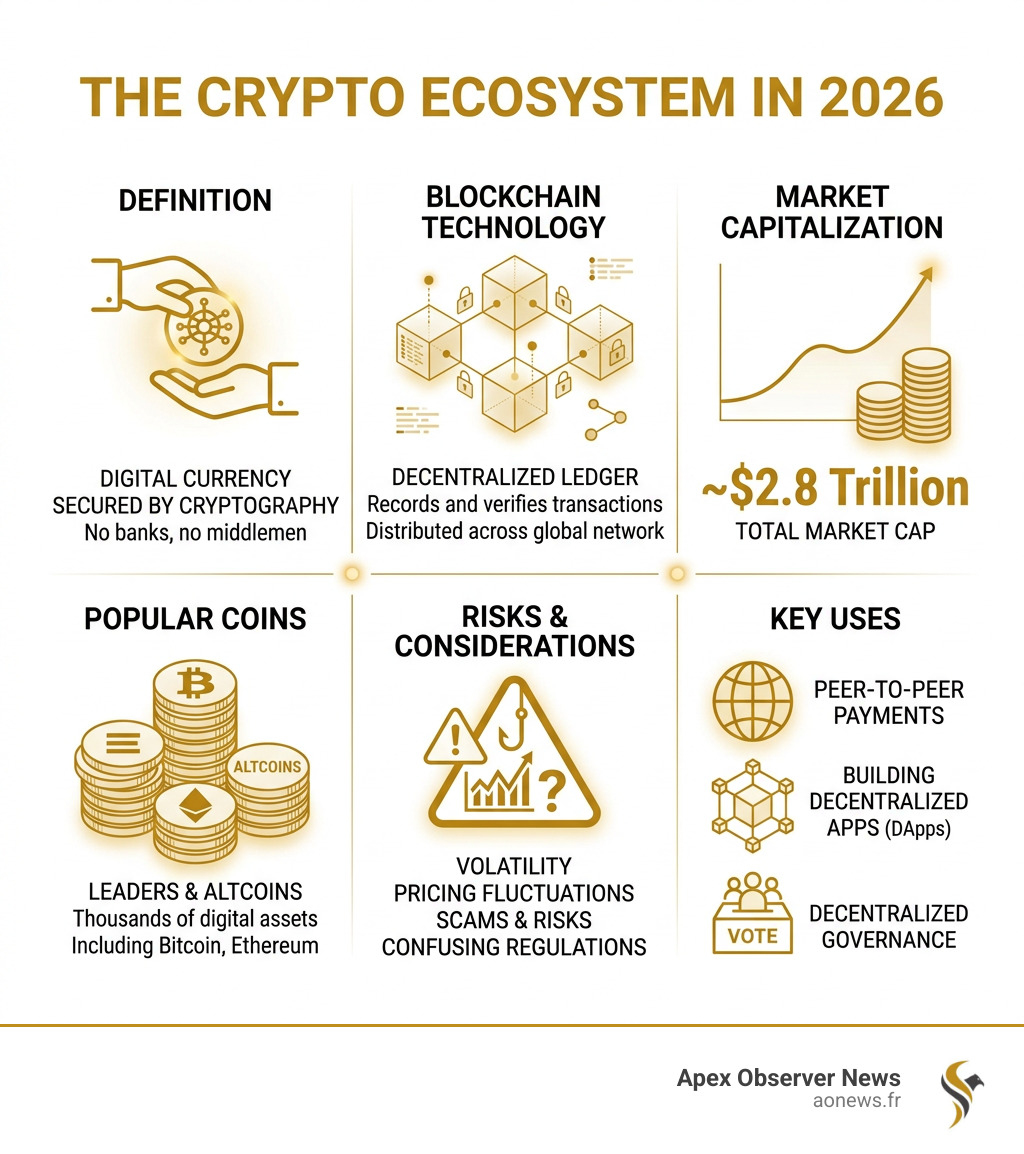
Crypto is digital money that runs on a decentralized network — no banks, no governments, no middlemen.
Here’s a quick snapshot of what you need to know:
| What it is | Digital currency secured by cryptography |
| How it works | Runs on blockchain, a shared public ledger |
| Who controls it | No single authority — it’s decentralized |
| Market size (Early 2026) | ~$3.1 trillion total market cap |
| How many exist | 25,000+ cryptocurrencies as of 2023 |
| Most well-known | Bitcoin, Ethereum, and thousands of altcoins |
Think of it this way: traditional money lives in banks. Crypto lives on a global network of computers, and anyone with internet access can use it.
Since Bitcoin launched in 2009, the space has exploded. Today there are over 25,000 cryptocurrencies, and more than 40 of them carry a market cap exceeding $1 billion. The total market hit over $3 trillion by early 2026 — making it impossible to ignore.
But crypto isn’t just about getting rich. It’s reshaping how people send money, build apps, and even vote on financial decisions — with no bank required.
It can also be risky. Volatile prices, scams, and confusing regulations trip up millions of investors every year. A 2024 Pew Research survey found that 63% of U.S. adults have little or no confidence in the reliability of crypto investments.
That’s exactly why a clear, honest guide matters.
I’m Faisal S. Chughtai, founder of ActiveX — a digital branding, web, and marketing agency — and I’ve spent years navigating the crypto ecosystem across app development, digital strategy, and online platforms. In this guide, I’ll break down everything from how crypto works to how to stay safe using it.
Understanding the Mechanics of Cryptocurrency
To understand crypto, we have to look under the hood at the technology that makes it tick. At its core, crypto is a digital payment system that doesn’t rely on banks to verify transactions. Instead, it uses a peer-to-peer system that allows anyone anywhere to send and receive payments.
Blockchain Technology and Distributed Ledgers
The magic happens on the blockchain. Think of a blockchain as a digital checkbook that is shared across thousands of computers worldwide. Every time someone sends crypto, that transaction is recorded in a “block” and added to a “chain” of previous transactions. Because everyone has a copy of this ledger, it’s nearly impossible to forge or double-spend the coins. This concept is explored deeply in Scientific research on cryptocurrency, which highlights how decentralization changes the economic landscape.
The Mining Process and Consensus Mechanisms
How are new coins created? Through a process called mining. In systems like Bitcoin, miners use powerful computers to solve complex mathematical puzzles. When they solve a puzzle, they verify a group of transactions and are rewarded with new crypto coins.
There are two main ways the network agrees that a transaction is valid, known as consensus mechanisms:
- Proof of Work (PoW): This is the original method used by Bitcoin. It requires significant computing power and electricity.
- Proof of Stake (PoS): A more energy-efficient alternative where “validators” are chosen based on how many coins they hold (their “stake”). Ethereum famously switched to this method in 2022, reducing its energy consumption by a staggering 99.9%.
The Role of Nodes and Validation
The network is held together by “nodes.” These are individual computers that run the crypto software and keep a copy of the blockchain. Nodes are the guardians of the network; they ensure that every transaction follows the rules. If someone tries to send coins they don’t have, the nodes will reject the transaction. This peer-to-peer validation is what makes crypto secure without needing a central boss or CEO.
The Diverse Landscape of the Digital Market
The crypto market is massive and incredibly diverse. While Bitcoin was the first, it certainly isn’t the only player in town. As of June 2023, there were more than 25,000 different cryptocurrencies in existence.
Market Capitalization and Bitcoin History
Market capitalization (or market cap) is the total value of all the coins in circulation. As of early 2026, the total crypto market cap was estimated at over US$3 trillion. Bitcoin remains the king, often making up a huge chunk of that value. It was created in 2009 by an anonymous person (or group) named Satoshi Nakamoto. Its primary goal was to create a “peer-to-peer electronic cash system” that bypassed traditional financial institutions.
Popular Crypto Assets: Beyond Bitcoin
Anything that isn’t Bitcoin is generally called an “altcoin.” Some of the most significant include:
- Ethereum (ETH): The second-largest crypto. It introduced “smart contracts,” which are self-executing contracts with the terms written directly into code. This allowed for the creation of what-is-nft and decentralized apps.
- Stablecoins: These are coins pegged to a stable asset, like the US Dollar. They are designed to avoid the wild price swings of typical crypto.
- Meme Coins: Think Dogecoin or Shiba Inu. These often start as internet jokes but can grow into billion-dollar projects driven by community hype.

Latest Data on Market Pairs
According to CoinMarketCap, there are now more than 2 million trading pairs being traded globally. This includes everything from established coins to brand-new tokens. If you’re curious about the latest movements, you can see how bitcoin-rebounds-above-90000-amid-divided-forecasts to get a sense of current market sentiment.
Historical Market Cycles
The crypto market moves in cycles. One of the biggest drivers is the “Bitcoin Halving,” an event that happens every four years and cuts the reward for mining new Bitcoins in half. Historically, this has led to “bull markets” where prices soar. On the flip side, we have “crypto winters” — long periods where prices drop and stay low. For example, the market cap was $2 trillion at the end of 2021 but halved just nine months later.
Navigating Exchanges and Security
If you want to get involved in crypto, you need a place to buy it and a place to keep it. This is where exchanges and wallets come in.
Digital Wallets: Hot vs. Cold Storage
A crypto wallet doesn’t actually “store” your coins; instead, it stores the private keys that allow you to access your coins on the blockchain.
- Hot Wallets: These are connected to the internet (like an app on your phone). they are convenient for trading but more vulnerable to hacks.
- Cold Wallets: These are offline devices, often looking like a USB stick. They are much more secure because they aren’t connected to the internet, making them the gold standard for long-term storage.
How to Secure Your Crypto Assets
Security is entirely your responsibility in the crypto world. There is no “forgot password” button for a blockchain.
- Seed Phrases: This is a string of 12 to 24 words that acts as the master key to your wallet. Never share this with anyone and never store it digitally.
- Two-Factor Authentication (2FA): Always use an app-based authenticator (like Google Authenticator) rather than SMS-based 2FA, which can be intercepted.
- Avoid Phishing: Scammers often create fake websites that look exactly like popular exchanges to steal your login info.
Despite these tools, Pew Research on investor confidence shows that 63% of Americans still worry about the safety of these systems.
Trading and Liquidity
When you trade, you’ll encounter “trading pairs” (like BTC/USD). You can place a Market Order (buy immediately at the current price) or a Limit Order (buy only when the price hits a specific target).
| Feature | Traditional Banking | Crypto Exchanges |
|---|---|---|
| Control | Bank manages your funds | You manage your private keys |
| Speed | 1-3 business days for transfers | Minutes to hours 24/7 |
| Fees | Monthly maintenance, wire fees | Network (gas) fees, trade fees |
| Security | Government insured (FDIC) | User-dependent; no insurance |
Challenges: Regulation, Scams, and the Environment
As crypto goes mainstream, it faces growing pains. Governments are trying to figure out how to tax and regulate it, while critics point to its environmental footprint.
Global Regulation and the MiCA Framework
Regulation varies wildly by country. For example, China has declared all crypto transactions illegal, while El Salvador made Bitcoin legal tender. In Europe, the Markets in Crypto-Assets (MiCA) framework is one of the most comprehensive sets of rules yet, aimed at protecting investors and ensuring the stability of the financial system. In the US, the SEC is actively debating whether most cryptos are “securities” (like stocks) or “commodities” (like gold).
Loss, Theft, and Fraud
The dark side of crypto involves scams and hacks. One operation, the BitClub Network, defrauded investors of over $700 million before being shut down. Common scams include:
- Ponzi Schemes: Using new investor money to pay “returns” to old investors.
- Romance Scams: Scammers build trust on dating apps to convince victims to “invest” in fake crypto platforms.
- Exit Scams: Project founders disappear with investor funds (often called a “rug pull”).
Environmental Impact of Mining
Mining Bitcoin requires a lot of electricity. By July 2019, Bitcoin’s consumption was estimated at 7 gigawatts — roughly the same as the entire country of Switzerland. A 2023 IMF working paper warned that crypto mining could generate 450 million tons of CO2 emissions by 2027.
Fortunately, the industry is moving toward sustainability. Many mining operations are relocating to areas with surplus renewable energy, such as wind farms in Texas or hydroelectric plants in Canada. And as mentioned, Ethereum’s move to Proof of Stake has virtually eliminated its carbon footprint. You can read more about these shifts in Research on mining emissions.
The Evolution and Future of Crypto
Where is all of this going? Crypto is evolving from a speculative investment into a suite of real-world tools.
Real-World Applications and Institutional Adoption
Major companies are now integrating crypto. For instance, AXA began accepting Bitcoin for insurance payments in 2021. We are also seeing the rise of:
- Decentralized Finance (DeFi): Financial services like lending and borrowing that happen entirely on the blockchain without a bank.
- NFTs: Digital ownership of art, music, or even tickets. Speaking of tickets, venues like the Crypto.com Arena in Los Angeles host massive events that are increasingly tied to digital ecosystems.
If you’re in the LA area, check out these upcoming events at the arena:
- Buy Tickets March 15, 2026: AEW presents REVOLUTION
- Buy Tickets June 13-14, 2026: Ariana Grande The Eternal Sunshine Tour
- Buy Tickets September 1 & 7, 2026: J. Cole The Fall-Off World Tour
Integration into Global Finance
Central banks are even exploring their own digital currencies, known as Central Bank Digital Currencies (CBDCs). These would be digital versions of the dollar or euro, combining the efficiency of crypto with the stability of a government-backed currency. This shift could revolutionize payment processing and remittances, making it cheaper and faster to send money across borders.
Frequently Asked Questions about Cryptocurrency
Is cryptocurrency legal globally?
Not everywhere. While it’s legal and regulated in the US, EU, and many other regions, countries like China have banned it entirely. Other nations, like pakistans-crypto-ban-may-isolates-itself-from-web-3-0-jobs-landscape-waqar-zaka, have faced internal debates about its legality. Always check your local laws before investing.
How do I start investing in digital assets?
The easiest way is to sign up for a reputable exchange, verify your identity (KYC), and link a bank account. Start small, do your research, and only invest money you can afford to lose. Many people start by looking into decoding-cryptocurrency-beyond-bitcoin-and-the-future-of-finance to understand the broader market.
What makes a cryptocurrency valuable?
Like gold or stocks, value is driven by supply and demand. If a coin has a lot of utility (like being used for smart contracts) or is very scarce (like Bitcoin’s 21 million coin limit), people are willing to pay more for it. Community trust and institutional adoption also play massive roles.
Conclusion
The world of crypto is fast-moving, complex, and occasionally a bit wild. Since 2009, we’ve seen it grow from a niche experiment into a $3 trillion global asset class. While the risks are real — from high volatility to environmental concerns and crypto-links-to-terror-funding-push-morocco-to-speed-up-regulation — the potential for innovation is even greater.
Whether you’re looking to trade the latest meme coin or simply want to understand the future of money, staying informed is your best defense. At Apex Observer News (Aonews.fr), we are committed to bringing you the latest headlines and deep dives into tech, business, and finance.
Explore more crypto insights on Aonews.fr and stay ahead of the curve in this digital revolution.
