

Why AI in Manufacturing Is Reshaping the Global Production Floor
AI in manufacturing is the use of machine intelligence — including machine learning, computer vision, and predictive analytics — to automate tasks, optimize production, and make smarter decisions across the factory floor.
Here’s a quick look at how manufacturers are putting AI to work right now:
| AI Application | What It Does | Key Benefit |
|---|---|---|
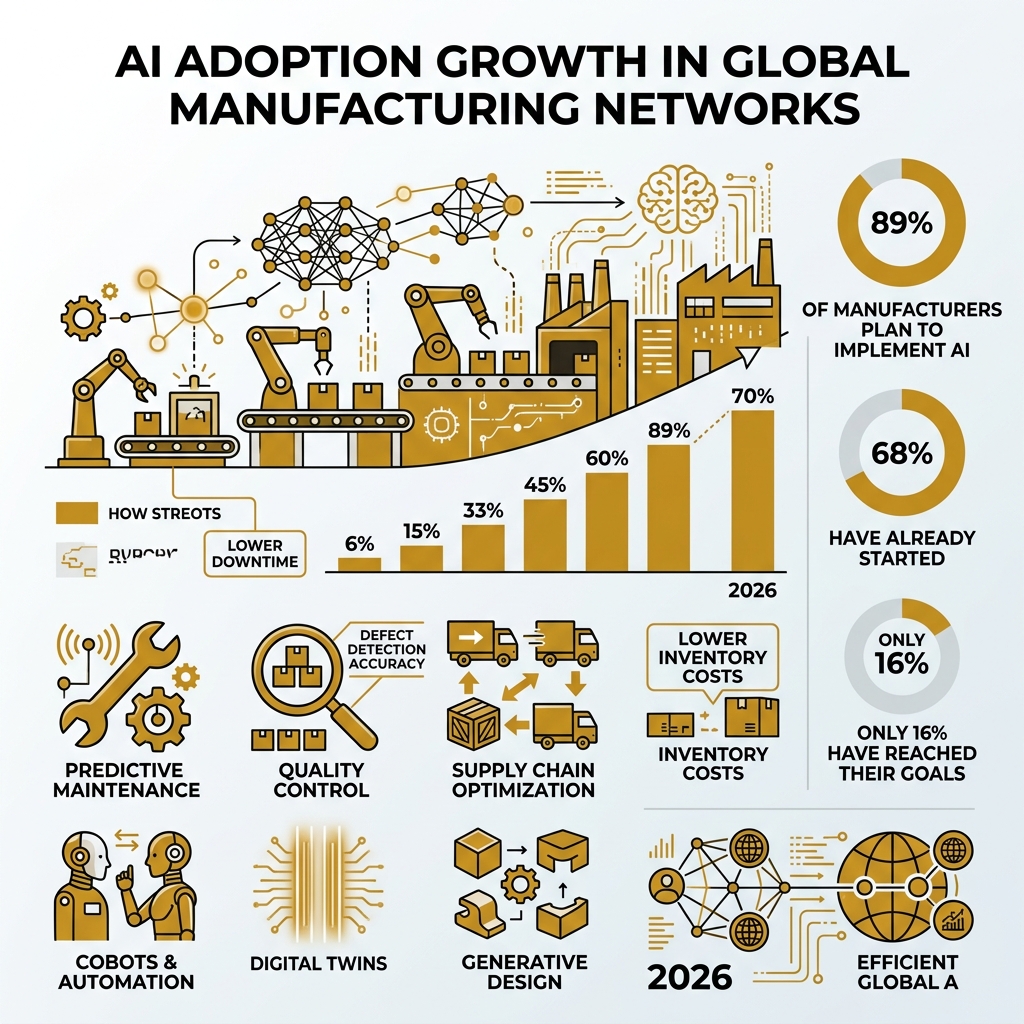
| Predictive Maintenance | Monitors equipment sensors to flag failures early | 35-50% less unplanned downtime |
| Quality Control | Uses computer vision to inspect products in real time | Up to 99.2% defect detection accuracy |
| Supply Chain Optimization | Forecasts demand and automates inventory | 18-25% lower inventory carrying costs |
| Cobots & Automation | Robots work safely alongside humans | Higher throughput, fewer injuries |
| Digital Twins | Virtual replicas simulate production before changes | Faster troubleshooting, lower risk |
| Generative Design | AI generates optimized part designs | Faster prototyping, less material waste |
The numbers tell a compelling story. According to industry surveys, 89% of manufacturers plan to implement AI in their production networks soon, and 68% have already started. Yet only 16% have reached their goals — which means the gap between ambition and execution is wide, and understanding how to do this right matters enormously.
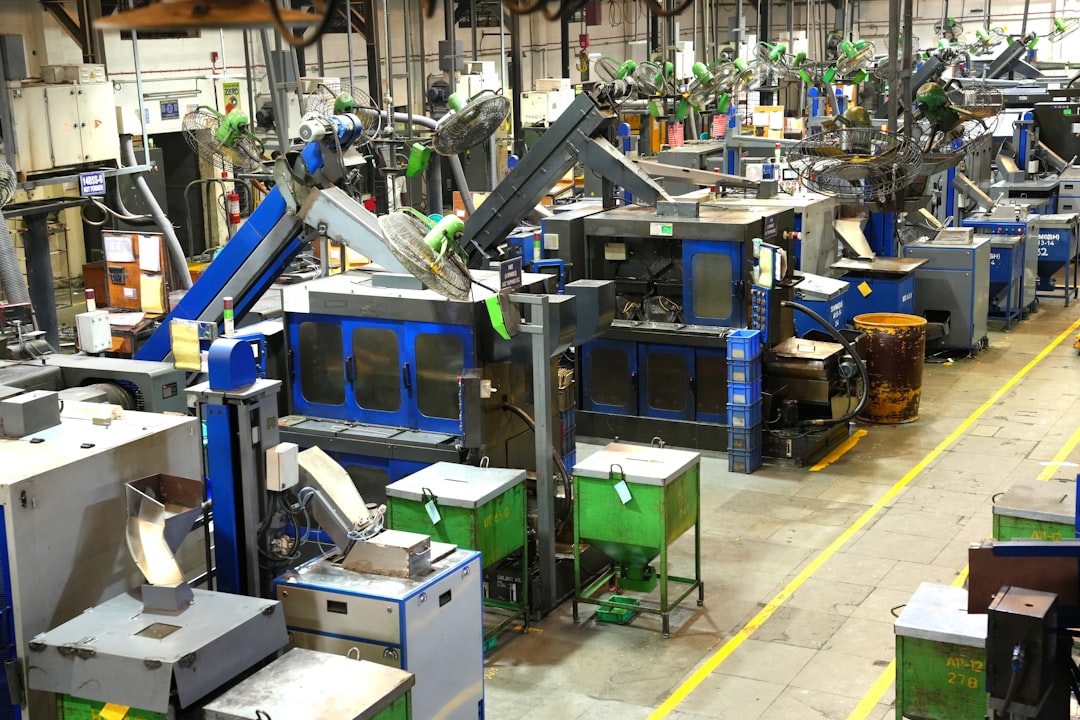
The manufacturing industry has always been an early adopter of new technology — from steam power to robotics to the internet. Today, artificial intelligence is the next leap. And unlike previous shifts, AI doesn’t just automate a single task. It connects data from every corner of the factory, learns continuously, and helps humans make faster, better decisions at every level.
This isn’t a distant future. It’s happening on production floors right now.
I’m Faisal S. Chughtai, founder of ActiveX, with hands-on experience in digital technology, app and web development, and AI-driven digital strategies — including how AI in manufacturing is being applied to optimize operations and drive competitive advantage. In the sections ahead, we’ll break down every key dimension of this transformation so you can act on it.
Ai in manufacturing terms explained:
Understanding AI in Manufacturing and Industry 4.0
We are currently living through what historians call the Information Age, a period defined by our mastery of digital tools. In production, this has manifested as Industry 4.0—the “Fourth Industrial Revolution.” Unlike the steam engines of the past, this revolution is powered by data.
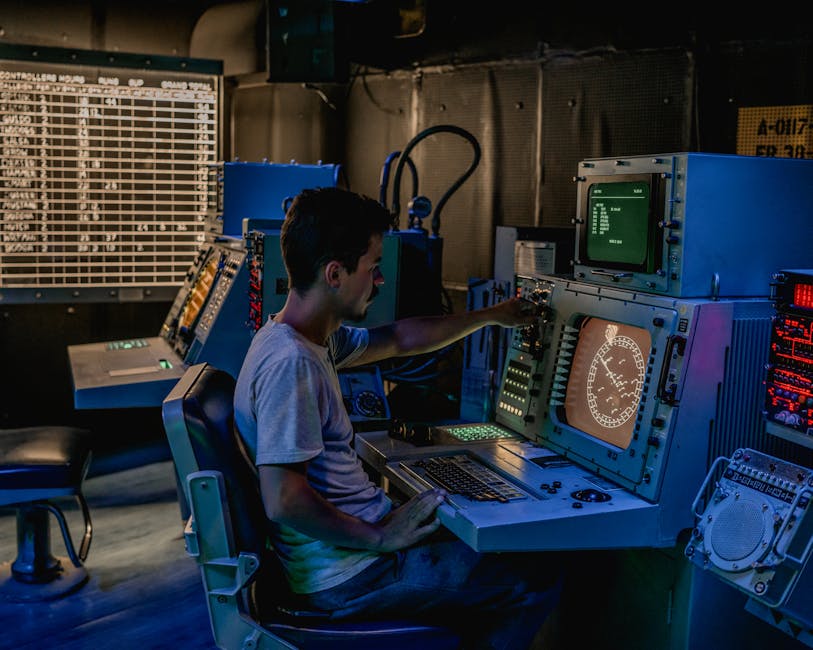
At its heart, ai in manufacturing integrates machine learning and neural networks into the very fabric of the shop floor. These systems don’t just follow a set of pre-programmed instructions; they learn from the environment. By processing massive datasets through application of artificial intelligence, factories are evolving into smart ecosystems where every machine is “aware” of its performance and its place in the larger production chain.
This shift moves us away from reactive management—fixing things when they break—to proactive, data-driven decision-making. Through real-time IoT (Internet of Things) integration, a factory can now sense a drop in humidity or a slight vibration in a motor and adjust its own parameters instantly to maintain peak efficiency.
Core Applications: From Predictive Maintenance to Quality Control
One of the biggest headaches for any plant manager is unplanned downtime. It is estimated that unplanned outages cost industrial sectors over $50 billion annually. This is where AI truly shines as a “precision surgeon” rather than a “firefighter.”
Predictive Maintenance
By using sensors to monitor heat, vibration, and noise, AI can predict when a machine is likely to fail. According to McKinsey research on predictive maintenance ROI, companies can see a 30-50% reduction in downtime and a 10-40% drop in maintenance costs. Instead of replacing a part every six months “just because,” we can wait until the AI flags a specific anomaly, saving both time and money.
Quality Control and Defect Detection
In traditional setups, quality control often relies on manual sampling—checking one out of every hundred items. AI changes the game through computer vision and nondestructive testing (NDT). High-speed cameras paired with deep learning models can inspect 100% of the output at line speed.
Whether it’s identifying a microscopic crack in a circuit board or a color drift on a high-speed printing press, AI achieves accuracy levels of 97-99%, far surpassing human capability. To understand the tech behind this, it helps to look at how deep learning and machine learning differ; while machine learning might recognize a “bad” part based on specific rules, deep learning can “see” subtle patterns in pixels that a human eye would miss entirely.
Smart Technologies: Cobots, Digital Twins, and Generative AI
The modern factory isn’t just about faster belts; it’s about smarter collaborators. We are seeing a massive rise in “Cobots”—collaborative robots designed to work alongside us.
| Feature | Traditional Industrial Robots | Collaborative Robots (Cobots) |
|---|---|---|
| Safety | Kept in cages/fences | Built-in sensors for human proximity |
| Programming | Requires complex coding | Can be “taught” by moving the arm manually |
| Flexibility | Fixed to one task | Easily reconfigurable for different jobs |
| Cost | High initial investment | Lower cost; suitable for SMEs |
The synergy between AI and robotics is creating workplaces where the heavy, repetitive lifting is done by machines, while humans focus on complex problem-solving.
Digital Twins and Generative Design
A “Digital Twin” is a virtual replica of a physical asset. By feeding real-time sensor data into this virtual model, we can simulate “what-if” scenarios without risking the actual machinery. This is particularly useful in additive manufacturing, where a single 3D print can generate a terabyte of data.
Furthermore, generative design allows engineers to input basic requirements—like “must weigh less than 2kg and support 500kg of pressure”—and the AI will generate thousands of optimized blueprints. This often results in organic-looking parts that are stronger and lighter than anything a human could design from scratch.
Overcoming Challenges in AI Adoption and Implementation
If AI is so great, why hasn’t everyone mastered it? The reality is that implementing ai in manufacturing is hard. As we noted earlier, while 68% of companies have started, many struggle to scale.
The Hurdles to Success
- Data Silos and Legacy Systems: Many factories run on “dumb” machines that are decades old. Integrating these with modern AI requires retrofitting sensors and bridging the gap between old-school hardware and new-school software.
- The Skills Gap: There is a significant shortage of workers who understand both manufacturing processes and data science. Training the existing workforce is essential.
- Cybersecurity: As factories become more connected, they become bigger targets for hacks. Robust cybersecurity measures are no longer optional.
- Ethics and Privacy: Manufacturers must navigate the complex landscape of AI ethics, ensuring that data collection doesn’t infringe on worker rights or compromise intellectual property.
To succeed, we recommend starting with high-impact, low-risk pilot projects. Don’t try to “AI-ify” the whole plant at once. Pick one bottleneck—like a specific machine that breaks often—and prove the ROI there first.
Frequently Asked Questions about AI in Manufacturing
What are the primary benefits of ai in manufacturing?
The most immediate benefits are operational efficiency and cost reduction. By automating repetitive tasks, companies can produce more with less waste. Beyond the balance sheet, AI significantly improves worker safety by taking over dangerous tasks and monitoring for hazards in real-time. Interestingly, these same technologies are also being applied to the future of food and production on farms, showing that “manufacturing” intelligence is a cross-industry win.
How does ai in manufacturing improve supply chain management?
AI acts like a crystal ball for logistics. It uses machine learning to analyze historical trends and external factors (like weather or shipping delays) to provide highly accurate demand forecasting. This prevents “inventory bloat” and ensures parts arrive exactly when needed. In many ways, your next production manager might be an algorithm capable of simulating thousands of disruption scenarios in seconds to find the most resilient path forward.
Is AI suitable for small-to-medium enterprises (SMEs)?
Absolutely. In fact, SMEs are often more agile than giants. Thanks to cloud-based SaaS (Software as a Service) models, you don’t need a $10 million server room to start using AI. Low-cost IoT sensors (some under $15) allow smaller shops to monitor their equipment and gain a competitive edge. Modular automation and “factory-in-a-box” solutions are making it easier than ever for smaller players to leapfrog older, slower competitors.
Conclusion
The future of ai in manufacturing isn’t about replacing humans; it’s about augmenting them. We are moving toward a world of “autonomous orchestration,” where AI handles the minute-by-minute adjustments while humans steer the strategic ship. Those who embrace these tools will find themselves with a massive competitive edge, producing higher-quality goods at a lower cost with less environmental impact.
At Apex Observer News, we keep a close eye on these shifts to ensure you stay ahead of the curve. The robot revolution is here—and it’s a lot more helpful than the movies led us to believe.
Explore more insights on artificial intelligence to stay updated on how technology is changing our world.
