


Why Artificial Intelligence in Agriculture Is Changing How We Feed the World
Artificial intelligence in agriculture is transforming farming by helping growers produce more food with fewer resources. Here’s a quick look at what it means in practice:
| AI Application | What It Does |
|---|---|
| Precision farming | Applies water, fertilizer, and pesticides only where needed |
| Crop monitoring | Uses drones and satellites to spot disease and stress early |
| Predictive analytics | Forecasts weather, yields, and pest outbreaks |
| Robotics & automation | Handles planting, weeding, and harvesting |
| Soil & irrigation management | Optimizes water use based on real-time sensor data |
Here’s the hard truth: the world will need to produce 60% more food over the next 25 years to feed a projected population of 9.7 billion by 2050. At the same time, climate change is making growing conditions less predictable, row crop yields are expected to drop by as much as 11% due to severe weather and pests, and over 160,000 farms in the US alone have disappeared since 2017.
That’s a lot of pressure on an already strained system.
AI isn’t a magic fix. But it gives farmers something they’ve never had before: the ability to make faster, smarter decisions backed by real data — from soil sensors, satellite imagery, weather models, and more.
Whether you manage a large commercial operation or a small family farm, understanding how AI fits into modern agriculture can mean the difference between struggling and thriving.
I’m Faisal S. Chughtai, founder of ActiveX, where I work at the intersection of technology, digital strategy, and emerging innovation — including the growing role of artificial intelligence in agriculture and its impact on global food systems. In this guide, I’ll walk you through what’s actually happening in AI-driven farming, what’s working, and where the real opportunities lie.
Glossary for artificial intelligence in agriculture:
The Current State of Artificial Intelligence in Agriculture
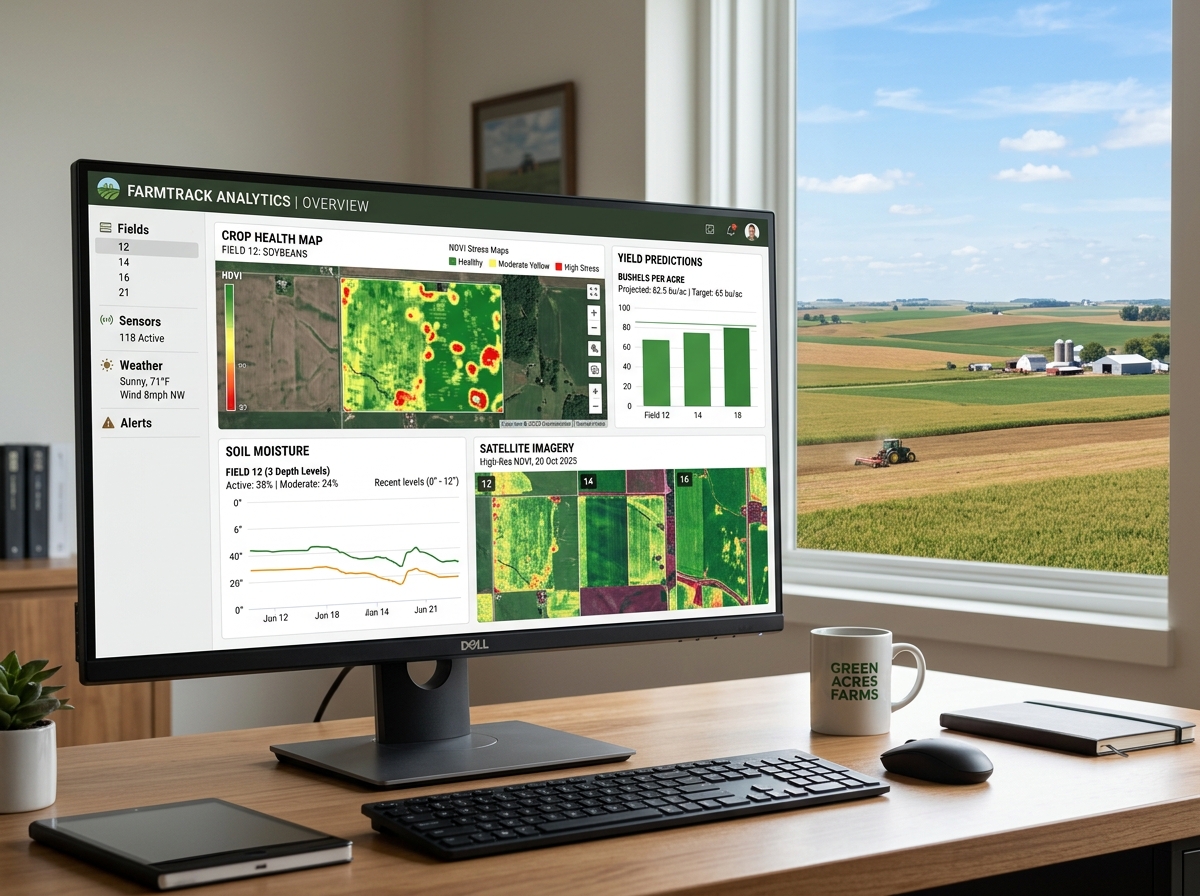
The shift toward high-tech farming isn’t just a trend; it’s a massive economic movement. The global market for artificial intelligence in agriculture is on a steep upward trajectory, expected to grow from USD 1.7 billion in 2023 to a staggering USD 4.7 billion by 2028. Some projections even suggest the market could reach nearly $17 billion by 2034 as adoption accelerates.
But why the sudden surge? For years, farming relied on “sparse experience”—the gut feelings and historical observations of a farmer. While valuable, this traditional approach often leads to resource waste. If you spray the whole field because you see a few bugs in one corner, you’re wasting money and chemicals. AI changes the game by moving us toward site-specific management.
The academic community is also taking note. The Scientific research on AI in agriculture has seen an explosion in peer-reviewed studies, with the field’s leading journal recently announcing an impact factor of 12.4. This research isn’t just staying in labs; it’s being deployed to boost the agricultural GDP of low- and middle-income countries by more than $450 billion annually.
However, we must address the “digital divide.” While large-scale operations are quickly embracing these tools, many smallholders still struggle with access. To help visualize the shift, here is how the landscape is changing:
| Feature | Traditional Farming | AI-Enabled Precision Agriculture |
|---|---|---|
| Decision Making | Experience and intuition | Data-driven predictive analytics |
| Resource Use | Uniform application (blanket spraying) | Variable-rate application (spot-specific) |
| Monitoring | Manual field walks | Real-time drone and satellite surveillance |
| Labor | Highly manual and labor-intensive | Automated robotics and remote oversight |
| Risk Management | Reactive to weather/pests | Proactive via simulation and forecasting |
Primary Applications and Technologies in Smart Farming
At its core, smart farming is about “Agricultural Intelligence.” This involves fusing agronomic expertise with massive datasets to make every seed count. When we talk about Harnessing AI for agricultural transformation, we are looking at a stack of technologies working in harmony.
Drones and satellites provide the “eye in the sky,” using multispectral sensors to see things the human eye cannot, such as early signs of nitrogen deficiency or heat stress. Meanwhile, IoT sensors buried in the soil or attached to livestock provide a constant stream of “ground truth” data. All this information is processed in the cloud using Big Data analytics to provide farmers with actionable advice on their smartphones.
Computer Vision for Pest and Weed Management
One of the most exciting breakthroughs in artificial intelligence in agriculture is the use of computer vision. Imagine a robot rolling through a field that can distinguish between a young cotton plant and a stubborn weed in milliseconds.
By analyzing the size, shape, and color of leaves, machine learning models can program Automated weed detection solutions to take action. Instead of spraying an entire field with herbicide, these robots can deliver a targeted “micro-dose” only to the weed. This doesn’t just save money; it prevents invasive plants from taking over while keeping the soil healthier.
Computer vision is equally powerful for pest detection. AI models can now identify specific insects—like moths, bees, or flies—with over 90% accuracy. By spotting an infestation the moment it starts, we can stop a localized problem from becoming a total crop failure.
Enhancing Sustainability through Artificial Intelligence in Agriculture
Sustainability is no longer a buzzword; it’s a requirement for staying within our “planetary boundaries.” AI contributes to a greener planet by ensuring we do more with less.
Water scarcity is a growing threat, but AI-driven irrigation systems can reduce water use significantly. By combining soil moisture data with ultra-localized weather forecasts, these systems only water when and where it is absolutely necessary. This resource optimization doesn’t just help the environment—it’s a massive driver of cost savings for the farm. Furthermore, AI helps monitor soil health, ensuring that we aren’t over-fertilizing, which reduces the carbon footprint of the entire operation.
Solving Global Food Challenges with AI
We are currently facing a “perfect storm” of challenges. Climate change is bringing extreme weather that traditional farming models simply weren’t built for. For example, ClimateAi simulations recently found that extreme heat and drought could lead to a 30% decrease in tomato output in Maharashtra, India, over the next two decades.
In the United States, we are seeing a different but equally dire problem: US farm disappearance statistics show that 160,000 farms have vanished since 2017—an 8% drop. This is largely due to rising costs and severe labor shortages.
AI provides a competitive edge in this harsh environment. Whether it’s a Climate impact on row crop yields study or a real-time pest alert, these tools allow us to adapt. If a farmer knows a heatwave is coming three weeks in advance, they can adjust their planting schedule or choose a more resilient seed variety.
Real-World Implementation and Case Studies
We don’t have to look far to see AI in action. Large-scale platforms like Syngenta’s Cropwise digital platform have already transformed management across more than 70 million hectares in over 30 countries. These systems connect data, tools, and services to help farmers manage their land from a single interface.
But it’s not just for the giants. Organizations like IBM and various non-profits are working to ensure that small-scale producers—who grow a third of the world’s food—aren’t left behind. There is a massive push to determine if AI advice for smallholders can be delivered via simple mobile apps or even SMS.
In Tanzania, researchers are using vision transformers on smartphones to help farmers phenotype plants in the field. In India, AI “adaptation playbooks” have helped over 100,000 smallholder farmers increase their productivity by up to 40% by providing better planting windows based on biophysics-based weather models.
Barriers to Adoption and Future Trends
Despite the clear benefits, the path to a fully AI-integrated farm isn’t without obstacles. We often hear about “farmer reluctance,” but this usually stems from very practical concerns:
- High Upfront Costs: Advanced sensors and robotic machinery require significant initial investment.
- Data Privacy: Farmers are rightfully protective of their data. Who owns the soil maps? Who can see the yield results?
- Technical Expertise: There is a steep learning curve. Not every farmer wants to be a data scientist.
- Infrastructure Gaps: AI requires connectivity. In many rural areas, high-speed internet is still a luxury.
Bridging the Technical Gap in Artificial Intelligence in Agriculture
To overcome these barriers, we need a collaborative effort. This includes government support in the form of grants for high-tech equipment and investments in rural broadband. We also need more open-source data ecosystems where researchers can share findings without compromising individual privacy.
The future of artificial intelligence in agriculture lies in “Embodied Intelligence”—robots that don’t just see, but also act with human-like dexterity. We are also seeing the rise of “Edge AI,” where the processing happens right on the tractor or drone, allowing it to work even in areas with no internet connection.
Frequently Asked Questions about AI in Farming
How does AI improve crop yields?
AI improves yields by removing the guesswork. It identifies the optimal time to plant, the exact amount of water needed, and detects diseases before they are visible to the human eye. By minimizing “stress” on the plants, it allows them to reach their full genetic potential.
Is AI affordable for small-scale farmers?
Currently, the “digital divide” is a challenge. However, many AI solutions are becoming mobile-based, requiring only a smartphone. Governments and international organizations are also subsidizing these technologies to ensure smallholders can remain competitive.
What are the main risks of using AI in agriculture?
The primary risks include data security breaches and an over-reliance on technology. If a system fails or provides a “hallucinated” recommendation during a critical growth stage, the results can be devastating. This is why AI should be seen as a tool to enhance human expertise, not replace it.
Conclusion
The future of food is digital. As we strive toward global food security goals, artificial intelligence in agriculture will be the engine that drives us there. From the wheat fields of the US to the smallholder farms of India, the digital transformation of the farm is well underway.
At Apex Observer News, we are committed to tracking these innovations and explaining how they impact your world. If you’re passionate about the intersection of tech and the real world, we invite you to Join our team and help us tell these vital stories.
The tractor revolutionized the 20th century; AI will define the 21st. By embracing these tools today, we can ensure a more sustainable, productive, and food-secure tomorrow for all 9.7 billion of us.
For more insights on the future of technology, check out our guides on the future of education or the ethics of AI.
