

Why the Renewable Energy Investment Boom Is Reshaping Global Capital
The renewable energy investment boom is no longer a future trend — it’s the defining capital story of 2025. Here’s a quick snapshot of where things stand right now:
| Key Metric | Figure |
|---|---|
| Global clean energy investment (2025) | $2.2 trillion of $3.3 trillion total |
| Global renewable investment, H1 2025 | $386 billion (+10% year-over-year) |
| New electricity capacity from renewables (2024) | 90%+ worldwide |
| Renewable capacity added in 2024 | 582 GW (record annual high) |
| Clean energy vs fossil fuel spending | Clean energy leads — for 10 years straight |
| Emerging markets’ share of clean energy spending | Only 15% in 2024 |
For the first time in history, clean energy is attracting more than twice the capital flowing into fossil fuels. In 2025, out of every dollar invested in energy globally, roughly two-thirds goes toward clean sources. That gap is widening every year.
Yet the boom is uneven. Asia captured 71% of new renewable capacity in 2024. Meanwhile, Africa — home to 60% of the world’s best solar resources — accounts for just 1% of installed solar PV globally. The money is moving fast, but not everywhere.
Policy uncertainty in the US, supply chain risks tied to critical minerals, and aging grid infrastructure are creating real headwinds even as headline numbers hit records.
I’m Faisal S. Chughtai, founder of ActiveX and a digital strategist who has tracked the intersection of capital markets and the renewable energy investment boom across global tech and energy sectors. In the sections ahead, we’ll break down exactly where the money is going, what’s driving it, and what it means for investors and pension markets navigating this shift.

Renewable energy investment boom terms explained:
The Global Renewable Energy Investment Boom: Breaking Records in 2025
We are witnessing a historic pivot in how the world powers itself. In the first half of 2025 alone, global investment in new renewable energy projects reached a staggering $386 billion. This represents a 10% jump from the previous year, proving that even in a volatile economic climate, the appetite for green electrons remains insatiable. According to the IEA, global energy investment is set to rise to $3.3 trillion in 2025, with clean energy accounting for a massive $2.2 trillion of that total.
Solar power continues to be the undisputed heavyweight champion of this surge. In 2024, solar alone added 453 GW of capacity, while wind contributed 114 GW. This dominance is driven by a simple economic reality: in many parts of the world, building new solar is now cheaper than continuing to run existing coal or gas plants. However, it’s not all smooth sailing for the big players. While small-scale solar (think residential rooftops) is thriving, utility-scale solar and onshore wind investments actually saw a dip in early 2025 due to grid congestion and revenue uncertainty.
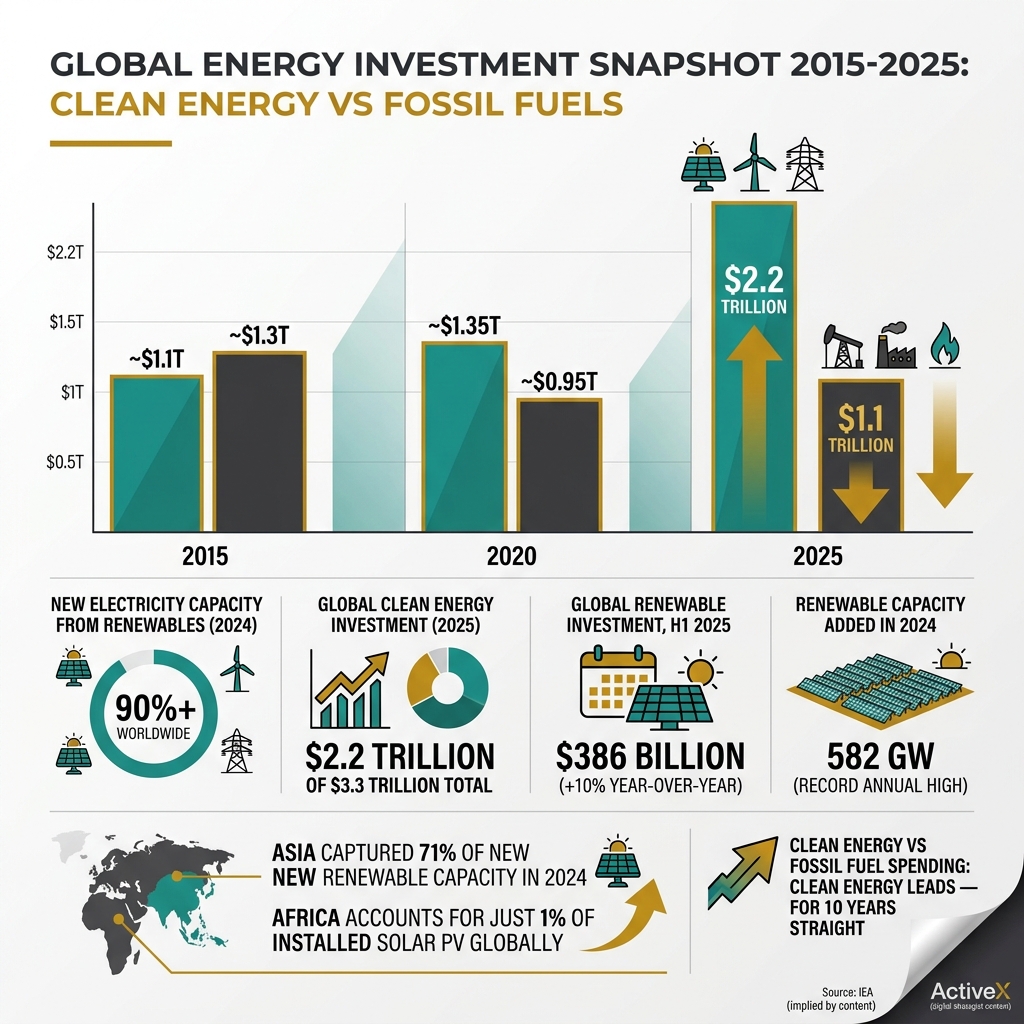
| Year | Clean Energy Investment ($B) | Fossil Fuel Investment ($B) |
|---|---|---|
| 2015 | ~1,100 | ~1,300 |
| 2020 | ~1,350 | ~950 |
| 2024 | ~2,000 | ~1,100 |
| 2025 | ~2,200 | ~1,100 |
As we can see, clean energy spending has consistently outpaced fossil fuels for a decade. The gap is no longer a crack; it’s a canyon.
Regional Disparities in the Renewable Energy Investment Boom
While the global numbers are rosy, the geographic distribution tells a story of “the haves and the have-nots.” Asia is currently the engine room of the renewable energy investment boom, accounting for 71% of all new capacity additions in 2024. China remains the dominant force, holding a 44% share of global new renewable investment in early 2025. India is also making waves, with its total energy investment hitting a record $150 billion in 2025, of which $101 billion was dedicated to clean energy.
In contrast, other regions are struggling to keep pace. Africa, despite its immense natural potential, saw its renewables capacity increase by only 7.2% in 2024. As noted in the podcast Renewables Boom Highlights Growing Regional Divide, this disparity is a major hurdle for global climate goals. In the Global South, nearly 90% of energy generation capital expenditure is now flowing into low-emission sources, but the absolute volume of capital is still far below what is needed to bridge the energy poverty gap. Emerging markets only received 15% of global clean energy spending in 2024, a figure that must rise if we are to achieve a truly global transition.
Strategic Drivers: Hyperscalers, Data Centers, and the AI Surge
If you’re wondering why tech giants are suddenly acting like energy utilities, look no further than the Artificial Intelligence (AI) revolution. Data centers are incredibly power-hungry, and as the race for AI dominance heats up, companies like Google, Meta, and Microsoft are scouring the globe for “firm” carbon-free power. This isn’t just about PR; it’s about operational survival. More than 90% of data center operators now cite power availability as their number one concern.
The US currently hosts 90% of hyperscalers’ global carbon-free energy contracts. This demand has supercharged the Power Purchase Agreement (PPA) market, where technology firms have signed deals for over 86 GW of renewable capacity since 2015. We’ve even seen tech leaders pivot toward advanced nuclear (SMRs) and geothermal to ensure their servers stay cool 24/7. Understanding these market shifts is crucial; for instance, why the Apple Stock Price Today Matters for Your Future often comes down to how these companies manage their massive infrastructure and energy overheads.
However, this surge in demand is colliding with a physical reality: the grid. In some hotspots, the wait time to connect a new data center to the power lines is now three to seven years. This bottleneck is forcing hyperscalers to become energy innovators, investing in on-site generation and long-duration storage to bypass the queue. As explored in How hyperscalers are fueling the race for 24/7 clean power, this trend is reshaping the very nature of energy demand.
Navigating Policy Shifts and Supply Chain Vulnerabilities
The renewable energy investment boom is currently navigating a maze of “One Big Beautiful” policy shifts, particularly in the United States. Recent legislative changes have accelerated the phaseout of key tax credits, such as the 45Y and 48E credits, for projects starting after mid-2026. This has created a frantic “rush to build” as developers try to safe-harbor their projects under older, more generous rules. At the same time, new Foreign Entity of Concern (FEOC) restrictions are making it much harder to source components from countries like China, Russia, and Iran.
These policy shifts are aimed at fostering domestic manufacturing, but they come with growing pains. In 2024, US solar PV module manufacturing capacity nearly tripled to 42 GW, yet the industry remains heavily reliant on global supply chains for raw materials. The Green Tech Revolution: How Technology is Driving Sustainability is essentially a race to secure the building blocks of the new economy: critical minerals.
The numbers are eye-opening. Demand for lithium rose nearly 30% between 2023 and 2024, while demand for other battery metals like nickel and cobalt is also climbing. If we stay on our current trajectory, critical mineral demand could double by 2030. Currently, China controls a staggering 91% of rare earth refining and over 70% of global battery production. Mitigating this dependency is now a matter of national security, leading to a surge in “friend-shoring” and domestic mining investments.
Overcoming Barriers to the Renewable Energy Investment Boom
The biggest threat to the renewable energy investment boom isn’t a lack of money; it’s a lack of wires. Our current grid infrastructure is simply not built for a world of distributed, intermittent power. To meet global climate goals, the total length of transmission and distribution lines needs to double by 2050 — that’s enough new wire to wrap around the Earth 2,000 times!
Annual investment in grids needs to jump from $410 billion today to $600 billion by 2030. Without this, the massive backlog of wind and solar projects — over 205 GW in the US alone — will continue to sit idle, waiting for a connection. As detailed in the report Electricity grids and secure energy transitions, permitting delays and community opposition are now among the biggest barriers to progress. It’s a classic case of “Not In My Backyard” (NIMBY) slowing down the “Green In My Portfolio.”
The New Energy Investment Paradigm: M&A and Private Capital
As the “green premium” of the last decade fades, a new, more pragmatic energy investment paradigm is emerging. This shift prioritizes efficiency, security, and competitiveness over pure decarbonization. We are seeing a move away from volatile public markets toward private capital. Private equity firms are stepping in to provide the bespoke financing that traditional banks often avoid. For example, TPG’s $2.2 billion acquisition of Altus Power signals a growing trend of “platform” M&A, where investors buy entire companies to gain scale and expertise rather than just individual assets.
This shift is also visible in the strategies of major asset managers. While some high-profile investors have made headlines with “short” positions on tech, such as Michael Burry’s Scion Asset Management Bets Against Nvidia and Palantir, the broader trend in energy is toward diversification. Investors are hedging capital-intensive renewable assets with stable, contracted cash flows.
Energy storage is the “glue” holding this new paradigm together. US operating storage capacity reached 37.4 GW by late 2025, up 32% year-to-date. Battery storage is no longer a luxury; it is the essential tool for providing “firm” power that can be dispatched even when the sun isn’t shining.
This move toward “solar-plus-storage” and hybrid portfolios is changing the risk-return profile of the sector. By pairing renewables with batteries, developers can capture higher prices during peak demand hours, turning an intermittent resource into a reliable, baseload-style asset.
Frequently Asked Questions about Renewable Energy Investment
Is the world on track to triple renewable capacity by 2030?
Currently, we are falling slightly short. While the growth is record-breaking, we need an annual growth rate of 16.6% to meet the COP28 goal of tripling capacity. At our current pace, we will miss the target by about 0.9 TW. Acceleration is needed, particularly in streamlining permitting and unlocking finance for the Global South.
How are interest rates affecting clean energy projects?
Clean energy projects are “front-heavy” — they require a lot of capital up-front but have very low operating costs. This makes them highly sensitive to interest rates. Higher-for-longer rates have increased the cost of capital, making some utility-scale projects less attractive compared to fossil fuel projects, which are more sensitive to fuel prices than interest rates. This is why private credit and innovative financing “transferability” models are becoming so popular.
What are the job prospects in the clean energy sector?
The news is overwhelmingly positive for workers. Clean energy employment reached 35 million in 2023, surpassing fossil fuel jobs. We expect to add another 10 million jobs by 2030, with the biggest gains in EVs, batteries, and solar. However, we are facing a massive labor shortage in specialized roles like electricians and welders. Reskilling the existing fossil fuel workforce will be one of the great social challenges of the decade.
Conclusion
At Apex Observer News, we see the renewable energy investment boom not just as a climate story, but as a total rewire of the global financial system. The shift toward efficiency, security, and competitiveness is creating a “new normal” where clean energy is the pragmatic choice, not just the idealistic one. While hurdles like grid bottlenecks and supply chain fractures remain, the sheer volume of capital — $2.2 trillion and counting — suggests that the momentum is now irreversible. As we move toward the COP28 goals, the focus will shift from “how much” we invest to “how fast” we can build. For more insights on the shifting tides of the global economy, be sure to check out our more business headlines.
