


What Are Independent Contractor 1099 Forms (and Who Needs Them)?
Independent contractor 1099 forms are the IRS tax documents businesses use to report payments made to non-employees for services rendered during the year. Here’s a quick breakdown of what you need to know:
Key facts at a glance:
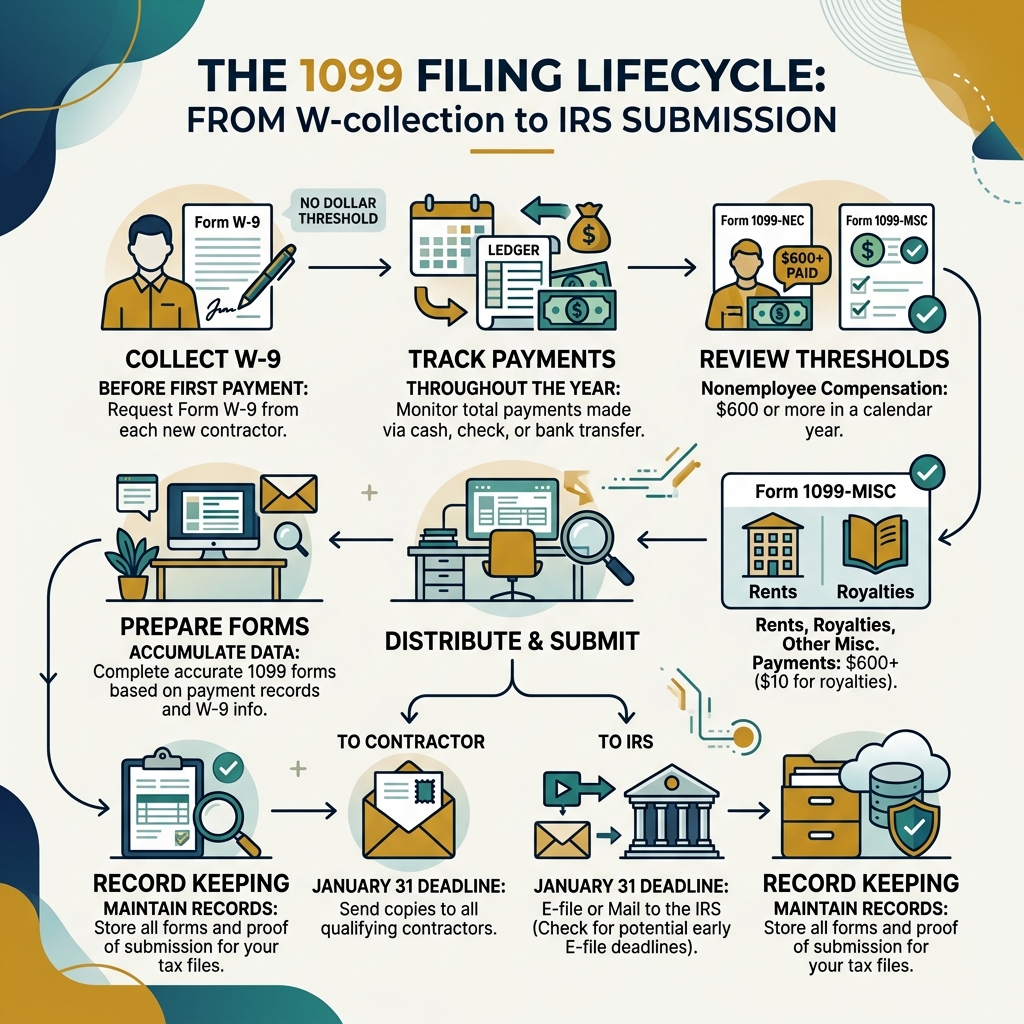
| Form | Who It’s For | Threshold |
|---|---|---|
| Form W-9 | Collect from contractor before first payment | No dollar threshold |
| Form 1099-NEC | Report nonemployee compensation to IRS + contractor | $600 or more paid in a year |
| Form 1099-MISC | Report rents, royalties, and other misc. payments | $600 ($10 for royalties) |
| Form 1099-K | Handled by payment processors (PayPal, Venmo, etc.) | Separate thresholds apply |
The short version: If you paid an independent contractor $600 or more in a year via cash, check, or bank transfer, you must file Form 1099-NEC with the IRS and send a copy to the contractor by January 31.
As of 2025, roughly 73 million Americans work independently. That’s tens of millions of contractors managing their own tax obligations — and tens of millions of businesses responsible for filing the right paperwork. Get it wrong, and the IRS penalties start at $60 per form and can climb to $660 for intentional disregard.
This guide cuts through the confusion. Whether you’re a business hiring a freelancer for the first time, or a contractor trying to understand what your clients are supposed to send you, you’ll find clear, actionable answers here.
I’m Faisal S. Chughtai, founder of ActiveX and a digital business strategist with hands-on experience helping businesses navigate compliance and reporting requirements — including the often-misunderstood world of independent contractor 1099 forms. Let’s walk through everything you need to stay on the right side of the IRS.
Terms related to independent contractor 1099 forms:
Understanding Independent Contractor 1099 Forms and Classification
Before we even touch a tax form, we have to address the elephant in the room: is your worker actually a contractor? The IRS is incredibly aggressive about misclassification. If we treat someone as a contractor who should be an employee, we could face massive back taxes and fines.
To stay safe, we must look at the legitimate contractor or an employee distinction. The IRS uses three main categories to decide:
- Behavioral Control: Do we control when, where, and how the worker does the job? If we provide the tools and dictate the specific sequence of steps, they might be an employee.
- Financial Control: Does the worker have unreimbursed business expenses? Do they have the potential for profit or loss? True contractors usually invest in their own equipment.
- Relationship Type: Is there a written contract? Are there employee-type benefits (insurance, vacation pay)? Is the work a key aspect of our regular business activity?
If we are ever unsure, we can submit Form SS-8 to the IRS. They will review the facts and make a formal determination for us. This is especially relevant as we see more gig economy trends globally, where the lines between freelance work and traditional employment continue to blur.

Essential Paperwork: Form W-9 and Written Contracts
The very first thing we should do when hiring is collect a Form W-9. Think of this as the “ID card” for independent contractor 1099 forms. It provides us with the contractor’s correct name and Taxpayer Identification Number (TIN), which could be an Social Security Number (SSN) or an Employer Identification Number (EIN).
We should keep these W-9s on file for at least four years. It’s our shield against the IRS if they ask why we didn’t withhold taxes. Alongside the W-9, a written contract is vital. It should specify that the worker is responsible for their own taxes and that no benefits are provided. For those looking to excel in this space, check out these 10 ways to freelance like a pro to ensure professional standards are met on both sides.
Reporting Nonemployee Compensation on Independent Contractor 1099 Forms
The “magic number” for reporting is $600. If we pay a contractor $600 or more during the tax year for services, we must file Form 1099-NEC. This threshold applies to the total amount paid throughout the year—so three payments of $200 each will trigger the requirement.
It is important to stay updated on Official 1099-NEC instructions because rules can shift. For instance, while the current threshold is $600, there have been legislative discussions about raising it to $2,000 for tax years beginning after December 31, 2025. Always keep a clean record of payments and invoices to make the January filing season less stressful. If you are a worker navigating these requirements, our freelance guide offers more depth on managing your business side.
Navigating 1099-NEC vs. 1099-MISC and 1099-K
One of the most common mistakes we see is using the wrong form. Until a few years ago, everything went on the 1099-MISC. Now, the IRS has split things up.
| Feature | 1099-NEC | 1099-MISC | 1099-K |
|---|---|---|---|
| Primary Use | Nonemployee Compensation (Services) | Rents, Royalties, Prizes | Third-party payment settlements |
| Threshold | $600 | $600 ($10 for Royalties) | Varies (check IRS guidance) |
| Reporting Entity | The Business Payer | The Business Payer | Payment Processors (PayPal, etc.) |
If we pay a contractor via PayPal, Venmo, or a credit card, we generally do not file a 1099-NEC. Why? Because the payment processor is responsible for reporting those amounts on a Form 1099-K. This prevents “double reporting” of the same income. However, the 1099-K IRS guidance has been in a state of flux recently, so always verify the current year’s dollar limits for these platforms.
Exceptions for Corporations and Attorneys
Generally, we don’t need to send independent contractor 1099 forms to corporations (C-corps or S-corps). If the W-9 shows the business is incorporated, we can usually skip the filing.
However, there are two “golden exceptions” where we must file even if the recipient is a corporation:
- Medical and Healthcare Payments: Payments to a corporation for health services must be reported.
- Attorneys: This is the big one. Payments for legal services must be reported on Form 1099-NEC (for fees) or 1099-MISC (for gross proceeds), even if the law firm is a massive corporation.
Always perform Taxpayer Identification Number (TIN) verification to ensure the information provided on the W-9 matches IRS records.
Compliance Deadlines, E-filing, and Penalties
Mark your calendars: January 31 is the hard deadline for Form 1099-NEC. We must have these forms filed with the IRS and copies provided to the contractors by this date.
The IRS has also moved toward mandatory electronic filing. If we are filing 10 or more information returns (including 1099s and W-2s combined), we are required to e-file. We can use the IRS’s IRIS (Information Returns Intake System) or the FIRE system.
While the Social Security Administration (SSA) handles W-2s, 1099s go directly to the IRS. If we miss the deadline, the fines grow the longer we wait. A form filed within 30 days of the deadline carries a $60 penalty; after August 1, that jumps to $330. If the IRS decides we intentionally ignored the requirement, the penalty is at least $660 per form with no maximum limit.
Tax Responsibilities for the Independent Contractor
If you are the one receiving independent contractor 1099 forms, your tax world looks a bit different than a W-2 employee’s. You are responsible for both the employer and employee portions of Social Security and Medicare taxes—this is known as the Self-Employment Tax, which totals 15.3%.
When it’s time to file, you’ll typically use Schedule C to report your profit or loss. Because no one is withholding taxes from your checks, the IRS expects you to pay as you go. This means making quarterly estimated tax payments using Form 1040-ES.
If you’re just starting out, learning how to become a freelancer involves more than just finding clients; it requires setting up a system to save roughly 25-30% of every check for the taxman.
Managing Backup Withholding on Independent Contractor 1099 Forms
What happens if a contractor refuses to give us a W-9? We are legally required to perform backup withholding. This means we must take 24% off the top of their payment and send it directly to the IRS using Form 945.
If we fail to do this, we—the business owners—could be held liable for that 24%. It’s a steep price to pay for a contractor’s missing paperwork. For the contractor, keeping track of deducting business expenses is the best way to lower that tax bill. This is a global reality for the self-employed, whether you’re working in the U.S. or looking for gig jobs in Pakistan.
Frequently Asked Questions about 1099 Forms
Do I need to send a 1099 to an LLC?
It depends on how the LLC is taxed. A Single-Member LLC is usually treated as a “disregarded entity” and needs a 1099. However, if the LLC has elected to be taxed as an S-Corp or C-Corp, you generally don’t need to send one. Always check the “Federal Tax Classification” box on their W-9 to be sure.
What happens if I miss the January 31 deadline?
Don’t panic, but act fast. The IRS offers a 30-day extension if you file Form 8809, but this does not extend the deadline to provide the copy to the contractor. If you simply missed it, file as soon as possible to minimize the per-form penalties.
Are payments via credit card reported on Form 1099-NEC?
No. Payments made by credit card or third-party networks like PayPal are excluded from 1099-NEC reporting. The bank or payment processor will report these on Form 1099-K if the contractor meets their specific thresholds. This protects us from double-reporting income and makes our lives a little easier during tax season.
Conclusion
Navigating independent contractor 1099 forms doesn’t have to be a nightmare. By collecting W-9s early, understanding the difference between the NEC and MISC forms, and keeping a close eye on the January 31 deadline, we can keep our businesses compliant and our contractors happy.
At Apex Observer News, we strive to bring you the most relevant updates on business compliance and the evolving gig economy. Stay organized, keep your records clean, and you’ll find that tax season is just another milestone in your business growth.
Ready to dive deeper into independent work? Explore more freelancing guides to master your professional journey.
