


Why Entrepreneurship Skills Determine Who Succeeds in Business
Entrepreneurship skills are the specific abilities that help people start, run, and grow a successful business. Here’s a quick overview of the most essential ones:
Core Entrepreneurship Skills at a Glance:
| Category | Key Skills |
|---|---|
| Hard Skills | Financial literacy, budgeting, data analysis, marketing, sales |
| Soft Skills | Communication, leadership, adaptability, resilience, negotiation |
| Mindset Skills | Creative thinking, pattern recognition, growth mindset, risk tolerance |
| Operational Skills | Time management, strategic planning, delegation, decision-making |
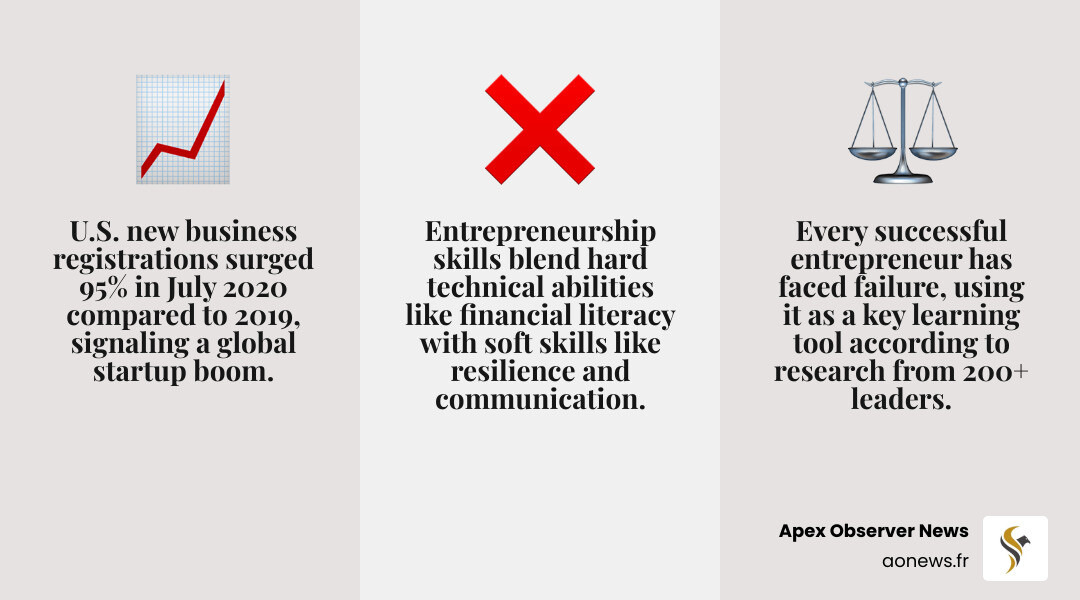
Starting a business has never been more common. U.S. new business registrations in July 2020 were 95% higher than the same period in 2019 — and similar surges were recorded in Japan and across Europe. More people than ever are taking the leap.
But having a great idea isn’t enough. The entrepreneurs who thrive are the ones who build the right skills — both the hard, practical ones like managing cash flow, and the soft ones like bouncing back from failure.
Research backed by interviews with over 200 leading entrepreneurs confirms one thing clearly: every single successful entrepreneur has experienced failure — and learned from it. The difference isn’t talent. It’s skills.
I’m Faisal S. Chughtai, founder of ActiveX, where I’ve worked hands-on with branding, digital marketing, web and app development, and business growth — all areas where entrepreneurship skills are tested daily. That real-world experience shapes everything in this guide.
Defining Essential Entrepreneurship Skills
When we talk about entrepreneurship skills, we are looking at a unique blend of professional expertise and personal character traits. Unlike traditional business roles where you might specialize in one area—like accounting or HR—an entrepreneur often starts as a “jack of all trades.”
At its core, these skills are divided into two main buckets: soft skills and hard skills. Soft skills are interpersonal and emotional, such as your ability to lead a team or stay calm when a shipment is late. Hard skills are technical, such as knowing how to read a balance sheet or set up a Facebook ad campaign.
What sets an entrepreneur apart from a traditional manager is risk tolerance and opportunity recognition. While a manager might focus on optimizing a process that already exists, an entrepreneur must find the “gap” in the market and create value where there was none before.
The data supports this shift toward self-employment. According to the U.S. Census Bureau data on business registrations, July 2020 saw a staggering 95% increase in new business applications compared to 2019. This post-pandemic business record suggests that more individuals are realizing that the traditional job market is changing, and developing entrepreneurship skills is the best way to secure their financial future.
The Core Categories of Entrepreneurial Competency
To master the art of starting a business, we need to look at the different categories of competency. We can’t just be “good with people” and expect to succeed if we don’t understand our bank account. Conversely, a mathematical genius might struggle if they can’t communicate their vision to investors.
| Feature | Hard Skills | Soft Skills |
|---|---|---|
| Definition | Teachable, measurable technical abilities. | Interpersonal, “people” skills. |
| Examples | Budgeting, Coding, Data Analysis. | Empathy, Resilience, Leadership. |
| How to Learn | Courses, books, certifications. | Experience, coaching, self-reflection. |
| Role in Business | The “engine” that runs operations. | The “oil” that keeps the engine smooth. |
One of the most critical foundations is financial literacy. This isn’t just about math; it’s about understanding the health of your venture. If you are looking at how to start ecommerce business in Pakistan, for example, you need to understand import costs, platform fees, and marketing spend before you ever make your first sale.
Practical Hard Skills for Mastering Entrepreneurship Skills
Hard skills are the tools in your belt. Without them, you’re just a person with a dream but no way to build it.
- Cash Flow Management: This is the heartbeat of your business. You need to track every dollar coming in and going out. Many businesses fail not because they aren’t profitable, but because they ran out of cash at the wrong moment.
- Profit and Loss (P&L) Tracking: Beyond daily cash, you must understand your overall margins. Are you actually making money after all expenses?
- Branding and Digital Marketing: If people can’t find you online, you don’t exist. This includes everything from storytelling and choosing the right color schemes to SEO and social media management.
- Sales Techniques: You are always selling—to customers, to potential employees, and to investors. Mastering the art of the “pitch” is non-negotiable.
- Technical Proficiency: Whether it’s using a CRM, managing a website, or understanding the latest AI tools, you need to be comfortable with technology.
If you are just starting out and looking for online business ideas or the best side hustle ideas, we recommend focusing on one hard skill first—like digital marketing—and building your business around that strength.
The Role of Soft Skills in Entrepreneurship Skills Mastery
While hard skills get you started, soft skills keep you going. They are often the “make or break” factor for long-term success.
- Communication and Active Listening: Great leaders don’t just talk; they listen. Gartner research on employee value shows that 82% of employees believe it is important for their organization to see them as a person, not just a worker. This requires high levels of empathy and active listening.
- Leadership and Team Collaboration: As you grow, you’ll need to delegate. You can’t do everything yourself. Understanding the role of Pakistani women in business and other diverse perspectives can help you build a more inclusive and effective team.
- Emotional Intelligence (EQ): This involves recognizing your own emotions and those of others. It helps in negotiation, resolving conflicts, and maintaining a positive company culture.
- Negotiation: Whether it’s a lease for an office or a contract with a supplier, you need to be able to fight for the best deal without burning bridges.
Strategies to Develop and Improve Your Abilities
The good news is that entrepreneurship skills are not entirely innate. While some people are naturally more outgoing or risk-tolerant, most of these abilities can be learned through deliberate practice and education.

1. Find a Mentor
Many successful entrepreneurs have navigated the same waters you are in now. A mentor provides a sense of connection and can help you avoid common pitfalls. They offer the “clarity” that only comes from experience.
2. Embrace a Growth Mindset
A growth mindset is the belief that your abilities can be developed through dedication and hard work. Instead of saying “I’m not good at sales,” you say “I haven’t mastered sales yet.” This perspective allows you to view challenges as opportunities to learn rather than as roadblocks.
3. Use Educational Resources
You don’t necessarily need an MBA, but structured learning helps. You can check out a HBS Online course flowchart to see which business fundamentals you might be missing. There are also many ways of online earning in Pakistan that allow you to “learn while you earn” by starting small freelance ventures.
4. Leverage Incubation and Networking
Don’t build in a vacuum. The benefits of incubation include access to office space, shared resources, and—most importantly—a community of peers. Networking isn’t just about handing out business cards; it’s about building genuine relationships that can lead to partnerships or funding.
5. Practice Public Speaking
Whether you are pitching to one person or a hundred, you need to speak with confidence. Practice your 30-second “elevator pitch” until it feels natural. Record yourself, watch it back, and adjust your tone and body language.
Overcoming Business Challenges with an Entrepreneurial Mindset
The path of entrepreneurship is rarely a straight line. It is filled with “pivot” moments and flat-out failures. The skill that separates the survivors from the rest is resilience.
Every successful entrepreneur we’ve studied talks about failure as a key learning experience. Take the story of Chobani yogurt. The founder bought a decaying, closed-down factory with a small loan and turned it into a $1 billion annual revenue business in just five years. He didn’t have a massive amount of cash; he had the vision to see a gap in the market and the resilience to fix a broken plant.
In our own backyard, the Applekid success story in Pakistan shows how local entrepreneurs are overcoming economic hurdles through innovation. Similarly, looking at the best innovative startups in Pakistan reveals a common thread: they all use pattern recognition to see trends before they become obvious.
The OODA Loop
To handle a crisis, many entrepreneurs use the OODA Loop:
- Observe: What is happening right now? (e.g., a sudden drop in sales).
- Orient: Why is it happening? (e.g., a new competitor or a technical bug).
- Decide: What is the best course of action?
- Act: Execute the decision quickly.
This framework allows for rapid decision-making in turbulent times. If you find yourself struggling, we have outlined specific steps for entrepreneurs in crisis and self-doubts to help you regain your footing.
Frequently Asked Questions about Entrepreneurship Skills
Are entrepreneurial skills innate or can they be learned?
This is the age-old “born vs. made” debate. While some people are born with a higher appetite for risk, the vast majority of entrepreneurship skills—like financial management, marketing, and even leadership—are learned through education and experience. Think of it like a muscle; the more you use these skills, the stronger they get.
What are the most critical skills for young entrepreneurs?
For those just starting out, we prioritize:
- Communication: Being able to explain your idea clearly.
- Financial Literacy: Knowing where your money is going.
- Adaptability: Being willing to change your plan when it isn’t working.
- Collaboration: Learning how to work with others even if you are a “solo-preneur.”
How do entrepreneurial skills differ from traditional management?
Traditional management often focuses on maintaining the status quo, managing existing resources, and minimizing risk within a stable environment. Entrepreneurial skills are focused on innovation, resource bootstrapping (doing more with less), and visionary leadership. An entrepreneur doesn’t just manage a budget; they often have to create the budget from thin air.
Conclusion
At Apex Observer News, we believe that the world is moving toward an “entrepreneurial economy.” Whether you are running a massive corporation or a small side hustle, having a solid grasp of entrepreneurship skills is your greatest asset. It allows you to be more than just an employee; it makes you a creator of value.
The journey isn’t easy—it requires constant strategic skill refinement and a thick skin. But the rewards, both financial and personal, are worth the effort. We encourage you to keep learning, keep networking, and most importantly, keep building.
Explore more business and entrepreneurship insights on our platform to stay ahead of the latest trends and success stories.
Top 10 Inspiring Entrepreneurs in Pakistan 2025
