


The Best Brokerage for Trading Penny Stocks: Quick Answer for 2025
Finding the best brokerage for trading penny stocks comes down to a few key factors: low or zero fees on OTC trades, reliable order execution, and access to the tools you need to trade smart.
Here are the top picks at a glance:
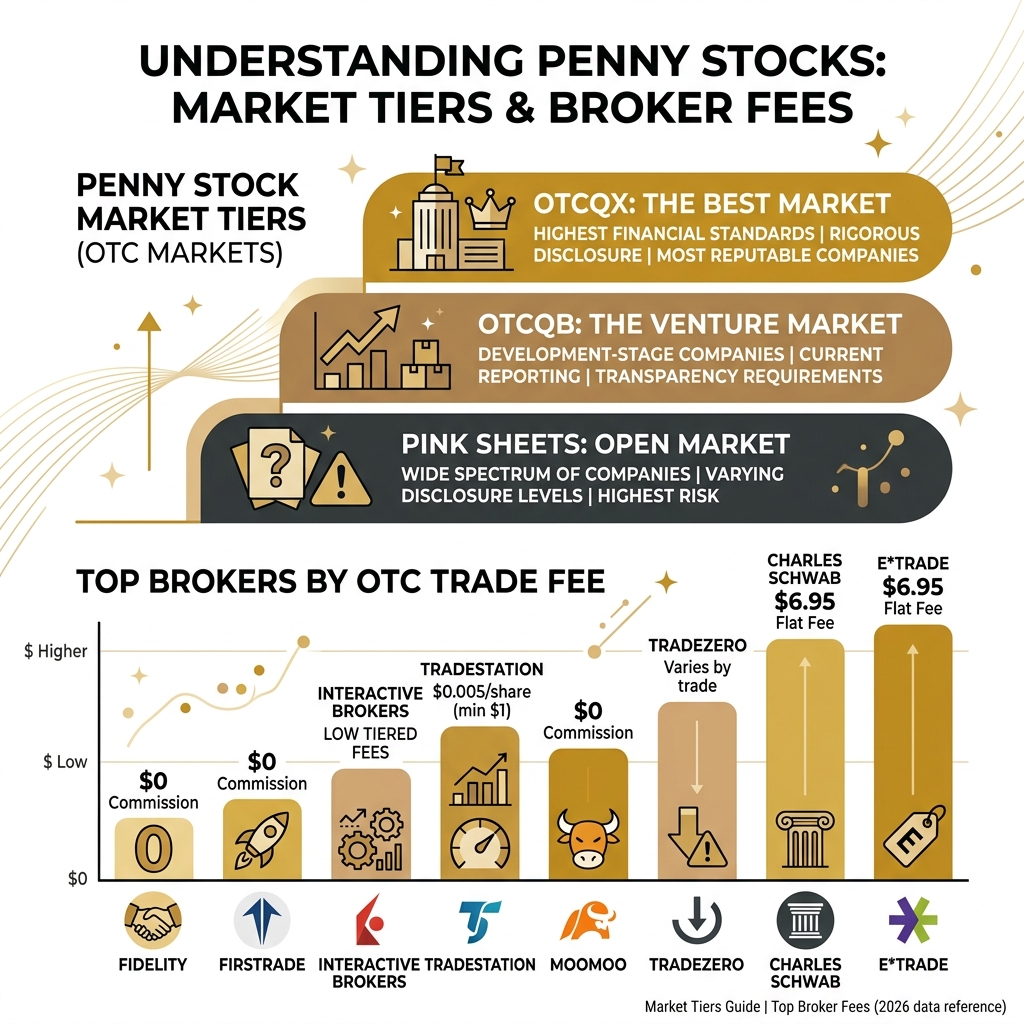
| Broker | OTC Trade Fee | Best For |
|---|---|---|
| Fidelity | $0 | Best overall, low costs, no PFOF |
| Firstrade | $0 | Commission-free OTC, beginner-friendly |
| Interactive Brokers | Low (tiered) | Advanced tools, risk management |
| TradeStation | $0.005/share (min $1) | Advanced traders, price improvement |
| Moomoo | $0 | Charting tools, mobile experience |
| TradeZero | Varies | Short selling, no PDT rule |
| Charles Schwab | $6.95 flat | Beginners, thinkorswim platform |
| E*TRADE | $6.95 flat | Ease of use |
Penny stocks are shares priced under $5 per share, as defined by the SEC. They mostly trade on OTC (over-the-counter) markets rather than major exchanges like the NYSE or Nasdaq. These are typically small or micro-cap companies — often early-stage businesses with little track record.
The appeal is obvious. Who wouldn’t want to buy in at ground-floor prices before a company takes off? Buying tens of thousands of shares at $0.10 or $0.25, then watching the price jump, sounds like a dream. But the risks are just as dramatic as the potential rewards — and the broker you choose can make or break your experience.
I’m Faisal S. Chughtai, founder of ActiveX, with hands-on experience in digital platforms, fintech tools, and evaluating the best brokerage for trading penny stocks for active retail traders. In this guide, I’ve broken down the top brokers so you can cut through the noise and trade with confidence.
Best brokerage for trading penny stocks glossary:
Defining Penny Stocks and Market Risks
Before we dive into our list of the best brokerage for trading penny stocks, we need to have a serious chat about what you’re actually buying. While the SEC technically defines a penny stock as any security trading under $5, many traders colloquially refer to stocks trading under $1 as the “true” penny stocks. These companies are often micro-cap or nano-cap firms that don’t meet the stringent listing requirements of the NYSE or Nasdaq.
Instead, they live on the OTC Markets. This is a decentralized market where dealers trade directly with one another. It is divided into three main tiers:
- OTCQX: The “Best Market” with the highest financial standards.
- OTCQB: The “Venture Market” for early-stage companies.
- Pink Sheets: The “Open Market” where transparency is often… well, let’s just say “optional.”
The Danger Zone: Why Caution is Key
Trading here isn’t like buying Apple or Microsoft. The risks are real, and they can eat your capital faster than a hungry goat in a vegetable patch.
- Liquidity Constraints: You might buy 50,000 shares of a company only to find there’s no one willing to buy them back when you want to sell. This is known as “low liquidity.”
- Transparency Issues: Unlike major corporations, many OTC companies don’t have to file audited financial statements. You’re often flying blind.
- Pump-and-Dump Schemes: We’ve all seen the “hot stock tips” in shady discord groups or spam emails. These are often orchestrated schemes where promoters inflate a stock’s price only to dump their shares on unsuspecting retail investors.
- High Volatility and Bid-Ask Spreads: The difference between the buy price and the sell price (the spread) can be massive. If a stock is trading at $0.10 (bid) and $0.15 (ask), you are essentially down 33% the moment you click “buy.”
Because of these risks, top-tier brokers like Fidelity require you to sign a specific risk acknowledgment before you can even place an order. It’s their way of saying, “Are you sure you want to do this?” For a deeper dive into how markets function, check out our cheat sheet to brokerage and trading.

Top Picks for the Best Brokerage for Trading Penny Stocks
Selecting the best brokerage for trading penny stocks means looking at execution quality and fees. If you’re buying 10,000 shares, a “per-share” fee can destroy your profits, while a flat fee might be better. Here are our top recommendations for 2025 and 2026.
1. Fidelity: The Low-Cost King
Fidelity is widely considered the best brokerage for trading penny stocks for most investors. Why? Because they offer $0 commissions on domestic OTC stocks. Most other big names like Schwab or E*TRADE charge $6.95 per trade.
Furthermore, Fidelity does not accept Payment for Order Flow (PFOF) for equity trades. This means they prioritize getting you the best possible price. In 2024, Fidelity reported that 96.02% of shares were price-improved, with an average execution speed of just 0.04 seconds.
2. Interactive Brokers (IBKR): The Professional’s Choice
If you are an active day trader, Interactive Brokers is hard to beat. They offer the Risk Navigator tool, which is specifically designed to monitor high-risk positions like penny stocks in real-time. While their interface can be a bit intimidating for beginners, their execution quality is legendary. As of late 2024, their total trading cost was a mere 4.1 basis points.
3. TradeStation: Best for Price Improvement
TradeStation is another powerhouse for those who need speed. They delivered over $32.6M in price improvements for their traders in 2023. Their per-share pricing ($0.005/share) is great for smaller orders, though high-volume penny traders should watch the math to ensure it doesn’t exceed flat-fee alternatives. If you’re just starting out, read the ultimate guide to picking your first stock market broker.
4. Firstrade: The Hidden Gem
Firstrade is a fantastic choice for those who want a simple, $0-commission experience. They offer full support for OTC markets and even provide a completely translated platform for Chinese-speaking investors. They also recently introduced FirstradeGPT, an AI tool to help with research.
5. TradeZero: The Short-Seller’s Paradise
Most brokers make it nearly impossible to “short” (bet against) a penny stock. TradeZero is the exception. They offer a patented short locator and, most importantly, no PDT (Pattern Day Trader) rule for certain account types, allowing you to trade as much as you want even with a smaller balance.
6. Moomoo: Best for Mobile Charting
Moomoo has quickly become a favorite for younger traders. Their mobile app is packed with professional-grade tools, including Level 2 quotes and 100+ technical indicators. They offer $0 commissions on stocks and ETFs, making them a strong contender for the title of best brokerage for trading penny stocks for mobile users.
Top best brokerage for trading penny stocks for OTC Access
Not all brokers give you the same “menu.” Some only allow you to trade stocks on the OTCQX tier, while others give you access to the wild west of the Pink Sheets.
- Fidelity and Firstrade offer broad access to most domestic OTC stocks with $0 fees.
- Charles Schwab provides access but charges a $6.95 flat fee, which can be steep for small positions.
- Interactive Brokers provides global access, which is vital if you are looking at international penny stocks (like those on the London Stock Exchange).
Before you commit, ensure your chosen platform doesn’t have “default restrictions” that require you to call a broker to place a trade, as this often incurs a “broker-assisted” fee of $25 or more. For more on platform variety, see everything you need to know about best trading platform.
Advanced Tools for Penny Stock Traders
When trading volatile stocks, information is your only shield. The best brokerage for trading penny stocks should provide:
- Level 2 Quotes: This shows you the “order book”—exactly how many people are waiting to buy and sell at various prices.
- Real-Time Scanners: Tools like Moomoo’s scanner or TradeZero’s ProScanner help you find stocks that are “breaking out” in real-time.
- TradingView Integration: Many traders prefer TradingView’s charts; brokers like Moomoo and TradeZero integrate these directly.
How to Choose the best brokerage for trading penny stocks Based on Fees
Fees are the silent killers of a penny stock portfolio. If you buy $100 worth of a stock and your broker charges a $6.95 commission, you are already down nearly 7% before the stock even moves.
Commission Structures Explained
- Commission-Free ($0): Brokers like Fidelity, Firstrade, and Moomoo are the gold standard here. They allow you to trade without a per-transaction cost. This is essential for “scaling” into or out of positions.
- Flat-Fee: Schwab and E*TRADE charge a flat $6.95. This is fine if you are buying $5,000 worth of a stock, but it’s terrible for small-time “spec” trades.
- Per-Share: TradeStation and Interactive Brokers often use this. For example, $0.005 per share. If you buy 10,000 shares of a $0.10 stock, that’s a $50 fee! Always check if there is a “cap” on per-share fees (usually 0.5% to 1% of the trade value).
Hidden Costs to Watch
- Activity Assessment Fees (TAF): These are tiny regulatory fees (usually a few cents) that all brokers pass on to you.
- Inactivity Fees: Some pro-level brokers charge you if you don’t trade at least once a month.
- Margin Rates: If you borrow money to trade, the interest rate matters. Moomoo and Interactive Brokers currently offer some of the most competitive margin rates in the industry.
To keep more of your money, read our guide on online free stock trading and explore the zero-commission dream.
Frequently Asked Questions about Penny Stock Trading
What is the best brokerage for trading penny stocks for beginners?
For beginners, Fidelity and Charles Schwab are the top choices. Fidelity wins on price ($0 OTC fees), while Schwab’s thinkorswim platform is world-class for learning. Both offer extensive educational libraries and “paper trading” (virtual trading) so you can practice without losing real money.
Can you trade penny stocks on mobile apps?
Absolutely. In fact, apps like Moomoo and Robinhood are designed specifically for mobile-first users. Moomoo is generally better for penny stocks because it offers more advanced charting and better OTC access than Robinhood.
Are OTC stocks the same as penny stocks?
Not exactly, but there is a massive overlap. “Penny stock” refers to the price (under $5), while “OTC” refers to where it is traded (not on a major exchange). You can find penny stocks on the Nasdaq (like struggling tech companies), and you can occasionally find higher-priced stocks on the OTCQX. However, the majority of penny stocks are traded over-the-counter.
Conclusion
At Apex Observer News, we believe that while penny stocks offer the allure of “get rich quick” returns, they require a “work hard” mentality to navigate safely. Choosing the best brokerage for trading penny stocks is your first and most important trade.
If you want the lowest possible costs, Fidelity is your best bet. If you need high-octane tools and short-selling capabilities, TradeZero or Interactive Brokers will serve you better. Regardless of your choice, always remember the golden rule of speculative trading: Never invest money you aren’t prepared to lose entirely.
For the latest updates on market shifts and economic trends, stay tuned to our stock market news and trends section. Happy trading!
