

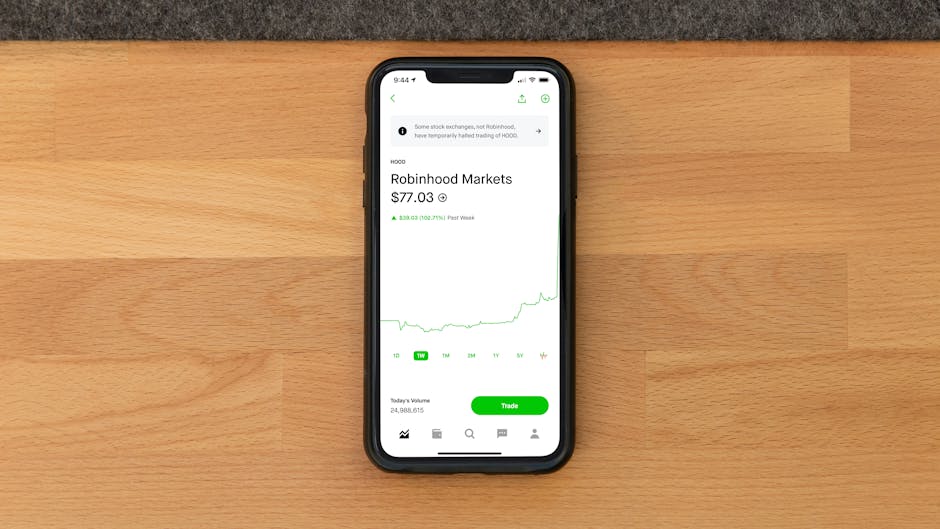
How Robinhood Commission Free Trading Stacks Up in 2026
Robinhood commission free trading changed the investing world forever — and if you want the short version, here it is:
Quick Answer: What You Need to Know
- No commissions on stocks, ETFs, and options trades
- No account minimum — start with as little as $1
- Revenue comes from payment for order flow (PFOF), Robinhood Gold subscriptions, and margin lending — not your trade fees
- Hidden costs exist: regulatory fees, a $100 outbound transfer fee, and a 1.75% instant withdrawal fee
- Best for: self-directed, active traders comfortable making their own decisions
- Not ideal for: hands-off investors who want managed portfolios or mutual funds
Before 2015, placing a single stock trade cost the average investor between $5 and $10 in commissions — with account minimums often sitting at $500 or more. For a 25-year-old with $200 to invest, diversifying across five stocks meant losing 25% of their money just in fees before a single share moved. Robinhood flipped that model on its head, and by 2019, every major broker in the United States had followed suit and dropped commissions entirely. Today, Robinhood serves over 25.5 million users — with nearly half of all new U.S. brokerage accounts between 2016 and 2020 opened on its platform.
But is it truly free? And is it the right platform for you? That’s exactly what this review digs into.
I’m Faisal S. Chughtai, founder of ActiveX and a digital finance technology strategist with hands-on experience analyzing platforms built around robinhood commission free trading and the fintech models that power them. In the sections ahead, I’ll break down every layer of how Robinhood works — from the fees you don’t see to the features worth paying for.
Basic robinhood commission free trading terms:
The Evolution of Robinhood Commission Free Trading
The story of robinhood commission free trading isn’t just about an app; it’s about a total industry disruption. Before Robinhood arrived, the “gatekeepers” of Wall Street kept wealth-building tools out of reach for many. High commissions and steep account minimums acted as a barrier to entry. We saw a massive shift between 2016 and 2022, where adults aged 35 and under went from being the least likely cohort to own a brokerage account to the most likely—a trend largely driven by Robinhood’s accessibility.

By offering zero account minimums, Robinhood allowed anyone to start trading and investing with just a few dollars. This “democratization” of finance was further fueled by the introduction of fractional shares, meaning you could buy $5 worth of a $3,000 stock. Furthermore, the platform expanded its hours, offering 24/5 market access for certain stocks and ETFs, allowing users to trade from Sunday evening through Friday evening. This mobile-first design made the stock market feel less like a stuffy boardroom and more like a modern tool for everyday life. For a deeper look at this movement, check out the zero-commission dream: a guide to free stock trading.
Understanding Payment for Order Flow in Robinhood Commission Free Trading
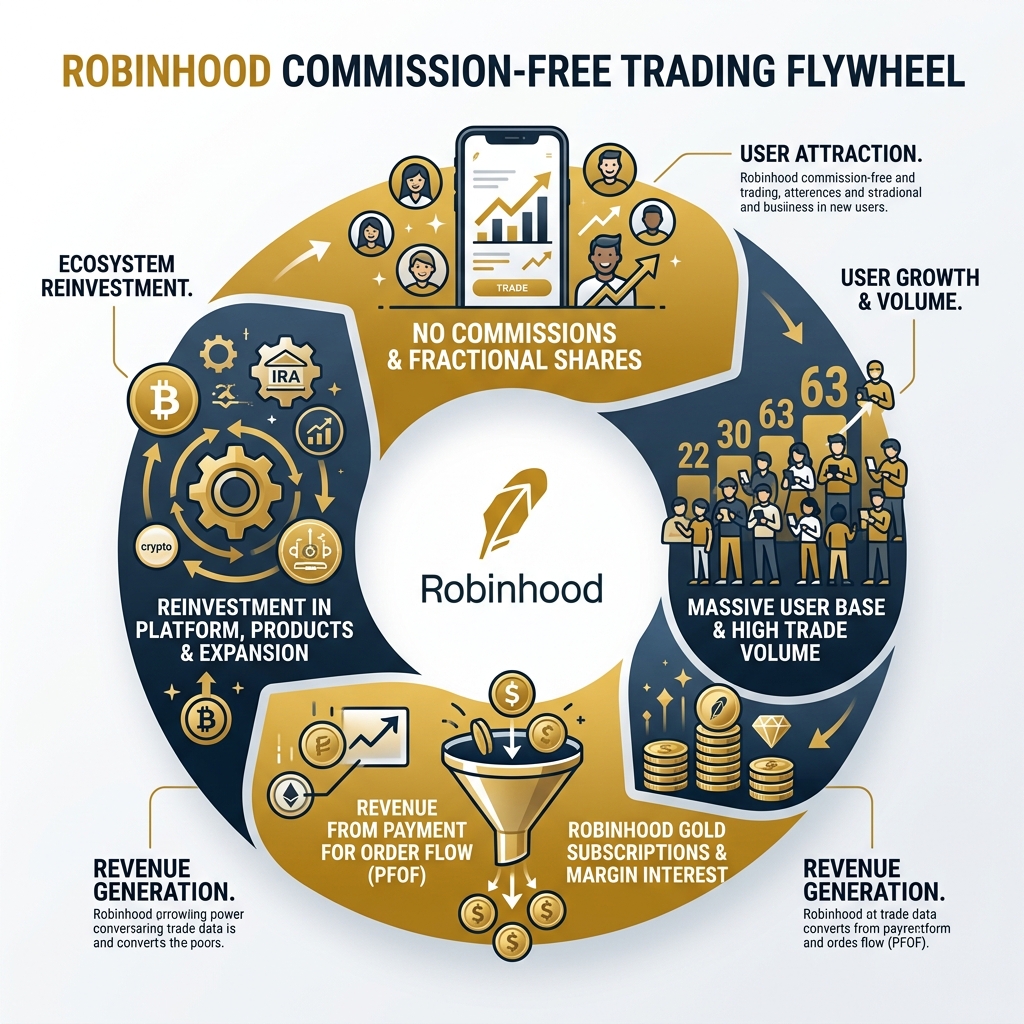
If you aren’t paying a commission, how does the broker stay in business? The answer for most robinhood commission free trading platforms is Payment for Order Flow (PFOF). When you place a trade, Robinhood doesn’t send it directly to the New York Stock Exchange. Instead, they route it to “market makers”—large financial firms like Citadel Securities or Susquehanna. These firms pay Robinhood a small fee for the right to execute your trade.
In Q2 2020 alone, Robinhood made $271.2 million from PFOF. While this keeps your commissions at zero, it has sparked debate over execution quality. Critics argue that brokers might prioritize the market maker who pays the most rather than the one providing the best price for the user. However, the SEC regulates these practices under Regulation NMS to ensure “best execution.” For many retail investors, the online free stock trading benefits of zero commissions far outweigh the tiny fractions of a cent lost in price improvement.
Educational Resources for New Investors
We know that giving a powerful tool to a beginner without instructions can be risky. To combat this, Robinhood has built a robust suite of “investing basics” resources. From their online library of articles to the daily “Robinhood Snacks” newsletter, they aim to improve financial literacy. These tools cover everything from understanding market volatility to reading technical indicators like Moving Averages (MA) and the Relative Strength Index (RSI). For those just starting, we recommend spending time in these sections to understand risk management before diving into complex trades.
How the Platform Monetizes Without Commissions
Beyond PFOF, Robinhood has several other ways to keep the lights on. One primary method is “net interest margin.” They earn interest on the uninvested cash sitting in your account. They also participate in “stock lending,” where they lend out the shares held in your account to other institutions (often for short selling) and keep the interest.
Another significant revenue stream is “rehypothecation.” In margin accounts, Robinhood can use your securities as collateral for their own bank loans. While this is standard industry practice, it’s a reason some conservative investors prefer cash accounts. You can find the full details of these practices in the Fee Schedule Robinhood. If you’re looking for a broader comparison of how different firms handle these fees, our guide on how to find the best low commission stock broker is a great place to start.
Maximizing Value with Robinhood Gold
For $5 a month, users can upgrade to Robinhood Gold. This subscription service is growing rapidly, with 3.5 million subscribers as of 2026. The value proposition is strong:
- 5% APY on uninvested cash (enrolled in the sweep program).
- 3% IRA Match on eligible contributions.
- Professional Research from Morningstar.
- Level 2 Market Data from Nasdaq.
- Bigger Instant Deposits (up to $50,000).
- Lower Margin Rates: Currently between 5.7% and 6.75%, with the first $1,000 of margin interest-free.
Hidden Costs and Regulatory Fees to Watch Out For
While robinhood commission free trading eliminates the “per-trade” fee, it doesn’t eliminate government-mandated fees. These are passed through directly to the user.
| Fee Type | Cost | Who Charges It? |
|---|---|---|
| Regulatory Transaction Fee (SEC) | $27.80 per $1M of principal (Sells only) | SEC |
| Trading Activity Fee (TAF) | $0.000166 per share (Sells only); Max $8.30 | FINRA |
| Options Regulatory Fee | Approx. $0.03 – $0.05 per contract | Options Exchanges |
| Outbound Account Transfer | $100 | Robinhood |
| Instant Withdrawal | 1.75% of amount | Robinhood |
| ADR Custodial Fee | $0.01 – $0.03 per share | Issuing Bank |
It is crucial to review the trading fees on Robinhood page regularly, as these regulatory rates change frequently. For example, the SEC fee is currently $0 as of May 2026 until a new rate is published.
Risks and Rewards of Robinhood Commission Free Trading
The “gamification” of the app has been a point of contention. The ease of use can lead to impulsive decisions, especially for beginners. The 24-hour market and instant deposits can make the stock market feel like a 24/7 casino if not approached with a strategy. We always suggest that new users read the ultimate guide to picking your first stock market broker to ensure they are choosing a platform that fits their long-term goals.
Margin trading and options are the highest-risk areas. Margin allows you to borrow money to buy more stock, which can amplify gains but also lead to “margin calls” where you lose more than your initial investment. Options trading is even more complex; before starting, it is legally required to read the Options Disclosure Document.
Investment Options and Account Security
Robinhood has expanded far beyond just “popular” stocks. Today, users have access to:
- 5,000+ Stocks and ETFs: Including most major U.S. listed companies.
- Options Trading: Commission-free (minus regulatory fees).
- Robinhood Crypto: Access to over 45 assets including BTC, ETH, SOL, and DOGE. Robinhood Crypto is a separate entity and is not covered by SIPC or FDIC insurance.
- Retirement Accounts: Traditional and Roth IRAs with a 1% or 3% (Gold) match.
Security is a top priority for us when reviewing any platform. Robinhood uses multi-factor authentication (2FA) and data encryption. They also offer a “Robinhood Protection Guarantee,” which protects users against unauthorized activity that isn’t their fault. Brokerage accounts are members of the SIPC, which protects securities customers of its members up to $500,000 (including $250,000 for claims for cash).
Frequently Asked Questions about Robinhood
Is Robinhood actually free to use for all trades?
For stocks, ETFs, and options, there are no base commission fees. However, you will still pay regulatory fees (SEC and TAF) on sell orders. These are usually just pennies for the average retail trade. Crypto trading is also commission-free, but Robinhood earns money on the “spread”—the difference between the buy and sell price.
How does Robinhood protect my investment account and data?
Robinhood employs industry-standard security measures, including 2FA, BCrypt hashing for passwords, and encryption for sensitive data. Your brokerage assets are protected by SIPC insurance up to $500,000 in the event of the firm’s failure, though this does not protect against market losses or cryptocurrency volatility.
What are the main differences between a standard account and Robinhood Gold?
A standard account is free and offers basic robinhood commission free trading. Robinhood Gold costs $5/month and adds 5% APY on cash, a 3% IRA match, professional research, Level 2 data, and lower margin interest rates. For active traders or those with significant uninvested cash, the $5 fee usually pays for itself quickly.
Conclusion
At Apex Observer News, we’ve watched Robinhood grow from a 500,000-person waitlist to a powerhouse with over $279 billion in Assets Under Management (AUM). Our final verdict is that robinhood commission free trading is an excellent tool for the self-directed investor who values a clean interface and low costs. While it lacks the deep fundamental research tools or mutual fund access found at traditional brokers, its “flywheel” of low barriers to entry and innovative features like the IRA match make it a formidable choice for the modern era.
Whether you’re looking for the latest stock market news or trying to decide if you should move your portfolio, Robinhood remains the benchmark for the “commission-free” revolution. Just remember: in investing, “free” doesn’t mean “risk-free.” Trade wisely.
