


Ripple XRP SEC Lawsuit: The Final Legal Outcome
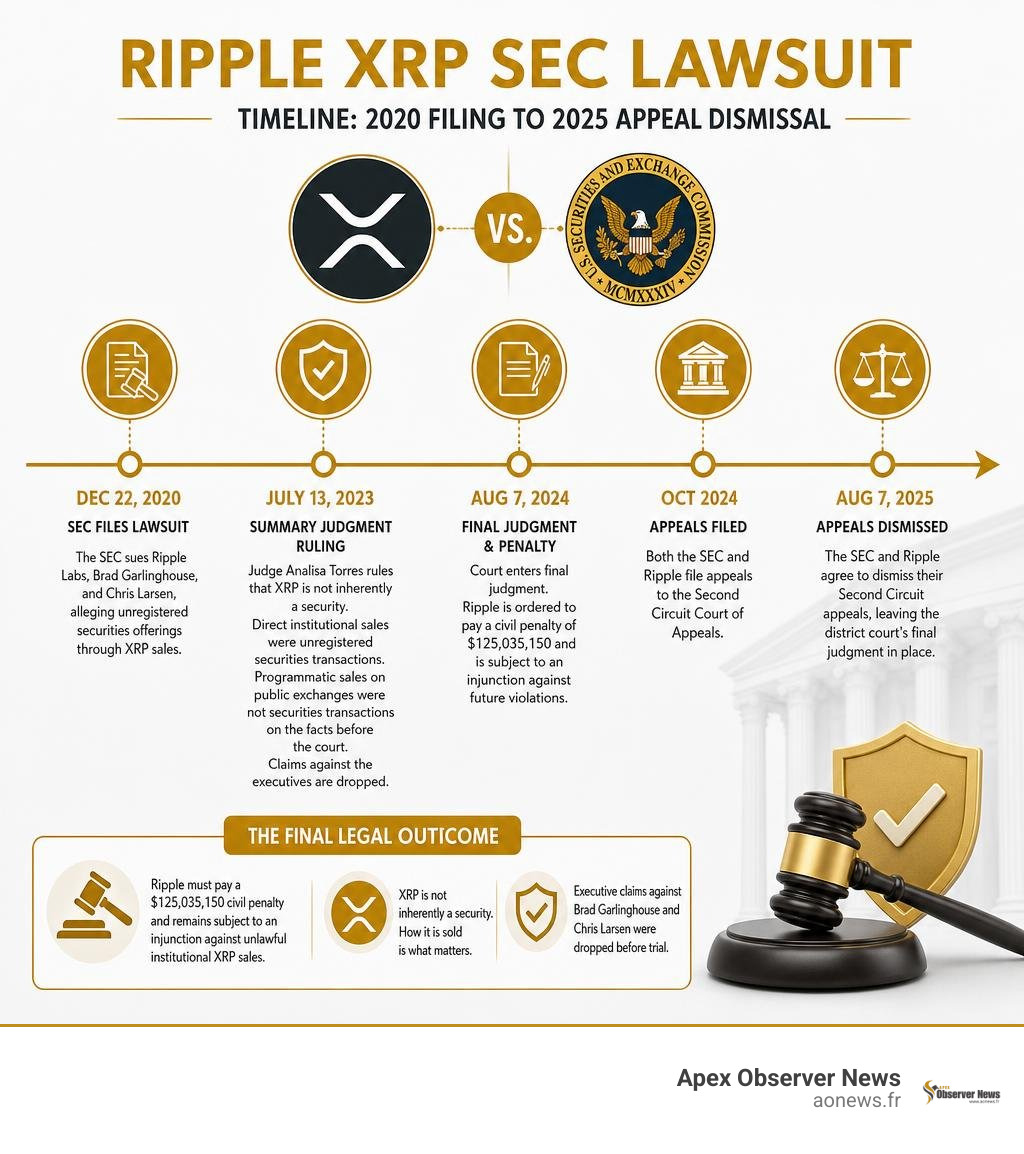
The Ripple XRP SEC lawsuit is over. In August 2025, the SEC and Ripple agreed to dismiss their Second Circuit appeals, leaving the district court’s final judgment in place: Ripple must pay a $125,035,150 civil penalty and remains subject to an injunction against unlawful institutional XRP sales.
The result was a split legal outcome. Judge Analisa Torres found that XRP is not inherently a security. But the way it is sold matters:
- Direct institutional XRP sales were unregistered securities transactions.
- Programmatic sales on public crypto exchanges were not ruled securities transactions on the facts before the court.
- The SEC’s claims against Ripple executives Brad Garlinghouse and Chris Larsen were dropped before trial.
This distinction matters far beyond XRP. It showed that U.S. securities law can apply to a token sale without automatically making every trade of that token a securities trade. It also leaves important questions for Congress, regulators, exchanges, and investors as crypto market-structure legislation, including the proposed CLARITY Act, develops.
I am Faisal S. Chughtai, founder of ActiveX, with experience in digital marketing, SEO, web technology, and blockchain-focused content. In this guide to the Ripple XRP SEC lawsuit, I break down the court outcome, what it changed, and what investors should watch next.
The Ripple XRP SEC Lawsuit: Origins, Charges, and Allegations
To understand how we arrived at this historic legal precedent in August 2026, we have to look back to December 2020. The U.S. Securities and Exchange Commission (SEC) launched a massive enforcement action in the U.S. District Court for the Southern District of New York against Ripple Labs, Inc., along with top executives Bradley Garlinghouse and Christian A. Larsen.

The agency alleged that Ripple raised over $1.38 billion by offering and selling more than 14.6 billion units of XRP without registering the distributions under Section 5 of the Securities Act of 1933. For those navigating The Ultimate Guide to Crypto, this lawsuit was viewed as an existential challenge to the entire digital asset ecosystem. The SEC’s fundamental thesis was straightforward: from its inception, XRP functioned as an investment contract, meaning every transaction—from institutional placements to secondary exchange trades—fell squarely within federal securities oversight.
The SEC’s Section 5 Claims Against Ripple, Garlinghouse, and Larsen
Under Section 5(a) and 5(c) of the Securities Act of 1933, offering or selling securities in interstate commerce without an effective registration statement or a statutory exemption is unlawful. The Commission alleged that Ripple financed its corporate operations and software development by continuously selling XRP into the market.
According to the official SEC First Amended Complaint, Ripple generated capital through two primary distribution tracks:
- Market Sales: Ripple sold at least 3.9 billion XRP through secondary exchanges for roughly $763 million between 2014 and late 2019.
- Institutional Sales: Ripple sold at least 4.9 billion XRP directly to institutional counterparties under written contracts, generating approximately $624 million through the third quarter of 2020.
The SEC also brought individual aiding and abetting claims against Christian Larsen and Bradley Garlinghouse. Regulators claimed the executives profited by roughly $600 million combined from their personal token sales—Garlinghouse selling over 321 million XRP for approximately $150 million, and Larsen (alongside his wife) netting at least $450 million from over 1.7 billion XRP.
Internal 2012 Legal Advice and Executive Knowledge
A central element of the SEC’s litigation rested on internal legal memoranda prepared for Ripple’s founders in February and October 2012 by international law firm Perkins Coie LLP. These memos warned that distributing XRP to investors presented a realistic legal risk of being classified as an investment contract under the landmark 1946 Supreme Court Howey test, especially if promoted as an asset that would increase in value through corporate efforts.
The Commission argued that leadership possessed early awareness of regulatory risks but proceeded anyway, creating an information asymmetry between the enterprise and public buyers. In response, Ripple mounted an aggressive defense, asserting that XRP functioned as a bridge currency for cross-border payments rather than a capital-raising equity vehicle. As we explore in Blockchain Unchained How Distributed Ledger Technology Is Transforming Industries, decentralized ledgers serve distinct technical utilities that do not always mirror traditional equity frameworks.
Landmark Judicial Rulings: Decoding Judge Torres’s Summary Judgment
On July 13, 2023, U.S. District Judge Analisa Torres issued a groundbreaking Summary Judgment Order that reshaped digital asset jurisprudence. Rather than issuing a blanket label, the court established that a digital token is not inherently a security on its face; instead, courts must evaluate the economic reality and totality of circumstances surrounding each distinct transaction.
For readers Decoding Cryptocurrency Beyond Bitcoin and the Future of Finance, Judge Torres’s analysis demonstrated that the Howey test must be applied to specific sales mechanisms rather than the underlying lines of code.

Institutional vs Programmatic Sales in the Ripple XRP SEC Lawsuit
Judge Torres segmented Ripple’s transactions into distinct legal buckets. The resulting decision produced a clear split victory:
| Transaction Category | Volume & Proceeds | Howey Analysis & Court Ruling | Final Securities Classification |
|---|---|---|---|
| Institutional Sales | 4.9B+ XRP (~$728.9M) | Sold pursuant to formal written contracts with sophisticated entities containing lockups and discounts; buyers expected profits from Ripple’s managerial efforts. | Unregistered Security Offering (Violated Section 5) |
| Programmatic Sales | 3.9B+ XRP (~$757.6M) | Algorithmic sales on public exchanges via blind bid/ask order books; buyers did not know who was selling and could not tie expectations to Ripple. | Non-Security Transaction (No Section 5 Violation) |
| Other Distributions | Token grants (~$609M value) | Distributed to employees, contractors, and third-party developers for services and ecosystem development; failed the “investment of money” prong. | Non-Security Transaction (No Section 5 Violation) |
The court highlighted that secondary market buyers on public exchanges purchased XRP in blind algorithmic transactions. Because these buyers had no direct contractual relationship with Ripple and often had no knowledge of whether they were purchasing tokens from Ripple or another trader, they could not possess a reasonable expectation of profit derived specifically from Ripple’s entrepreneurial efforts.
Rejection of Disgorgement and the $125 Million Civil Penalty
Following the summary judgment ruling, the SEC sought nearly $2 billion in remedies, including $876.3 million in disgorgement, $198.1 million in prejudgment interest, and an $876.3 million civil penalty. Ripple argued any penalty should not exceed $10 million, noting the company spent approximately $150 million on legal fees over four years defending the case.
In the SDNY Remedies and Final Judgment Order, Judge Torres rejected the SEC’s massive disgorgement demand. Citing the Second Circuit’s SEC v. Govil precedent and the Supreme Court’s Liu v. SEC, the court ruled that disgorgement requires proof that investors suffered measurable pecuniary harm. Because institutional purchasers received the digital assets they bargained for, disgorgement was inappropriate.
The court applied a Tier 1 civil penalty—reflecting that the litigation involved registration infractions rather than fraud or deceit—ordering Ripple to pay $125,035,150 alongside an injunction against future Section 5 violations.
Macro Regulatory Shifts and the Crypto Industry Landscape
The resolution of the litigation sent shockwaves across the United States digital asset industry. For years, regulatory enforcement had operated under ambiguous parameters. While consumer advocacy remains critical—a point examined in Why the Financial System Needs Safeguards After the Crypto Crash—market participants demanded bright-line legislative boundaries rather than regulation by enforcement.
How the Ripple XRP SEC Lawsuit Compares to the Terraform Labs Ruling
The legal standard established by Judge Torres did not go unchallenged. Just weeks after the Ripple summary judgment, U.S. District Judge Jed Rakoff issued an order in SEC v. Terraform Labs, explicitly declining to follow Judge Torres’s reasoning regarding programmatic sales.
Judge Rakoff held that secondary market purchasers could harbor the same profit expectations as institutional investors regardless of order-book blindness. This tension between Southern District of New York judges fueled anticipation for appellate review. However, when the SEC and Ripple entered into their joint stipulation of dismissal in August 2025, it left Judge Torres’s distinction intact as binding law for Ripple and an influential precedent across federal district courts.
The CLARITY Act and Future Asset Classifications
The legal distinction between direct institutional contracts and programmatic exchange trading has accelerated congressional momentum for comprehensive legislation. The proposed Digital Commodity Exchange Act and the CLARITY Act aim to codify these principles into federal statute.
Under the framework envisioned by the CLARITY Act:
- Digital tokens that maintain a decentralized network structure and functional utility are formally categorized as digital commodities under Commodity Futures Trading Commission (CFTC) oversight.
- Direct initial fundraising rounds with institutional covenants remain subject to SEC investor-protection rules.
- Secondary market exchange trading gains statutory immunity from retroactive securities litigation.
Market Performance, Spot ETFs, and XRP Price Trajectory in 2026
The legal clarity achieved by the dismissal of appeals cleared regulatory roadblocks that had previously constrained domestic institutional capital.

Following the resolution of the enforcement action, XRP’s market capitalization surged by more than $30 billion as major trading venues restored full liquidity.
Institutional Adoption and Spot XRP ETF Inflows
The formalization of XRP’s non-security status on secondary markets cleared the path for institutional financial vehicles. In 2025, seven U.S. spot XRP ETFs launched on major domestic exchanges, quickly attracting over $1.29 billion in cumulative net inflows. Institutional asset managers entered the market, with major global banking institutions, including Goldman Sachs, disclosing significant spot XRP ETF positions in quarterly institutional filings.
Furthermore, over $3.5 billion in tokenized real-world assets (RWAs) have been deployed across the XRP Ledger, reinforcing its core utility as an enterprise bridge mechanism for cross-border liquidity and On-Demand Liquidity (ODL) networks.
Whale Activity and Technical Price Catalysts
Despite substantial institutional inflows, XRP’s trading valuation has faced macroeconomic volatility. After reaching an interim high of $3.66 in mid-2025, XRP trades near $1.14 in August 2026, consolidating above key psychological support at $1.00.
Market analysts point to several competing market forces:
- Extended Domestic Business Development Stagnation: Ripple faced five years of domestic regulatory headwinds while non-U.S. fintech competitors expanded market share.
- On-Chain Whale Accumulation: Daily large-scale ledger transactions (transfers exceeding $1 million) have shown cyclical accumulation by long-term institutional custodians.
- Pending Legislative Triggers: Broad market forecasts indicate price targets ranging from $2.80 up to $6.53, largely conditional on whether federal market-structure bills pass through Congress before year-end.
Frequently Asked Questions About the Ripple Legal Outcome
Did Ripple win the legal battle against the SEC?
The resolution of the case represents a split victory where Ripple secured its most vital operational objective. As recorded in SEC Litigation Release No. 26369, the Second Circuit appeals were mutually dismissed in August 2025. Ripple successfully established that programmatic secondary sales on exchanges are not securities, and individual charges against its executives were dropped. However, the SEC secured a $125 million penalty and an injunction against future unregistered institutional sales.
Why did Judge Torres treat programmatic and institutional XRP sales differently?
The distinction centers on the third prong of the Howey test: the reasonable expectation of profits derived from the entrepreneurial efforts of others. Institutional buyers entered into formal, written purchase contracts directly with Ripple, receiving negotiated discounts and lockup agreements, making it clear their investment was tied to corporate performance. Conversely, programmatic buyers on public exchanges purchased tokens through blind bid-and-ask order books without knowing the seller’s identity, meaning they could not reasonably expect profits derived specifically from Ripple’s efforts.
What is the final financial penalty Ripple paid to conclude the case?
Ripple was ordered to pay a civil penalty of $125,035,150. The court denied the SEC’s original demand for over $876 million in disgorgement because the agency failed to demonstrate that institutional purchasers suffered measurable pecuniary harm.
Conclusion
The resolution of the four-year enforcement action marks a defining turning point in the history of American cryptocurrency regulation. By spending roughly $150 million in legal defense fees to challenge the Commission’s broad regulatory reach, Ripple established a critical legal boundary: standalone digital assets are not inherently investment contracts, and open-market exchange transactions cannot simply be lumped together with private institutional placements.
At Apex Observer News, we continue to monitor how these judicial precedents reshape global fintech markets, digital asset capital flows, and statutory legislation. As institutional spot ETFs attract billions and central banks evaluate cross-border settlement rails, XRP’s established regulatory status positions it among top global digital assets. To explore how major digital assets stack up against international market standards, review our comprehensive analysis on currency ranking in the world.
Shooting Outside Belleville Synagogue Leaves Officer and One Person Injured
