

Pakistan: The Essential Guide to the World’s 5th Most Populous Nation
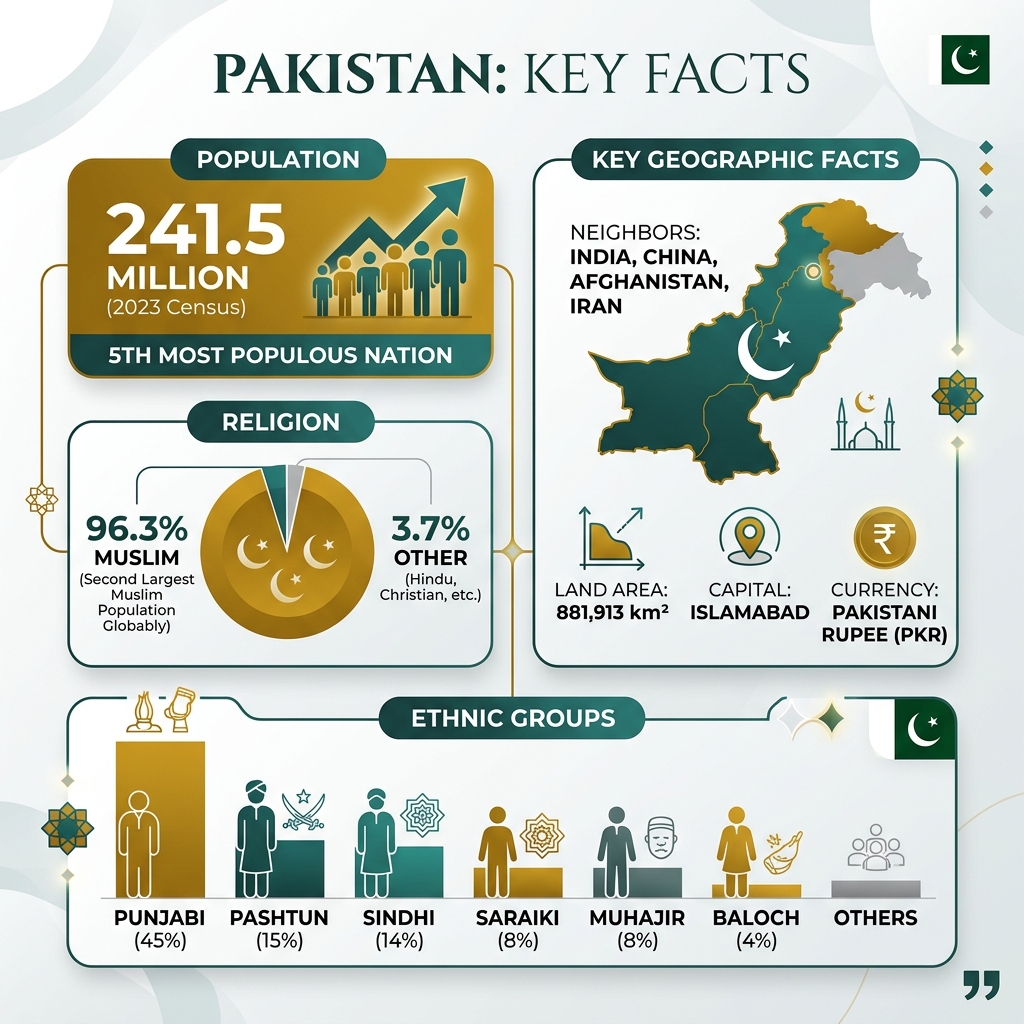
Pakistan is a South Asian nation of over 241.5 million people — making it the fifth most populous country on Earth and home to the second-largest Muslim population in the world.
Here are the key facts at a glance:
| Category | Details |
|---|---|
| Official Name | Islamic Republic of Pakistan |
| Population | 241.5 million (2023) |
| Capital | Islamabad |
| Area | 881,913 km² (33rd largest) |
| Religion | 96.3% Muslim |
| Languages | Urdu, English (official) + regional languages |
| Government | Federal Parliamentary Republic |
| President | Asif Ali Zardari (since March 10, 2024) |
| Prime Minister | Shehbaz Sharif |
| GDP (PPP) | $1.67 trillion (27th globally) |
| Currency | Pakistani Rupee (PKR) |
Pakistan sits at a crossroads — literally and figuratively. It borders India, Afghanistan, Iran, and China. It hosts ancient civilizations, nuclear capabilities, and one of the world’s fastest-growing ICT sectors. It also faces serious challenges: terrorism threats, economic pressure, climate vulnerability, and ongoing human rights concerns.
Whether you’re researching travel, business, history, or current events, this guide covers everything you need to know.
I’m Faisal S. Chughtai, founder of ActiveX — a digital branding, development, and marketing firm with deep roots in Pakistan’s tech landscape. My hands-on experience navigating Pakistan’s digital economy gives this guide a grounded, real-world perspective you won’t find in a standard textbook overview.
Must-know pakistan terms:
The Historical Journey of Pakistan: From Ancient Civilizations to Independence
To understand modern pakistan, we have to look back thousands of years. The land that makes up the country today was the cradle of one of the world’s earliest urban societies: the Indus Valley Civilization.
Ancient Roots and Empires
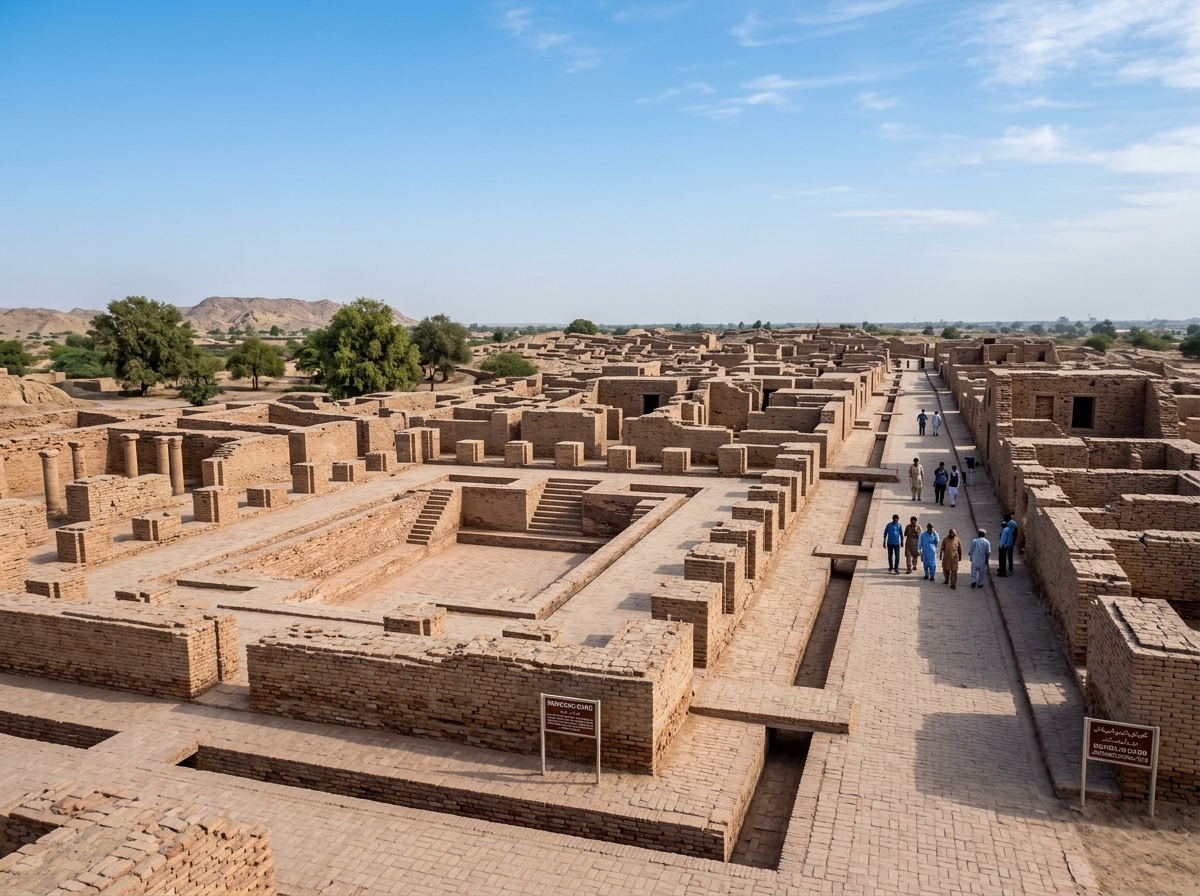
Around 2500 BCE, cities like Mohenjo-Daro and Harappa flourished along the Indus River. These ancient people were incredibly advanced, with planned streets and drainage systems that would put some modern neighborhoods to shame! Over the centuries, the region became a melting pot of cultures. It saw the arrival of the Aryans, the Greeks under Alexander the Great, and the spread of Buddhism and Hinduism.
By the medieval period, Islamic influence began to take hold, eventually culminating in the grand Mughal Empire. The Mughals left an indelible mark on the landscape, building architectural wonders like the Badshahi Mosque and the Lahore Fort.
The Road to Partition
In the 18th and 19th centuries, the British Raj gradually took control of the subcontinent. As the movement for independence grew in the early 20th century, so did the “Two-Nation Theory.” This idea suggested that Muslims and Hindus were two distinct nations that could not live peacefully within a single state.
The name “Pakistan” itself has a fascinating origin. It was coined in 1933 by a student named Choudhry Rahmat Ali. He created it as an acronym for the Muslim-majority regions: Punjab, Afghania (North-West Frontier), Kashmir, Sindh, and Baluchistan. In Persian and Urdu, the word “Pak” also means “pure,” making pakistan the “Land of the Pure.” You can explore more about the Wiktionary etymology of “Pakstan” to see how the name evolved.
Finally, on August 14, 1947, the British partitioned India, and pakistan was born. Muhammad Ali Jinnah, known as the Quaid-e-Azam (Great Leader), became the nation’s first Governor-General. The partition was a bittersweet victory; while it created a new homeland, it also triggered one of the largest and most violent mass migrations in human history, with millions of people crossing the new borders.
Governance, Diplomacy, and the Geopolitical Landscape
Today, pakistan is a federal parliamentary republic. This means power is shared between the central government in Islamabad and the four provinces: Punjab, Sindh, Khyber Pakhtunkhwa, and Balochistan.
Current Leadership
As of early 2024, the political landscape has seen significant shifts. Asif Ali Zardari was sworn in as the 14th President on March 10, 2024, becoming the first person to be elected to that office twice. While the President is the ceremonial head of state, the real executive power lies with the Prime Minister, currently Shehbaz Sharif.
A Nuclear Power in a Tense Region
We cannot talk about pakistan without mentioning its military. It boasts the 7th largest standing armed forces in the world. More importantly, it is the only Muslim-majority nation with nuclear weapons. This status makes it a critical player in global security, especially given the long-standing tensions with neighboring India. Both nations have fought multiple wars, primarily over the disputed territory of Kashmir.
In an era where people worry about world war 3 or ww3, Pakistan’s strategic location and military capabilities keep it at the center of international diplomacy.
Pakistan’s Role in Global Diplomacy
Pakistan is very active on the world stage. We see this through their work at the Permanent Mission of Pakistan to the UN and the frequent Official Foreign Office statements regarding regional stability.
The country maintains a complex relationship with the United States while fostering a deep “iron brotherhood” with China. It is also a member of the Shanghai Cooperation Organisation (SCO) and the Organisation of Islamic Cooperation (OIC).
One of the key pillars of Pakistani diplomacy is the Kashmir dispute. The country consistently calls for a plebiscite in the region under UN supervision. Beyond this, Pakistan often acts as a mediator in Middle Eastern conflicts, such as the rivalry between Saudi Arabia and Iran. You can follow their latest diplomatic moves on the Diplomatic Mission in New York social media pages.
Economic Outlook and Modern Infrastructure
Pakistan’s economy is a mix of traditional agriculture and a rapidly growing service sector. While it faces high inflation and debt, there are significant pockets of opportunity.
Economic Indicators
As of 2025 estimates, Pakistan’s GDP (PPP) stands at approximately $1.67 trillion, making it the 27th largest economy in the world by that metric. However, the nominal GDP is lower, at around $410.5 billion.
The State Bank of Pakistan works to manage the currency (the Rupee) and control inflation, which has been a major hurdle for the average citizen in recent years.
The Digital Leap: ICT and Freelancing
One of the most exciting developments we’ve seen is the explosion of the Information and Communication Technology (ICT) sector. Pakistan has become one of the top destinations for global freelancing. From software development to digital marketing, young Pakistanis are powering a gig economy and common gig jobs in pakistan that brings in vital foreign exchange.
Major global players are taking notice, too. For example, chromebook assembly line pakistan marks a historic tech leap for the country’s manufacturing capabilities.
Infrastructure and CPEC
The China-Pakistan Economic Corridor (CPEC) is a massive multibillion-dollar investment aimed at modernizing Pakistan’s infrastructure. This includes building highways, power plants, and the strategic Gwadar Port. While it has brought much-needed energy to the grid, it also adds to the country’s complex debt profile.
For those looking to enter the market, understanding how to start ecommerce business in pakistan or exploring it companies in pakistan can reveal a landscape full of untapped potential.
Security, Human Rights, and Travel Realities
We want to be honest: traveling to or living in pakistan requires a realistic understanding of the security and human rights environment.
Travel Advisories
Most Western governments, including the US State Department Travel Information, advise travelers to exercise a high degree of caution. There are specific “no-go” areas, particularly near the borders with Afghanistan and certain parts of Balochistan and Khyber Pakhtunkhwa, due to the risk of terrorism and kidnapping.
However, major cities like Islamabad, Lahore, and Karachi are generally more stable, provided you follow local advice and stay in secure areas like the Diplomatic Enclave.
Human Rights Concerns
The Human Rights Watch country analysis often highlights challenges regarding free speech and the protection of minorities.
- Blasphemy Laws: These are often criticized for being misused to settle personal scores or target religious minorities.
- Women’s Rights: While women hold high positions in government and business (see our piece on female entrepreneurs in pakistan), issues like “honor killings” and forced marriages persist in some rural areas.
- Free Press: Journalists often face pressure from both state and non-state actors, making it a challenging environment for media freedom.
Essential Health and Safety for Visiting Pakistan
If you are planning a visit, your health should be a priority.
- Vaccinations: Ensure your vaccination requirements are up to date. This includes routine shots plus protections against Hepatitis A risks and Typhoid.
- Polio: Pakistan is one of the last countries where polio is endemic. If you stay for more than four weeks, you may need proof of a polio vaccination to exit the country.
- Malaria and Dengue: Mosquito-borne illnesses are common. Use repellent and stay in screened or air-conditioned rooms.
- Air Quality: Major cities suffer from extreme smog, especially in winter. Check air pollution monitoring sites before heading out, as levels in Lahore can sometimes be the worst in the world.
Geography, Climate, and Cultural Norms
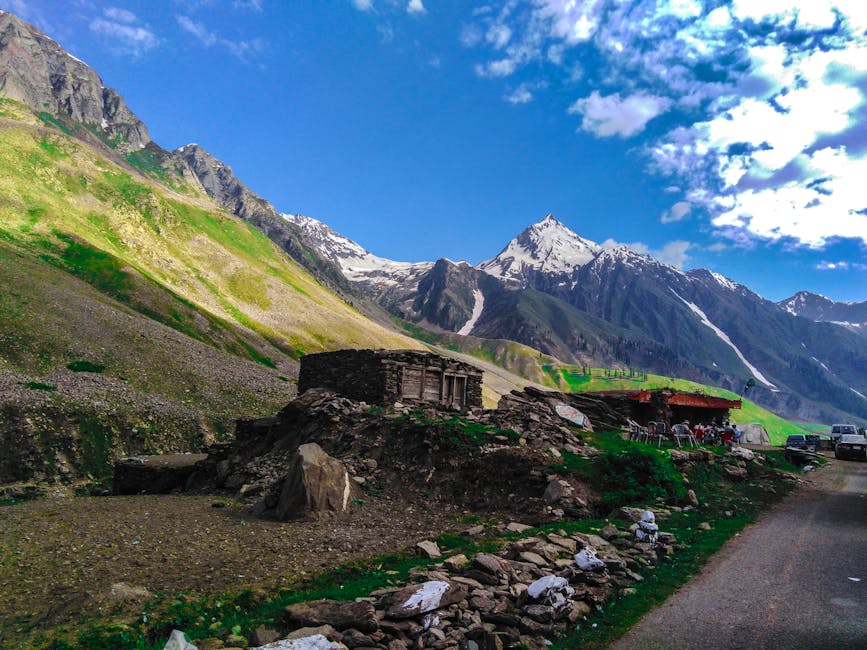
Pakistan’s geography is nothing short of spectacular. It contains five of the world’s fourteen “eight-thousand meter” peaks.
From the Peaks to the Coast
In the north, you’ll find the soaring Karakoram and Himalayan ranges, including the mighty K2.
The heart of the country is the Indus River plain, a fertile region that supports most of the population and agriculture. To the south, the landscape shifts to the rugged plateaus of Balochistan and finally the Arabian Sea coast.
Climate Change and Natural Disasters
Unfortunately, pakistan is one of the most climate-vulnerable nations. The Pakistan Meteorological Department monitors increasingly frequent extreme weather events. The 2022 floods were particularly devastating, submerging a third of the country and affecting 33 million people. This has sparked a global conversation about “climate justice” and the responsibility of wealthier nations toward those suffering most from global warming.
Navigating Cultural Norms
Pakistan is a conservative society, and we recommend respecting local customs to ensure a smooth experience.
- Dress Code: Modesty is key. Women should generally wear long tops and loose trousers (the shalwar kameez is the national dress and very comfortable!). In mosques, a headscarf is required.
- Alcohol: The sale and consumption of alcohol are prohibited for Muslims. Non-Muslims and foreigners can sometimes obtain it at high-end hotels, but it is not publicly available.
- LGBTQ+ Rights: Same-sex acts are technically illegal under colonial-era laws, and the community faces significant social stigma.
- Ramadan: During the holy month of fasting, it is illegal and culturally insensitive to eat or drink in public during daylight hours.
A Tapestry of People
Pakistan is incredibly diverse. The major ethnic groups include:
- Punjabis: The largest group, centered in the Punjab province.
- Pashtuns: Known for their distinct culture and presence in the northwest.
- Sindhis: With deep roots in the Indus Valley.
- Balochs: From the vast, resource-rich southwest.
- Muhajirs: Descendants of those who migrated from India during Partition.
Frequently Asked Questions about Pakistan
What is the current political leadership of Pakistan?
As of 2024, Asif Ali Zardari is the President, and Shehbaz Sharif is the Prime Minister. The country recently held general elections in February 2024, leading to a coalition government.
What are the major health risks for travelers in Pakistan?
The primary risks include food and water-borne diseases (Typhoid, Hepatitis A), mosquito-borne illnesses (Malaria, Dengue), and polio. Air pollution is also a significant concern in large cities like Lahore and Karachi during the winter months.
How does climate change affect Pakistan’s environment?
Pakistan faces melting glaciers in the north, which lead to “Glacial Lake Outburst Floods,” and increasingly erratic monsoon patterns that cause massive river flooding. Heatwaves are also becoming more frequent and intense, with temperatures in some cities exceeding 50°C (122°F).
Conclusion
Pakistan is a land of profound contrasts. It is a place where ancient history meets a digital future, and where breathtaking natural beauty exists alongside significant social and economic hurdles. While regional stability remains a concern, the resilience of its 241.5 million people and the rapid growth of sectors like ICT suggest a nation with immense untapped potential.
At Apex Observer News, we are committed to bringing you real-time updates on these global shifts. From geopolitical tensions to the latest tech breakthroughs in South Asia, we curate the news that matters most.
Whether you are looking for it jobs in islamabad or just want to stay informed about the beauty of lahore, the story of pakistan is one that continues to evolve every day. Keep following us for the latest headlines and deep dives into the world’s most dynamic regions.
