

Why Foreign Exchange Rate Fluctuations Matter to Everyone
Foreign exchange rate fluctuations are constant shifts in how much one currency is worth compared to another — and they affect far more than just traders and banks.
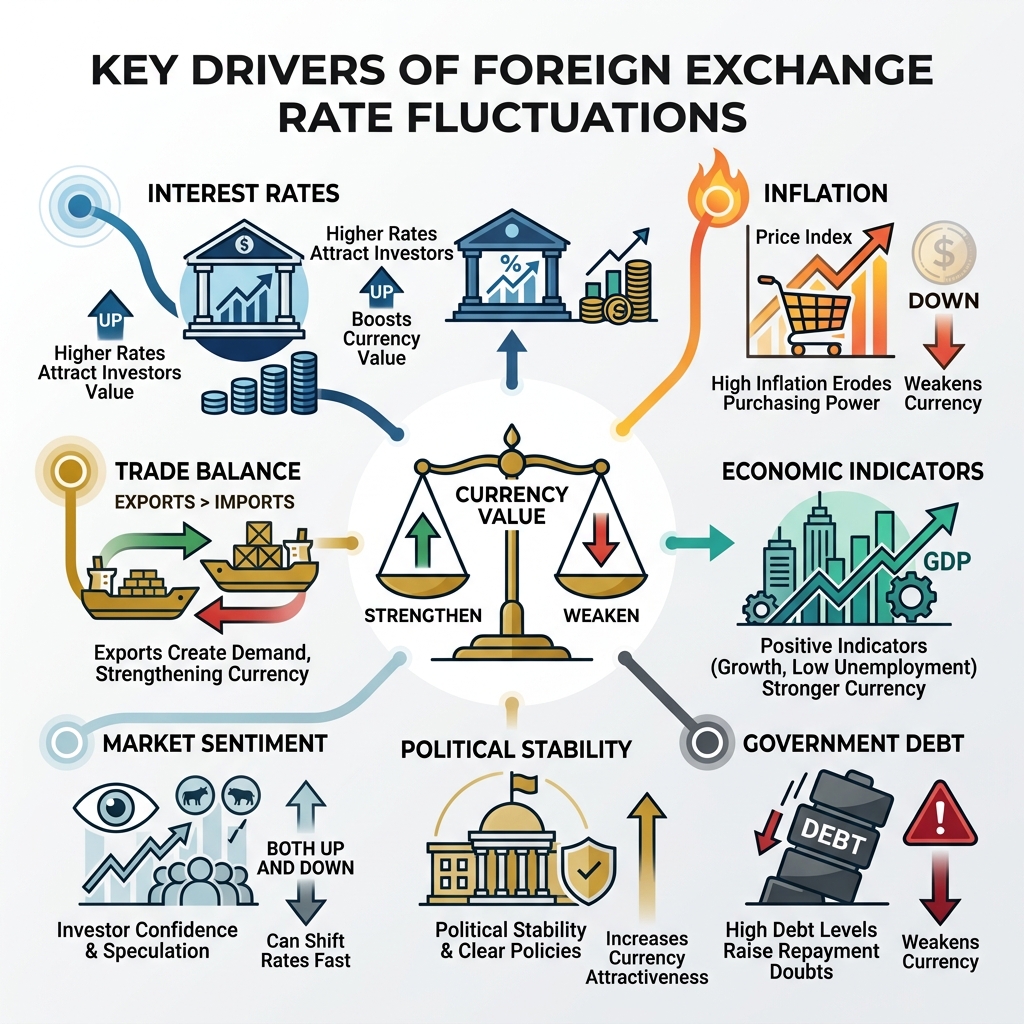
Here’s a quick breakdown of the main reasons exchange rates change:
- Interest rates — Higher rates attract foreign investors, boosting a currency’s value
- Inflation — High inflation erodes purchasing power, weakening a currency
- Trade balances — Countries that export more than they import tend to have stronger currencies
- Economic indicators — GDP growth, unemployment, and recession signals all move exchange rates
- Market sentiment and speculation — Investor confidence and speculative trading can shift rates fast
- Political stability — Elections, conflicts, and policy uncertainty create currency volatility
- Government debt — High debt levels raise doubts about repayment, putting pressure on a currency
The forex market is the largest financial market on the planet, with more than $6 trillion traded every single day. That means even small shifts in any of the factors above can ripple across the global economy — affecting the price of your imported gadgets, the cost of an overseas trip, and the bottom line of businesses operating across borders.
I’m Faisal S. Chughtai, a digital strategist and founder of ActiveX, with hands-on experience tracking how foreign exchange rate fluctuations impact international business, branding, and digital commerce across markets. In the sections ahead, I’ll walk you through exactly what moves exchange rates — and what it means for you.
Similar topics to foreign exchange rate fluctuations:
Understanding the Mechanics of Currency Pairs
To understand why foreign exchange rate fluctuations happen, we first need to look at how currencies are priced. In forex, currencies never stand alone; they travel in pairs.
The Anatomy of a Currency Pair
When you look at a quote like EUR/USD = 1.10, you are looking at a “base” currency (the Euro) and a “quote” currency (the US Dollar). This number tells us that 1 Euro is worth 1.10 US Dollars. If that number moves to 1.15, the Euro has strengthened (appreciated), and the Dollar has weakened (depreciated).
It sounds simple, but when you realize that the global forex market processes over $6 trillion in daily volume — and some recent estimates even push that toward $9.6 trillion — you can see how these tiny decimal movements add up to massive shifts in global wealth. You can explore more about these mechanics through FX trading and global economies.
Floating vs. Fixed Exchange Rates
Not all currencies play by the same rules. We generally categorize them into two systems:
- Floating Exchange Rates: Most major currencies (like the USD, EUR, and GBP) are “floating.” Their value is determined purely by supply and demand in the open market. If everyone wants Dollars to buy US tech stocks, the Dollar goes up.
- Fixed (Pegged) Exchange Rates: Some countries tie their currency’s value to another, more stable currency. For example, the Hong Kong dollar has been pegged to the US Dollar for nearly four decades, usually staying within a tight band of 7.75 to 7.85.
| Feature | Floating Exchange Rate | Fixed (Pegged) Exchange Rate |
|---|---|---|
| Determination | Market supply and demand | Government or Central Bank intervention |
| Volatility | High (changes by the second) | Low (stable by design) |
| Examples | USD, EUR, JPY, GBP | HKD, Saudi Riyal, many Caribbean currencies |
| Risk | Market risk | Devaluation risk if the peg breaks |

Primary Factors Driving Foreign Exchange Rate Fluctuations
Why does the market decide one currency is “better” than another today? It usually comes down to a handful of heavy-hitting economic forces. We like to think of these as the “levers” that central banks and markets pull.
Interest Rate Differentials
This is arguably the biggest driver of foreign exchange rate fluctuations. Think of it this way: if you have $10,000 to save, would you put it in a bank account paying 1% interest or 5% interest? Investors do the same thing on a global scale.
When a central bank raises interest rates, it offers a higher return to lenders. This attracts foreign capital, which causes the currency’s value to rise. A perfect example is the Japanese yen, which depreciated by roughly 24% against the dollar since 2021 because the Bank of Japan kept rates near zero while the US Fed hiked them aggressively. You can keep an eye on these pivotal moments by checking the US Federal Reserve monetary policy meeting dates 2025 and the Bank of England Monetary Policy Committee dates 2025.
Inflation Targets
Inflation is the silent killer of currency value. If a country has consistently high inflation, the purchasing power of its currency is eroding. Investors see this and start selling, leading to depreciation. Most major central banks, like the Bank of England, aim for a “sweet spot” of about 2% inflation to keep the economy stable without scaring off investors.
Trade Balances and Debt
A country’s “Current Account” is basically its report card for trade. If a country exports more than it imports (a trade surplus), there is high demand for its currency because foreign buyers need it to pay for those exports. Conversely, a large trade deficit can lead to foreign exchange rate fluctuations on the downside.
Government debt also plays a role. If a nation’s debt-to-GDP ratio sky-rockets — for instance, the US ratio grew from 64% at the start of the Global Financial Crisis to about 120% today — investors may worry about the risk of default or future inflation, which can weaken the currency.
Economic Indicators and Foreign Exchange Rate Fluctuations
Markets are obsessed with data. Every time a new report drops, exchange rates twitch. Here are the big ones we watch:
- GDP Growth: A strong, growing economy suggests healthy returns for investors, boosting the currency.
- Unemployment Rates: High unemployment often signals an economic slowdown, which might lead the central bank to cut interest rates (weakening the currency).
- Recession Signals: Technically defined as two consecutive quarters of negative GDP growth, a recession usually sends investors running for the exits.
Tracking these trends over time is vital for any business. For instance, looking at Historical USD/JPY exchange rate charts shows how decades of economic policy can create long-term trends in currency value.
Market Sentiment and Foreign Exchange Rate Fluctuations
Sometimes, the math doesn’t matter as much as the feeling. This is where speculation and “safe-haven” status come in.
- Speculation: If traders believe a currency will rise in the future, they buy it now. This demand can become a self-fulfilling prophecy, driving the price up.
- Safe-Havens: When the world feels like it’s falling apart (think wars or pandemics), investors flock to “safe” currencies like the US Dollar, the Swiss Franc, or the Japanese Yen. During the 2008-09 Global Financial Crisis, the US Dollar appreciated by 14.3% against major currencies simply because it was seen as the safest place to hide.
- The Convenience Yield: The US Dollar is special. Because it’s the world’s reserve currency, it has a “convenience yield”—people want it because they can use it almost anywhere for anything.
- The Carry Trade: This involves borrowing money in a currency with low interest rates (like the Yen) to invest in a currency with high rates. However, if the low-rate currency suddenly gets stronger, these trades can “unwind” spectacularly. We saw this in August 2024, when the Yen appreciated by 4% in just a few days, causing massive losses for global investors.
For a deeper look at how sentiment can trigger a total meltdown, the Asian Financial Crisis case study is a must-read.
How Currency Volatility Affects Global Business and Trade
If you’re a business owner, foreign exchange rate fluctuations aren’t just numbers on a screen; they are threats to your profit margins.
The Exporter’s Dilemma
Imagine you manufacture high-end headphones in the UK and sell them to a distributor in the US.
- If the Pound weakens: Your headphones become cheaper for Americans to buy. You might sell more units, and when you convert those US Dollars back into Pounds, you actually end up with more money than you expected.
- If the Pound strengthens: Your headphones suddenly become more expensive in the US. Your sales might drop, and your profit margin gets squeezed.
The Cost of Imports
On the flip side, a weak domestic currency is a nightmare for companies that rely on foreign parts. If your local currency drops by 20%, your imported raw materials could suddenly cost you 25% more. This often leads to “imported inflation,” where businesses have to raise prices for consumers just to stay afloat.
Investment and Tourism
Currency volatility also dictates where money flows. A stable currency attracts Foreign Direct Investment (FDI) because companies feel safe building factories and offices there.
Even your vacation is affected! A sudden swing in exchange rates can make a trip to Paris 15% more expensive before you even board the plane. This is why understanding exchange rate swings and intervention is crucial for both policymakers and travelers.
Strategies to Mitigate Foreign Exchange Risk
So, how do we stop these foreign exchange rate fluctuations from ruining our financial plans? We use a process called “hedging.” Think of it as an insurance policy for your money.
1. Forward Contracts
A forward contract allows you to “lock in” an exchange rate for a future date (often up to 12 months in advance). If you know you have to pay a German supplier €100,000 in six months, you can agree on the rate today. Even if the Euro skyrockets tomorrow, your price stays the same.
2. Limit Orders
Instead of watching the charts all day, you can set a “limit order.” You tell your broker, “If the rate hits 1.25, buy $50,000 for me.” This allows you to take advantage of favorable market moves while you sleep.
3. Currency Options
An option gives you the right, but not the obligation, to exchange money at a certain rate. It’s like a safety net. If the rate moves in your favor, you can ignore the option and use the market rate. If the rate moves against you, you use your option to protect yourself.
4. Diversification and Clauses
Smart businesses don’t put all their eggs in one currency basket. By operating in multiple regions, they can offset a loss in one currency with a gain in another. Additionally, many international contracts now include “currency clauses” that allow for price adjustments if the exchange rate moves by more than a certain percentage (e.g., 5%).
For a step-by-step guide on setting up these protections, we recommend reading how businesses can reduce foreign exchange risk.
Frequently Asked Questions about Currency Markets
Why do exchange rates change every day?
Because the forex market never sleeps! It is a 24-hour, decentralized marketplace. Every time a company buys oil, a tourist buys a souvenir, or a hedge fund manager makes a bet, the supply and demand for those currencies shift. Add in constant breaking news about inflation or politics, and you have a recipe for non-stop movement.
Is it better for a country to have a strong or weak currency?
There’s no “right” answer here — it depends on who you ask!
- A strong currency is great for consumers (cheaper imports and travel) and helps keep inflation low.
- A weak currency is a boon for exporters and the tourism industry, as it makes their goods and services more competitive on the global stage.
Sometimes, a currency that is too strong can actually hurt an economy by making its domestic industries non-competitive, leading to job losses.
How do central banks intervene in forex markets?
Central banks don’t just sit on their hands. If they feel foreign exchange rate fluctuations are becoming dangerous, they might:
- Use Foreign Reserves: They buy or sell their own currency in massive quantities to move the price.
- Adjust Interest Rates: As we discussed, moving rates is the most common way to influence currency demand.
- Market Signaling: Sometimes just hinting that they might intervene is enough to scare speculators and stabilize the rate.
You can find academic insights into how well these tactics actually work in this research on foreign currency intervention effectiveness.
Conclusion
Navigating foreign exchange rate fluctuations can feel like trying to predict the weather in the middle of a hurricane. However, by understanding the core drivers — interest rates, inflation, trade, and market sentiment — you can start to see the patterns in the chaos.
At Apex Observer News, we believe that staying informed is your best defense against market volatility. Whether you are a business owner trying to protect your margins or an investor looking for the next opportunity, we provide the real-time news aggregation you need to stay ahead of the curve.
From the latest shifts in the US Dollar to breaking news on global trade agreements, we curate the headlines that matter most to your wallet. Don’t let the market catch you off guard — stay tuned to our latest business and market headlines for your daily dose of financial clarity.
