

Why the Latest Green Energy Technology Is Changing Everything in 2025
The latest green energy technology is moving faster than most people realize — and 2025 is shaping up to be a turning point.
Here’s a quick snapshot of the top green energy innovations making waves right now:
| Technology | What It Does | Key Stat |
|---|---|---|
| Perovskite Solar Cells | Higher efficiency at lower cost than silicon | Over 25% efficiency today; tandem cells exceed 30% |
| Bifacial Solar Panels | Captures sunlight from both sides | Up to 30% more electricity than standard panels |
| Floating Solar (Floatovoltaics) | Solar panels on water surfaces | 20 TW potential from 10% of world’s reservoirs |
| Green Hydrogen | Clean fuel for industry and transport | 434 major projects funded between 2020-2024 |
| Solid-State & Sodium-Ion Batteries | Better, safer energy storage | Storage market growing at 9.5% annually |
| AI & Smart Grids | Optimizes power flow and predicts demand | Cuts waste and improves grid stability |
| Bladeless Wind Turbines | Urban-friendly wind energy | Oscillation-based, no rotating blades |
| Flexible & Transparent Solar | Solar built into windows, vehicles, devices | MIT cells generate 18x more power per kg |
| Carbon Capture (CCS/BECCS) | Removes CO2 from the atmosphere | Paired with renewables for net-zero goals |
| Blockchain Energy Management | Decentralized, transparent energy trading | Market growing at 71.1% CAGR through 2030 |
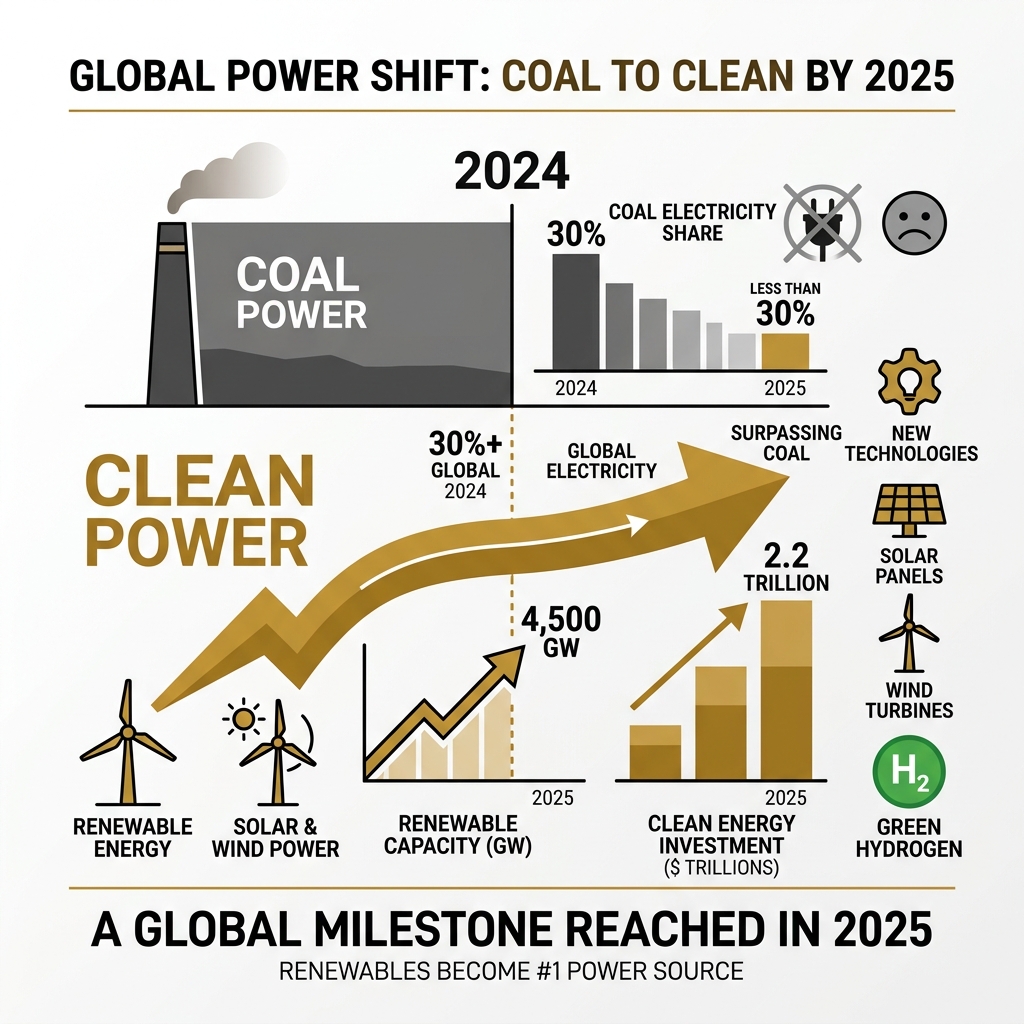
Renewables already powered over 30% of global electricity in 2024. By 2025, they’re expected to surpass coal as the world’s number one energy source — a milestone that would have seemed impossible just a decade ago.
The numbers behind this shift are staggering. Global clean energy investment is set to hit $2.2 trillion in 2025. Renewable capacity is on track to reach 4,500 GW — equivalent to the combined power output of China and the United States. And the world’s energy demand is still climbing, projected to more than double from 26,000 TWh in 2023 to 66,000 TWh by 2050.
That gap between what we need and what clean energy can deliver is exactly where innovation comes in.
I’m Faisal S. Chughtai, founder of ActiveX, with years of experience tracking digital and technology trends including the latest green energy technology across web, app, and content platforms. I’ll break down the 10 most common questions people are asking about where green energy is headed — and give you clear, honest answers.
Latest green energy technology definitions:
The Future of Solar: Perovskite and High-Efficiency Cells
For decades, silicon has been the undisputed king of solar power. However, we are now entering the era of “Solar 3.0,” where a material called perovskite is set to dethrone or at least revolutionize the traditional panel. Perovskite solar cells are the latest green energy technology causing a stir in labs worldwide because they offer a rare combination: higher efficiency and lower manufacturing costs.
Traditional silicon panels have a physical limit on how much sunlight they can convert into electricity. Perovskite cells, however, can be “tuned” to absorb different parts of the light spectrum. When we layer a perovskite cell on top of a standard silicon cell, we create what is known as a tandem solar cell. These tandem designs are smashing records. In late 2023, LONGi Solar reached a 26.81% efficiency for a silicon-perovskite tandem cell, and more recently, researchers have achieved a certified efficiency of 30.02% in triple-junction devices.
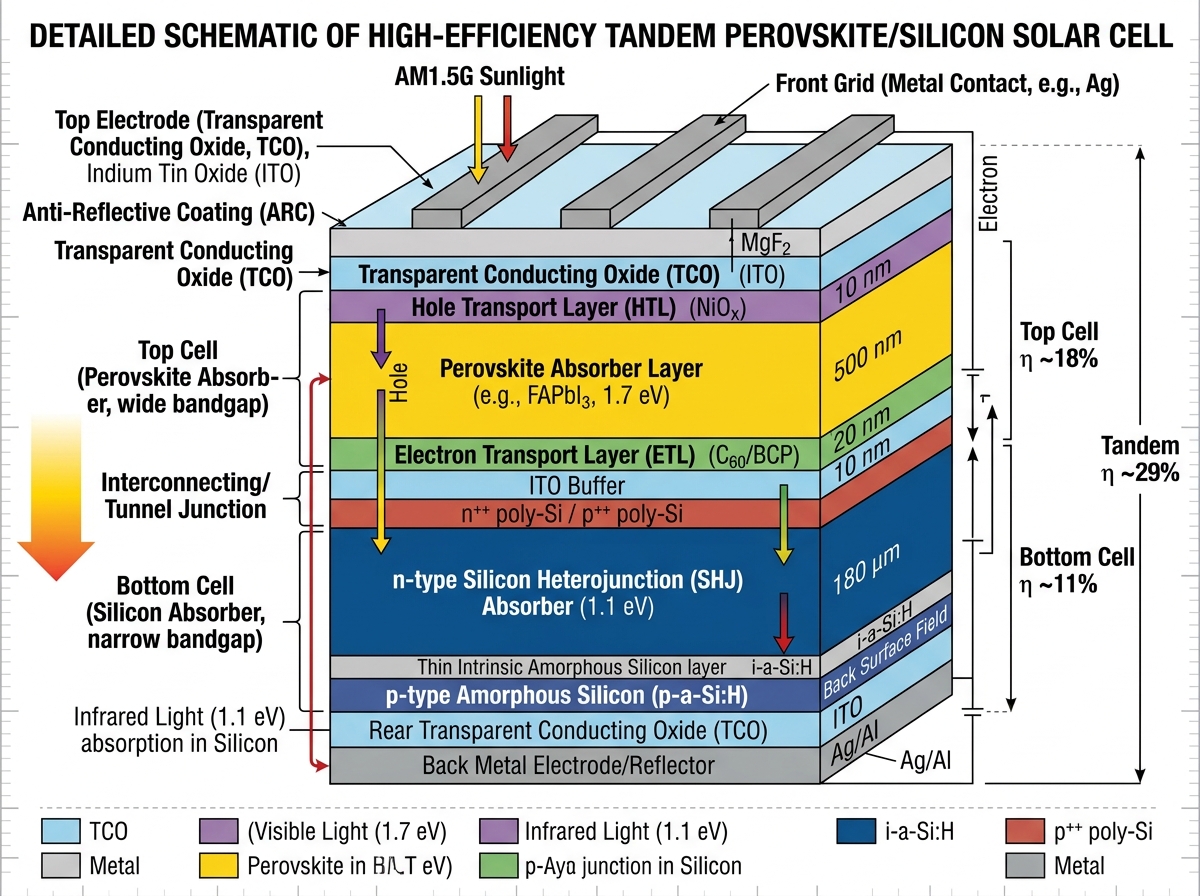
One of the biggest advantages of perovskite is its manufacturing process. Unlike silicon, which requires energy-intensive, high-temperature purification, perovskite can be produced using simple, low-temperature solution-based coating methods. This could lead to significantly cheaper panels in the very near future. You can track these record-breaking milestones through the Scientific research on solar cell efficiency database.
| Feature | Traditional Silicon | Perovskite-Silicon Tandem |
|---|---|---|
| Max Efficiency | ~26% (Theoretical) | 30% – 43% (Projected) |
| Manufacturing Temp | High (>1400°C) | Low (<150°C) |
| Material Usage | Thick crystalline layers | 10 to 1000x less material |
| Flexibility | Rigid | Can be thin and flexible |
Integrating Latest Green Energy Technology into Consumer Electronics
The shift toward perovskite isn’t just about utility-scale farms; it’s about making energy harvesting personal. Because perovskite can be printed onto thin, flexible substrates, we are seeing the rise of ultralight fabric solar cells. MIT researchers recently unveiled cells thinner than a human hair that are 18 times more powerful per kilogram than conventional glass panels.
Imagine a world where your wearable tech, your smartphone, or even your clothing is constantly sipping power from the environment. We’ve already seen concepts like the Lenovo Yoga Solar PC, which integrates 84 ultra-efficient cells directly into the laptop lid. This latest green energy technology means we are moving away from “charging” devices and toward devices that simply never run out of juice.
Maximizing Space with Latest Green Energy Technology
As the world scrambles to install more solar, we are running into a major hurdle: land scarcity. We can’t just cover every acre of farmland with panels. To solve this, we are looking at two ingenious solutions: bifacial panels and floating solar.
Bifacial solar panels are designed to capture sunlight from both sides. While the front catches direct rays, the back absorbs light reflected off the ground (albedo). In reflective environments like snow, sand, or even white-painted rooftops, these panels can generate up to 30% more electricity than standard one-sided panels. They have become so effective that they represented over 90% of the module types used in global simulations in 2024.
Then there is “floatovoltaics” — solar farms that float on water. These are typically installed on man-made reservoirs or lakes. Not only do they save land, but the water provides a natural cooling effect that boosts the panels’ efficiency by up to 15%. According to Scientific research on floating solar potential, covering just 10% of the world’s reservoirs with floating solar could produce 20 TW of electricity—that is 20 times the current global solar capacity!
Innovative Designs in Wind and Urban Power
Wind energy is also getting a makeover. Traditional turbines with massive blades aren’t always suitable for urban areas due to noise and space. Enter bladeless wind turbines. A Spanish startup has developed a design that uses an elastic rod to sway or oscillate in the wind. This vibration is converted into electricity, making it safe for birds and quiet enough for city rooftops.
We are also seeing “3D-printed energy trees” that can harvest solar, kinetic, and even heat energy. These bio-inspired designs can be placed in gardens or natural settings, infinitely replicated through additive manufacturing. Even our transport is going green; solar-powered trains in some regions are now exporting up to 75% of their generated energy back to the grid when they aren’t in use.
Breakthroughs in Energy Storage and Green Hydrogen
The “holy grail” of the energy transition is storage. Since the sun doesn’t always shine and the wind doesn’t always blow, we need batteries that can hold massive amounts of power for long periods. While Lithium-ion has been the standard, the latest green energy technology is moving toward Solid-State, LFP (Lithium Iron Phosphate), and Sodium-ion batteries.
Sodium-ion batteries are particularly exciting because they use salt — a cheap and abundant resource — instead of expensive lithium. They are safer, perform better in cold weather, and help solve the looming material shortage. The global energy storage market is projected to reach $31.72 billion by 2031, growing at a steady 9.5% annual rate.
For sectors that are “hard-to-electrify,” like heavy shipping, aviation, and steel manufacturing, green hydrogen is the answer. By using renewable electricity to split water into hydrogen and oxygen (electrolysis), we create a clean fuel that emits only water vapor when burned. The Scientific research on green hydrogen investment shows that projects reached 434 final investment decisions by 2024, with total investments surging to $75 billion. In Spain, the world’s first off-grid solar-to-hydrogen plant is being built, using “Decoupled Water Electrolysis” (DWE) to handle the intermittency of solar power without needing expensive grid backups.
Digital Transformation: AI and Smart Grids
We can’t just plug more renewables into an old grid and hope for the best. The energy system of 2025 is becoming a “Smart Grid,” managed by AI and Digital Twins. A digital twin is a virtual replica of a physical energy system that allows operators to run simulations and predict problems before they happen.
AI is also playing a massive role in predictive maintenance. By using data analytics and sensors, we can identify which solar panel or wind turbine is likely to fail and fix it proactively, ensuring the grid remains stable. Furthermore, blockchain technology is revolutionizing energy management. Decentralized ledgers allow for transparent energy trading between neighbors, where someone with extra solar power on their roof can sell it directly to someone down the street. According to Scientific research on blockchain in energy, this market is expected to grow at a staggering 71.1% CAGR through 2030.
The Role of AI in Managing Latest Green Energy Technology
While AI helps manage energy, it also consumes a lot of it. Data center electricity consumption is set to more than double to 945 TWh by 2030, largely driven by the AI boom. This has created a new trend: nearly a third of data centers are now expected to run entirely on onsite renewable power by 2030 to bypass strained grids. Power availability has officially surpassed fiber-optic proximity as the most important factor for selecting a data center site.
Global Policy and Market Growth for 2025
None of these technological leaps happen in a vacuum. Policy is the engine driving the latest green energy technology into the mainstream. In Europe, the Scientific research on EU energy policy through the REPowerEU Plan has accelerated wind and solar deployment, doubling growth rates compared to the pre-crisis era.
Meanwhile, China continues to dominate the manufacturing landscape, adding 350 GW of renewable capacity in 2023 alone—roughly two-thirds of all global deployment. India is also ascending rapidly, having reached its 2030 goal of 40% renewable capacity nine years ahead of schedule. India is now building massive “Giga Energy Complexes” that house gigawatt-scale manufacturing for solar panels, battery storage, and hydrogen electrolyzers all in one place.
Global energy investment in clean technologies is set to reach $2.2 trillion in 2025. This isn’t just about the environment; it’s about energy security, job creation, and economic resilience. By reducing reliance on imported fossil fuels, countries are securing their industrial futures.
Overcoming Challenges to Scale Renewable Tech
Despite the optimism, we still face hurdles. Perovskite cells, for all their brilliance, still struggle with long-term stability when exposed to moisture and heat. Manufacturers are currently working on advanced encapsulation techniques to protect these sensitive materials.
There is also the issue of material scarcity and waste. As we install millions of panels, we must think about what happens when they reach the end of their life. Innovative Scientific research on solar upcycling projects, like the Surya Arka project in India, are already piloting ways to repurpose old panels into tools for agriculture.
Finally, we are seeing the rise of Carbon Capture and Storage (CCS/BECCS). While the goal is to stop emitting CO2, we also need to remove what is already there. The EU and UK are investing billions to develop storage capacity for millions of tons of CO2 annually. These technologies, paired with renewables, are the final pieces of the net-zero puzzle.
Frequently Asked Questions about Green Energy
Which solar technology is expected to reach 30% efficiency?
The latest green energy technology leading this charge is the perovskite-silicon tandem cell. By layering perovskite on top of traditional silicon, these “triple-junction” devices can capture a much wider range of the solar spectrum. While standard panels hover around 20-22%, these tandem cells have already hit a certified 30.02% efficiency in lab settings. This breakthrough is made possible by advanced photon management, using SiOx nanoparticles to reflect light back into the cell layers.
How does green hydrogen help decarbonize transport?
Green hydrogen is a game-changer for heavy-duty transport like trucks, ships, and even planes where batteries are too heavy or inefficient. By using a fuel cell, hydrogen is converted into electricity to power a motor, with the only byproduct being pure water. Because it can be produced off-grid using the latest green energy technology like solar-to-hydrogen plants, it offers a way to replace fossil fuels in heavy industry and long-haul shipping without needing a massive overhaul of the electrical grid.
When will renewables surpass coal as the leading energy source?
The shift is happening right now. According to IEA projections, renewable electricity is expected to surpass coal as the world’s leading energy source by 2025. With over 30% of global electricity already coming from renewables in 2024 and an expected jump to 4,500 GW of capacity by next year, the “reign of coal” is effectively coming to an end. This transition is being accelerated by massive investments in China, the EU, and the US.
Conclusion
At Apex Observer News, we believe that staying informed about the latest green energy technology is essential for understanding tomorrow. From the windows of our buildings generating power to the salt in our batteries, the transition to a sustainable future is no longer a distant dream—it is a $2.2 trillion reality unfolding in 2025.
The road ahead still has challenges, from material stability to grid integration, but the pace of innovation is relentless. As we move toward a world powered by the sun, wind, and water, we are not just saving the planet; we are building a more secure and prosperous energy future for everyone. Stay tuned to our emerging technologies section for the latest updates on this green revolution.
