

Kim, a 50-year-old office worker, was recently surprised to hear from his father that he had invested 300 million Korean won in U.S. Treasury bonds, which had been kept in a savings account as retirement funds. The father explained that he was recommended by a securities firm employee, saying, “They never default, and they provide over 11 million won in cash annually, which is good for living expenses and offers much higher interest than savings accounts.” He also mentioned that the valuation had increased by 8.8 million won in won terms due to the recent sharp rise in the dollar-to-won exchange rate. Kim said, “After hearing my father’s story, I thought about buying some with my spare funds.”
Amid growing attention to Korean investors’ U.S. stock investments due to the high dollar-to-won exchange rate, it has been revealed that individual Korean investors have also purchased U.S. Treasury bonds on a large scale this year. The U.S. 10-year government bond rate, considered safer than Korean bonds, was 4.14% annually as of the 5th, higher than most Korean term deposits. Additionally, unlike most deposits that pay principal and interest at maturity, U.S. bonds pay interest every six months—a feature particularly favored by retired seniors. According to the Bank of Korea, the average deposit rate in Korea as of October was 2.6%, and the 10-year Korean government bond rate was 3.358% as of the 5th’s closing price. With U.S. bonds offering 4%, they are far more attractive than Korean deposits (2% range) and Korean bonds (3% range).
◇Individual Overseas Bond Investment Balance Surpasses National Pension
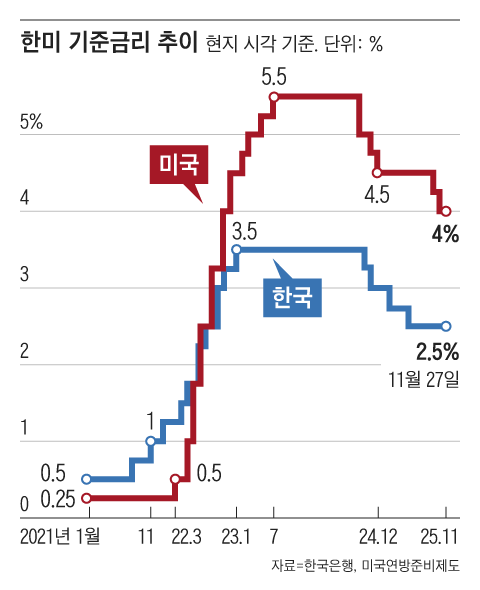
According to the Bank of Korea’s International Investment Position report, as of the end of the third quarter, Korean individuals’ (account name: “non-financial corporations, etc.”) overseas bond investment balance was $39.1316 billion, up $2.5 billion from $36.6246 billion in the previous quarter and $16.1228 billion from $23.088 billion in the same period last year. The third-quarter individual investment amount surpassed the National Pension Service’s (general government) investment of $38.23 billion. This phenomenon is similar to the period between late 2019 and early 2020, when the U.S. temporarily raised interest rates before the COVID-19 pandemic, causing a Korea-U.S. interest rate inversion. However, the inversion gap was 0.75 percentage points then, compared to 1.5 percentage points now.
The growth rate of overseas bond investments is also rapid. The year-on-year growth rate was 96% in the first quarter, 105% in the second quarter, and 70% in the third quarter. At this pace, the annual growth rate could set a new record following last year’s surge. However, according to October’s balance of payments data, individual investors net-sold $490 million in overseas bonds as funds flowed into overseas stocks.
Due to the longest-ever Korea-U.S. interest rate inversion since July 2022, the net investment amount (purchases minus sales) of overseas bonds first exceeded $10 billion last year and is likely to match or surpass that scale this year. According to the Bank of Korea’s October balance of payments data, individuals’ net purchases of overseas bonds from January to October were $12.6 billion, nearly matching last year’s $13.3 billion.
The increase in Koreans’ overseas bond investments is also attributed to securities firms’ aggressive marketing of U.S. bonds. As high-net-worth individuals prefer products that provide regular cash flow, securities companies have actively marketed U.S. bonds as “high-yield safe products” since last year and launched “direct purchase” services for U.S. bonds. However, investors should note that if bonds are not held until maturity, they may incur losses if interest rates rise, and a drop in the dollar-to-won exchange rate could also lead to losses.
◇Korea-U.S. Interest Rate Inversion Persisting for Over Three Years
The Korea-U.S. interest rate inversion, ongoing for over three years, is unlikely to resolve soon. Korea’s benchmark interest rate is 2.5%, while the U.S. rate is 3.75–4%. Even if the Bank of Korea freezes its rate, the U.S. Federal Reserve would need to cut rates by 0.25 percentage points six times—or three times with “big steps” (0.5 percentage point cuts)—to reach a similar level.