

How life began on Earth is one of the biggest remaining questions in science.
Now, NASA has taken a major step towards answering this query.
The US space agency has discovered essential sugars on Bennu – an ancient asteroid 200 million miles away from Earth.
The five–carbon sugar ribose was found on the asteroid, as well as six–carbon glucose.
This marks the first time this sugar has been found in an extraterrestrial sample.
The researchers, led by a team at Tohoku University in Japan, emphasise that these sugars are not evidence of aliens.
Instead, they could provide key clues to the origins of life here on Earth.
‘Although these sugars are not evidence of life, their detection, along with of amino acids, nucleobases, and carboxylic acids in Bennu samples, show building blocks of biological molecules were widespread throughout the solar system,’ the team explained.
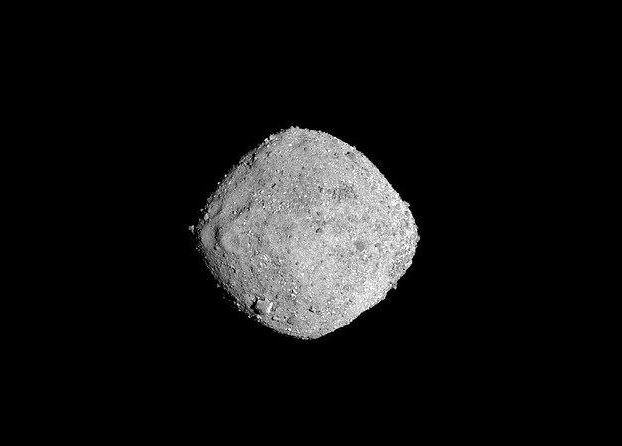
Bennu is an asteroid made from rocks that formed nearly 4.6 billion years ago.
Every six years, the asteroid – which is around 500 metres wide – passes close to Earth, coming within 186,000 miles of our planet.
In 2020, NASA’s OSIRIS–REx mission seized upon a close flyby, collecting samples from Bennu and returning them to Earth three years later, on 24 September 2023.
Since then, scientists have been analysing the samples to learn more about the conditions in our solar system billions of years ago.
In the latest study, the Tohoku University team set out to understand whether or not Bennu contains the building blocks of life.
Here on Earth, the sugars deoxyribose and ribose are key building blocks of DNA and RNA, respectively.
DNA is the primary carrier of genetic information in cells, while RNA performs numerous essential functions.
‘All five nucleobases used to construct both DNA and RNA, along with phosphates, have already been found in the Bennu samples brought to Earth by OSIRIS–REx,’ said Dr Yoshihiro Furukawa, who led the new study.


‘The new discovery of ribose means that all of the components to form the molecule RNA are present in Bennu.’
<cs-card “=”” class=”card-outer ” id=”native_ad_collapse-inarticle-0″ part=”” size=”_1x_2y”>

This isn’t the first time ribose has been found on an extraterrestrial object.
In fact, the sugar has previously been found in two meteorites recovered on Earth.
However, the key difference in the Bennu sample is that deoxyribose – the key building block of DNA – was not found.
‘If Bennu is any indication, this means ribose may have been more common than deoxyribose in environments of the early solar system,’ the researchers explained.
According to the researchers, the findings support the ‘RNA world’ hypothesis.
This suggests that the first forms of life relied on RNA as the primary molecule to store information and to drive chemical reactions necessary for survival.
‘Present day life is based on a complex system organized primarily by three types of functional biopolymers: DNA, RNA, and proteins,’ explained Dr Furukawa.
‘However, early life may have been simpler.’
The researchers also found evidence of glucose on Bennu.
This marks the first evidence that an important energy source for life as we know it was also present in the early solar system.
While Bennu provides key clues about life on Earth, it also poses a threat to our planet.
A recent study found that there is a one-in-2,700 chance of a collision with Earth in September 2182.
