


Why an Introduction to Entrepreneurship Can Change How You See the World
Introduction to entrepreneurship is the study of how people spot opportunities, take calculated risks, and build ventures that create real value — for themselves and society.
Here’s a quick breakdown of what it covers:
- What it is: Starting and running a business by combining ideas, people, and resources
- Who does it: Anyone willing to take on risk to solve a problem or meet a need
- Why it matters: Entrepreneurs drive job creation, innovation, and economic growth
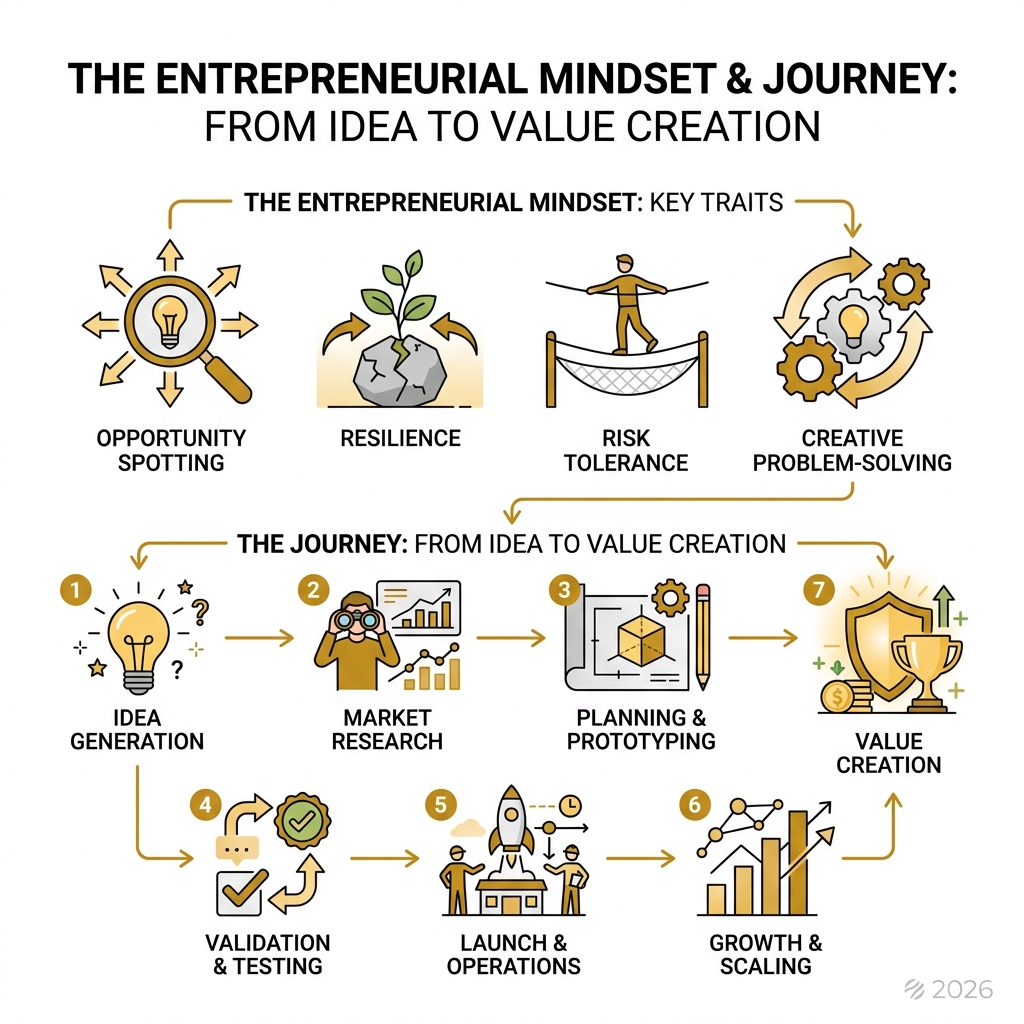
- Key skills: Opportunity spotting, financial literacy, resilience, communication
- How it works: A structured process — from idea to launch to growth to harvest
- Types: Small business, scalable startup, large company (intrapreneurship), and social entrepreneurship
Nearly one in three working-age people already own a business or plan to start one within three years, according to the Global Entrepreneurship Monitor. And in 2025 alone, about 36.2 million small businesses were operating in the United States.
Yet for many people, the concept still feels vague or overwhelming. What exactly is an entrepreneur? Do you need a degree? A big idea? A pile of cash?
The honest answer: none of those are strictly required. What you do need is a solid foundation — and that’s exactly what this guide gives you.
I’m Faisal S. Chughtai, founder of ActiveX and a hands-on builder of brands, apps, and digital strategies — my work sits at the intersection of entrepreneurship and technology, making this introduction to entrepreneurship deeply personal and practical for me. Let’s dig into what it really takes to think and act like an entrepreneur.
What is an Introduction to Entrepreneurship?
When we talk about an introduction to entrepreneurship, we aren’t just talking about opening a shop. We are looking at a dynamic field that has evolved over centuries. Historically, the word “entrepreneur” comes from the French verb entreprendre, meaning “to undertake.”
In the 18th century, economist Richard Cantillon was one of the first to define the entrepreneur as a “bearer of uncertainty.” He observed that farmers and merchants bought goods at a certain price today to sell them at an uncertain price tomorrow. They didn’t just work; they assumed the financial risk of the unknown.
Later, Joseph Schumpeter added a layer of “creative destruction” to our understanding. He argued that entrepreneurs don’t just fill gaps in the market; they destroy old ways of doing things by introducing new products, methods, and markets. Think of how digital streaming “destroyed” the video rental store. This is the heart of economic coordination — shifting resources from low-productivity areas to high-productivity ones.
To truly grasp this field, we recommend exploring resources like the Kwantlen Polytechnic University Introduction to Entrepreneurship, which provides a deep dive into how these historical concepts apply to modern ventures. Understanding the history helps us realize that being an entrepreneur is about being a coordinating agent in a capitalist economy. It requires a specific toolkit, which you can explore further in our guide on the complete list of entrepreneurship skills.
Defining the Entrepreneurial Script in an Introduction to Entrepreneurship
Why do some people see a problem and walk away, while others see a problem and start a company? The answer lies in cognitive perspectives — how we think and process information.
In an introduction to entrepreneurship, we study the “venturing script.” This is a mental roadmap that successful entrepreneurs follow. It isn’t just about having a “gut feeling”; it’s about having arrangements, willingness, and ability cognitions.
- Arrangements: Having the necessary resources or knowing how to get them.
- Willingness: Being psychologically ready to take the plunge.
- Ability: Possessing the skills to execute the plan.
This script involves a sequence: searching for an idea, screening it for viability, planning the finance, setting up the firm, and eventually “harvesting” the value (selling the business or going public). If you’re looking for a structured academic approach to these mental frameworks, the Academic Course Catalog Introduction to Entrepreneurship – BUSI 336 offers a great overview of how these principles are taught in a formal setting.
The Importance of Entrepreneurs to Society
We cannot overstate how vital entrepreneurs are to our global economy. In the United States, the 36.2 million small businesses are the literal backbone of the workforce. The majority of Americans work for small businesses, not giant conglomerates.
Entrepreneurs create a “ripple effect” of innovation. When a new business opens, it doesn’t just create jobs for its founders; it creates demand for suppliers, accountants, and service providers. They solve community problems that large corporations might overlook.
Furthermore, we see a massive shift in who is leading these ventures. For instance, the role of Pakistani women in business highlights how entrepreneurship provides a path to economic empowerment and social change in developing markets. Whether it’s a tech startup in Silicon Valley or a textile business in Lahore, entrepreneurs drive the productivity and tax revenue that keep societies functioning.
The 4 Pillars of Entrepreneurial Ventures
Not all businesses are created equal. When starting your introduction to entrepreneurship, it is helpful to categorize ventures into four main pillars.

- Small Business Entrepreneurship: These are typically “lifestyle” businesses. Think of a local bakery, a plumbing service, or a boutique marketing agency. The goal is usually to provide a comfortable living for the owner and their family, rather than taking over the world.
- Scalable Startup Entrepreneurship: This is the “Silicon Valley” model. These entrepreneurs start with a unique idea and look for venture capital to scale rapidly. They aim for massive growth and high revenue, often reaching $100 million or more.
- Large Company Entrepreneurship (Intrapreneurship): This happens within established corporations. It involves employees acting like entrepreneurs to create new divisions or products. For example, when a tech giant launches a new gaming console or a cloud service, that’s intrapreneurship.
- Social Entrepreneurship: These ventures focus on solving social or environmental problems. While they may still be for-profit, their primary “bottom line” is the impact they have on the community or the planet.
Table: Small Business vs. Scalable Startups
| Feature | Small Business | Scalable Startup |
|---|---|---|
| Primary Goal | Steady profit & lifestyle | Rapid growth & high valuation |
| Funding | Savings, SBA loans, family | Venture capital, Angel investors |
| Innovation | Low to Moderate (Existing models) | High (Disruptive technology) |
| Exit Strategy | Pass to family or keep running | IPO or Acquisition |
| Risk Level | Moderate | Very High |
Personality Types in an Introduction to Entrepreneurship
We often ask, “Am I the right type of person to do this?” Research suggests there isn’t just one “entrepreneurial type.” Instead, there are several distinct personalities:
- The Builder: They are focused on revenue and scaling. They want to pass $5 million in revenue within a few years and keep going.
- The Innovator: They love the “lightbulb moment.” They are often inventors who might eventually hand over the daily operations to someone else so they can go back to creating.
- The Specialist: These individuals use their deep expertise in a specific niche (like law or coding) to build a firm around their skills.
- The Opportunist: They have a “nose” for timing. They see a market trend and jump in at exactly the right moment to capitalize on it.
- The Hustler: They start small, work hard, and are masters of networking and sales.
- The Imitator: They don’t reinvent the wheel; they find a successful model and improve upon it or bring it to a new location.
It is important to remember that even the most successful founders face dark days. If you find yourself struggling, we have compiled steps for entrepreneurs in crisis and self-doubts to help you navigate those emotional hurdles.
Key Characteristics and Traits for Success
While personalities differ, we’ve noticed that successful entrepreneurs share a few core “DNA” traits.
First is resilience. You will fail. Your first product might tank, or your first investor might say no. Resilience is what allows you to pivot and try again. Second is financial savviness. You don’t need to be a CPA, but you must understand cash flow. If you run out of money, the game is over.
Third is flexibility. The market doesn’t care about your five-year plan if the world changes (like it did during the 2020 pandemic). Successful entrepreneurs adapt. Finally, visionary leadership and communication skills are non-negotiable. You have to convince employees to work for you, customers to buy from you, and investors to believe in you.
We see these traits exemplified globally, such as the rising tide of female entrepreneurs in Pakistan who are overcoming cultural and economic barriers through sheer persistence and vision.
Navigating the Process: From Idea to Harvest
An introduction to entrepreneurship would be incomplete without a roadmap of the actual process. It generally follows these steps:
- Feasibility Analysis: Before you spend a dime, ask: Is this actually a good idea? This involves assessing industry attractiveness (is the market growing?) and target market attractiveness (do people actually want this product?).
- The Business Model Canvas: Instead of a 50-page business plan, many modern entrepreneurs use a one-page “canvas” to map out their value proposition, customer segments, and revenue streams.
- Intellectual Property (IP): Protect your ideas! Whether it’s a patent for a new invention or a copyright for your software code, IP is often your most valuable asset.
- Launching the MVP: Build a “Minimum Viable Product.” Don’t wait for perfection. Launch a basic version, get feedback, and iterate.
For those in the U.S., resources like the US Small Business Administration (SBA) offer invaluable help with these steps. Meanwhile, for a look at how this process is playing out in emerging tech hubs, check out the best innovative startups in Pakistan.
Financing and Legal Structures
How do we pay for all of this? Most entrepreneurs start with bootstrapping — using their own savings and “sweat equity.” This gives you total control but puts your personal finances at risk.
If you need more capital, you might look for Angel investors (wealthy individuals) or Venture Capital (firms that invest other people’s money). Crowdfunding platforms have also become a popular way to validate an idea and raise funds simultaneously.
On the legal side, you must choose a structure. This affects your taxes and your personal liability:
- Sole Proprietorship: Easiest to set up, but you are personally responsible for all debts.
- LLC (Limited Liability Company): Protects your personal assets from business debts.
- Corporation (C-Corp or S-Corp): Better for raising venture capital and scaling, but more complex to manage.
For detailed tax implications, we always recommend the IRS Tax Guide for Small Business.
Frequently Asked Questions about Starting a Business
Why are entrepreneurs important to the economy?
Entrepreneurs are the primary drivers of innovation and productivity. They create new markets where none existed before. By starting businesses, they generate tax revenue that funds public services and provide jobs that sustain communities. They are the “coordinating agents” that make the economy more efficient.
What are the main challenges in defining entrepreneurship?
It is a “chaotic” and multi-dimensional process. Scholars often struggle to define it because it’s not just about a person’s traits, but also the environment and the specific actions they take. Some see it as a behavior (what you do), while others see it as a mindset (how you think). There is no one-size-fits-all definition.
Do I need a degree to be an entrepreneur?
Absolutely not. While an introduction to entrepreneurship course can give you a massive head start and a network, many of the world’s most famous founders were college dropouts. What matters more than a degree is skill acquisition, a willingness to learn continuously, and the ability to build a strong network of mentors and advisors.
Conclusion
At Apex Observer News, we believe that entrepreneurship is one of the most exciting paths a person can take. As we look toward the future, the impact of AI and digital tools will only make it easier for individuals to launch ventures from their own homes.
However, the core of an introduction to entrepreneurship remains the same: it’s about having an “ownership attitude.” Whether you are starting a global tech firm or just trying to be more innovative in your current job, thinking like an entrepreneur will serve you well.
Stay curious, keep testing your ideas, and remember that every giant corporation started as a small, risky idea in someone’s mind. For more deep dives into business, check out more entrepreneurship insights on our platform.
