


Why Income Protection Insurance Could Be Your Most Important Financial Decision
Income protection insurance is a policy that pays you a regular monthly benefit — typically 50–75% of your pre-disability income — if illness or injury stops you from working.
Here’s a quick breakdown of the essentials:
| Key Detail | What You Need to Know |
|---|---|
| What it covers | Illness or injury preventing you from working |
| How much it pays | Usually 50–75% of your pre-disability income |
| When payments start | After a waiting period (14 days to 2 years) |
| How long payments last | From 2 years up to age 65, depending on your policy |
| Who it’s for | Anyone who depends on their income to cover bills, mortgage, or family expenses |
| Cost | Roughly 1–3% of your annual salary |
The numbers behind income loss are sobering. About one in four of today’s 20-year-olds will become disabled before they reach age 67. And 4 in 10 families would face financial hardship within six months if the primary wage earner couldn’t work. Yet despite this, only 33% of working Australians insure their income.
Put simply: most people insure their car and home without a second thought — but leave their most valuable asset, their earning power, completely unprotected.
I’m Faisal S. Chughtai, a digital strategist and founder of ActiveX with deep experience analyzing financial products — including income protection insurance — to help everyday people make smarter, more informed decisions. In this guide, I’ll break down everything you need to know in plain language so you can figure out what’s right for you.
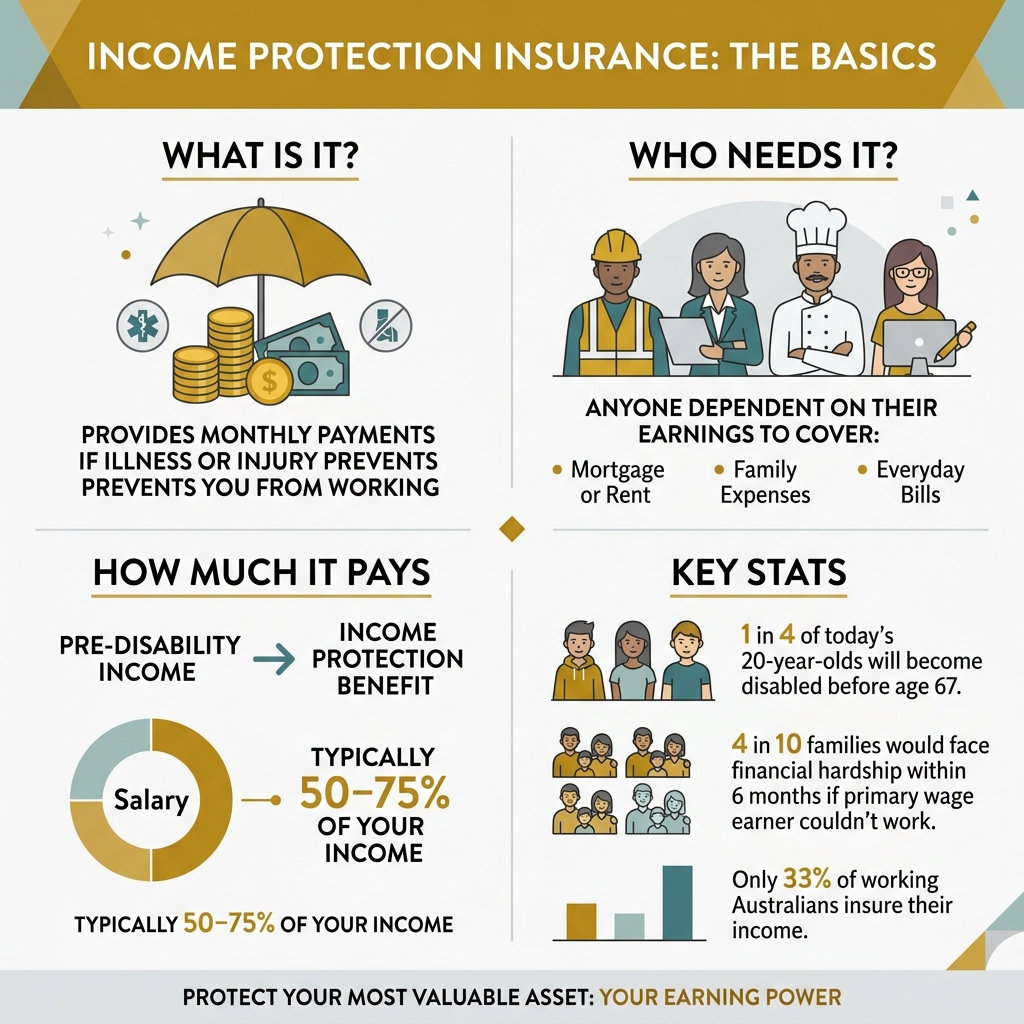
Income protection insurance word roundup:
What is Income Protection Insurance and How Does it Work?

At its heart, income protection insurance acts as a replacement for your paycheck. If you are unable to work due to a legitimate illness or injury, the insurance company steps in to provide monthly benefits. Unlike life insurance, which typically pays out a lump sum upon death, this coverage is designed to keep your daily life running while you are still here but unable to earn.
To understand how it works, we need to look at the “gears” that make the policy turn:
Monthly Benefits
Most policies cover between 50% and 75% of your gross (pre-tax) income. Some modern policies in specific regions may offer up to 90% for the first six months before dropping to 70%. The reason it doesn’t cover 100% is simple: insurers want to ensure there is still a financial incentive for you to return to work once you are healthy enough.
Waiting Periods (The Elimination Period)
Think of this as your policy’s “excess” or deductible, but measured in time rather than dollars. It is the period you must be off work before payments begin. Common choices include 14, 28, 60, or 90 days, though some go as long as two years.
- Expert Tip: A longer waiting period will significantly lower your premiums. However, you must ensure you have enough personal savings or sick leave to cover your expenses during that gap.
Benefit Periods
This is the duration for which the insurer will keep paying you. You can choose a short-term period (like 2 or 5 years) or a long-term period that lasts until you reach retirement age (usually 65 or 67).
Own-Occupation vs. Any-Occupation
This is arguably the most critical definition in your policy:
- Own-Occupation: You are considered disabled if you cannot perform the specific duties of your current job. This is the gold standard for professionals like surgeons or psychologists.
- Any-Occupation: You only receive benefits if you cannot work in any job that you are reasonably suited for by education or experience. This is harder to claim on but usually cheaper.
For more context on how this fits into a broader safety net, you might want to read more info about health insurance plans to see how medical coverage and income replacement work hand-in-hand. You can also review the Social Security Fact Sheet to understand the baseline government support available.
Comparing Income Protection Insurance to Other Safety Nets
Many people assume that if they get sick, the government or their employer will simply take care of them. While these “safety nets” exist, they often have holes large enough to fall through.
The Reality of SSDI (Social Security Disability Insurance)
In the United States, SSDI is the primary government fallback. However, the average monthly SSDI payment as of June 2024 was just $1,715. For most families, that barely covers a mortgage, let alone groceries, utilities, and car payments. Furthermore, the Social Security Administration has very strict definitions of disability; you often have to prove you cannot work any job at all, and the condition must be expected to last at least a year or result in death.
ACC Limitations (New Zealand Context)
In New Zealand, the Accident Compensation Corporation (ACC) is excellent for injuries. It can cover up to 80% of your income if you have an accident. However, a common mistake is assuming ACC covers everything. It does not cover:
- Illnesses (like cancer or heart disease)
- Strokes
- Mental health conditions
- Most disabilities resulting from age or natural wear and tear
If you suffer a stroke and can’t work, ACC won’t provide weekly compensation because it wasn’t an “accident.” This is where private income protection insurance becomes vital.
| Feature | Income Protection Insurance | SSDI (US) | ACC (NZ) |
|---|---|---|---|
| Coverage Trigger | Illness & Injury | Severe, long-term disability | Accidents only |
| Benefit Amount | Up to 75% of salary | Average $1,715/mo | Up to 80% of salary |
| Definition | Can be “Own-Occupation” | Very strict “Any-Occupation” | Injury-based |
| Wait Period | Choice (e.g., 30 days) | 5 months | 1 week |
For those in NZ, understanding ACC Weekly Compensation is a great starting point to see where your gaps lie.
Income Protection Insurance vs. Disability Insurance
In the US, the term “income protection insurance” is often used interchangeably with “disability insurance.”
- Short-Term Disability (STD): Typically covers 40–70% of your income for 3 to 6 months. It’s great for recovering from surgery or a broken bone.
- Long-Term Disability (LTD): Kicks in after STD ends and can last for years or until retirement.
One major difference is that in some international markets (like the UK or Australia), income protection can sometimes include “Mortgage Protection” or “Redundancy” riders, whereas US disability insurance is strictly health-related. It is also important to note the injuries ACC doesn’t cover to realize that emotional issues or non-accidental physical ailments require private backup.
Who Should Consider Getting Coverage?
If you have a pulse and a paycheck, you should probably consider it. However, it is absolutely essential for:
- The Self-Employed: You don’t have paid sick leave or employer-sponsored plans. If you stop, the money stops.
- Mortgage Holders: Your bank doesn’t care if you’re in a cast; the mortgage is still due on the first of the month.
- Families with One Primary Earner: 4 in 10 families face hardship within six months of losing their main income. 1 in 5 would face it within one month.
Despite these risks, only 33% of working Australians insure their income, leading to a massive “underinsurance gap” that leaves families vulnerable to losing their homes or depleting their life savings during a health crisis.
Costs, Calculations, and Policy Features
How much does peace of mind cost? Generally, a long-term income protection insurance policy costs between 1% and 3% of your annual salary. If you earn $70,000 a year, you might pay between $700 and $2,100 annually. When you consider that this protects your ability to earn millions over your lifetime, the “ROI” is incredible.
Premium Types: Stepped vs. Level
- Stepped Premiums: These start cheaper but increase every year as you get older (and the statistical risk of illness increases).
- Level Premiums: These are more expensive at the start but stay the same over time. They are often much cheaper in the long run if you plan to keep the policy for 10+ years.
Another financial bonus: In many jurisdictions, if you pay for your policy with after-tax dollars outside of an employer plan, the premiums are tax-deductible. This can effectively “discount” the cost of your insurance by your marginal tax rate.
For those looking at long-term family protection, comparing this with term life insurance is a smart move, as many people bundle these policies to save on costs.
Calculating Your Income Protection Insurance Needs
To find your “magic number,” follow the 75% rule but verify it against your reality:
- List Essential Expenses: Mortgage/rent, utilities, groceries, insurance, and debt repayments.
- Account for Inflation: Look for a policy with a COLA (Cost of Living Adjustment) rider. This ensures your monthly benefit increases over time so your purchasing power doesn’t vanish.
- Future Increase Options: This allows you to increase your coverage as your salary grows without having to undergo new medical exams.
Common Exclusions and Making a Claim
Not everything is covered. Standard exclusions often include:
- Redundancy: Most policies cover illness/injury, not being fired or laid off (though some specific “redundancy” add-ons exist).
- Self-harm: Intentional injuries are never covered.
- Criminal Activity: Injuries sustained while committing a crime.
- Pre-existing Conditions: If you already have a chronic back issue, the insurer may exclude that specific condition from your coverage.
When it comes to making a claim, the process involves submitting medical evidence from your doctor. It’s heartening to note that reputable insurers have high acceptance rates; for instance, some major providers like Asteron Life have reported accepting 97.7% of claims. Many policies also include Rehabilitation Support, paying for vocational retraining or home modifications to help you get back to work sooner.
Frequently Asked Questions
Is income protection insurance tax-deductible?
Yes, in many cases. If you own the policy individually and pay premiums with after-tax money, you can typically claim a tax deduction. However, keep in mind that if the premiums are deductible, the monthly benefits you receive during a claim will usually be treated as taxable income.
Can I get coverage through my employer or as an individual?
Both! Many employers offer “Group Disability” as a perk. It’s often cheaper but usually less flexible. Individual policies stay with you even if you change jobs and allow you to customize the “Own-Occupation” definitions and benefit periods to your specific needs.
When is the best time to buy a policy?
Now. Seriously. Insurance premiums are based on age and health. The younger and healthier you are when you sign up, the lower your premiums will be. Plus, you avoid the risk of developing a “pre-existing condition” that could be excluded later.
Conclusion
At Apex Observer News, we believe that financial literacy is the foundation of a secure life. Income protection insurance isn’t just another bill; it’s the “insurance for your insurance.” It ensures that even if your health fails, your financial plan doesn’t.
By understanding the demystified terms — from waiting periods to own-occupation definitions — you are now equipped to choose a policy that fits your lifestyle. Don’t wait until you’re part of the “1 in 4” statistic to think about your earning power.
To keep your financial journey on track, protect your future with expert insurance insights and stay updated with the latest trends in the industry. Your future self will thank you for the security you build today.
