

Who Is Imran Khan? Cricket Legend, Prime Minister, and Political Prisoner
Imran Khan is one of the most recognized figures in modern history — a cricket world champion turned Prime Minister of Pakistan, now imprisoned amid a sweeping political crisis.
Here is a quick snapshot:
| Category | Key Fact |
|---|---|
| Full Name | Imran Ahmed Khan Niazi |
| Born | October 5, 1952, Lahore, Pakistan |
| Cricket Career | 88 Tests, 362 wickets, 1992 World Cup winner |
| Politics | Founded PTI in 1996; PM from 2018 to 2022 |
| Removed From Office | April 2022 via no-confidence vote |
| Legal Cases | 186 cases as of December 2024; 14-year sentence in Al-Qadir Trust case |
| Current Status | Imprisoned at Adiala Jail, Rawalpindi |
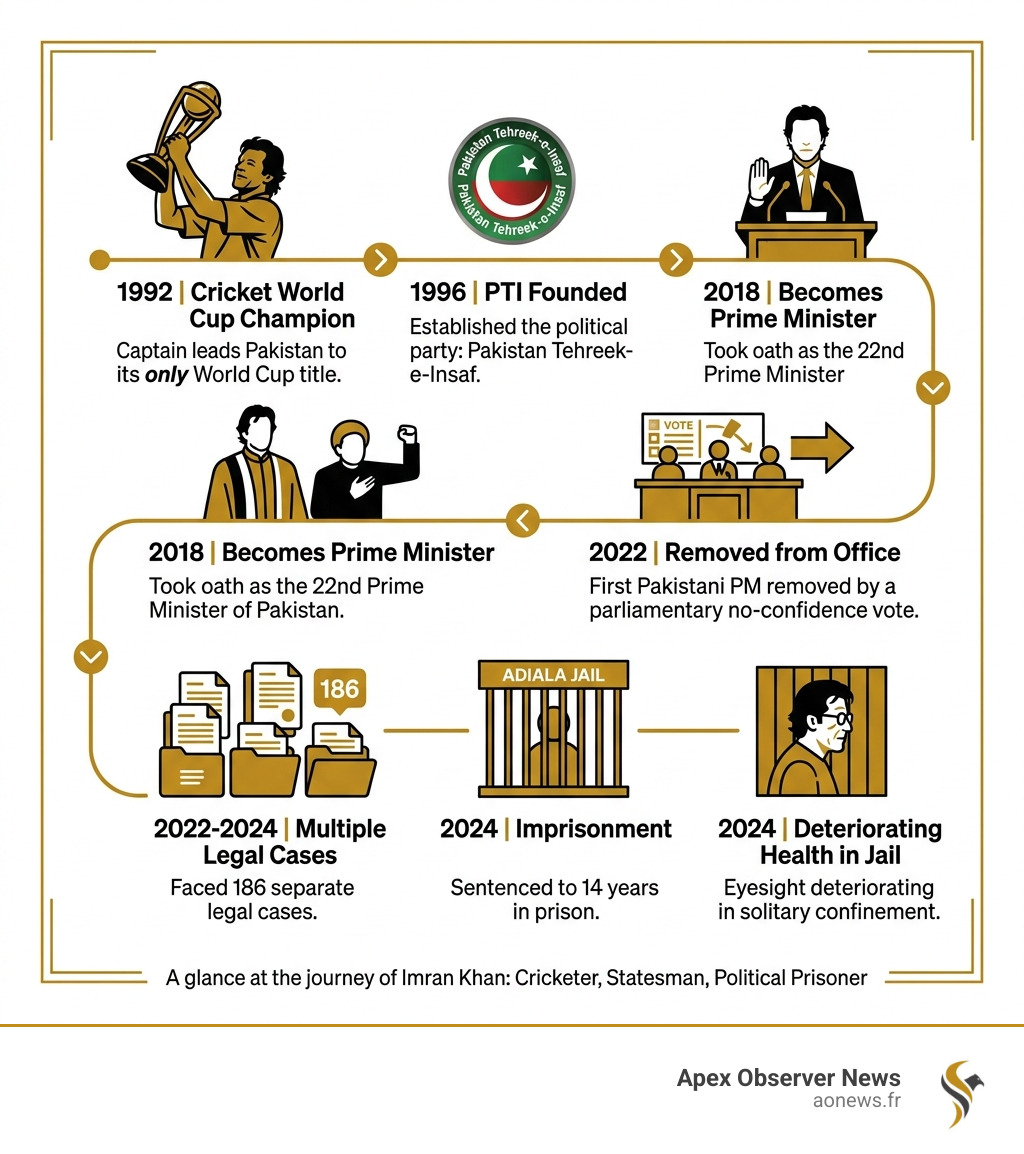
His story is extraordinary. He led Pakistan to its only Cricket World Cup title in 1992. He built a cancer hospital that now gives free treatment to 70% of its patients. Then he became Prime Minister — and was the first in Pakistan’s history to be removed by a parliamentary vote.
Since 2022, his legal troubles have multiplied fast. As of late 2024, he faces 186 separate legal cases and has been sentenced to 14 years in prison. His eyesight is deteriorating in solitary confinement. And his party, PTI, still won the most directly elected seats in the 2024 general elections — even with him behind bars.
Whether you follow cricket, global politics, or human rights, the Imran Khan story touches all of it.
I’m Faisal S. Chughtai, a digital strategist and founder of ActiveX, with years of experience tracking high-impact political figures like Imran Khan through data-driven media and SEO research. Read on for a full, clear breakdown of everything you need to know.
From Cricket Legend to the Rise of PTI
Before he was a political firebrand, imran khan was the undisputed king of Pakistani cricket. Born into an affluent Niazi Pathan family in Lahore, his path to greatness seemed almost predestined, given his family’s deep roots in the sport. He was educated at Aitchison College in Lahore and later at the University of Oxford, where he polished the suave, erudite persona that would later charm both London salons and Pakistani rallies.
His cricket career spanned two decades (1971–1992), during which he transformed from a medium-pace bowler into one of the fastest and most feared all-rounders in the world. He wasn’t just a player; he was a leader who demanded excellence. He famously pioneered the use of neutral umpires to remove bias from the game and mastered the art of reverse swing, a skill he passed down to legends like Wasim Akram.
The pinnacle of his sporting life came in 1992. At the age of 39, he led a “cornered tigers” squad to a breathtaking World Cup victory against England at the Melbourne Cricket Ground. He top-scored with 72 runs in the final and took the winning wicket, cementing his status as a national deity.
The Philanthropist
Following his retirement in 1992, imran khan turned his focus to a deeply personal cause. After losing his mother to cancer, he founded the Shaukat Khanum Memorial Cancer Hospital & Research Centre in 1994. It was a monumental task that many said was impossible, but today, it remains a beacon of hope, providing free care to approximately 70% of its patients. He also established Namal College in Mianwali to provide technical education to rural youth.
The Political Ideology of imran khan
In 1996, he pivoted to politics, founding the Pakistan Tehreek-e-Insaf (PTI), or the Pakistan Movement for Justice. For years, he was dismissed as a “political lightweight,” winning only a single seat in 2002. However, his message of “Naya Pakistan” (New Pakistan) eventually struck a chord with a younger generation tired of the revolving door of traditional political dynasties.
His ideology is a blend of:
- Anti-Corruption: A relentless focus on recovering “looted wealth” from former leaders.
- Islamic Welfare State: The vision of Riyasat-e-Madina, a society based on social justice and support for the poor.
- Populism: Mobilizing the masses against entrenched elites and “foreign interference.”
- Justice: Emphasizing the rule of law for all, regardless of status.
By 2011, his “tsunami” of support began to swell, leading to a massive rally in Lahore that signaled his arrival as a major third force in Pakistani politics. In the 2018 general elections, he finally broke the duopoly, winning all five constituencies he contested and becoming the 19th Prime Minister.
| Statistic/Milestone | Value/Date |
|---|---|
| Test Wickets | 362 |
| Test Runs | 3,807 |
| ODI Wickets | 182 |
| PTI Founded | April 25, 1996 |
| Sworn in as PM | August 18, 2018 |
| World Record | Most Test wickets as a captain (187) |
Governance and Global Stance of imran khan
When imran khan took office in 2018, we saw a leader determined to overhaul the Pakistani state. However, he inherited a fragile economy with a massive balance-of-payments crisis, forcing him to seek an IMF bailout despite his previous criticisms of such loans.
Domestic Achievements
Despite the economic hurdles, his government launched several ambitious projects:
- Ehsaas Programme: Recognized as one of the world’s most effective poverty alleviation models, it provided a safety net for millions, especially during the pandemic.
- Sehat Sahulat Card: A groundbreaking universal health insurance initiative allowing citizens to access private hospital care for free.
- COVID-19 Response: We noted his “smart lockdown” strategy, which used military-grade tracking technology to seal off virus hotspots rather than shutting down the entire economy. This approach was praised for protecting daily wage earners while managing the health crisis.
- Billion Tree Tsunami: An environmental masterstroke aimed at restoring Pakistan’s ecosystems. He also announced 15 new national parks under the “Protective Areas Initiative.”
Geopolitical Tensions and Foreign Policy
On the world stage, imran khan was vocal and often polarizing. He took a strong stand against Islamophobia, successfully lobbying the UN to declare March 15 as the International Day to Combat Islamophobia. He was a frequent critic of US drone strikes and famously stated that Pakistan would no longer be a “hired gun” for foreign wars.
His foreign policy was defined by:
- The Afghan Peace Process: He long argued there was no military solution in Afghanistan, a stance that was eventually vindicated during the US withdrawal.
- Kashmir: He remained a fierce critic of India’s 2019 decision to revoke the special status of Jammu and Kashmir, leading to a freeze in bilateral ties.
- Russia and China: He sought to strengthen ties with regional powers. His visit to Moscow in February 2022, which coincided with the invasion of Ukraine, drew significant Western criticism and added to the friction with Washington.
The 2022 Ouster and the Cipher Controversy
The turning point for imran khan came in early 2022. As inflation rose and his relationship with the powerful military establishment—specifically General Qamar Javed Bajwa—began to sour, the opposition moved a no-confidence motion.
In April 2022, he became the first Prime Minister in Pakistan’s history to be removed by such a vote. Khan did not go quietly. He alleged a “foreign-funded conspiracy” led by the United States to topple his government because of his independent foreign policy. He famously waved a “diplomatic cipher” (a secret cable) at a public rally, claiming it contained proof of US threats.
The Aftermath
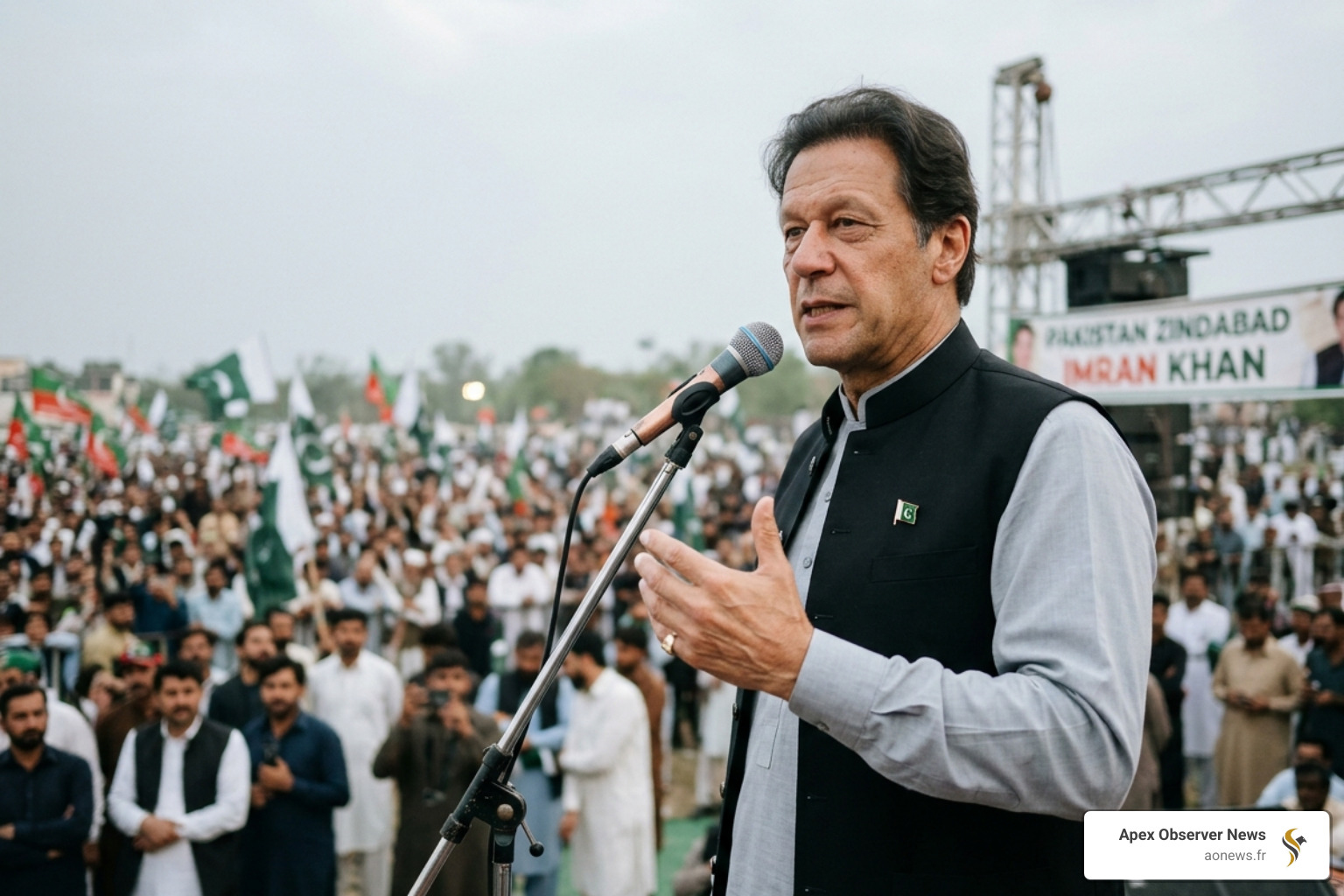
His removal sparked massive nationwide protests. In November 2022, while leading a protest march in Wazirabad, he survived an assassination attempt, suffering gunshot wounds to his leg. He blamed the current government and senior military figures for the plot, accusations they vehemently denied.
The tension reached a breaking point on May 9, 2023, when his brief arrest led to widespread riots. Protesters targeted military installations, an unprecedented act in Pakistan. This led to a massive crackdown on PTI, with many leaders arrested or forced to leave the party.
Legal Battles and Current Imprisonment Status
Since his ouster, imran khan has been entangled in a web of legal challenges. As of late 2024, he has faced approximately 186 cases, ranging from corruption to terrorism and even attempted murder.
Key Convictions
- Toshakhana Case: Allegations that he illegally sold state gifts. He was initially sentenced to three years, which was later suspended, but he faced a subsequent 14-year sentence alongside his wife, Bushra Bibi.
- Cipher Case: Accusations of leaking state secrets by making the diplomatic cable public. He was sentenced to 10 years, though he was later acquitted in this specific case by the High Court.
- Al-Qadir Trust Case: A corruption case involving a land settlement, resulting in a 14-year prison sentence in 2024.
- Iddat Case: A highly controversial case regarding the legality of his marriage to Bushra Bibi, for which they were initially jailed but later acquitted.
Health and Prison Conditions
Currently held at Adiala Jail in Rawalpindi, concerns about his health have grown. Recent medical reports from the Pakistan Institute of Medical Sciences diagnosed him with right central retinal vein occlusion. While initial filings quoted Khan as saying he had only 15% vision left in his right eye, a medical board later rejected the severity, reporting some improvement.
His family and PTI said that his treatment in solitary confinement raises serious human rights concerns. The Supreme Court of Pakistan has ordered the formation of an independent medical team to ensure he receives proper care.
International Reactions to the Imprisonment of imran khan
The international community has not stayed silent. Amnesty International has demanded his immediate release, labeling his detention as arbitrary.
Perhaps most surprisingly, cricket has rallied behind him. Australian legend Greg Chappell was one of the lead signatories on an open letter calling for his fair treatment. Other greats like Michael Holding, Sunil Gavaskar, and Kapil Dev have also spoke publicly or supported petitions for due process. These icons argue that political repression damages a nation’s international credibility.
Frequently Asked Questions about Imran Khan
Why was Imran Khan removed from office in 2022?
Imran Khan was removed via a no-confidence motion in the National Assembly. The official reasons cited by the opposition were economic mismanagement and rising inflation. However, Khan maintains he was removed due to a “foreign-funded conspiracy” and a fallout with the military leadership over key appointments and his neutral stance on global conflicts.
What are the main legal cases against him?
The primary cases include the Toshakhana case (misuse of state gifts), the Cipher case (mishandling of secret documents), and the Al-Qadir Trust case (alleged corruption involving land). He also faces numerous charges related to the May 9 riots and various other administrative and political allegations.
What is the current status of his health in prison?
The most pressing concern is his eyesight. He suffers from a retinal vein occlusion in his right eye. While his legal team and family have expressed concerns about permanent vision loss, government medical boards claim he is receiving adequate treatment and showing signs of improvement.
Conclusion
The legacy of imran khan remains a work in progress. To his millions of supporters, he is a “Qaidi Number 804” (Prisoner 804)—a symbol of resistance against a corrupt system. To his critics, he is a populist who polarized the nation and struggled to manage the economy.
What is undeniable is his impact. Even from behind bars, his influence was clear in the 2024 elections, where PTI-backed independents won the largest number of seats despite being stripped of their party symbol. The ongoing tension between Khan, the current government, and the military continues to define Pakistan’s political stability.
At Apex Observer News, we are committed to bringing you real-time updates on this developing story. The intersection of sports, global diplomacy, and human rights in the life of imran khan is a testament to the complex world we live in.
